

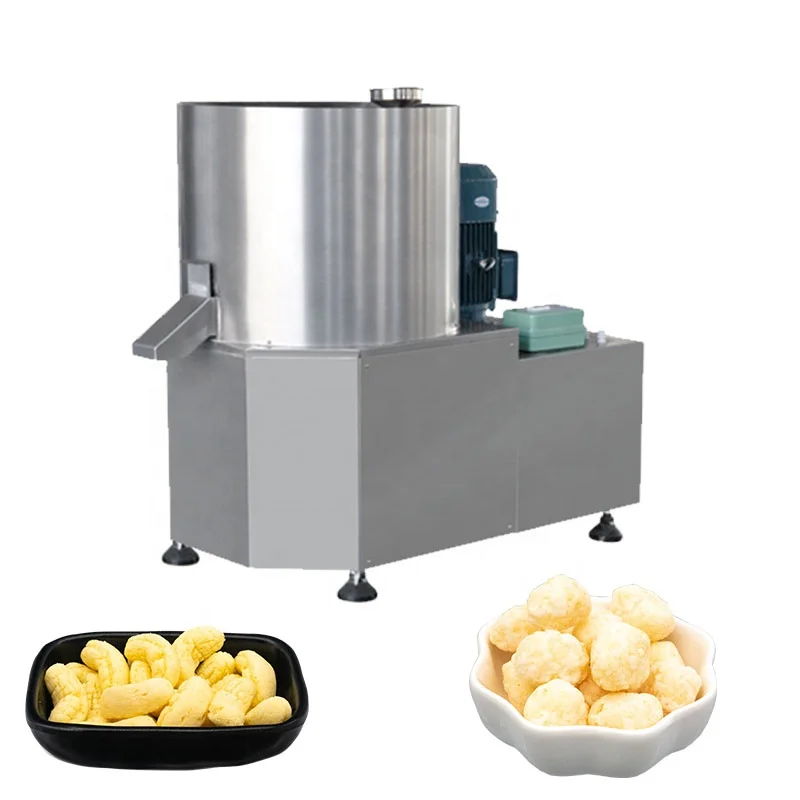
Twin Screw Puffed Snack Production Line, 100–500 kg/h, PLC & MCC Control, Food-Grade SS304 — engineered for corn, rice, and multi-grain puff extrusion with die options including ball, tube, stick, ring, and fruit loop shapes.
- Screw configuration and die design matched to your raw material moisture, starch content, and target expansion density for consistent texture across batches
- Full line throughput-matched from mixing through drying and packing, with in-house trial runs on your material before shipment
Description
Screw Configuration Matched to Material — every twin-screw build starts with the buyer’s actual corn, rice, or multi-grain sample and a documented die layout before steel is cut.
Technical Specifications
| Parameter | Value |
|---|---|
| Product Type | Twin Screw Extruded Puffed Snack Production Line |
| Screw Type | Twin screw (co-rotating) |
| Output Capacity | 100–500 kg/h (basis not stated in source — confirm raw material, moisture, product shape) |
| Raw Material | Corn, rice, millets, wheat, oat, barley (flour or grits) |
| Voltage & Frequency | Three-phase 380 V / 50 Hz; single-phase 220 V / 50 Hz; configurable to local supply |
| Control System | PLC and MCC with electricity control box; Delixi or Delta inverter available |
| Motor | Siemens (made in China) or equivalent China top brand |
| Contact Material | Food-grade stainless steel 201 or 304 |
| Energy Source | Electricity, gas, diesel, or steam (selectable per site utility) |
| Power Consumption | ~100 kW (electric heating); 50–60 kW (gas or diesel heating) — rated or peak not specified |
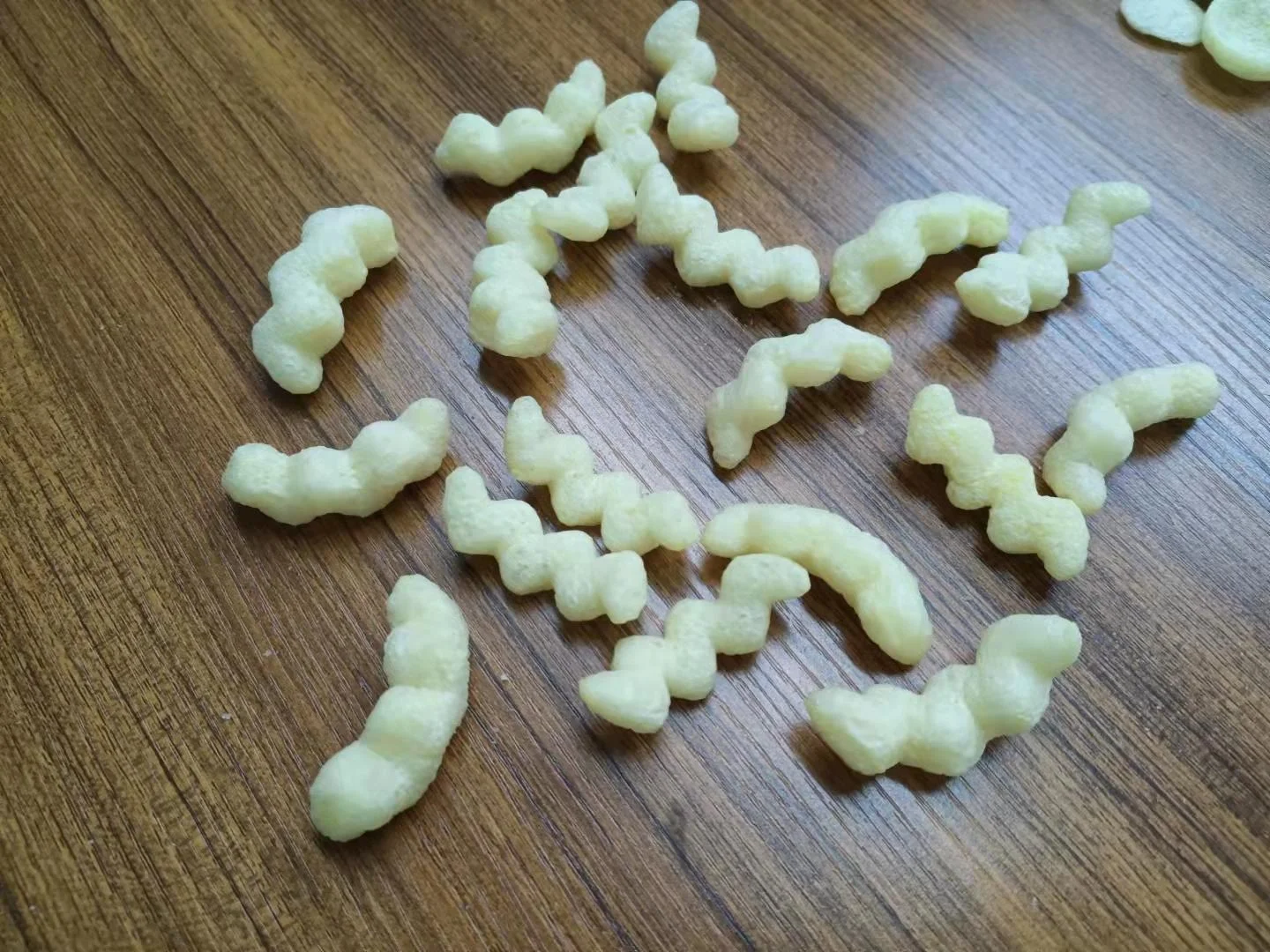
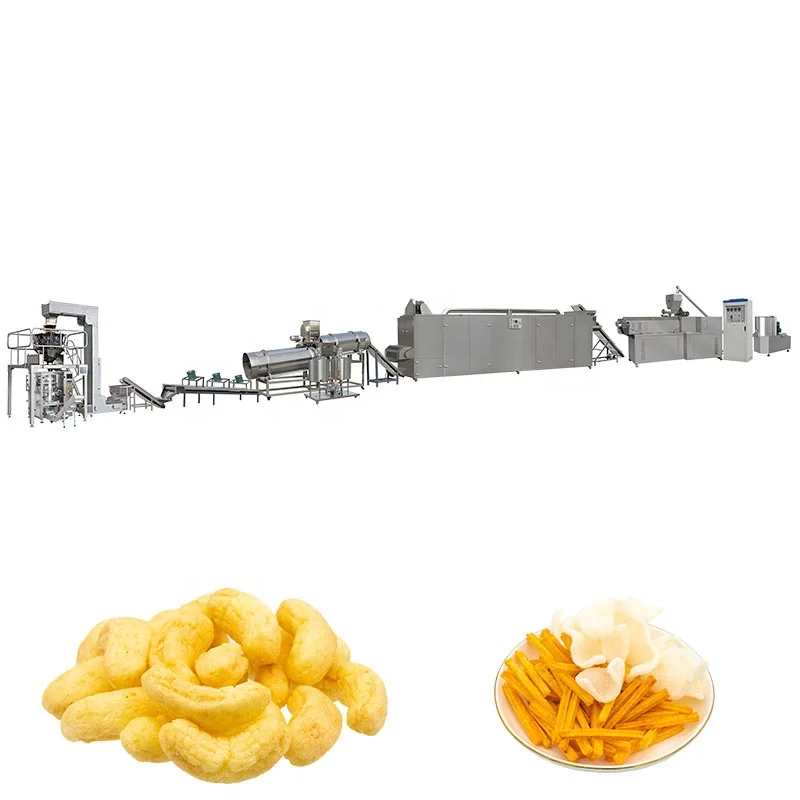
| Die Shapes | Ball, tube, stick, ring, fruit loop, star, wheel, flower, heart |
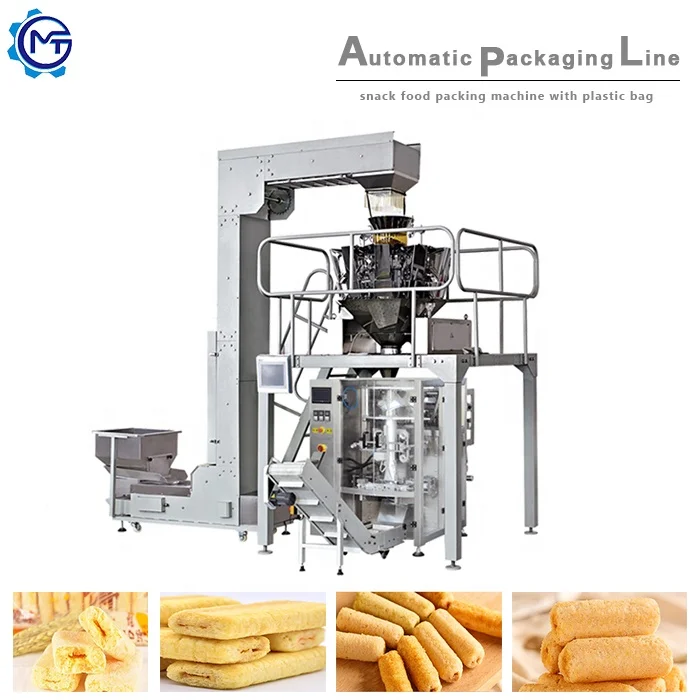
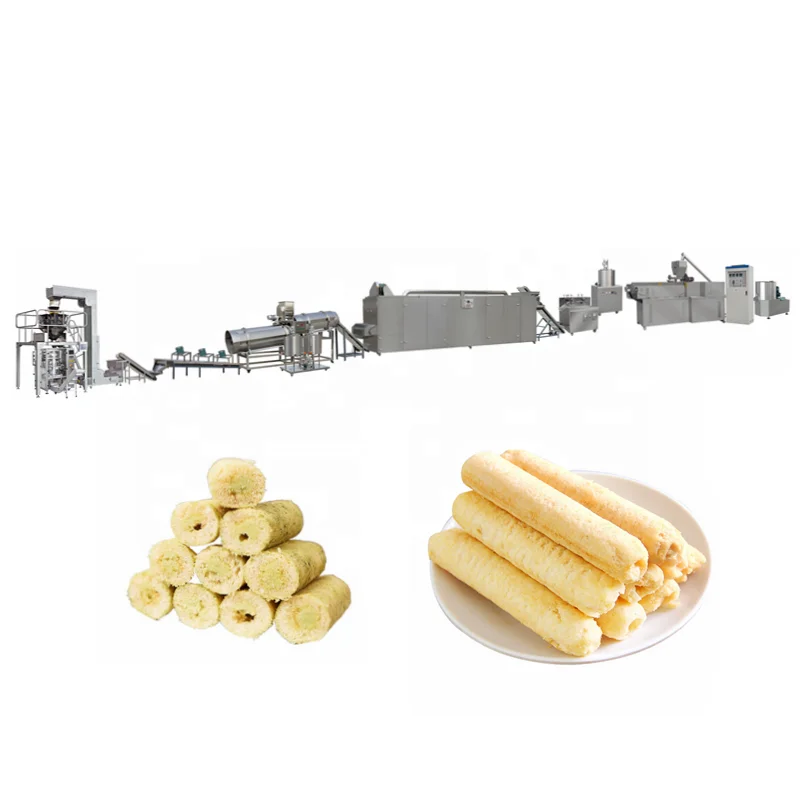
| Line Stations | Mixer → Extruder → Vibrate Cooler → Roasting Machine (Dryer) → Packing Machine |
| Assembly State | Complete line with all supporting equipment |
| Standards | CE (company-level, since 2014), ISO (company-level) |
Application Suitability
| Application | Material or Output |
|---|---|
| Puffed corn snacks and cheese balls | Corn grits or corn flour at controlled moisture |
| Multi-grain puffed snacks | Rice, millet, wheat, oat, barley blends |
| Core-filled extruded snacks | Grain flour outer with cream or peanut filling |
| Breakfast cereal formats | Corn, rice, oat flakes or extruded shapes |
| Coated and seasoned snack pieces | Extruded base with oil, cheese, or spice coating |
What "500 kg per Hour" Leaves Out About Puffed Snack Lines
A capacity number means nothing until you know the moisture content, grit size, and target density it was measured on.
I spent years on assembly floors in Shandong watching extruder lines get built to a brochure figure, then shipped to a buyer whose corn arrives at a different moisture level than the factory test grain. The puff comes out dense, throughput drops, and the dryer is suddenly the bottleneck. That pattern repeats across the snack sector because most quotations list a peak number measured on ideal flour, not the buyer’s actual grits [NEED_CITE: moisture variation in grain supply chains and its effect on extrusion throughput].
When a buyer specifies a puff corn extruder production line turnkey, the first question should never be about price — it should be about what raw material was used when that capacity figure was written down, and whether the dryer and cooler downstream were sized to the same number.
How Screw Profile and Die Geometry Shape the Final Snack
The twin-screw configuration handles a wider range of grain particle sizes than a single-screw design because the intermeshing flight creates positive conveying and self-wiping action. For corn grits that are coarser or carry higher fiber content, the screw elements must be arranged to build sufficient shear and residence time before the material reaches the die. Change the element sequence and the same grain recipe produces a different expansion ratio, a different crunch, and a different bulk density in the bag.
Die geometry then determines the cross-section of each piece — a star die concentrates shear at the points and produces sharper expansion, while a ring die spreads it evenly for a lighter bite. On this line, the same extruder platform can run ball, tube, stick, ring, fruit loop, star, wheel, flower, and heart dies, so a single puff corn extruder production line turnkey covers a broad product catalogue without a second machine.
Why Throughput Matching Across Stations Matters More Than Extruder Speed
An extruder that pushes 500 kg/h of wet extrudate into a cooler rated for 300 kg/h is not a 500 kg/h line — it is a 300 kg/h line with an oversized motor. This mismatch is the single most common reason a new snack line underperforms after commissioning. Every station on this layout — mixer, extruder, vibrate cooler, roasting machine, and packing machine — is specified against the same target throughput so the number you plan around holds at the end of the shift [NEED_CITE: throughput balancing methodology in extruded snack lines].
The vibrate cooler removes surface moisture and sets the outer shell before the roasting stage, preventing the dryer from having to handle water that should have been flashed off earlier. When the cooler is undersized, the dryer runs hotter and longer, scorching the surface while the core stays chewy — a texture defect that consumers notice immediately.
Reading the Specs That Actually Determine Snack Quality
The twin-screw design gives operators independent control over shear and residence time by rearranging screw elements, which is critical when switching between corn flour and whole-grain blends that gelatinize at different rates. A longer barrel with more kneading blocks suits high-amylose rice, while a shorter compression zone works better for waxy corn with rapid starch breakdown.
Power draw sits around 100 kW with electric barrel heating but drops to 50–60 kW when gas or diesel heating is selected, which changes the utility plan and transformer sizing for the whole workshop. The PLC and MCC control panel with a Delixi or Delta inverter holds barrel temperature zones and screw speed within tight bands, reducing batch-to-batch variation in puff diameter and color.
Food-grade stainless steel 201 or 304 contact parts resist the acidic seasoning dust and oil mist that accumulate during flavored snack runs, cutting cleaning time between product changeovers. Die changes are mechanical rather than electronic — the operator swaps the die plate and adjusts the cutter, so shape variety depends on the die inventory supplied with the line, not on software upgrades.
The Cost of Skipping a Material Trial Before Shipment
Buyers who approve a line on paper specs and skip the in-house trial run often discover after installation that their local corn variety expands differently than the factory test grain. The screw profile that produced perfect cheese balls in Shandong may yield flat, dense pieces on South American maize, forcing a costly screw element reorder and weeks of lost production [NEED_CITE: starch gelatinization differences across corn varieties].
Voltage mismatches surface the same way — a line wired for 380 V / 50 Hz connected to a 440 V / 60 Hz supply will run motors at the wrong speed, throwing off screw RPM and feeder synchronization. These are not warranty issues; they are specification failures that a pre-shipment trial and a confirmed electrical schematic would have caught.
What Sets This Build Apart at the Project Level
Every station from the mixer to the packing machine is sourced and assembled under one supplier, so throughput numbers are calculated against the same material flow rather than stitched together from separate vendor data sheets. Screw configuration and die design are documented against the buyer’s raw material sample, not copied from a generic build sheet.
An in-house testing workshop runs the buyer’s actual grain through the extruder before the line is crated, producing a trial run report that travels with the shipment. Electrical schematics are drawn and voltage confirmed for the destination country before production begins, avoiding the rewiring delays that stall commissioning. The PLC and MCC panel is programmed in the operator’s language, and the control logic covers every station, so the line runs as one system from day one.
Documentation & Verification
- Line layout drawing with throughput calculation for every station matched to your grain type
- Screw element sequence and die configuration record tied to your raw material trial
- Trial run report from in-house workshop on your corn or rice sample before dispatch
- Electrical schematic with voltage, frequency, and control language confirmed for your market
- CE declaration of conformity and ISO certificate at company level
- Operation and maintenance manual covering extruder, cooler, dryer, and packing station
Installation, Commissioning & Support
- Foundation plan showing floor load for the twin-screw extruder and roasting machine footprint
- Dedicated circuit sizing based on 100 kW electric or 50–60 kW gas heating draw
- Assembly sequence for mixer, extruder, vibrate cooler, dryer, and packing machine stations
- First-run parameter log capturing barrel temperatures, screw RPM, and die pressure on your material
- Operator training on PLC and MCC interface with Delixi or Delta inverter adjustment
- Wear parts list covering screws, dies, and barrel liners with reorder intervals
What to Include in Your Inquiry
Send your raw material type, particle size, and typical moisture range so the screw profile and die selection start from your actual grain rather than a generic recipe. Confirm the daily output target, workshop dimensions, and local voltage and frequency so the line layout and electrical schematic match your site conditions. If you need multiple snack shapes or coated variants, list the target formats so die inventory and coating drum capacity are included from the start.
Frequently Asked Questions
Q: How is line capacity verified before the puff corn extruder production line turnkey ships?
A: Every line is trial-run in the in-house testing workshop using the buyer’s own raw material. The trial run report documents actual throughput, expansion ratio, and product density achieved on that specific grain at its delivered moisture level, so the capacity figure you receive is tied to your material, not a generic flour test.
Q: How are screw configuration and die design chosen for my raw material?
A: The screw element sequence is built around your grain’s particle size, starch type, and moisture content to achieve the required shear and residence time. Die geometry is then matched to the target snack shape and bulk density, and both are recorded in a configuration sheet that ships with the line.
Q: Could the dryer or cooler bottleneck the extruder output?
A: Each station on the line — mixer, extruder, vibrate cooler, roasting machine, packing machine — is specified against the same throughput target. The cooler and dryer are sized to handle the wet extrudate volume the twin-screw extruder produces, so no single station caps your line below the quoted output.
Q: What electrical details are confirmed before production starts?
A: Voltage, frequency, and control panel language are confirmed in writing before the line enters production. The electrical schematic reflects your site’s supply — whether three-phase 380 V / 50 Hz or a local variant — so motor speeds and inverter settings are correct at commissioning.
Q: What documentation ships with the puff corn extruder production line turnkey?
A: You receive the line layout with capacity calculation, screw and die configuration record, trial run report on your raw material, electrical schematic, CE declaration, ISO certificate, factory test record, operation manual, wear parts list, and packing photographs for customs clearance.
Related products
-

Puff Corn Extruder Machine Puffed Core Filled Snack Food Production Line Machine
¥8,500.00 Select options This product has multiple variants. The options may be chosen on the product page -

New Stainless Steel Automatic Snack Food Machinery Extruder Puffed Corn Maize Puff Processing Line for Food Industry High
¥12,350.00 Select options This product has multiple variants. The options may be chosen on the product page -

Puff Corn Snacks Food Line Puffed Rice Ball Production Making Equipment Machines
¥10,565.00 Select options This product has multiple variants. The options may be chosen on the product page -

New Puffed Snack Food Machine Production Line Corn Flake Puff Corn Making Machine Twin Screw Extruder 100-500kg/h Capacity Food
¥8,500.00 Select options This product has multiple variants. The options may be chosen on the product page


