

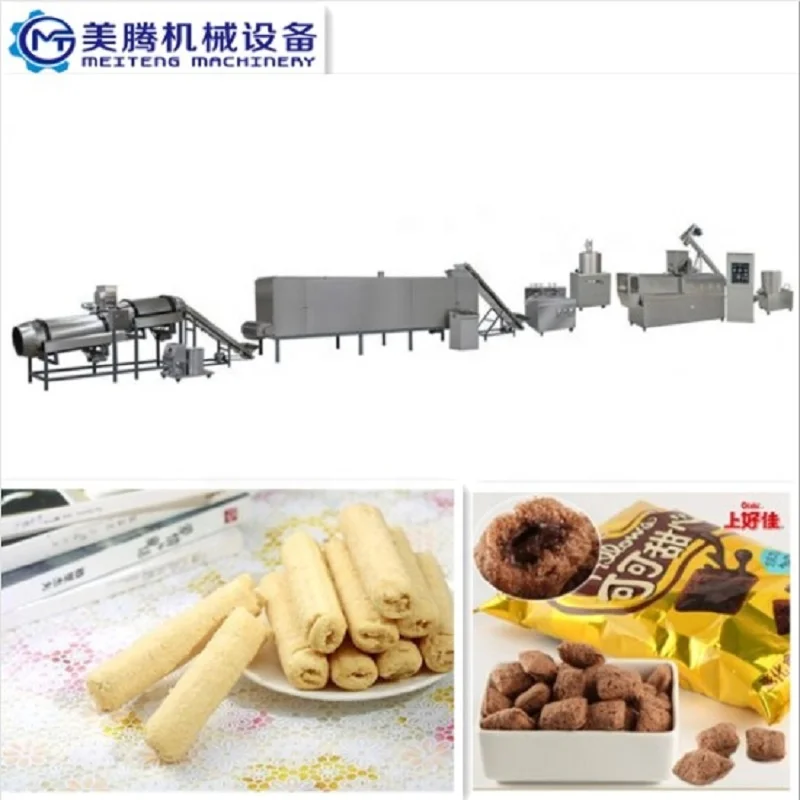
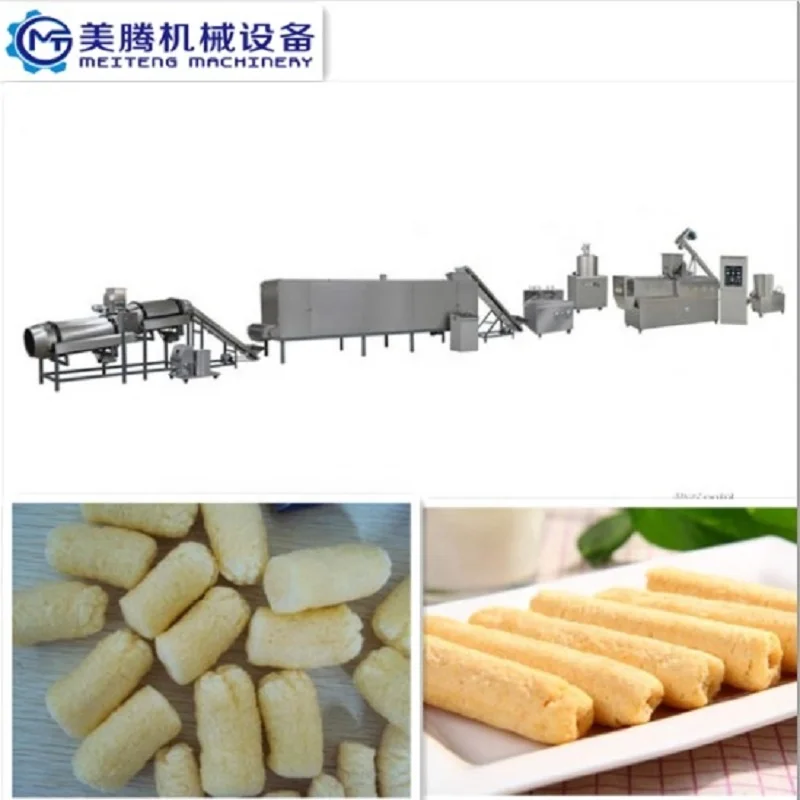
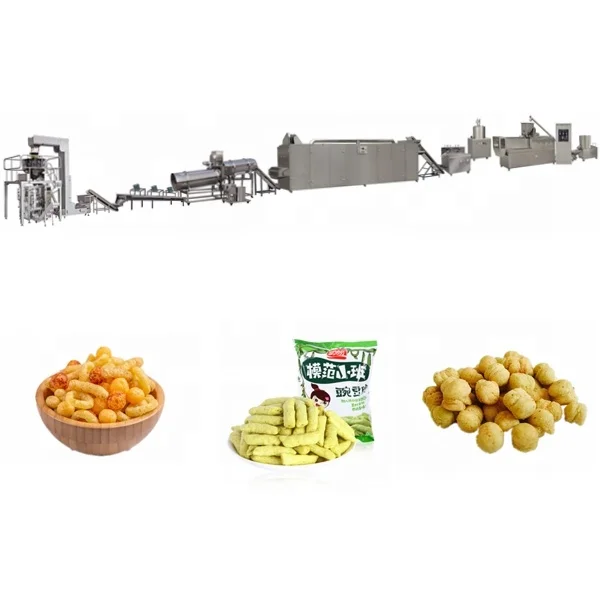
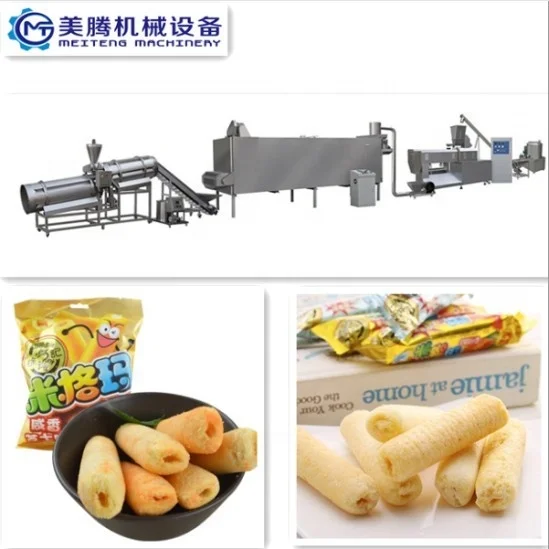
MT70 / MT85 / MT75 Twin Screw Extrusion Puffed Snack Production Line, 130–220 kW installed power, gas or electric dryer — designed for turnkey snack projects from layout through commissioning.
- Screw configuration and die design matched to your raw material for target density and expansion control
- Every station throughput-matched across mixing, extruding, drying, coating, and packing
In-house trial runs on your actual recipe before shipment, with full line layout and capacity calculation provided.
Description
Throughput-Matched Turnkey Line Design — Every station from batching through extrusion, drying, coating, and packing is sized to the same real-world output so the puffed snack extrusion production line turnkey runs without bottlenecks.
Technical Specifications
| Parameter | Value |
|---|---|
| Model | MT70 / MT85 / MT75 |
| Product Type | Twin Screw Extrusion Puffed Snack Production Line |
| Screw Type | Twin Screw |
| Installed Power | MT70 — 130 kW; MT85 — 180 kW; MT75 — 220 kW |
| Power Consumption | MT70 — 95 kW; MT85 — 120 kW; MT75 — 130 kW |
| Output Capacity | MT70 — 100–120 kg/h (basis to be confirmed); MT85 — 200–300 kg/h (basis to be confirmed); MT75 — 300–500 kg/h (basis to be confirmed) |
| Overall Dimensions (L×W×H) | MT70 — 21 × 1.5 × 2.2 m; MT85 — 25 × 1.5 × 2.2 m; MT75 — 28 × 1.5 × 2.2 m |
| Line Stations | Mixing → Extruding → Drying → Coating/Flavoring → Cooling → Packing |
| Dryer Heating Source | Gas or Electric (selectable) |
| Coating System | Double tumble sugar melting, elevator, coating drum, spraying nozzle |
| Extruder System | Feeding, extruding, cutting, heating, gearing, controlling |
| Screw Feature | Automatic lubricating and cooling function; wear-resistant screw treatment |
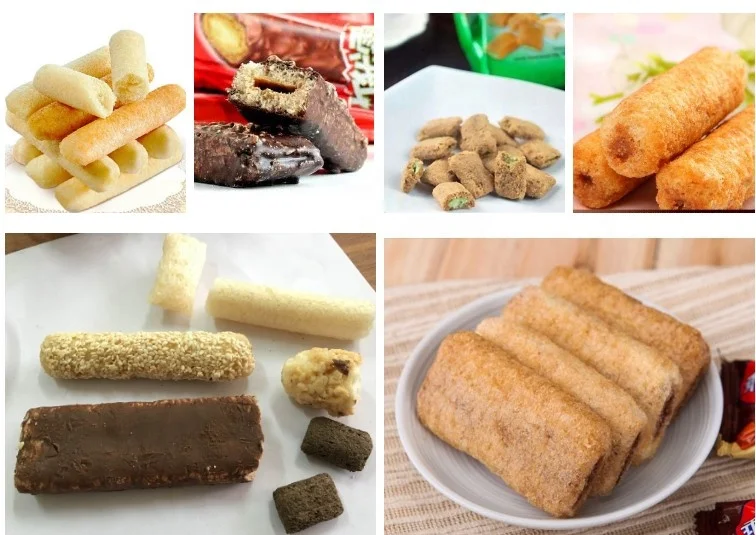
| Die Configuration | Interchangeable dies for ball, tube, stick, ring, fruit loop, star, wheel, flower, heart, cheese ball shapes |
| Raw Materials | Corn, rice, wheat, oat, barley flour, and similar grain-based formulations |
| Certification | CE, ISO |
| Assembly State | Turnkey production line; OEM/ODM customization available |
Application Suitability
| Application | Material or Output |
|---|---|
| Cheese ball and corn ring production | Corn flour, corn grits, rice flour blends |
| Fruit loop and cereal ring extrusion | Wheat flour, oat flour, multigrain blends |
| Stick, tube, and star-shaped snacks | Rice flour, barley flour, composite grain recipes |
| Heart and flower novelty shapes for confectionery-coated snacks | Corn and rice blends with sugar coating |
| Co-expressed or filled snack formats | Grain flour base with cream or jam center filling |
| Capacity expansion for existing snack manufacturers | Second or third line installation alongside current extruders |
What "300 kg/h" Really Means on a Puffed Snack Extrusion Production Line Turnkey
Capacity is only real when it matches your raw material and moisture content.
I spent years on assembly floors before moving into line planning, and the most common argument I hear during commissioning is about output numbers that looked solid on paper but collapse the moment the buyer’s actual corn flour hits the barrel. A puffed snack extrusion production line turnkey quoted at a nominal rate assumes a standard recipe at a fixed moisture level. Switch to a higher-protein corn variety or a rice-heavy blend, and expansion behavior changes entirely — the product comes out dense, the die blocks more often, and the coating drum receives uneven shapes that tumble poorly. [NEED_CITE: effect of raw material protein content on extrusion expansion rate]
This is why we run trial production on the buyer’s actual raw material before the line ships. The screw configuration and die selection are finalized against your recipe, not copied from a generic build.
Screw Configuration Dictates Product Density and Texture
The twin-screw extruder at the heart of this line uses an automatic lubricating and cooling system that maintains barrel temperature stability across long production runs. More importantly, the screw elements are arranged in a configuration matched to the buyer’s raw material — higher shear zones for corn-dominant recipes that need aggressive gelatinisation, gentler conveying elements for rice or oat blends that scorch under excessive mechanical energy. A puffed snack extrusion production line turnkey that ships with a generic screw setup will produce inconsistent expansion from batch to batch, and that inconsistency travels all the way to the packing station.
How the Die, Dryer, and Coating Drum Must Talk to Each Other
The interchangeable die plate allows shape changes — ball, tube, ring, star, wheel, heart — without swapping the entire extruder head. But shape is only half the equation. A fruit loop requires a different moisture exit profile in the dryer than a solid cheese ball, and the double tumble coating system must receive product at the right surface temperature for sugar or seasoning adhesion. [NEED_CITE: relationship between post-dryer moisture content and coating adhesion in extruded snacks] When we design the line layout, the dryer length, drum diameter, and spraying nozzle count are all calculated against the extruder’s real throughput on your specific recipe, so no station sits idle while another chokes.
Reading the Power and Dimension Numbers
The installed power across the three models ranges from 130 kW on the MT70 to 220 kW on the MT75, but power consumption during operation sits lower — 95 kW, 120 kW, and 130 kW respectively — because the heating, gearing, and feeding systems cycle rather than run continuously at peak draw. The line footprint stretches from 21 meters on the MT70 to 28 meters on the MT75, with a consistent 1.5-meter width and 2.2-meter height across all models. This linear arrangement matters for utility planning: gas-fired dryers need exhaust routing and combustion air supply along the center section, while electric dryers demand dedicated circuit capacity sized to the heating element load. The twin-screw design with automatic lubrication reduces maintenance intervals compared to manually greased systems, which directly affects how you staff the line during multi-shift operation.
The Cost of Skipping Raw Material Trials Before Shipment
When a puffed snack line arrives at a factory with a screw combination that was never tested on the buyer’s corn flour, the first production week becomes an expensive experiment. The extruder runs, but expansion falls short, the product density misses the target market specification, and the coating drum produces uneven coverage on misshapen pieces. [NEED_CITE: typical commissioning delays caused by untested screw configurations in food extrusion] Operators spend days adjusting feed rate, moisture injection, and barrel temperature zones trying to compensate for a configuration mismatch that should have been resolved in the testing workshop. The dryer gets tuned to the wrong product, the seasoning application rate drifts, and packaging rejects climb until the screw and die combination is finally reworked on-site — a process that takes longer and costs more than a pre-shipment trial ever would.
Why This Line Is Configured as One Integrated Project
The entire puffed snack extrusion production line turnkey — from mixing and batching through extrusion, drying, double tumble coating, cooling, and packing — comes from a single supplier, which means every station is throughput-matched rather than assembled from independent vendors who each quote their own nominal capacity. The screw and die configuration is documented against your raw material sample before the line enters production. The in-house testing workshop runs your actual recipe so expansion, density, and shape are verified before any steel is crated. Electrical schematics and voltage specifications are confirmed against your local grid before wiring begins, eliminating the commissioning delays that happen when a 50 Hz machine lands in a 60 Hz facility. [NEED_CITE: voltage and frequency standards by export market] The CE and ISO certifications travel with the line documentation, and the wear parts list specifies exact screw element and die part numbers so replacements arrive correctly when first changeover is due.
Documentation & Verification
- Line layout and capacity calculation showing throughput match across all stations
- Trial run report on your raw material with density and shape verification
- Screw and die configuration record specifying elements matched to your recipe
- Electrical schematic with voltage and frequency confirmed to your local standard
- CE declaration of conformity and ISO certificate included in shipment dossier
- Operation and maintenance manual with wear parts list and replacement intervals
Installation, Commissioning & Support
- Foundation and floor leveling plan sized to the 21–28 m line footprint and 2.2 m height clearance
- Dedicated electrical circuit design matched to 95–130 kW operating power consumption and local voltage
- Dryer exhaust and gas supply routing specified for gas-heated or electric-heated configuration
- On-site screw and die fine-tuning against your production recipe after installation
- Operator training covering twin-screw feeding, barrel zone temperature, and automatic lubrication monitoring
- Spare screw elements and interchangeable dies supplied with part numbers documented in wear parts list
What We Need to Configure Your Line
Send us your primary raw material type and any recipe variations you plan to run, along with your target daily output and the product shapes you need from the die set. Tell us your factory floor dimensions, local voltage and frequency standard, and whether your facility uses gas or electric heating for the dryer section. If you have existing upstream grinding or downstream packing equipment, share the interface specifications so the line connects without throughput gaps.
Frequently Asked Questions
Q: How is actual line capacity verified against my raw material and recipe?
A: We run a trial production in our testing workshop using your actual raw material sample before the line ships. The screw configuration, die selection, barrel temperature profile, and moisture settings are adjusted during this trial until expansion, density, and shape meet your target specification. A written trial report with measured output rate accompanies the shipment.
Q: Can the line layout fit my existing factory footprint?
A: The line footprint ranges from 21 to 28 meters in length depending on the model selected, with a 1.5-meter width. We design the layout based on your factory floor plan, accounting for dryer exhaust routing, coating drum access, and packing station placement. U-shaped or L-shaped arrangements are available when straight-line space is limited.
Q: What is the phased installation and commissioning schedule?
A: Mechanical placement and alignment of stations comes first, followed by electrical connection and utility hook-up for gas or electric dryer supply. Then we run the extruder on your raw material to verify screw and die configuration, tune the dryer moisture profile, and calibrate the coating drum. Operator training runs alongside the final production trials.
Q: How are throughput rates matched between the extruder, dryer, and coating stations?
A: Each station is sized based on the extruder’s verified output on your specific recipe, not on a generic nominal capacity. The dryer belt length and air volume, coating drum diameter and tumble speed, and cooling conveyor length are all calculated so product flows continuously without accumulation or starvation at any point.
Q: What operator training and wear parts support is included?
A: Training covers twin-screw feeding control, barrel temperature zone management, automatic lubrication system monitoring, and die changeover procedure. A documented wear parts list with exact screw element and die part numbers is included so replacements can be ordered and received before the first scheduled changeover is due.
Related products
-

Sweet Puffed Rice Making Machine Stainless Steel Extruded Puff Snacks Ball Food Produce Machinery
¥7,580.00 Select options This product has multiple variants. The options may be chosen on the product page -

New Stainless Steel Automatic Snack Food Machinery Extruder Puffed Corn Maize Puff Processing Line for Food Industry High
¥12,350.00 Select options This product has multiple variants. The options may be chosen on the product page -

Automatic Corn Crisps Extruder Production Machine for Maize Chips and Corn Sticks New Condition
¥8,000.00 Select options This product has multiple variants. The options may be chosen on the product page -

Fully automatic puff snack processing line
¥8,500.00 Select options This product has multiple variants. The options may be chosen on the product page


