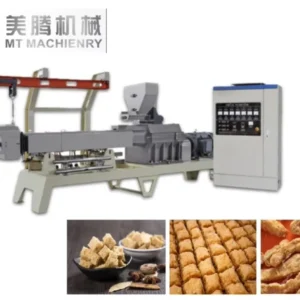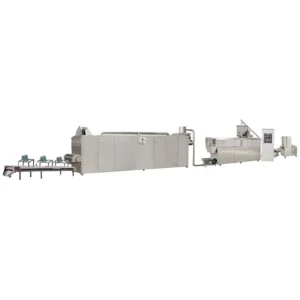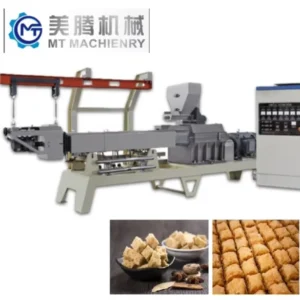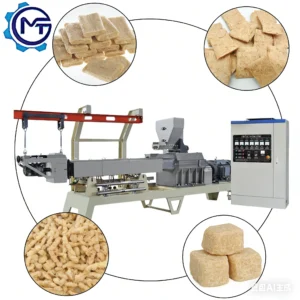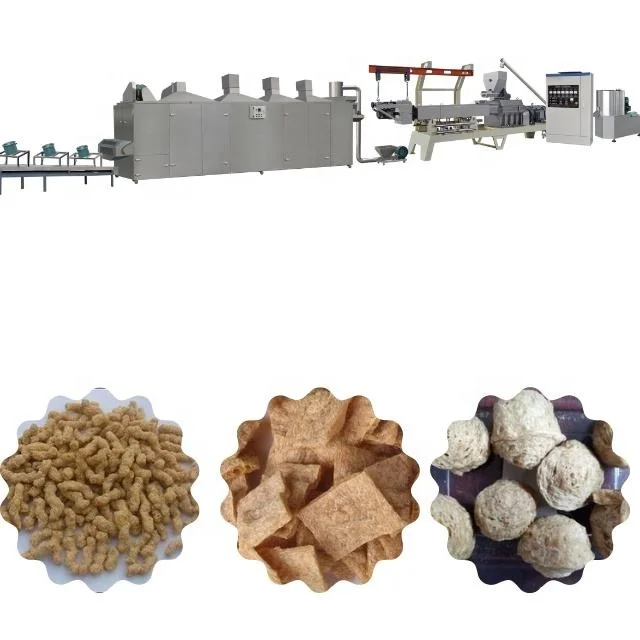
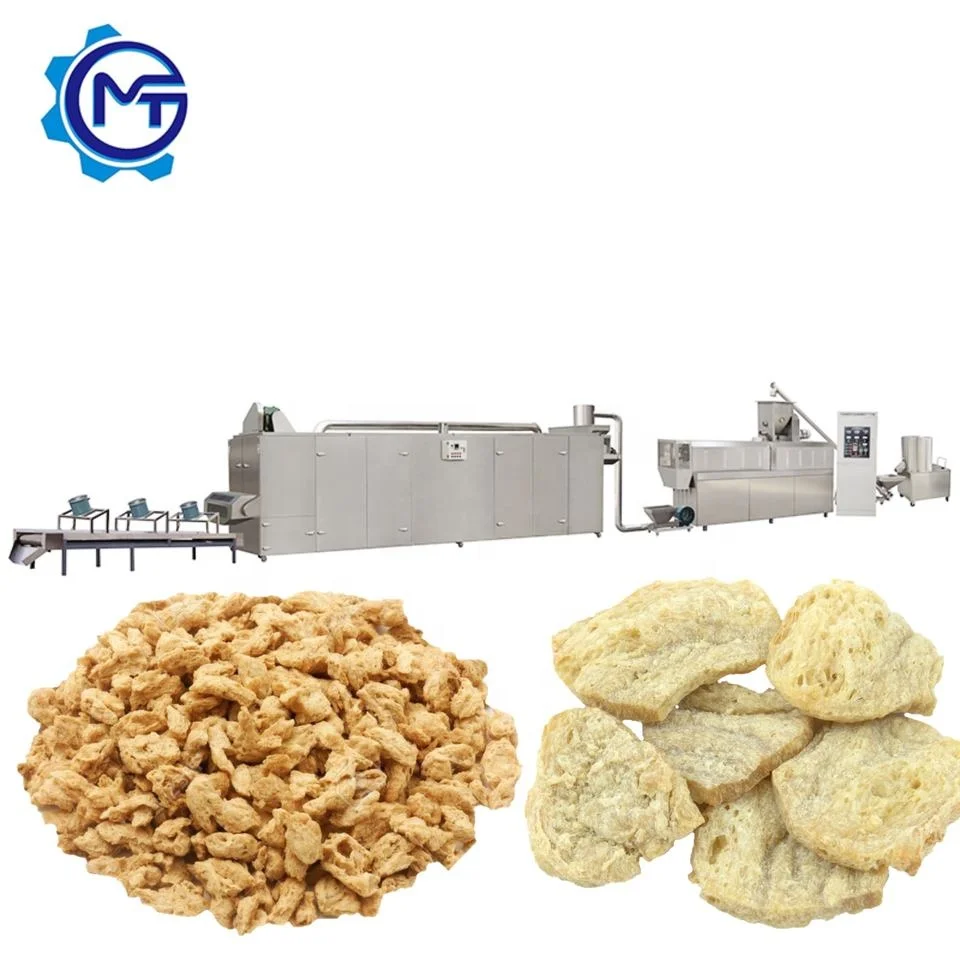


MT65, MT70, MT85 Textured Soy Protein Extrusion Production Line, Twin-Screw, PLC Control — configured as a complete turnkey project from batching through packing. Screw configuration and die design are matched to your soybean meal formulation and target fiber structure, with throughput verified across every station to eliminate bottlenecks. Trial runs on your actual raw material are completed in our testing workshop before shipment.
- Line layout and capacity calculation provided for each station
- Electrical schematic with voltage and frequency confirmed to your factory supply
- CE and ISO certified with full wear parts list and maintenance support
Description
Whole-Line Throughput Matching — every station from the mixer through the twin-screw extruder to the dryer and packing end is sized against the same target output, so a MT85 running at its rated extrusion capacity never waits on an undersized roaster or cooler.
Technical Specifications
| Parameter | Value |
|---|---|
| Product Type | Textured Soy Protein Extrusion Production Line |
| Models Available | MT65, MT70, MT85 |
| Screw Configuration | Twin-screw |
| Output Capacity (MT65) | 150–200 kg/h (basis not stated in source — confirm raw material formulation and moisture content) |
| Output Capacity (MT70) | 200–300 kg/h (basis not stated in source — confirm raw material formulation and moisture content) |
| Output Capacity (MT85) | 600–800 kg/h (basis not stated in source — confirm raw material formulation and moisture content) |
| Installed Power (MT65 / MT70 / MT85) | 85 kW / 120 kW / 195 kW |
| Real Operating Power (MT65 / MT70 / MT85) | 65 kW / 90 kW / 165 kW |
| Overall Dimensions (MT65) | 18000 × 1300 × 2300 mm |
| Overall Dimensions (MT70) | 20000 × 1500 × 2400 mm |
| Overall Dimensions (MT85) | 24000 × 3500 × 4300 mm |
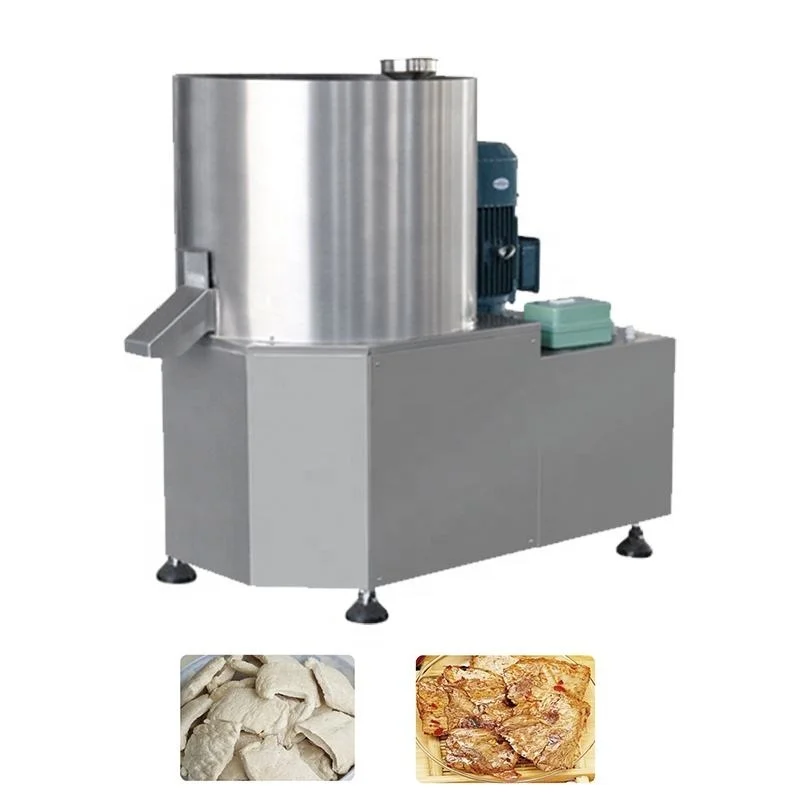
| Mixer Tank Volume | 150 kg per batch |
| Mixer Mixing Time | 10 min per batch |
| Mixer Rotary Speed | 385 rpm |
| High-Temperature Roaster Effective Belt Length | 3.5 m |
| Roaster Heating Elements | Far infrared, 3.9 kW × 24 units |
| Contact Material | Food-grade stainless steel |
| Control System | PLC with MCC integration |
| Certification | CE (company-level since 2014), ISO |
| Warranty | 1 year complete line, lifetime maintenance service |
Application Suitability
| Application Scenario | Primary Raw Material / Output |
|---|---|
| Textured vegetable protein (TVP) for meat analogue producers | Low-temperature defatted soybean meal, peanut meal |
| Plant-based ham and sausage ingredient processing | Soy protein concentrate blended with starch and fiber |
| Canned food and ready-meal soy meat chunks | Soybean meal formulated for high-moisture extrusion |
| Quick-frozen food ingredient supply | Textured soy protein in granule, flake, or chunk form |
| Fast-food chain plant-based patty and nugget production | Defatted soy flour with binding agents |
Why Nominal Extruder Capacity Rarely Survives Contact with Your Soybean Meal
A line rated on paper output often loses half its throughput the moment the buyer’s actual soybean meal formulation enters the barrel.
I once stood next to a single-screw extruder that was supposed to push out textured soy meat at its nameplate rate. The customer’s soybean meal had a different protein-to-starch ratio than the standard test formulation, and the fiber structure simply failed to develop at the expected feed rate. The extruder choked, the downstream dryer sat half-empty, and the whole line was producing well below what everyone had planned for. We reconfigured the screw elements and adjusted the barrel temperature profile section by section until the protein matrix aligned properly. That textured soy protein production line turnkey project only stabilized after the screw geometry matched the real raw material — not the catalog sample [NEED_CITE: effect of soybean meal protein dispersibility index on extrusion throughput].
Barrel Sections, Screw Elements, and the Protein Matrix
The twin-screw extruder at the heart of this line is where soybean meal transforms into a fibrous, meat-like structure. Each barrel section along the barrel can be independently heated, letting the operator build a temperature gradient that controls starch gelatinisation and protein denaturation in sequence. The screw elements are interchangeable: mixing blocks, conveying segments, and reverse-flight sections can be rearranged so that the shear profile matches the specific soybean meal the buyer is sourcing locally. A textured soy protein production line turnkey setup only delivers consistent fiber when the screw configuration is written to the buyer’s formulation, not copied from a generic build.
Throughput Matching Across Every Station on the Floor
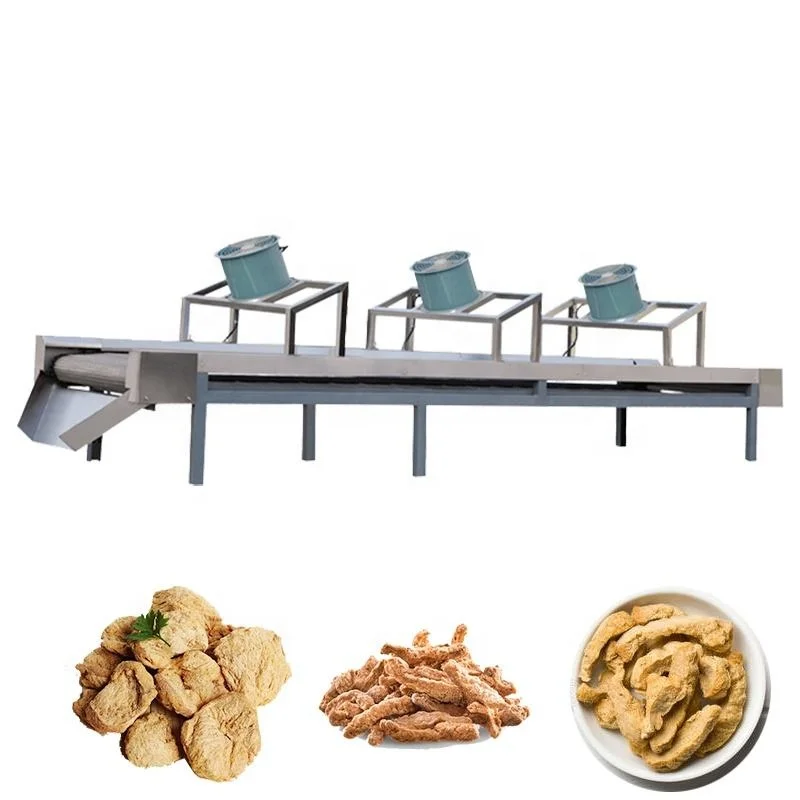
An extrusion line is only as fast as its slowest station. The mixer in this setup handles 150 kg batches with a 10-minute cycle at 385 rpm, feeding into the extruder at a rate that keeps the hopper level steady without surging. Downstream, the high-temperature roaster provides 3.5 meters of effective belt travel under 24 far-infrared heating elements, drying the extruded soy chunks before they enter the cooling machine. When a plant-based meat processor scales from a MT65 to a MT85, every station — mixer output, roaster belt speed, cooler airflow — is recalculated so that no single unit becomes a bottleneck [NEED_CITE: throughput balancing methodology for multi-station extrusion lines].
What the Power and Dimension Figures Mean on the Workshop Floor
The MT65 draws 65 kW of real operating power across an 18-meter line footprint, making it workable inside a standard industrial bay with typical ceiling clearance. The MT85, by contrast, occupies 24 meters in length and rises to over 4 meters in height with a 3.5-meter width — it needs dedicated high-bay floor space and a three-phase supply rated for 165 kW continuous draw. The far-infrared roaster alone accounts for roughly 93.6 kW of installed heating capacity across its 24 elements, which is why utility planning has to happen before the floor layout is finalized. Choosing between the MT65, MT70, and MT85 is not just about target output; it is about whether the buyer’s facility can supply the power and space each model demands.
When a Missing Trial Run Costs More Than the Extruder Itself
Sending an extrusion line to a buyer’s factory without first running their actual soybean meal through the machine is a gamble. If the protein content, moisture level, or particle size of the local meal differs from the test standard, the screw configuration shipped from the factory may produce dense, poorly textured output that cannot be sold as plant-based meat analogue. The buyer then faces weeks of on-site troubleshooting — paying for engineer visits, burning raw material on failed batches, and missing delivery commitments to their own customers [NEED_CITE: cost of post-installation extrusion line commissioning delays].
Why This Line Is Supplied as One Coordinated Project
The textured soy protein production line turnkey model means the mixer, extruder, roaster, cooler, and packing station all leave the same factory floor, tested together before crating. Screw and die configurations are recorded against the buyer’s specific formulation, so replacements can be reordered without guessing. The PLC and MCC cabinet are wired and labeled in the control language the buyer confirmed during the specification stage. A dedicated machine testing workshop allows trial runs on the buyer’s actual soybean meal before the line ships, producing a documented test report that both sides can reference during installation. Utility requirements — voltage, frequency, phase — are confirmed and matched to the destination factory’s supply before production begins, preventing the commissioning delays that happen when a 380 V machine arrives at a 415 V site.
Documentation & Verification
- Line layout drawing showing station-by-station throughput calculation against your target output
- Screw and die configuration record matched to your soybean meal formulation
- Trial run report from our testing workshop using your raw material sample
- Electrical schematic with confirmed voltage, frequency, and control language
- Factory test record with extruder barrel temperature profile logged during run
- CE declaration of conformity and ISO certificate for customs and regulatory filing
Installation, Commissioning & Support
- MT85 requires a high-bay floor area of at least 24 × 3.5 m with 4.3 m overhead clearance
- Three-phase supply rated for 165 kW continuous draw on the MT85, with dedicated breaker circuits for the 93.6 kW roaster
- Line ships in modular sections; barrel segments and roaster belt are reassembled and aligned on-site
- First-run commissioning includes barrel temperature profiling and screw speed calibration on your soybean meal
- Operator training covers PLC screen navigation, batch recipe storage, and emergency stop sequences
- Wear parts list specifies screw elements, die plates, and barrel liners with recommended first-replacement intervals
What We Need from You to Size the Line
Share the specific soybean meal or plant protein blend you plan to run, including protein content and typical moisture level. Let us know your target daily output and the shift pattern you operate. Confirm your factory’s voltage, frequency, and whether you need the PLC interface in a language other than English or Chinese. If you have existing upstream milling or downstream packing equipment, send the make and model so we can match interface heights and conveyor speeds.
Frequently Asked Questions
Q: How is line capacity verified on my specific soybean meal formulation before shipment?
A: We ask you to send a representative sample of your soybean meal or protein blend to our testing workshop. We run it through the extruder using the screw and die configuration planned for your order, log barrel temperatures and throughput rates, and provide a trial run report documenting the actual output and product texture achieved under those conditions.
Q: How do you prevent throughput mismatches between the extruder, dryer, and cooler?
A: Every station is calculated against the same target output during the layout phase. The mixer batch cycle, extruder feed rate, roaster belt speed, and cooler capacity are all specified so that material flows continuously without queuing or starving any unit. If you change your formulation later, we recalculate the balance.
Q: What electrical specifications are confirmed before production starts?
A: We confirm voltage, frequency, phase, and plug type for your factory’s supply, along with the language for the PLC interface and alarm messages. The electrical schematic is included in the documentation package so your electricians can prepare the correct breakers and cabling before the line arrives.
Q: What does the installation and commissioning schedule look like?
A: The line arrives in modular sections. Our engineers supervise reassembly, level the extruder and roaster, connect utilities, and run the first production batches using your raw material. Operator training runs in parallel, and we do not sign off on commissioning until the line holds stable output on your formulation.
Q: How are spare wear parts managed after the line is running?
A: You receive a wear parts list specifying every screw element, die plate, and barrel liner segment by part number. We recommend when to plan the first replacement based on the abrasiveness of your raw material, and parts are manufactured in-house so lead times stay within typical multi-week windows.
Related products
-
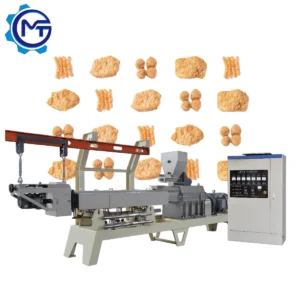
Textured Soy Protein Production Line for Vegetarian Meat Nugget Manufacturing
¥8,238.27 Select options This product has multiple variants. The options may be chosen on the product page -

Vegetarian Meat Floss Production Line with Twin Screw
¥9,500.00 Select options This product has multiple variants. The options may be chosen on the product page -
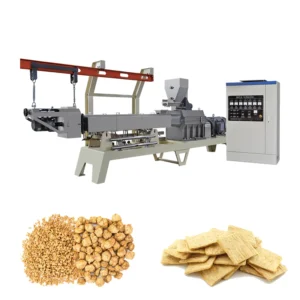
New Condition Soybean Protein Machine for Soy Chunks Production Textured Vegetable Protein Production Line
¥30.00 Select options This product has multiple variants. The options may be chosen on the product page -
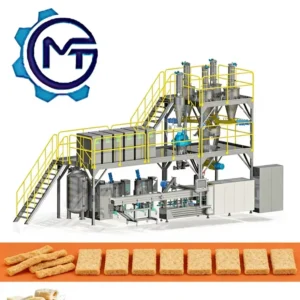
High Capacity Soy Protein Vegetarian Meat Processing Line
¥9,500.00 Select options This product has multiple variants. The options may be chosen on the product page