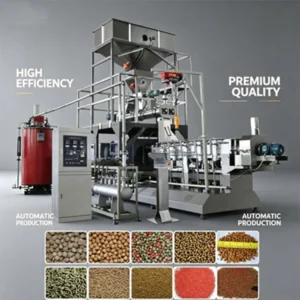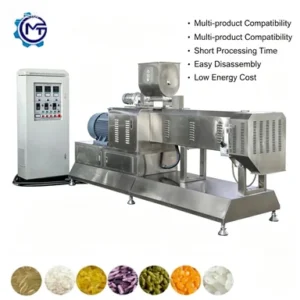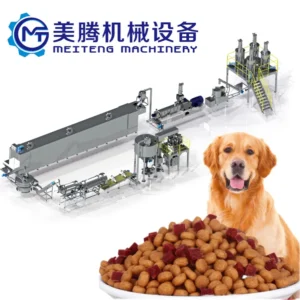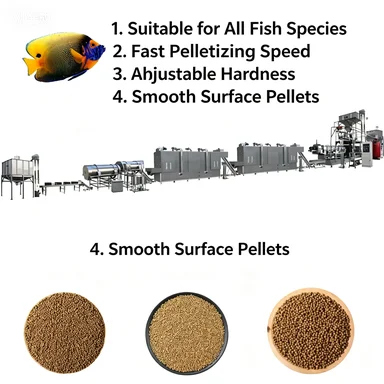
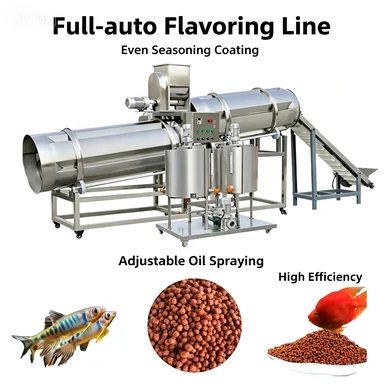



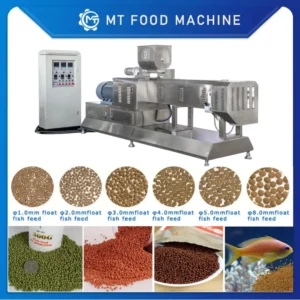
Wet Twin Screw Extruder Aquatic Feed Production Line, 0.5–12 mm pellet range, PLC controlled — engineered for floating and sinking pellet formats.
- Screw configuration and die design matched to your raw material formulation, ensuring target pellet density and starch gelatinisation
- Fully automatic continuous operation with throughput balanced across feeding, mixing, extruding and pelletizing stations
- Stainless steel food-grade contact materials throughout the product zone
Turnkey line layout and capacity calculation provided with throughput matched at every station, in-house trial runs on your raw material before shipment, and pre-sales consultation through to operator training.
Description
Balanced Throughput Across Stations — every dryer, coater and packer is sized to match the extruder output so the aquatic feed line never idles at one bottleneck.
Technical Specifications
| Parameter | Value |
|---|---|
| Product Type | Twin Screw Extruder Aquatic Feed Production Line |
| Output Capacity | 500 kg/h floating fish feed pellets (basis not stated in source — confirm raw material formulation, moisture and pellet diameter) |
| Pellet Diameter Range | 0.5 mm – 12 mm |
| Screw Type | Twin Screw |
| Control System | PLC Controlled (brand and language options to be confirmed) |
| Structure Material | Stainless Steel (main contact parts) |
| Line Stations | Feeding, Mixing, Extruding, Pelletizing, Drying, Coating, Packing (downstream configuration to be confirmed) |
| Automation Level | Fully automatic continuous operation |
| Voltage & Frequency | To be confirmed against target market |
| Rated Power (kW) | To be confirmed against motor nameplate |
| Overall Dimensions (L×W×H) | To be confirmed from layout drawing |
| Net Weight | To be confirmed from shipping documents |
| L:D Ratio / Screw Diameter | To be confirmed from extruder datasheet |
| Barrel Zones / Temperature Profile | To be confirmed from process sheet |
| Die Configuration | To be confirmed against pellet size range |
| Moisture Range / Steam or Water Injection | To be confirmed for wet extrusion process |
| Certification | CE / ISO available per company profile (line-specific declaration to be verified) |
Application Suitability
| Application | Material or Output |
|---|---|
| Floating pellets for catfish and tilapia grow-out stages | Fish meal, soybean meal, corn flour, vitamin premix |
| Sinking pellets for shrimp and bottom-feeding species | High-protein aquatic feed formulations with controlled density |
| Starter crumble for fish larvae and fry | Fine-grain formulations requiring 0.5 mm – 2 mm die apertures |
| Small and medium-scale continuous aquatic feed factories | Multi-shift operation on diversified raw material blends |
Why "500 kg/h" Can Mean Nothing for Your Formulation
Nominal output collapses the moment your raw material blend changes starch content or moisture level.
I have watched feed mills in South Asia receive an extruder rated for a certain throughput, only to discover that their local soybean-heavy formula gelatinises differently than the test grain used in the factory. The screw profile and die aperture set for one recipe produce under-expanded pellets on another, and the whole line stalls while the die plate is swapped out. Capacity is only meaningful when tied to a specific formulation, moisture percentage and pellet diameter — which is why an aquatic fish feed production line turnkey project must include a trial run on the buyer’s actual raw material before the machines leave the workshop [NEED_CITE: extrusion capacity dependence on raw material formulation and moisture].
Wet Extrusion Density Control for Floating and Sinking Targets
Achieving a stable floating pellet requires precise moisture injection and barrel temperature profiling so that starch gelatinisation traps enough gas before the pellet exits the die. A twin-screw configuration gives operators independent control over shear, residence time and steam addition, letting them shift from a buoyant catfish pellet to a dense sinking shrimp pellet without a full screw rebuild. The aquatic fish feed production line turnkey layout places the conditioner and steam injection points upstream of the barrel so moisture is uniform before the material reaches the first kneading block.
Matching Dryer Capacity to Extruder Throughput
An extruder pushing high-moisture pellets into an undersized dryer creates a queue that backs up to the die face, forcing the PLC to throttle the screw speed and sacrifice the very output the line was sized for. On this aquatic feed system, dryer bed area and residence time are calculated against the maximum extruder discharge rate so that pellets enter the coating drum at the target moisture level. Balanced station capacity removes the most common cause of unplanned stops on continuous aquatic feed lines [NEED_CITE: throughput matching between extrusion and drying in continuous feed production].
Screw Geometry, Die Aperture and the 0.5 mm to 12 mm Pellet Range
The twin-screw L:D ratio determines how long the formulation stays in the barrel under heat and pressure. A longer L:D gives more time for starch conversion on high-fibre aquatic blends, while a shorter one suits starch-rich recipes that gelatinise quickly. Die aperture and face-cutting speed together define the pellet length and diameter; switching from a 12 mm grow-out die plate to a 0.5 mm starter die requires matching screw element pitch to the smaller die openings so back-pressure stays within the motor’s rated torque. Food-grade stainless steel contact surfaces prevent corrosion from salt-laden aquatic premixes and meet the hygiene expectations of export-bound feed shipments.
The Hidden Cost of a Generic Screw Build
When screw elements and die plates are selected from a catalogue rather than matched to the buyer’s formulation, the first week of production usually reveals density drift — floating pellets that gradually sink after storage, or sinking pellets that fracture during pneumatic conveying. Correcting this on-site means shipping replacement screw profiles across borders, waiting weeks for customs clearance and running substandard feed in the meantime. Factories that skip the pre-shipment trial run often spend longer on commissioning than they would have spent on the factory test itself [NEED_CITE: screw and die configuration impact on pellet density stability in aquatic feed extrusion].
Why Source the Full Line from One Supplier
A single supplier designs the batching system, extruder, dryer, coating drum and packing station as one integrated project, so throughput figures are calculated across every station rather than quoted per machine. The screw and die configuration is recorded against the buyer’s raw material sample, and a trial run in the in-house testing workshop validates pellet density and appearance before the line is crated. Electrical schematics, voltage and PLC language are confirmed in writing before production starts, avoiding the rewiring delays that commonly hold up commissioning. Pre-sales engineering, on-site installation, operator training and ongoing wear-parts supply all sit under one project file, keeping accountability clear.
Documentation & Verification
- Line layout and capacity calculation with matched throughput at every station
- Screw and die configuration record tied to buyer’s raw material and pellet density target
- Trial run report on customer raw material conducted before shipment
- Electrical schematic with voltage, frequency and PLC language confirmed in writing
- CE declaration of conformity and ISO certificate applicable to the line
- Operation and maintenance manual with wear-parts list and replacement intervals
Installation, Commissioning & Support
- Foundation plan sized to the twin-screw extruder weight and vibration profile
- Dedicated power circuit matching confirmed voltage, frequency and rated kW of the full line
- Modular shipment with labelled station assemblies for sequenced unloading and positioning
- PLC parameter loading and barrel temperature profile calibration during first production run
- Operator training on die changes across the 0.5 mm to 12 mm pellet range
- Initial spare screw elements and die plates shipped with the line to cover first replacement cycle
What to Share Before Requesting a Quotation
To size an aquatic fish feed production line turnkey project accurately, provide your target species list, raw material formulation with approximate protein and starch percentages, desired pellet diameter range and whether you need floating, sinking or both pellet types. Include your workshop floor area and ceiling height, local voltage and frequency, preferred PLC interface language, and any upstream or downstream equipment you intend to retain. If you can ship a sample of your raw blend, a pre-shipment trial run will confirm pellet density and appearance before the line is built.
Frequently Asked Questions
Q: How is the 500 kg/h capacity figure verified, and on which formulation is it based?
A: That figure is a reference value and must be verified against your specific raw material blend, moisture level and target pellet diameter. Before quotation, we run a trial on a sample of your formulation in the testing workshop and record the actual throughput, pellet density and starch gelatinisation degree, so the capacity in the contract reflects your recipe, not a generic grain.
Q: How do you guarantee floating versus sinking pellet density?
A: Pellet density is controlled through screw configuration, barrel temperature profile and moisture injection, all adjusted to your formulation. A pre-shipment trial run on your raw material produces samples of both floating and sinking pellets, and the results are documented in a trial run report so you can confirm density meets your market specification before the line ships.
Q: How is throughput balanced between extruder, dryer, coating drum and packing?
A: Each downstream station is sized during the layout phase so its maximum processing rate matches or exceeds the extruder discharge rate. The capacity calculation document shows the throughput at every station, preventing bottlenecks that would otherwise force the PLC to throttle extruder speed and reduce actual line output.
Q: What voltage, frequency and PLC language are configured for our market?
A: Voltage, frequency and control interface language are confirmed in writing during the specification stage, before production starts. The electrical schematic reflects your local power standards and the PLC/HMI labels are set in the agreed language so operators can read alarms and parameter screens from day one of commissioning.
Q: What spare wear parts ship with the line and what is the lead time for replacements?
A: An initial set of screw elements, die plates and barrel liners is included based on the wear-parts list matched to your formulation abrasiveness. Replacement lead times depend on configuration and destination, and the wear-parts list in your documentation pack identifies each component so reorders can be placed before stock runs out.
Related products
-
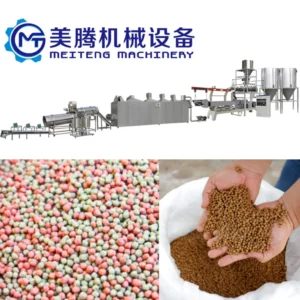
2-3t/h High Capacity Multi-Species Fish Feed Processing Line to Produce Fish Food
¥55,000.00 Select options This product has multiple variants. The options may be chosen on the product page -
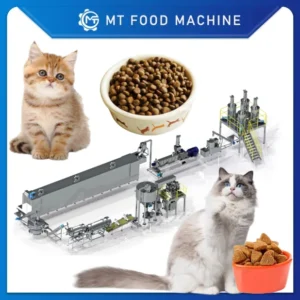
MT135 Brand 2.5-3.0t/h PLC Controlled Multi-Species Cat Food Processing Line
¥55,000.00 Select options This product has multiple variants. The options may be chosen on the product page -
4-5t/h High Capacity Multi-Species Fish Feed Processing Line to Produce Fish Food
¥65,000.00 Select options This product has multiple variants. The options may be chosen on the product page -
Energy Saving Automatic Twin Screw Extruder Floating Sinking Aquatic Fish Feed Industrial Production Processing Line
¥65.00 Select options This product has multiple variants. The options may be chosen on the product page