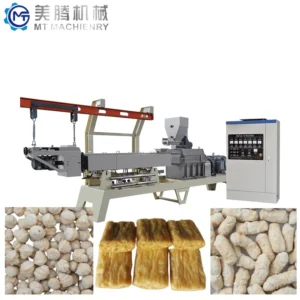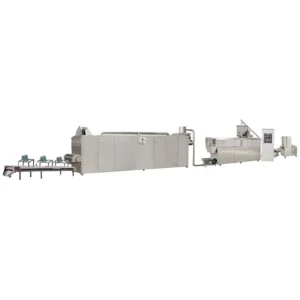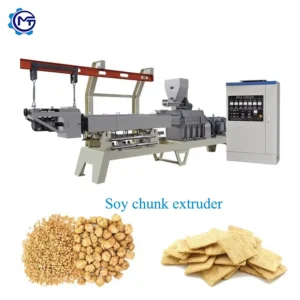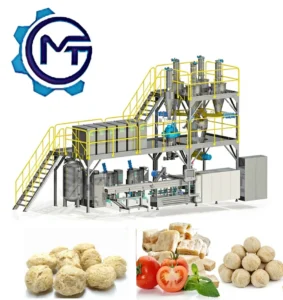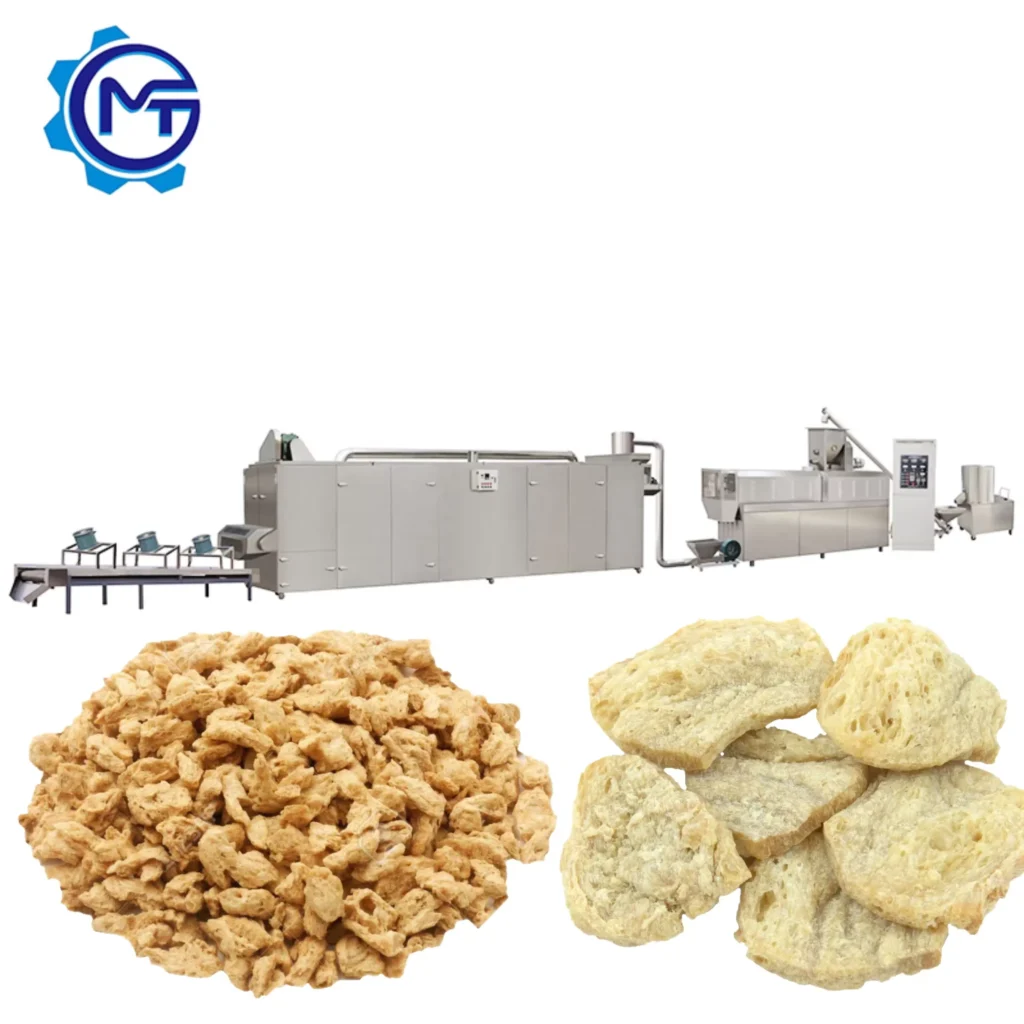


MT65 / MT70 / MT75 / MT85 Textured Soybean Protein Processing Line, Twin-Screw Extrusion, PLC & MCC Control, Multi-layer Dryer — complete turnkey layout from batching through cooling with throughput matched at every station.
- Screw configuration and die design specified to your defatted soya flour and target fibre structure
- Trial runs on customer raw material in our testing workshop confirm achievable output and product texture before shipment
- CE and ISO certified line with electrical schematic and voltage confirmed to your installation site
Description
Integrated Line Engineering — Every station from the mixer through the multi-layer dryer is capacity-balanced under one build responsibility, preventing the extruder from outpacing the dryer or the cooling conveyor becoming a bottleneck on your textured soy protein line.
Technical Specifications
| Parameter | Value |
|---|---|
| Model | MT65 / MT70 / MT75 / MT85 |
| Product Type | Textured Soybean Protein Processing Line |
| Screw Type | Twin Screw |
| Installed Power | 84 kW (MT65) / 160 kW (MT70) / 190 kW (MT75) / 210 kW (MT85) |
| Power Consumption | 59 kW (MT65) / 120 kW (MT70) / 140 kW (MT75) / 140 kW (MT85) |
| Output Capacity | 100–150 kg/h (MT65) / 150–200 kg/h (MT70/MT75) / 250–300 kg/h (MT85) (basis not stated in source — confirm raw material type, moisture content and die configuration) |
| Overall Dimensions (L×W×H) | 40 000×1 200×2 200 mm (MT65) to 45 000×1 500×3 500 mm (MT85) |
| Main Motor Power | 22 kW / 30 kW / 45 kW (model-dependent) |
| Control System | PLC and MCC, configurable |
| Line Stations | Mixer → Screw Conveyor → Twin Screw Extruder → Air Conveyor → Multi-layer Dryer → Cooling Machine |
| Dryer Type | Multi-layer, adjustable temperature and time, double pitch roller chain drive, round-trip drying |
| Dryer Energy Options | Fuel / Gas / Electricity |
| Mixer Power | 4 kW / 7.5 kW / 15 kW (model-dependent) |
| Rotary Cutting Motor | 0.75 kW |
| Assembly State | Complete line from batching through cooling |
| Standards | CE, ISO |
Application Suitability
| Application | Material or Output |
|---|---|
| Textured vegetable protein (TVP/TSP) production | Defatted soya flour, low-temperature soya flakes |
| Soya nuggets and soya chunks for food service | High-protein soy flour blends at controlled moisture |
| Plant-based meat analogues | Soy and pea protein mixes with starch binders |
| Fortified snack bases | Cereal-protein blends adjusted by screw and die change |
What "150 kg per Hour" Actually Means on a Soy Protein Line
Rated capacity holds only when the raw material, moisture level, and die geometry match the test conditions — anything else shifts the number.
I spent half a month on-site in the Pearl River Delta region re-tuning a texturised protein line because the buyer swapped in a heavy pea-protein blend after the factory trial ran on standard defatted soya flour. Barrel temperatures, feed moisture, and screw pitch all had to be reworked from scratch, and the fibre pull that makes TVP convincing simply would not form under the original settings [NEED_CITE: effect of protein source variation on extrusion shear and fibre alignment]. When a textured soy protein production line turnkey quote lists a single output figure without naming the test material, that number is a starting assumption, not a guarantee. Confirming the premise before the purchase order is signed saves weeks of commissioning time.
Screw Configuration and Fibre Structure Alignment
The twin-screw extruder in this textured soy protein production line turnkey system is set up with screw elements and die geometry chosen for the buyer’s specific raw material blend. Stagger angles, kneading block count, and reverse-flight sections all determine how much shear the protein matrix receives inside the barrel. Too little shear and the product exits as a pasty lump; too much and the fibres tear apart before they can align into the layered, meat-like texture the market expects.
Throughput Balance Across Every Station
A line that pushes 250 kg/h out of the extruder but feeds into a dryer rated for 180 kg/h creates a backlog that forces the extruder to idle or dump product. Each station in this textured soy protein production line turnkey build — mixer batch size, screw conveyor feed rate, extruder output, air conveyor capacity, multi-layer dryer residence time, and cooling belt speed — is calculated against the others so the line runs continuously without intermediate buffering [NEED_CITE: line balancing principles in continuous food extrusion plants]. The result is a steady product flow from raw ingredient infeed to cooled output ready for packing.
Reading the Specifications That Matter Most
The main motor power range of 22 kW to 45 kW across the model lineup directly correlates with barrel torque available for high-viscosity protein doughs. Low-temperature soya flakes demand more mechanical energy inside the barrel than pre-gelatinised starches because the protein unfolds and realigns under sustained shear rather than simply melting. Multi-layer dryer energy options — fuel, gas, or electricity — affect both operating cost and installation requirements; a gas-fired dryer needs venting and combustion air supply that an electric unit does not. The PLC and MCC control system maintains barrel temperature zones within tight tolerances across shifts, which is essential because even a few degrees of drift in the conditioning zone can collapse the fibre structure that gives soya chunks their bite. Mixer capacity ranging up to 170–180 kg per batch on the larger models ensures that the extruder never starves for feed during continuous operation.
The Cost of Skipping Raw-Material Trials
When a line ships without a trial run on the buyer’s actual defatted soya flour or soya flakes, the first production run becomes the experiment. Screw configurations that worked on the factory floor’s standard material may produce dense, under-expanded nuggets on a different protein-to-starch ratio. Dryer temperature and belt speed settings that cured one product format may leave another too moist for shelf stability [NEED_CITE: moisture content and shelf stability in extruded soy protein products]. Sorting out these variables on-site, with the buyer’s customers waiting for delivery, turns a commissioning visit into a development project that can stretch well beyond the planned schedule.
Why Buyers Place Repeat Orders Here
Every station from batching to cooling comes from one supplier, so throughput matching is an engineering decision made before the line is built, not an afterthought negotiated between vendors. Screw and die configuration is specified to the buyer’s raw material and target product format — nuggets, chunks, or granules — rather than copied from a generic build. An in-house testing workshop allows trial runs on customer-supplied defatted soya flour or low-temperature soya flakes before the equipment leaves the factory. The PLC and MCC control architecture supports remote diagnostics and recipe storage so that once the correct parameters are established, they can be recalled for every subsequent batch. On-site installation, commissioning, and operator training are carried out by the same engineering team that designed the screw profile, keeping knowledge continuity intact.
Documentation & Verification
- Line layout and capacity calculation showing matched throughput at every station for your target output
- Screw and die configuration record specific to your soya flour blend and product format
- Factory trial run report on your raw material confirming fibre structure and achievable capacity before dispatch
- Electrical schematic and voltage confirmation matching your installation site requirements
- Operation and maintenance manual with wear parts list for screws, dies, and dryer chain components
Installation, Commissioning & Support
- Foundation plan accounts for the 40–45 m line footprint and dryer height up to 3 500 mm
- Dedicated power circuit sized for installed load up to 210 kW with confirmed voltage and frequency
- Modular station delivery allows phased assembly in workshops with limited overhead clearance
- First-run parameter tuning covers barrel zones, feed rate, and dryer temperature for your raw material
- Operator training includes screw changeover, die swap, and PLC recipe recall procedures
- Wear parts supply covers twin-screw elements, die plates, and dryer chain links with lead-time agreement
Before You Send an Inquiry
Share your raw material specification — protein content, moisture level, and whether you are working with defatted soya flour, low-temperature flakes, or a blend including pea or wheat protein. Provide your target product format, daily volume, and the available workshop floor space and ceiling height. Confirm local voltage, frequency, and preferred control language so the electrical package is right before the line ships.
Frequently Asked Questions
Q: How is the output capacity verified, and what raw material premise does it depend on?
A: Output is measured during a trial run using your actual raw material — defatted soya flour or low-temperature soya flakes — at a defined moisture content and die configuration. The capacity figure in the initial specification is a baseline; the trial run report issued before shipment confirms what your specific material achieves on the selected model.
Q: How do you match screw and die configuration to our specific soya flour and target fibre structure?
A: We review your raw material data sheet, then select kneading block arrangement, screw stagger angle, and die aperture geometry to deliver the shear and pressure profile your protein matrix requires. A trial run validates the fibre pull and density before the configuration is locked in.
Q: Can a trial run on our raw material be performed before shipment?
A: Yes. Our in-house testing workshop runs your supplied defatted soya flour or soya flakes through the configured twin-screw extruder and downstream dryer, producing a trial run report with actual output, product texture assessment, and process parameters before the line is crated.
Q: How is throughput balanced across the mixer, extruder, dryer, and cooling stations?
A: Each station is sized against the extruder’s verified output on your material. Mixer batch cycle time, screw conveyor feed rate, multi-layer dryer belt speed and residence time, and cooling conveyor length are all calculated so no station starves or overflows during continuous operation.
Q: What does on-site installation, commissioning, and operator training cover?
A: Our engineers handle station positioning, utility connection verification, barrel zone calibration, and dryer tuning on your raw material. Training covers PLC recipe management, screw and die changeover, dryer chain maintenance, and daily inspection routines specific to your line configuration.
Related products
-

Vegetarian Meat Floss Production Line with Twin Screw
¥9,500.00 Select options This product has multiple variants. The options may be chosen on the product page -
Twin Screw Extruder for High Moisture Vegetarian Meat
¥9,500.00 Select options This product has multiple variants. The options may be chosen on the product page -
High Productivity Single Screw Extruder Machine New Condition Textured Soya Meat & Soy Protein Like Meat Making Machine
Price range: ¥20.00 through ¥30.00 Select options This product has multiple variants. The options may be chosen on the product page -
Textured Soy Protein Production Line for Vegetarian Meat Nugget Manufacturing
¥8,238.27 Select options This product has multiple variants. The options may be chosen on the product page