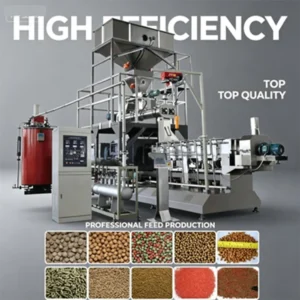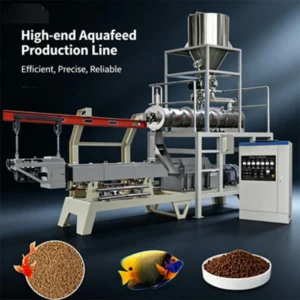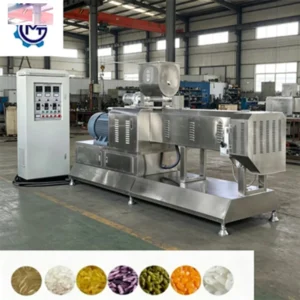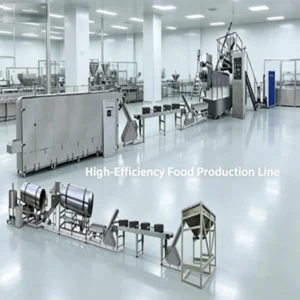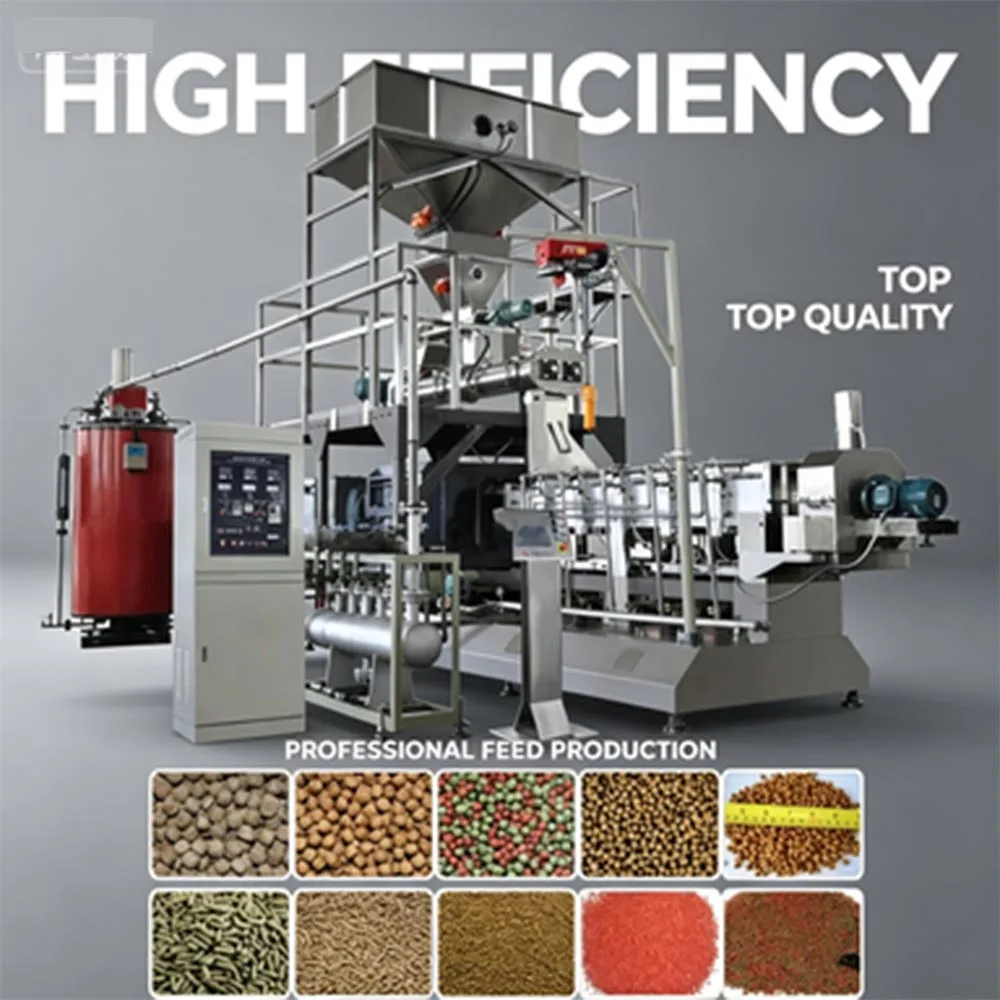

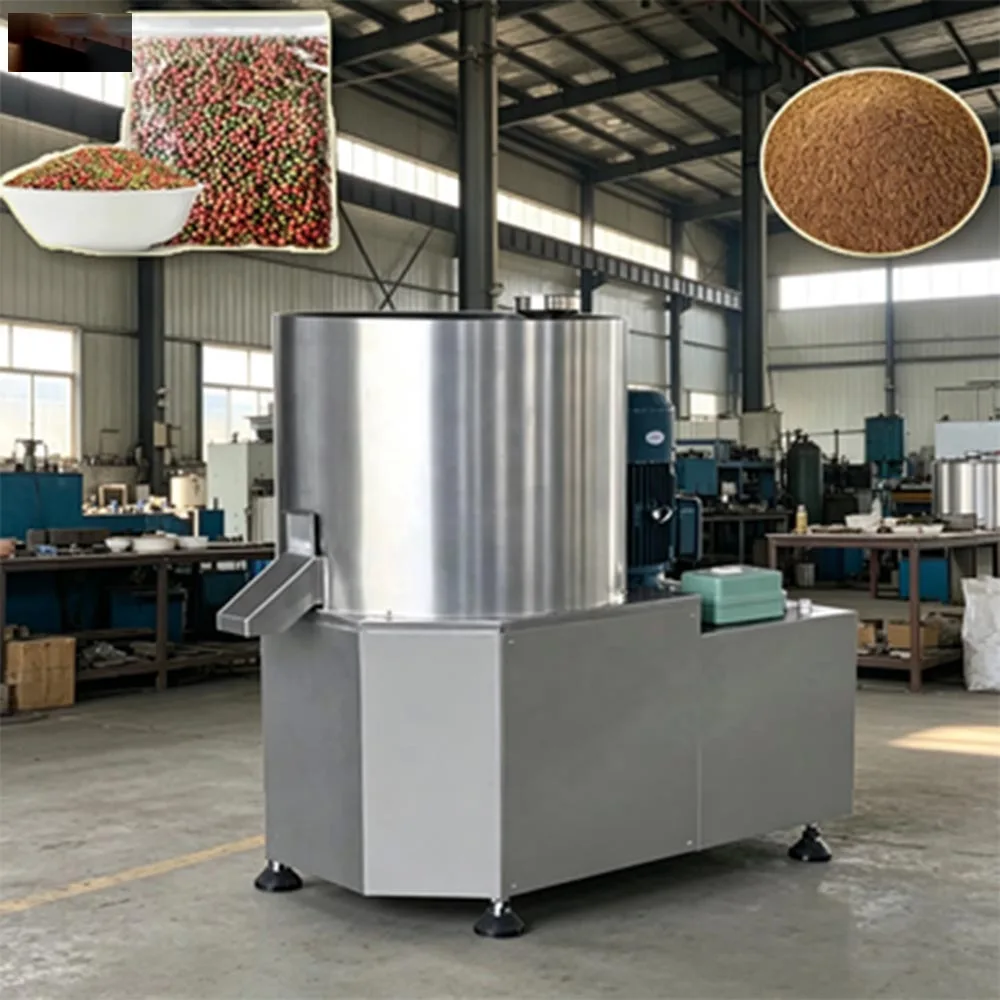


Twin Screw Fish Feed Production Line, PLC Control, 304 Stainless Steel — engineered as a complete turnkey aquatic feed extrusion system from batching through drying and coating, with every station throughput-matched to prevent bottlenecks. Twin screw configuration and die design are specified to your raw material formulation, enabling adjustable pellet buoyancy and density for both floating and sinking feed formats. In-house trial runs on your actual raw material are completed before shipment to verify output quality.
- Line stations: mixer, extruder, dryer, seasoning coater, vibrating sieve, conveyors
- Pellet size, hardness, and buoyancy adjustable for koi, goldfish, tropical fish, and freshwater species
- CE and ISO certified production with full electrical schematic and voltage confirmation before build
Description
Balanced throughput — every station from mixer to vibrating sieve is sized together so the line runs at one continuous pace instead of waiting on a bottleneck.
Technical Specifications
| Parameter | Value |
|---|---|
| Product Type | Twin Screw Aquatic Feed Extrusion Line |
| Screw Type | Twin screw |
| Control System | PLC automatic control system |
| Line Stations | Raw material mixer, extruder, dryer, seasoning coating machine, vibrating sieve, conveyor equipment |
| Material Contact Parts | Food grade 304 stainless steel |
| Output Capacity | Large stable processing capacity for medium-large scale production (basis to be confirmed — depends on raw material formulation, pellet size, and moisture content) |
| Pellet Types | Floating and sinking fish feed pellets |
| Pellet Adjustability | Pellet size, hardness, buoyancy adjustable |
| Raw Materials Supported | Fish meal, soybean meal, corn powder, compound additives |
| Target Aquatic Species | Koi, goldfish, tropical fish, freshwater fish |
| Automation Level | Full continuous automatic production from mixing to finished product discharging |
| Energy Features | Optimized energy saving transmission structure and heating system |
| Assembly State | Complete matched production configuration |
| Standards | CE, ISO |
Application Suitability
| Application | Material or Output |
|---|---|
| Commercial floating fish feed for koi and goldfish | Fish meal, soybean meal, corn powder blends |
| Sinking pellet production for freshwater aquaculture | Compound additives with high-protein formulations |
| Tropical fish feed in varied pellet diameters | Mixed grain and protein raw materials |
| Medium to large scale feed factory continuous runs | Bulk batches across multiple aquatic species requirements |
What "Rated Capacity" Leaves Out About a Fish Feed Production Line Turnkey
Capacity means nothing unless it was measured on your actual formula.
I once watched a line in Colombia get commissioned with great fanfare. The trial runs back in Jinan used a standard corn starch base. When the buyer’s real formulation — heavy on fish meal — went through the barrel, the pellets sank when they were supposed to float. Two weeks of screw reconfiguration and moisture tuning followed before the float rate met market expectations. A fish feed production line turnkey quoted on a generic recipe tells you what the machine can do in theory, not what it will do with the ingredients you actually source locally. [NEED_CITE: raw material variability and extrusion behavior]
How Screw Configuration Controls Pellet Buoyancy
Floating and sinking pellets demand different shear profiles inside the barrel. The twin screw arrangement allows operators to rearrange screw elements and adjust the die geometry so that expansion and density land within the narrow window each aquatic species requires. A fish feed production line turnkey that ships with a generic screw build will struggle the moment the raw material blend shifts, forcing on-site adjustments that delay production ramp-up.
Why Dryer and Coater Sizing Cannot Be an Afterthought
An extruder pushing product faster than the dryer can remove moisture creates a backlog of wet pellets that stick together and degrade. The seasoning coating machine must also match throughput, otherwise flavor application becomes uneven and rejects climb. Every station on this line is calculated against the extruder output so the fish feed production line turnkey runs continuously without intermediate buffers filling up or starving downstream equipment. [NEED_CITE: throughput balancing in continuous extrusion lines]
Reading the Specs That Matter Most
The twin screw design gives processors a wider raw material window compared to single screw extruders — higher fat and protein content can pass through without blocking the barrel. Food grade 304 stainless steel on all contact parts prevents corrosion from the salts and additives common in aquatic formulations. The PLC automatic control system maintains barrel temperature profiles and screw speed across long production runs, reducing batch-to-batch variation that buyers in export markets increasingly scrutinize. Pellet size and hardness are adjusted through die selection and moisture management rather than requiring a different machine altogether.
The Hidden Cost of Unmatched Line Stations
When the dryer is undersized relative to extruder output, operators are forced to slow the entire line to match the slowest station. That lost capacity compounds across every shift. Similarly, a coating drum that cannot keep up means some pellets leave the line under-seasoned, leading to customer complaints about palatability. These mismatches rarely show up in a single-machine quotation because each vendor only guarantees their own equipment. [NEED_CITE: line integration failures in aquaculture feed projects]
Why Buyers Source This Line From One Supplier
Every station is configured under a single line layout and capacity calculation, so throughput is matched from the mixer through to the vibrating sieve rather than assembled from disconnected vendors. Screw and die configurations are specified to the buyer’s raw material and target pellet buoyancy before production begins. An in-house testing workshop runs the buyer’s actual formulation before the line ships, catching density and texture issues while changes are still inexpensive. Electrical schematics confirm voltage, frequency, and control language for the destination market so commissioning starts with the correct parameters already loaded.
Documentation & Verification
- Line layout and capacity calculation showing throughput matched across every station
- Trial run report produced on your actual fish meal and soybean meal formulation
- Screw and die configuration record tied to your target floating or sinking pellet density
- Electrical schematic confirming voltage, frequency, and PLC language for your facility
- CE declaration of conformity and ISO certificate for customs and regulatory clearance
- Wear parts list covering screws, dies, and dryer components for your first reorder
Installation, Commissioning & Support
- Foundation and floor space planned around the full station sequence from mixer to packing
- Power supply sized for the PLC-controlled extruder motor, dryer heaters, and conveyor drives
- Stations arrive pre-assembled with documented assembly sequence for on-site connection
- First production run supervised to confirm pellet buoyancy, size, and moisture targets
- Operator training covers screw element changes, die swaps, and PLC parameter adjustment
- Spare screw elements and die plates stocked for your initial replacement cycle
What We Need Before Quoting Your Line
Share your raw material formulation — especially the ratio of fish meal to grain components — and the pellet diameter range your market requires. Tell us your local voltage and frequency, the control language your operators read, and whether you need floating, sinking, or both pellet types. If you have an existing dryer or packing system that should integrate with the new extrusion front end, send us the throughput specs so we can match the line around them.
Frequently Asked Questions
Q: How is line capacity verified, and what raw material formulation is it based on?
A: Capacity is verified through a trial run in our testing workshop using the buyer’s actual raw material blend. The resulting trial run report documents throughput, pellet density, and moisture levels achieved on that specific formulation. Any capacity figure quoted before this test carries the note that final output depends on the confirmed recipe.
Q: How is screw and die configuration matched to produce the correct floating or sinking pellet density?
A: Screw elements are arranged to deliver the shear and residence time needed for the target expansion level. Die geometry is then selected to set pellet diameter and cut length. Both are adjusted during the in-house trial run until buoyancy tests confirm the pellets behave as the buyer’s market expects.
Q: How is throughput balanced between the extruder, dryer, and coating stations to prevent bottlenecks?
A: Each station is sized during the line layout phase based on the extruder’s confirmed output on the buyer’s formulation. The dryer’s evaporation capacity and the coating drum’s residence time are calculated to match or slightly exceed that output, preventing wet pellet backlog or seasoning gaps.
Q: What voltage, frequency, and control language options are confirmed before commissioning?
A: The electrical schematic is prepared after the buyer confirms local supply standards. The PLC interface language is set to match the operator team’s working language. Voltage and frequency mismatches caught at this stage prevent costly rewiring or transformer additions during installation.
Q: How does the in-house trial run on customer raw material work before shipment?
A: The buyer ships a representative sample of their formulation to the testing workshop. The line runs that material through the configured extruder and dryer, and the resulting pellets are tested for size, density, and buoyancy. Adjustments to screw elements or moisture settings are made before the machine is packed for dispatch.
Related products
-
Premium Pet Food Processing Equipment Dog Cat Feed Making Machine
¥9,500.00 Select options This product has multiple variants. The options may be chosen on the product page -
Premium Pet Food Processing Equipment Dog Cat Feed Making Machine
¥9,500.00 Select options This product has multiple variants. The options may be chosen on the product page -
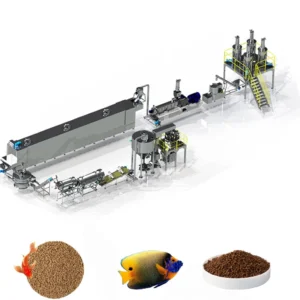
Automatic Fish Feed Production Line Machine Floating Sinking Pellet Manufacturing High Capacity Energy Saving Design
¥9,500.00 Select options This product has multiple variants. The options may be chosen on the product page -
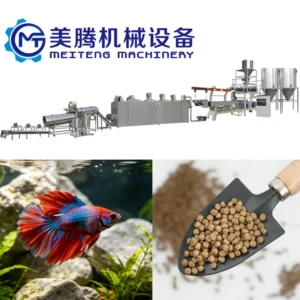
1.0-1.2t/h High Capacity Multi-Species Fish Feed Processing Line to Produce Fish Food
¥45,000.00 Select options This product has multiple variants. The options may be chosen on the product page