

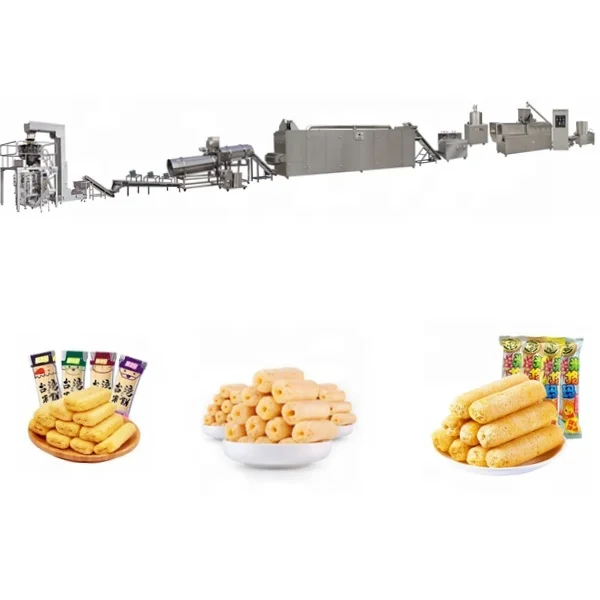


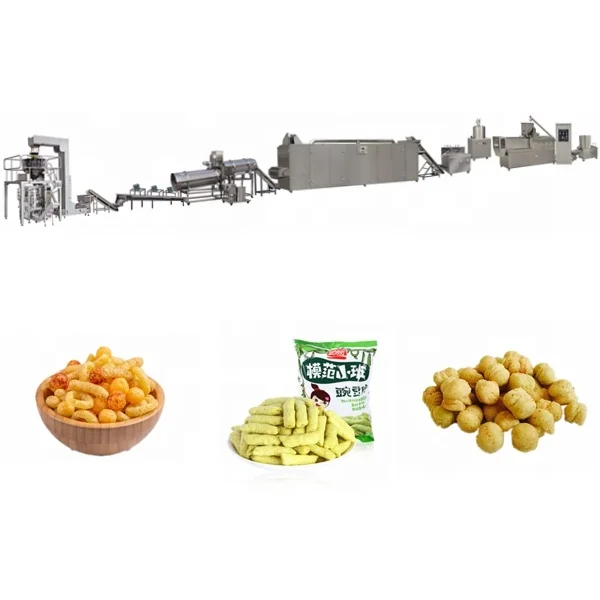
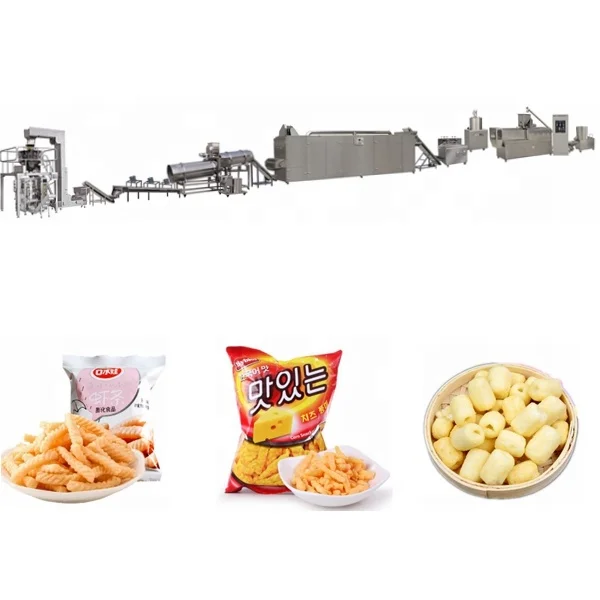
Twin Screw Snack Food Extrusion Line, 380V, Food-Grade SS 201/304 — engineered for puffed cereal snacks from wheat, corn, rice, and multi-grain blends.
Screw configuration and die design are matched to your raw material’s moisture profile and target expansion density, ensuring consistent texture across formats like cheese balls, core-filled snacks, and fortified puffed sticks. Multiple energy options (electricity, gas, diesel, steam) align with local utility conditions, while throughput-matched stations from mixer to packing eliminate bottlenecks.
Factory trial runs on your actual raw material validate output before shipment, with complete electrical schematics and voltage confirmation provided for your market.
- Twin screw extrusion with application-specific screw and die setup
- Line stations balanced for continuous throughput
- CE certified construction with full documentation support
Description
Throughput-matched extrusion lines — every station from batching to packing configured under one supplier to prevent bottlenecks, with screw and die design verified against your actual cereal formulation before shipment.
Technical Specifications
| Parameter | Value |
|---|---|
| Product Type | Twin Screw Snack Food Extrusion Line |
| Screw Configuration | Twin screw (co-rotating) |
| Contact Material | Food grade stainless steel 201 or 304 |
| Motor | Siemens (China) or domestic premium brand |
| Inverter | Delixi or Delta |
| Energy Source | Electricity, gas, diesel, or steam (selectable) |
| Rated Power | ~100 kW (electric heating); 50–60 kW (gas/diesel heating) |
| Voltage & Frequency | 380V/50Hz three-phase; 220V/50Hz single-phase (customizable) |
| Control System | PLC and MCC available (configuration to be confirmed) |
| Line Stations | Mixer → Extruder → Vibratory cooler → Roasting unit → Packing machine |
| Output Capacity | Basis to be confirmed with raw material and target moisture |
| Barrel Zones | To be specified based on formulation |
| L:D Ratio | To be specified based on target expansion |
| Overall Dimensions | To be confirmed after layout proposal |
| Net Weight | To be confirmed after layout proposal |
| Certification | CE compliant; ISO certified manufacturing |
Application Suitability
| Application | Material or Output |
|---|---|
| Puffed cereal sticks | Corn grits, wheat flour, rice, millet at controlled moisture |
| Core-filled extruded snacks | Multi-cereal base with cream or jam center filling |
| Fortified puffed snacks | Blends enriched with vitamins, plant proteins, or minerals |
| Artificial and restructured rice | Rice flour and starch mixtures requiring specific die shaping |
| Roasted savory formats | Extruded shapes requiring post-extrusion roasting and seasoning |
What "Nominal Line Capacity" Leaves Out About Your Raw Material
A capacity figure quoted without naming the raw material and moisture content is a number without meaning.
When a snack food extrusion production line turnkey proposal arrives with a single throughput number, it rarely mentions what formulation was used to derive that figure. I have seen lines built around a 500 kg/h promise collapse to half that output once the buyer’s actual corn grits — slightly coarser grind, different starch ratio — entered the barrel. The extruder runs, the product exits, but the expansion is wrong, the density misses the market spec, and the dryer cannot keep pace because it was sized for a different volume. The entire snack food extrusion production line turnkey investment underdelivers from day one [NEED_CITE: industrial extrusion capacity validation standards].
How Screw Configuration Determines Whether Your Wheat Formula Expands Correctly
A twin screw platform gives operators the latitude to adjust screw element sequencing — forward elements for conveying, kneading blocks for shear, reverse elements for residence time. When wheat flour replaces part of the corn base, the gluten content changes the melt rheology inside the barrel. The screw combination must be rearranged to manage that difference, or the extrudate exits dense and under-expanded. A snack food extrusion production line turnkey system only performs as well as the screw profile matched to the buyer’s actual blend.
Why Energy Source Selection Must Precede Line Layout
The choice between electric, gas, diesel, and steam heating alters the dryer footprint, the utility connections, and the ongoing operating cost in ways that reshape the entire plant layout. A facility running on steam from an existing boiler has a fundamentally different energy profile than one wiring high-amperage electric circuits. Specifying the energy source early ensures the roasting and drying stations are sized correctly and the snack food extrusion production line turnkey layout fits the available utility infrastructure [NEED_CITE: industrial heating energy cost comparison by region].
What the Barrel and Motor Specifications Mean for Daily Production
The rated power of approximately 100 kW under electric heating reflects the energy required to maintain barrel zone temperatures while the twin screws generate shear across the full L:D ratio. Food-grade stainless steel construction in 201 or 304 grades ensures contact surfaces resist corrosion from acidic or high-moisture formulations, which is relevant when producing fortified snacks with mineral additives. The Siemens or premium domestic motor paired with a Delixi or Delta inverter gives variable speed control, allowing operators to adjust screw RPM in response to real-time expansion behavior — a critical variable when switching between a wheat-heavy and corn-heavy recipe on the same shift.
The Hidden Cost of Unmatched Station Throughput
When an extruder is sourced from one vendor and the dryer from another, neither party owns the throughput gap between them. The extruder may push product faster than the roasting unit can handle, forcing the line to idle or the product to pile up wet and undeveloped. Flavoring drums sized too small create a second bottleneck downstream. These mismatches rarely appear in individual machine quotes but surface immediately during commissioning, costing weeks of lost production [NEED_CITE: production line integration bottleneck analysis].
Why Sourcing the Full Line from One Supplier Changes the Outcome
The mixing, extrusion, vibratory cooling, roasting, and packing stations are designed together so that each station’s capacity aligns with the others, eliminating the throughput gaps that plague multi-vendor assemblies. Screw configuration and die geometry are specified to the buyer’s raw material profile and target snack density, not copied from a generic template. An in-house testing workshop allows trial runs on the buyer’s actual cereal blend before shipment, so formulation issues are resolved at the factory rather than on the buyer’s floor. Voltage, frequency, and control language are confirmed during the specification stage, preventing commissioning delays. Pre-sales engineering support extends through on-site installation, operator training, and ongoing wear parts supply.
Documentation & Verification
- Line layout and capacity calculation showing throughput balance across all stations
- Screw and die configuration record matched to your cereal formulation
- Trial run report conducted on your raw material in the testing workshop before dispatch
- Electrical schematic with voltage, frequency, and control language confirmed for your market
- CE declaration of conformity and ISO manufacturing certificate
- Operation and maintenance manual with wear parts list
Installation, Commissioning & Support
- Foundation and utility planning based on the confirmed ~100 kW or 50–60 kW power configuration
- Dedicated electrical circuit sizing for the three-phase 380V or customized local voltage requirement
- Complete line arrives as multiple stations requiring sequential assembly and inter-station conveyance alignment
- First-run parameter setting covers barrel temperature profile, screw RPM, and die pressure for your formulation
- Operator training addresses screw element changes when switching between wheat, corn, and multi-cereal recipes
- Wear parts inventory including replacement screw segments and die plates supplied with initial shipment
Before You Request a Quote
To configure a line that holds its rated output on your actual material, share your cereal formulation including grain type, grind size, and target moisture content. Specify your local voltage and frequency so the motor and control panels are built correctly from the start. Confirm your available floor space and ceiling height to ensure the layout fits without compromise. If you need a trial run on your raw material before committing, state that requirement early in the inquiry.
Frequently Asked Questions
Q: How is line capacity verified against my specific raw material and moisture content?
A: We run your actual cereal formulation through the twin screw extruder in our in-house testing workshop. The trial records expansion ratio, product density, and achievable throughput under your target moisture. These results form the basis of the capacity figure in the final quotation, so the number you receive reflects your material, not a generic benchmark.
Q: How do you ensure throughput matching between the extruder, dryer, and flavoring stations?
A: Every station is specified under a single engineering proposal, meaning the mixer output rate, extruder throughput, vibratory cooler capacity, roasting unit volume, and packing speed are calculated together. The line layout document shows the balanced flow rate at each station before production begins.
Q: What voltage, frequency, and control language options are confirmed before production?
A: During the specification stage we confirm your site’s voltage and frequency — whether 380V/50Hz, 220V/50Hz, or another local standard — and the preferred control language for the PLC and HMI interface. These details are locked into the electrical schematic before manufacturing starts, preventing commissioning delays.
Q: Can I run a trial on my raw material in your testing workshop before shipment?
A: Yes. The in-house testing workshop is equipped for trial runs using the buyer’s actual grain blend. The trial report documents screw configuration, barrel temperatures, die selection, and the resulting product characteristics, giving you verified data before the line leaves the factory.
Q: What is the phased installation and commissioning schedule for a complete turnkey line?
A: Installation proceeds in phases: foundation and utility preparation, station placement and conveyance connection, electrical and control integration, then sequential dry runs and product trials. Commissioning covers parameter optimization on your formulation, operator training on screw changes and daily maintenance, and a sustained production run to confirm throughput before handover [NEED_CITE: industrial food line commissioning best practices].
Related products
-

Full Automatic Crispy Maize Chocos Corn Flakes Breakfast Cereals Processing Production Line Industrial Equipment
¥1,000.00 Select options This product has multiple variants. The options may be chosen on the product page -

Puff Corn Snacks Food Line Puffed Rice Ball Production Making Equipment Machines
¥10,565.00 Select options This product has multiple variants. The options may be chosen on the product page -

Puffed Snacks Seasoning Flavor Machine Twin Screw Corn Puffing Food Making Extruder Equipment
¥8,355.00 Select options This product has multiple variants. The options may be chosen on the product page -

Full Automatic Puffed Corn Snack Food Extruder Puffed Snack Corn bar Making Machine
¥8,500.00 Select options This product has multiple variants. The options may be chosen on the product page


