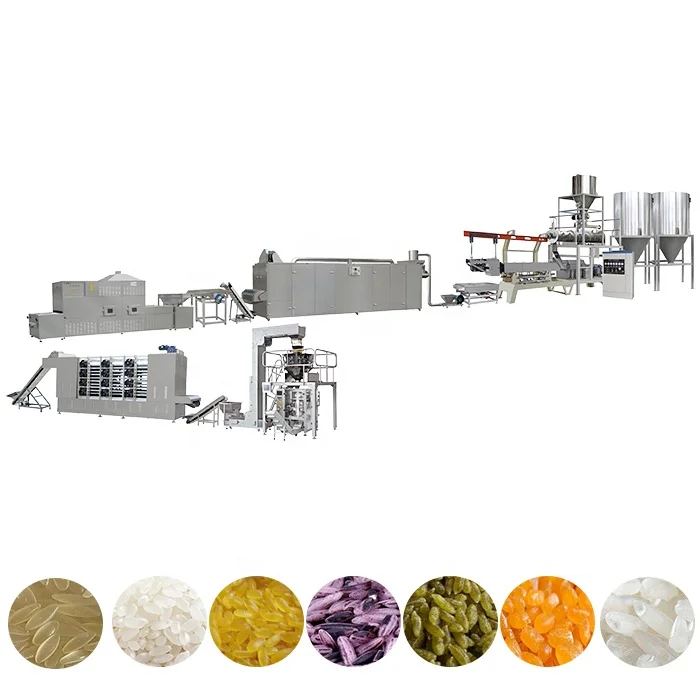
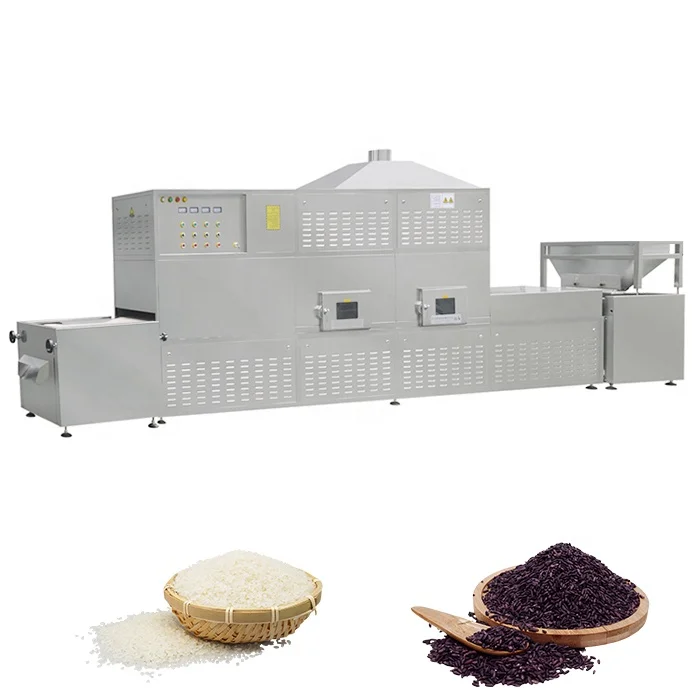


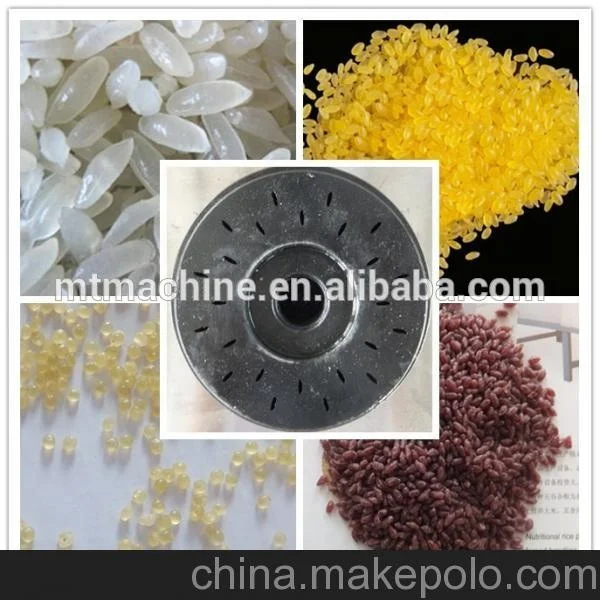
MT65, MT70, MT85, MT75, MT95 Fortified Artificial Rice Extrusion Production Line, Twin-Screw, PLC Control — engineered as a complete turnkey project from batching through extrusion, drying and packing. Every station’s throughput is matched to eliminate bottlenecks, with screw configuration and die design specified to your raw material blend and target kernel density.
- Line layout and capacity calculation provided showing balanced throughput across all stations
- Trial runs on customer raw material completed in-house before shipment
- On-site installation, commissioning and operator training included
Description
Integrated Throughput Engineering — Every station from batching through extrusion, drying, and packing is sized as one balanced system, eliminating the bottlenecks that arise when an extruder is paired with mismatched downstream equipment in a turnkey artificial rice production line.
Technical Specifications
| Parameter | Value |
|---|---|
| Product Type | Fortified Artificial Rice Extrusion Production Line |
| Model Range | MT65 / MT70 / MT85 / MT75 / MT95 |
| Screw Type | Twin-screw (single or double screw feeding system optional based on material) |
| Installed Power | 85 kW (MT65) / 120 kW (MT70) / 235 kW (MT85) / 180 kW (MT75) / 260 kW (MT95) |
| Power Consumption | 60 kW (MT65) / 85 kW (MT70) / 165 kW (MT85) / 135 kW (MT75) / 195 kW (MT95) |
| Output Capacity | 80–100 kg/h (MT65) / 100–120 kg/h (MT70) / 200–300 kg/h (MT85) / 300–500 kg/h (MT75) / 800–1000 kg/h (MT95) (basis to be confirmed against raw material formulation and moisture content) |
| Overall Dimensions | 28×1.2×2.2 m (MT65) / 30×1.5×2.2 m (MT70) / 34×3.5×4.3 m (MT85) / 32×3.5×4.3 m (MT75) / 36×3.5×4.3 m (MT95) |
| Control System | Frequency speed controlling, high automation with PLC and MCC |
| Lubrication & Cooling | Automatic lubricating and cooling system |
| Heating Source (Dryer) | Electric or gas configurable |
| Production Procedure | Mixing → Extruding → Vibrating → Low temperature drying → Cooling → High temperature roasting → Cooling → Packing |
| Standards | CE certified, ISO certified |
Application Suitability
| Application | Material or Output |
|---|---|
| Fortified rice kernel production for nutrition programmes | Broken rice, rice bran, corn, millet blended with vitamin and mineral premix |
| Artificial rice from grain by-products | Wheat, oats, buckwheat, beans, starch restructured into uniform kernels |
| Government staple food fortification projects | Multi-grain blends with micro-nutrient enrichment at scale |
| Value-added rice processing | Low-grade broken rice converted into premium-shaped fortified kernels |
What "Rated Capacity" Ignores in Fortified Rice Extrusion
Your actual formulation determines the line’s real output, not the nameplate figure.
I once set up a nutritional powder and fortified rice line for a Southeast Asian buyer where our standard rice flour ran through trial extrusion without issues. When the customer shipped their own fortified premix — loaded with minerals and heat-sensitive vitamins — the screw speed, barrel temperature profile, and moisture targets all had to be reworked from scratch. That delay cost them roughly two weeks of production time they had already promised to their government programme partner [NEED_CITE: typical commissioning delays from untested raw material formulations]. This is why every artificial rice production line turnkey project we build starts with a trial run on the buyer’s own material, not a generic benchmark.
Screw Configuration and Die Geometry for Kernel Formation
In fortified rice extrusion, the twin-screw configuration must handle abrasive mineral particles alongside starch-rich base materials. The screw elements are arranged to control shear intensity: too aggressive and the vitamin premix degrades before the die; too gentle and the starch fails to gelatinize properly, leaving kernels that crumble during packaging. The die orifice shape directly governs the final kernel geometry — elongated, rounded, or grain-mimicking — and must be matched to the buyer’s target market expectation. Each artificial rice production line turnkey installation we deliver ships with a screw and die configuration record specific to the buyer’s confirmed formulation.
Full-Line Throughput Matching Across Every Station
An extruder running at full output means little if the downstream dryer cannot handle the moisture load, or if the cooling conveyor creates a backlog that forces the extruder to idle. On a recent fortified rice project, the buyer initially sourced the dryer separately and discovered it could not keep pace with the extruder’s throughput, creating a bottleneck that reduced actual line output well below the quoted capacity. We now engineer the mixer batch cycle, extruder feed rate, dryer residence time, and packing speed as a single calculated system [NEED_CITE: throughput matching methodology for continuous food processing lines]. This ensures the artificial rice production line turnkey project delivers sustained output rather than a theoretical peak.
Interpreting the Power and Capacity Range
The installed power spans from 85 kW on the MT65 to 260 kW on the MT95, reflecting the increasing barrel length, screw torque, and drying load as capacity grows. The difference between installed and consumed power — for example 235 kW installed versus 165 kW consumed on the MT85 — accounts for motor startup surge and heater cycling, which matters for sizing your facility’s electrical infrastructure. The twin-screw design across all models provides the mixing intensity needed for uniform distribution of micronutrients throughout the starch matrix. Frequency speed controlling on every drive point allows operators to fine-tune screw RPM, feeder rate, and dryer belt speed independently, maintaining kernel density and texture consistency across production runs.
The Hidden Cost of Skipping Material Trials
When an extrusion line ships without a trial run on the buyer’s actual formulation, the first weeks of production become an expensive experiment. Operators adjust screw speed, barrel zone temperatures, and moisture addition in real time, generating off-spec kernels that must be reprocessed or discarded. In fortified rice production this problem compounds because the vitamin and mineral premix reacts differently to heat and shear than plain starch — adjustments that fix the kernel shape may simultaneously destroy nutrient retention [NEED_CITE: thermal degradation thresholds for common vitamin premixes in extrusion]. That is why we require raw material samples before finalizing the screw configuration and die design for any artificial rice production line turnkey order.
Why Source the Complete Line from One Project Partner
Every station — batching, mixing, extruding, vibrating, low-temperature drying, cooling, high-temperature roasting, and packing — is designed and supplied as a single project, so throughput calculations are validated across the entire chain rather than assumed between separate vendors. The in-house testing workshop allows trial runs on your specific grain blend and premix before any equipment leaves the factory, confirming kernel density, shape, and nutritional retention against your specification. Screw and die configurations are engineered to your confirmed formulation, not copied from a generic reference build. Electrical schematics are prepared with your facility’s voltage, frequency, and control language confirmed before production begins, preventing commissioning delays on site. CE and ISO documentation is provided as standard, supporting import clearance and local regulatory compliance for grain fortification projects.
Documentation & Verification
- Line layout showing throughput balance across mixer, extruder, dryer, roaster, and packing stations
- Screw and die configuration record matched to your specific grain and premix formulation
- Factory trial run report on your raw material confirming kernel shape, density, and nutrient retention
- Electrical schematic with confirmed voltage, frequency, and control language for your facility
- CE declaration of conformity and ISO certificate for customs clearance and regulatory filing
Installation, Commissioning & Support
- Foundation and floor plan prepared for the MT85’s 34×3.5×4.3 m footprint or equivalent model dimensions
- Dedicated electrical circuit sized for the selected model’s installed power, up to 260 kW on the MT95
- PLC and MCC control panels configured with operator language and frequency speed parameters before arrival
- On-site commissioning covering barrel zone temperature calibration, screw RPM tuning, and dryer belt speed synchronization
- Operator training on twin-screw feed rate adjustment, die changeover, and automatic lubrication system monitoring
- Wear parts list covering screw elements, die plates, and dryer belt sections with recommended replacement intervals
What to Share When Requesting a Proposal
To size the line accurately, we need your base material types (broken rice, corn, multi-grain blend), the vitamin and mineral premix composition, and your target kernel shape and density specification. Share your facility’s available floor area and ceiling height, local voltage and frequency standard, and preferred control interface language. If you have existing upstream milling or downstream packaging equipment, let us know the connection points so the line integrates without throughput gaps. Providing a raw material sample for trial extrusion before quotation allows us to confirm the screw configuration and lock realistic output figures.
Frequently Asked Questions
Q: How is line capacity verified against my specific fortified rice formulation?
A: Before shipment, we run your actual grain blend and premix through the twin-screw extruder in our testing workshop. We document screw speed, barrel temperature, moisture content, and the resulting kernel density and shape. The trial run report confirms whether the selected model meets your target output under real material conditions, not generic benchmarks.
Q: What voltage, frequency, and control language options are confirmed before production?
A: We request your facility’s electrical specification during the proposal stage and confirm voltage, phase, frequency, and plug standard before the electrical schematic is finalized. The PLC and MCC control interface is configured in your preferred language so operators can begin training on day one of commissioning.
Q: Can I run a trial on my own raw material before the line ships?
A: Yes. Our in-house testing workshop is equipped for full extrusion trials on buyer-supplied grain blends and premixes. We adjust screw configuration, die geometry, and barrel temperature zones until kernel shape, texture, and nutritional retention match your specification, and we issue a signed trial report before dispatch.
Q: How do you ensure dryer and cooler capacity matches extruder output across the full line?
A: Every station’s throughput is calculated as one system during the layout phase. The dryer residence time, cooling conveyor length, and roaster capacity are all sized against the extruder’s confirmed output on your material, so no single station becomes a bottleneck that limits actual production.
Q: What does on-site installation, commissioning, and operator training cover?
A: Our team handles mechanical assembly, electrical connection verification, barrel temperature calibration, and full-line throughput testing using your raw material. Operator training covers twin-screw operation, die changeover, frequency speed adjustment, automatic lubrication system checks, and daily maintenance routines specific to your line configuration.
Related products
-

Máquina Extrusora de Doble Tornillo Automática Controlada por PLC de Alta Calidad de 500kg/h para Polvo de Nutrición de Arroz para Bebés
¥8,238.27 Add to cart -
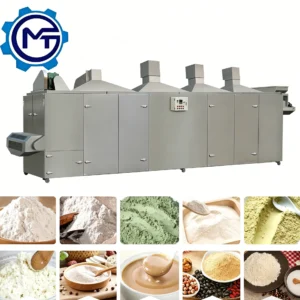
Línea de producción de extrusión de polvo de nutrición de arroz orgánico para bebés de la marca MT, aprobada por CE, con capacidad de 500 kg/h y grado automático.
¥9,500.00 Add to cart -
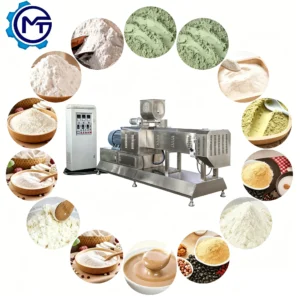
Línea de producción de alimentos para bebés en polvo de nutrición fortificada totalmente automática
¥8,238.27 Select options This product has multiple variants. The options may be chosen on the product page -
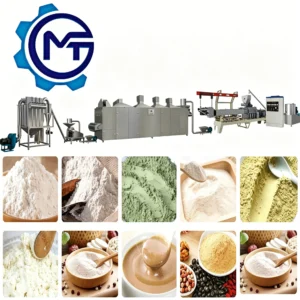
Línea de procesamiento de producción automática de 500 kg/h de polvo de nutrición de arroz para bebés orgánico y sin gluten
¥8,238.27 Add to cart