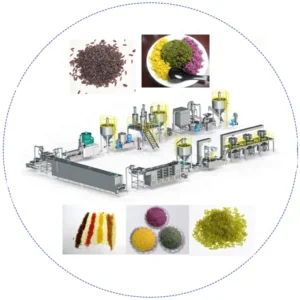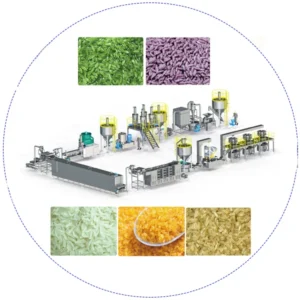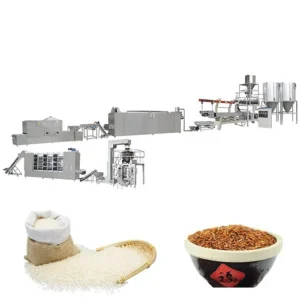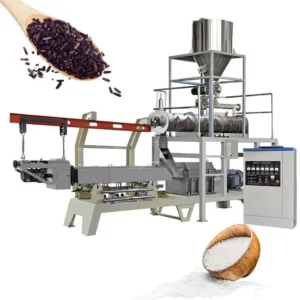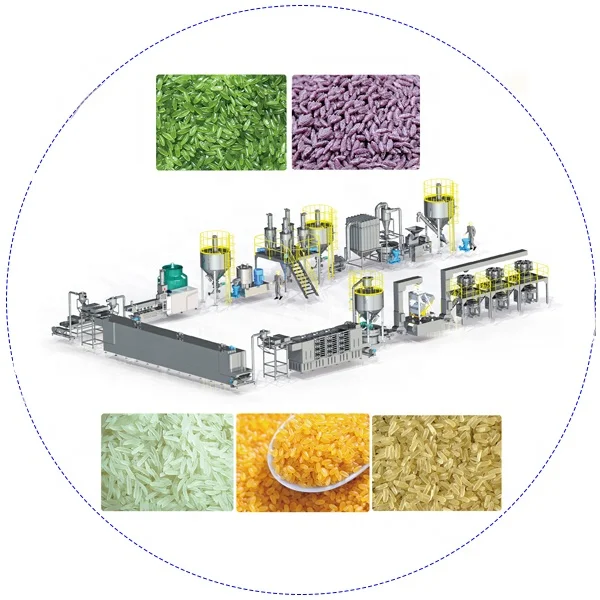
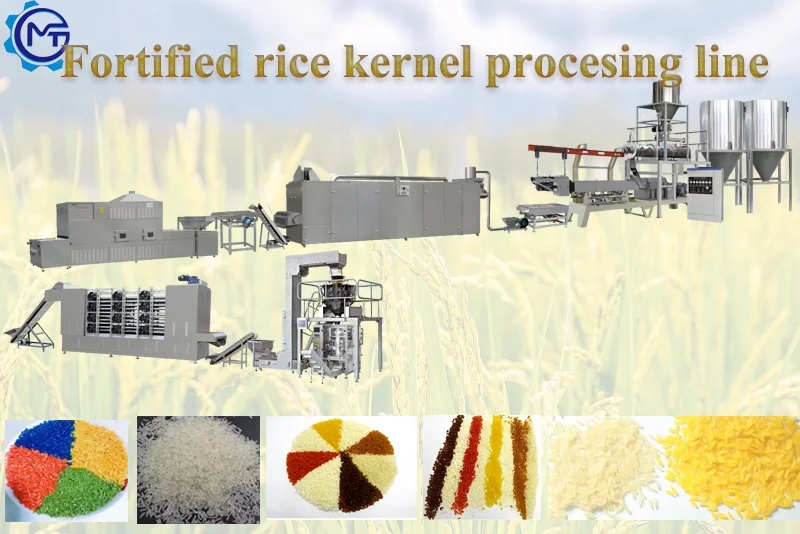
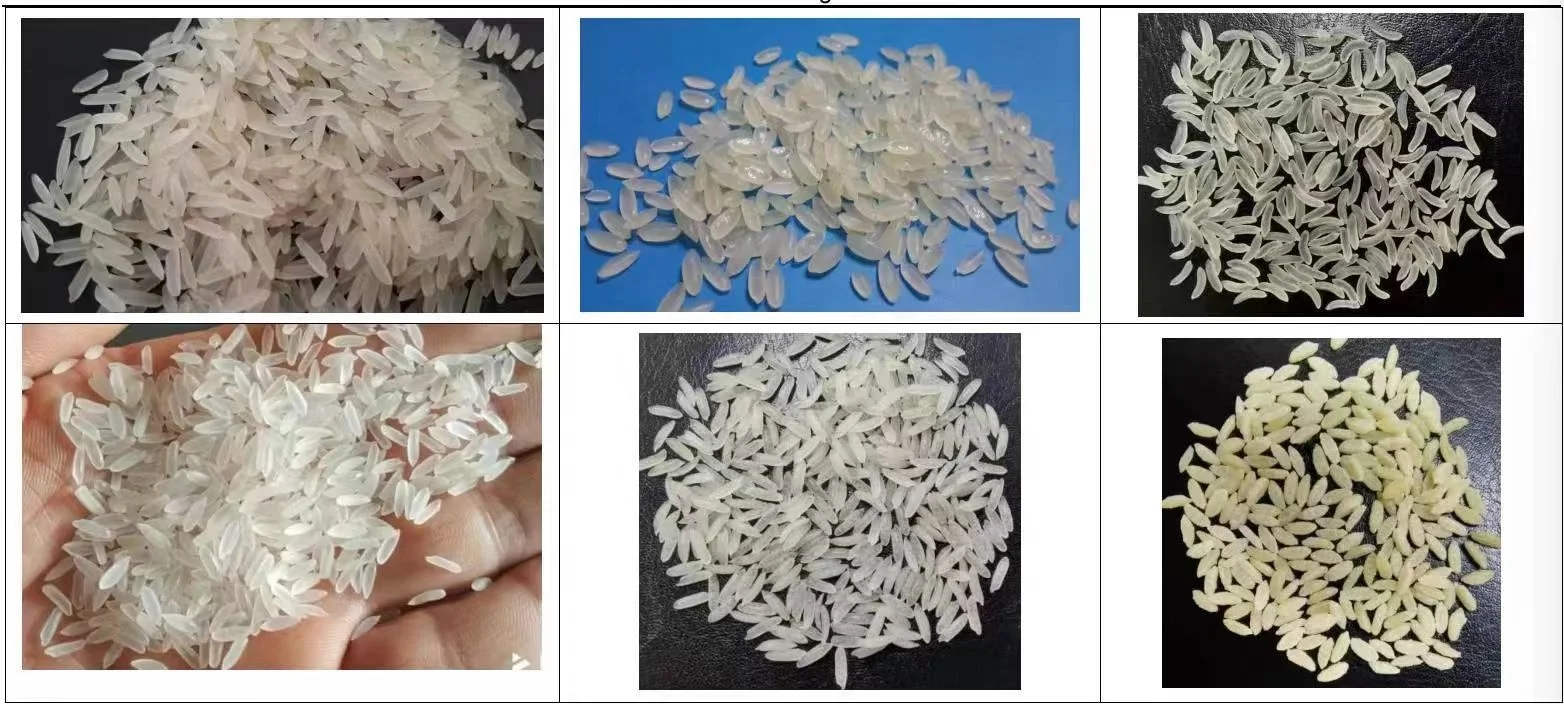
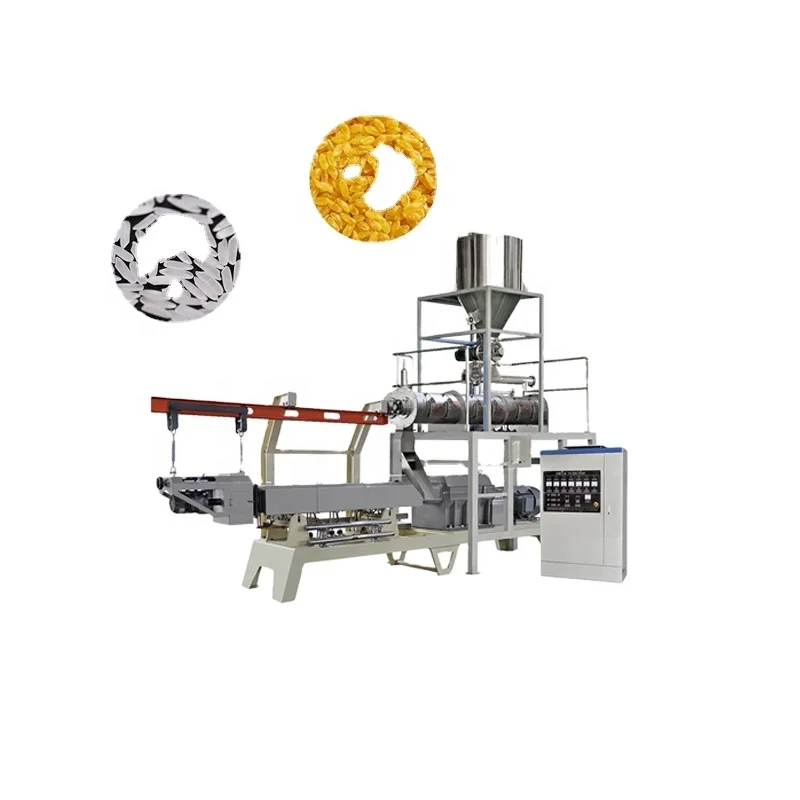
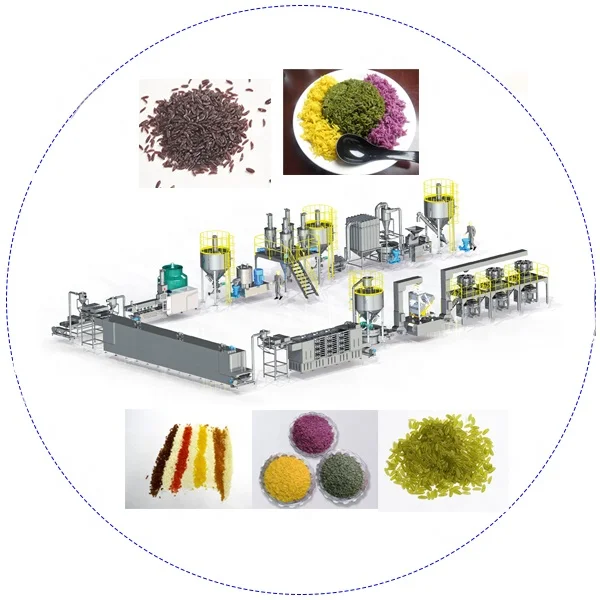
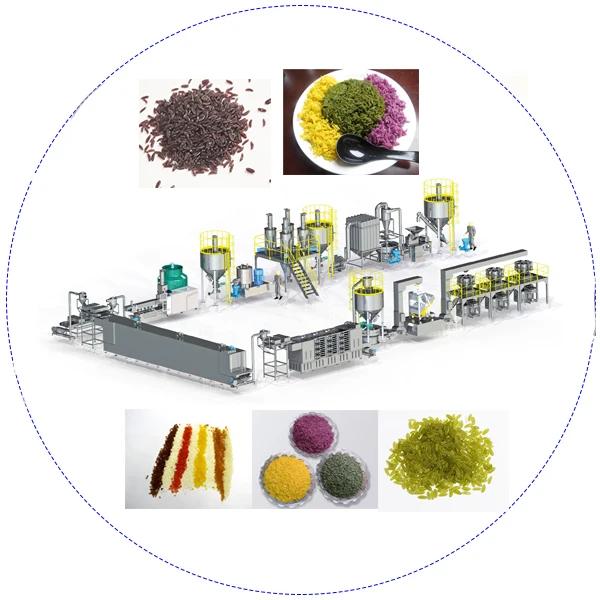
MT65 Fortified Artificial Rice Processing Line, Twin Screw, 85KW Installed Power — engineered as a complete turnkey system from mixing through extrusion, drying, roasting, and packing with throughput balanced across every station.
- Screw configuration and die design matched to your raw material blend and target kernel dimensions
- Frequency speed control with PLC automation for stable output and flexible recipe adjustment
- Raw material compatibility includes broken rice, corn, millet, wheat, oats, and vitamin/mineral additives
Trial runs conducted on your actual formula in our testing workshop before shipment, confirming kernel shape, density, and cooking behavior with a full report provided.
Description
Turnkey Integration — Every station from batching through packing engineered under one roof to match your fortified rice formula throughput.
Technical Specifications
| Parameter | Value |
|---|---|
| Product Type | Fortified Artificial Rice Processing Line |
| Available Models | MT65 / MT70 / MT85 / MT75 / MT95 |
| Screw Type | Twin Screw |
| Installed Power | 85 kW (MT65) / 120 kW (MT70) / 235 kW (MT85) / 180 kW (MT75) / 260 kW (MT95) |
| Power Consumption | 60 kW (MT65) / 85 kW (MT70) / 165 kW (MT85) / 135 kW (MT75) / 195 kW (MT95) |
| Output Capacity | 80-100 kg/h (MT65) / 100-120 kg/h (MT70) / 200-300 kg/h (MT85) / 300-500 kg/h (MT75) / 800-1000 kg/h (MT95) (basis not stated in source — confirm raw material / moisture content) |
| Overall Dimensions | 28×1.2×2.2 m (MT65) / 30×1.5×2.2 m (MT70) / 34×3.5×4.3 m (MT85) / 32×3.5×4.3 m (MT75) / 36×3.5×4.3 m (MT95) |
| Control System | Frequency speed controlling, high automation |
| Heating Source (Dryer) | Electric or gas |
| Line Stations | Mixing, Extruding, Vibrating, Low temperature drying, Cooling, High temperature roasting, Cooling, Packing |
| Raw Materials | Broken rice, corn, millet, wheat, oats, buckwheat, bean, starch, vitamin and mineral additives |
| Assembly State | Complete turnkey line |
| Certification | CE |
Application Suitability
| Application | Material or Output |
|---|---|
| Fortified artificial rice production | Broken rice and rice bran blended with vitamin and mineral additives |
| Nutritional couscous processing | Corn, millet, and wheat formulated for high-nutrition food programs |
| Value-added grain conversion | Broken rice, oats, buckwheat, and bean mixtures for retail or institutional supply |
| Government and NGO nutrition contracts | Fortified rice kernels meeting specific micro-nutrient dosage targets |
Why "Nominal Capacity" Rarely Survives Your Actual Formula
A line rated on paper often underperforms the moment your raw material blend hits the barrel.
On a recent installation in Colombia, the customer’s nutritional powder blend ran significantly higher in protein than the sample we tested. The screw configuration was not recalibrated before commissioning, and the extruder choked within hours. Throughput dropped noticeably below the nameplate figure, leaving the dryer and packing stations waiting for material. That kind of mismatch does not show up in a brochure — it shows up on your first production shift. When sourcing a Fortified Artificial Rice Production Line turnkey, the capacity conversation must start with your exact raw material certificate of analysis, not a generic grain baseline. [NEED_CITE: typical variation in protein and moisture content across broken rice and pulse suppliers]
Throughput Matching Across Every Station
A complete Fortified Artificial Rice Production Line turnkey only performs when each station handles the same mass flow. The extruder output must align with the vibrating conveyor feed rate, the low-temperature dryer residence time, and the roasting oven belt speed. When these are sourced from separate vendors, throughput gaps appear as bottlenecks or idle equipment. Engineering the entire sequence — mixing, extruding, vibrating, drying, cooling, roasting, and packing — under one supplier keeps the mass balance intact from the batching hopper to the final bag.
Screw Configuration Driven by Your Blend
Twin-screw extrusion gives you adjustable shear, residence time, and mixing intensity, but only when the screw elements are arranged for your specific formulation. A blend heavy in broken rice starch gelatinises differently from one dominated by bean protein and oat fibre. The screw profile, die geometry, and barrel temperature zones are specified against your material report so the rice kernel exits with the correct shape, density, and cooking behaviour — not a generic setting carried over from the last production run. [NEED_CITE: twin-screw element arrangement and its effect on starch gelatinisation degree]
What the Specifications Actually Mean on the Floor
The installed power figures across the MT65 through MT95 range reflect the torque demand of pushing dense, vitamin-fortified dough through a restrictive die plate. Higher power models correspond to larger screw diameters and longer barrels, which increase residence time and allow more complete starch gelatinisation — critical when your formula includes raw bean flour that must be fully cooked. Frequency speed controlling lets the operator dial screw RPM independently of feeder rate, so you can adjust expansion and kernel density without stopping the line. The choice between electric and gas heating on the dryer section affects your utility planning: electric gives precise zone control in regions with stable grids, while gas suits sites where electricity tariffs make thermal loads expensive. Overall line dimensions scale with model selection, so floor plan confirmation should happen before you finalise the extruder size.
The Hidden Cost of Skipping the Trial Run
Shipping an extruder without a documented trial on your raw material formula is a gamble that usually loses. When the screw and die combination is guessed rather than tested, the first week of production becomes an expensive experiment. Kernel shape drifts outside specification, density fluctuates, and downstream drying times no longer match the product moisture. Operators spend shifts adjusting parameters that should have been locked in before the crate left the factory. In a nutrition program where each kernel must carry a precise micro-nutrient dose, inconsistent extrusion means inconsistent fortification — a compliance failure no amount of post-installation tuning can quickly fix. [NEED_CITE: consequences of unverified extruder configurations in fortified food programs]
Why This Line Is Built Differently
Every station is calculated as part of a single mass-flow model, so the dryer capacity is never an afterthought to the extruder output. The screw and die configuration is documented against your raw material certificate of analysis before production begins, not borrowed from a generic template. An in-house testing workshop runs your actual blend through the extruder before shipment, producing a trial report that confirms kernel dimensions, density, and cooking behaviour. Electrical schematics and voltage specifications are confirmed against your factory supply standard, avoiding the commissioning delays that arise from mismatched frequency or control language. Pre-sales engineering, on-site installation, commissioning, and operator training all sit within one project team, so accountability does not fragment across vendors.
Documentation & Verification
- Line layout and capacity calculation showing throughput balance across mixing, extrusion, drying, roasting, and packing
- Screw and die configuration record matched to your specific raw material blend and target kernel dimensions
- Trial run report on your actual fortified rice formula confirming output rate, kernel shape, and density
- Electrical schematic with voltage and frequency confirmed to your local factory supply standard
- CE declaration of conformity and ISO certificate included with shipment documentation
Installation, Commissioning & Support
- Foundation plan aligned to the selected model footprint, from 28 m (MT65) up to 36 m (MT95) line length
- Dedicated power circuit sized to the installed power range of 85 kW to 260 kW depending on model
- Assembly and utility connections supervised on site by the same team that configured the screw profile
- First-run parameter setting logged against your raw material formula for future production reference
- Operator training covers frequency speed control adjustment and die change procedures for kernel specification changes
- Wear parts list supplied with recommended spare screw elements and die plates for the first replacement cycle
What We Need to Move Forward
To size the line and prepare a layout, send your raw material certificate of analysis showing protein, starch, moisture, and fibre content. Confirm your target hourly output, local voltage and frequency standard, and the control language your operators need. If you have existing upstream milling or downstream packing equipment, share the interface dimensions so the line can be designed around them.
Frequently Asked Questions
Q: How is line capacity verified on my specific raw material formula?
A: Your raw material certificate of analysis is reviewed first. A trial run is conducted in the testing workshop using your actual blend, and the output rate, kernel dimensions, and density are recorded in a report shared before shipment. Capacity is quoted based on those results, not a generic grain baseline.
Q: How do you prevent bottlenecks between extruder, dryer, and packing?
A: Every station is engineered under one supplier with throughput calculated as a continuous mass-flow model. The dryer belt speed, roasting oven residence time, and packing rate are all matched to the extruder output so no station waits for material or overflows.
Q: What electrical and control details are confirmed before shipment?
A: Voltage, frequency, and control language are confirmed against your factory specifications during the design phase. An electrical schematic is provided for approval before production begins, and the control panel is labelled in your chosen language to avoid commissioning delays.
Q: What does the pre-shipment trial report include?
A: The report documents the screw and die configuration used, barrel temperature profile, output rate on your formula, kernel dimensions, density measurements, and cooking behaviour observations. It serves as the baseline reference for on-site commissioning.
Q: How is installation managed for a complete turnkey line?
A: The project team that designed the layout travels to your site for installation. Commissioning includes first-run parameter logging on your raw material, operator training on the frequency speed control system, and handover of the wear parts schedule for ongoing maintenance.
Related products
-
Máquina Automática de Fabricación de Polvo Nutricional Cereal de Arroz Seguro para Bebés
¥30.00 Select options This product has multiple variants. The options may be chosen on the product page -

Línea de procesamiento de extrusión de arroz en polvo nutricional para bebés de alta precisión 500kg/h
¥9,500.00 Add to cart -

Línea de proceso de fabricación de extrusora de polvo de nutrición para bebés de 500 kg/h automática industrial
¥8,238.27 Add to cart -
Máquina de hacer harina de arroz para bebés con extrusora de doble tornillo de 150-500kg/h
¥9,500.00 Select options This product has multiple variants. The options may be chosen on the product page