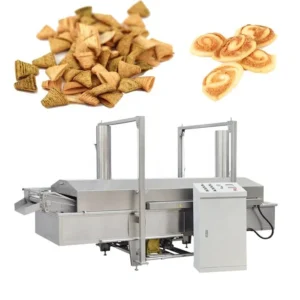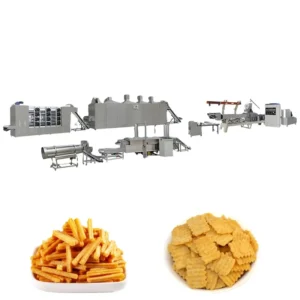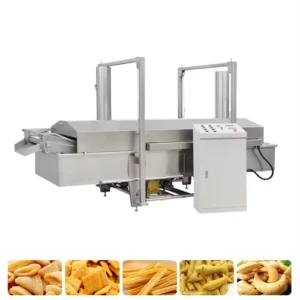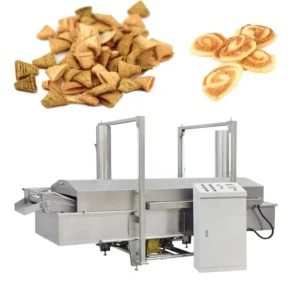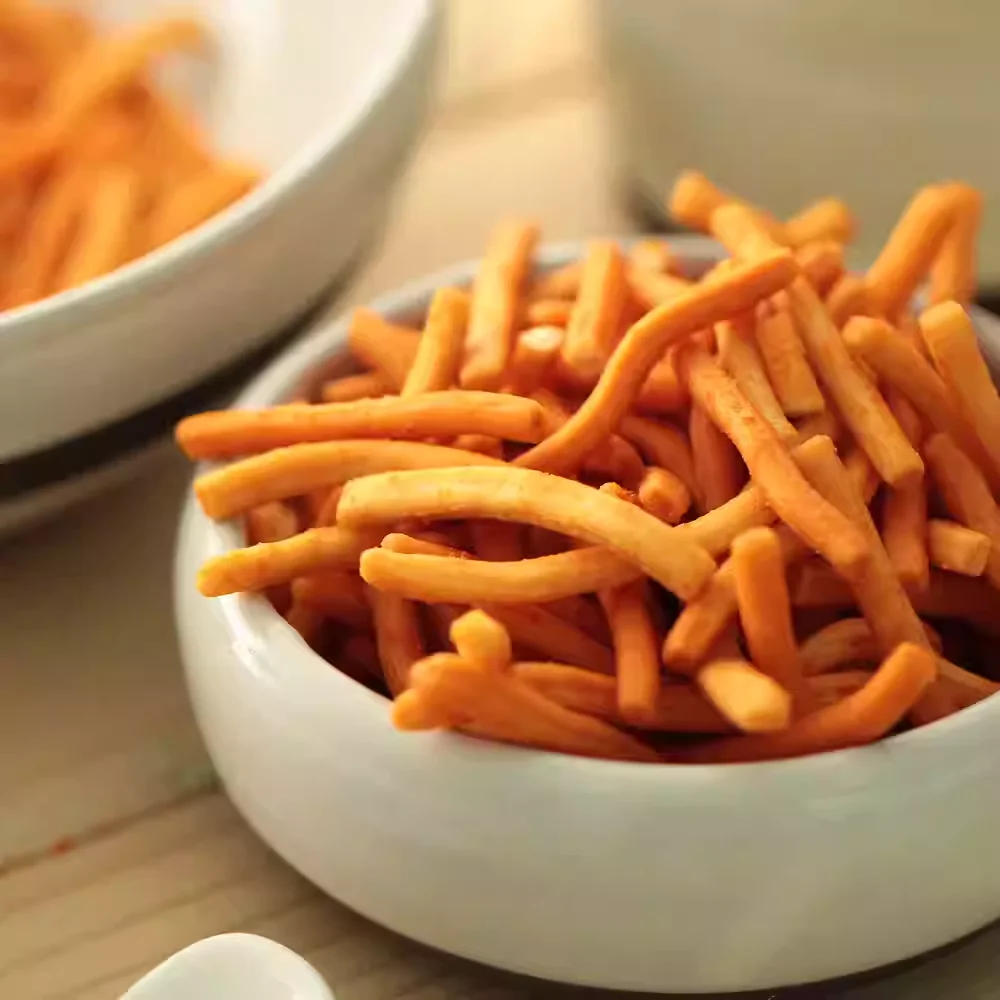


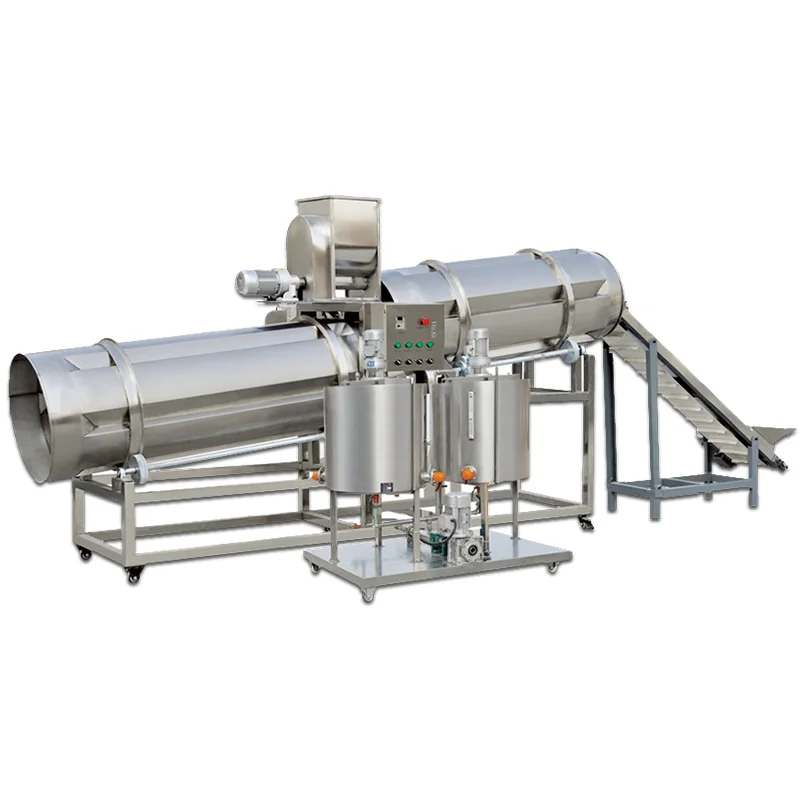
MT delivers matched throughput from batching through packing under one supplier, with in-house trial runs validating fry results on your raw material before shipment.
Description
Integrated Frying Station — Throughput matched across extruder, fryer, and de-oiling stations within one project scope rather than assembled from separate vendors.
Technical Specifications
| Parameter | Value |
|---|---|
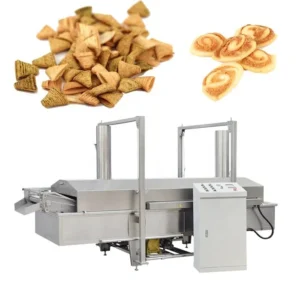
| Product Type | Automatic Continuous Deep Fryer for Snack Food Extrusion Line |
| Power Source | Electric or gas heating (dual option) |
| Heating Tube Power | 60 kW (electric heating variant) |
| Drive Motor Power | 2.6 kW |
| Voltage & Frequency | 380V / 50Hz (configurable for target market) |
| Oil Tank Capacity | 320 L |
| Overall Dimensions (L×W×H) | 6700 × 2200 × 1200 mm |
| Net Weight | 2000 kg |
| Output Capacity | 100–1000 kg/h (basis to be confirmed against product type, moisture and pre-fry density) |
| Control System | PLC |
| Belt Type | Upper and lower double-layer stainless steel mesh belt |
| Speed Control | Frequency conversion stepless speed regulation |
| Oil Filtration | Continuous circulation filtration system |
| Lifting System | Automatic hood and mesh belt lifting |
| Slag Discharge | Bottom slag discharge system |
| Construction Material | Food-grade 304 stainless steel |
| Warranty | 1 year |
Application Suitability
| Application | Material or Output |
|---|---|
| Fried corn chips | Corn masa and corn grits dough formed by upstream extruder |
| Extruded fried snacks | Wheat, rice, corn, and multigrain pellets expanded through twin-screw extrusion |
| Fried pellet chips | 2D and 3D pellet snacks requiring oil frying for final expansion and texture |
| Tortilla chips and taco shells | Corn-based sheeted or extruded dough pieces |
| Integrated snack line upgrading | Replacing batch fryers with continuous frying for consistent throughput |
Why Quoted Fryer Capacity Rarely Survives Contact With Your Actual Raw Material
The fryer must be sized against the extruder’s real output on your specific formulation, not its nameplate rating.
When I helped commission a fried snack line in the Middle East last year, the continuous fryer was rated well above the extruder’s nominal output. The problem was not the fryer itself — it was the material entering it. The customer’s corn flour had a higher fat content than our standard trial material, which meant lower expansion out of the extruder, denser pellets hitting the oil, and longer frying times needed per kilogram. The oil temperature dropped every time a new batch entered, and the belt speed we had calibrated on our trial material was too fast for theirs. We had to recalibrate the entire frying profile on-site, which cost everyone time and product [NEED_CITE: raw material variability in extrusion snack processing].
Sizing an automatic continuous frying machine for snack production line projects demands that someone checks the actual pre-fry density, moisture content, and expansion behaviour of the buyer’s raw material — not just the extruder brochure number.
How Throughput Matching Prevents the Bottleneck Nobody Quoted For
In a turnkey fried snack line, the fryer sits between the extruder-former and the de-oiling and flavouring stations. If the automatic continuous frying machine for snack production line setups runs faster than the de-oiling belt can handle, product piles up, cools unevenly, and absorbs excess oil. If it runs slower than the extruder feeds, the extruder must be throttled back, and the whole line operates below its intended capacity. The layout must specify matched belt speeds, transfer heights, and buffer zones at every handoff point so that throughput holds steady from batching through packing.
Oil Management Across Long Production Runs
Continuous frying degrades edible oil through hydrolysis and oxidation, particularly when moisture-laden extruded snacks enter the tank. The continuous circulation filtration system on this unit removes suspended particles and fines before they carbonise on heating surfaces, which maintains oil quality across extended runs. The bottom slag discharge system works in parallel to pull heavier sediment out of the tank without stopping the belt. For producers running multiple product formats in one shift, the automatic hood and mesh belt lifting allows the tank to be accessed for cleaning between changeovers without manual disassembly [NEED_CITE: edible oil degradation mechanisms in continuous industrial frying].
Reading the Specifications That Actually Matter
The 60 kW heating tube power in the electric variant determines how quickly the oil recovers temperature after each product load enters. A higher thermal recovery rate means less fluctuation at the belt entry point, which matters when frying thin corn chips that require precise oil contact time. The 320 L oil tank capacity sets the volume-to-product ratio; a larger volume relative to throughput holds temperature more steadily but takes longer to heat from cold start. The frequency-controlled belt speed allows frying time to be adjusted continuously — critical when switching between a dense pellet chip that needs a longer fry and a light corn chip that overcooks in seconds. The PLC control stores these profiles so operators recall them by product code rather than re-entering parameters manually each shift. The 380V / 50Hz electrical supply must be confirmed against the buyer’s facility before production begins, as rewiring after installation delays commissioning.
What Happens When the Line Was Not Designed as One System
I have watched snack producers spend weeks troubleshooting a fryer that was technically fine on its own but mismatched to the stations around it. The extruder pushed more product than the fryer belt could carry at the required frying time, so operators sped the belt up to keep pace — and pulled undercooked chips with excess moisture and short shelf life. The downstream de-oiling centrifuge then received product still saturated with surface oil, and the flavouring drum could not distribute seasoning evenly onto oily surfaces. Every station performed to its individual spec sheet, yet the line as a whole could not hold the target output quality. These failures trace back to procurement decisions made station by station instead of as one integrated layout [NEED_CITE: production line integration failures in food processing].
What This Project Scope Actually Includes
Line layout and capacity calculation are completed before the quotation stage, so fryer throughput is matched to the specific extruder model and raw material rather than selected from a catalogue page. Screw configuration and die design on the upstream twin-screw extruder are specified together with frying parameters so that the pellet density entering the oil is known in advance. An in-house testing workshop runs the buyer’s actual raw material through the extruder and fryer before shipment, producing a trial run report that documents belt speed, oil temperature, and frying time for that specific formulation. Pre-sales consultation extends through on-site installation, commissioning, operator training, and ongoing maintenance support. All contact surfaces are food-grade 304 stainless steel, and the unit ships fully assembled as a continuous line station rather than as field-fabricated components.
Documentation & Verification
- Line layout showing fryer position, transfer heights, and throughput match to extruder output
- Trial run report on customer raw material documenting fry time, oil temperature, and product result
- Electrical schematic with confirmed voltage and frequency for the destination facility
- Machine specification sheet covering heating power, tank capacity, and belt dimensions
- Wear parts list covering mesh belt sections, heating elements, and filtration consumables
- CE declaration of conformity and factory test record before dispatch
Installation, Commissioning & Support
- Foundation must support 2000 kg static load across the 6700 × 2200 mm footprint with level tolerance for belt tracking
- Dedicated 380V circuit sized for 60 kW heating load plus 2.6 kW drive motor with confirmed frequency
- Unit ships fully assembled; hood and mesh belt lifting system tested before crating for transport
- PLC commissioning includes product profile entry for frying time and belt speed per snack format
- Operator training covers oil filtration maintenance, slag discharge intervals, and belt tension checks
- Spare mesh belt sections and heating elements shipped with first order; reorder lead time confirmed at quotation
What We Need From Your Side to Start the Layout
Provide the raw material specification you will actually run — including flour type, fat content, and target moisture after extrusion — so the fryer can be sized against real pre-fry density rather than a generic assumption. Share your facility voltage and frequency, available floor space with ceiling height, and whether the fryer connects to an existing line or a new build from batching through packing. If you have a target daily output, tell us the shift pattern so we calculate hourly throughput accordingly.
Frequently Asked Questions
Q: How is frying capacity verified against the extruder’s actual output on a specific raw material?
A: We run the buyer’s raw material through the upstream twin-screw extruder and into the fryer in our testing workshop before shipment. Belt speed, oil temperature, and frying time are documented in a trial run report, so the capacity figure reflects your formulation rather than a generic rating.
Q: What voltage and frequency configurations are confirmed before shipment for the target country?
A: The standard configuration is 380V / 50Hz, but the electrical supply must match the destination facility. We confirm voltage, frequency, and plug standard during the specification stage and reflect it on the electrical schematic before production begins to avoid commissioning delays.
Q: How is the fryer positioned within the full line layout to avoid bottlenecking upstream or downstream stations?
A: The layout specifies transfer heights, belt speed ranges, and buffer zones between the extruder-former, the fryer, and the de-oiling and flavouring stations. Throughput at each handoff point is calculated so no station forces the others to run above or below their intended capacity.
Q: Which spare wear parts are included with first shipment and what is the reorder lead time?
A: The first shipment includes spare mesh belt sections, heating elements, and filtration consumables. Reorder lead times are confirmed during quotation so the buyer can plan maintenance intervals and inventory levels before the line enters regular production.
Related products
-

Nueva línea de producción automática de bocadillos Puff Bugles Precio máquina para hacer chips de maíz máquina de maíz frito alta productividad grande
¥8,570.00 Select options This product has multiple variants. The options may be chosen on the product page -
Puffed Octopus Snack Processing Line – Full-Automatic Fried Octopus Production Machinery
¥65.00 Select options This product has multiple variants. The options may be chosen on the product page -
Máquinas automáticas para la fabricación de snacks crujientes Bugles, extrusora de alimentos Sala a base de harina de trigo.
¥100.00 Select options This product has multiple variants. The options may be chosen on the product page -
Máquina de fabricación de snacks de maíz en polvo con extrusora de doble tornillo, producción de nachos, chips de tortilla y Doritos. Línea de producción de snacks salados.
¥50.00 Select options This product has multiple variants. The options may be chosen on the product page