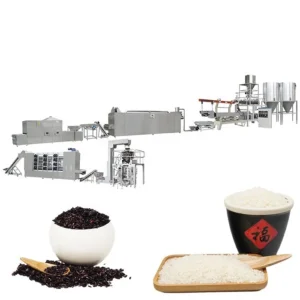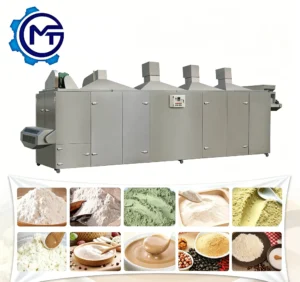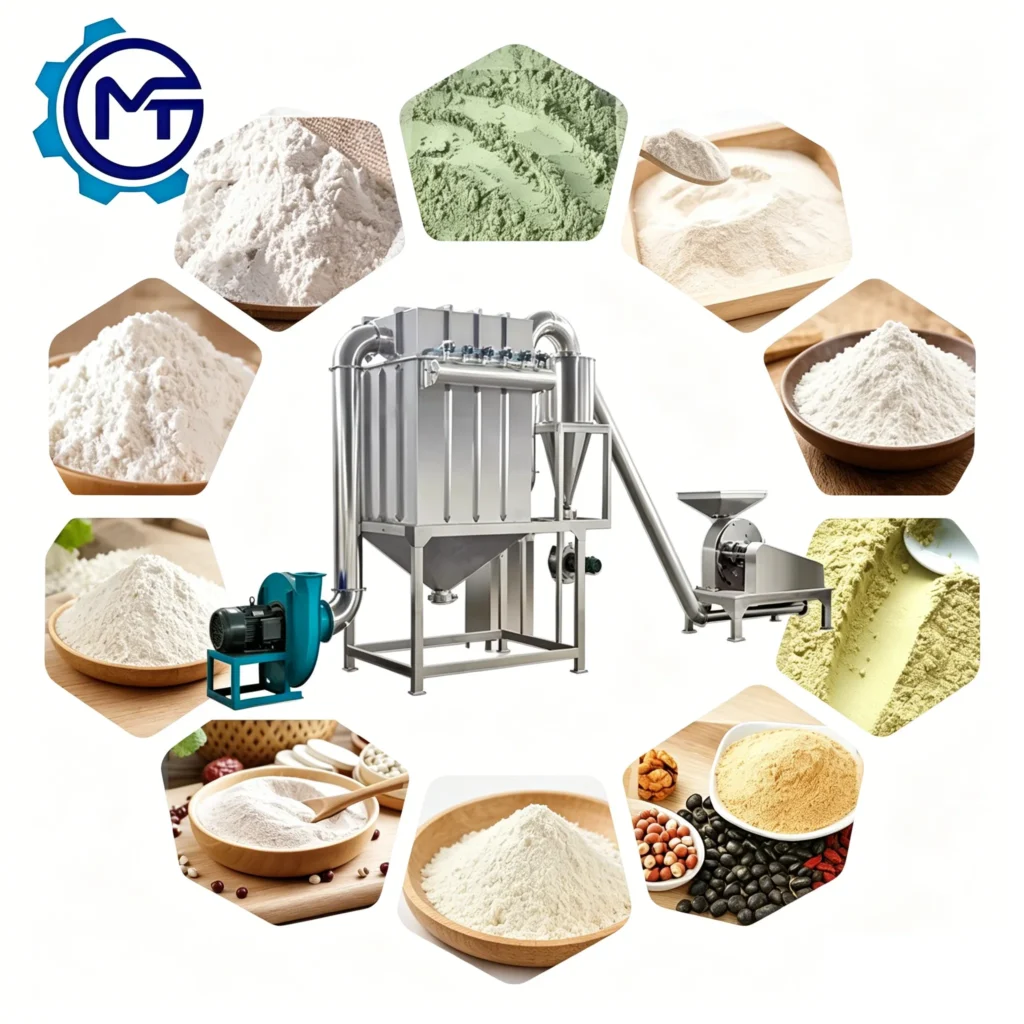

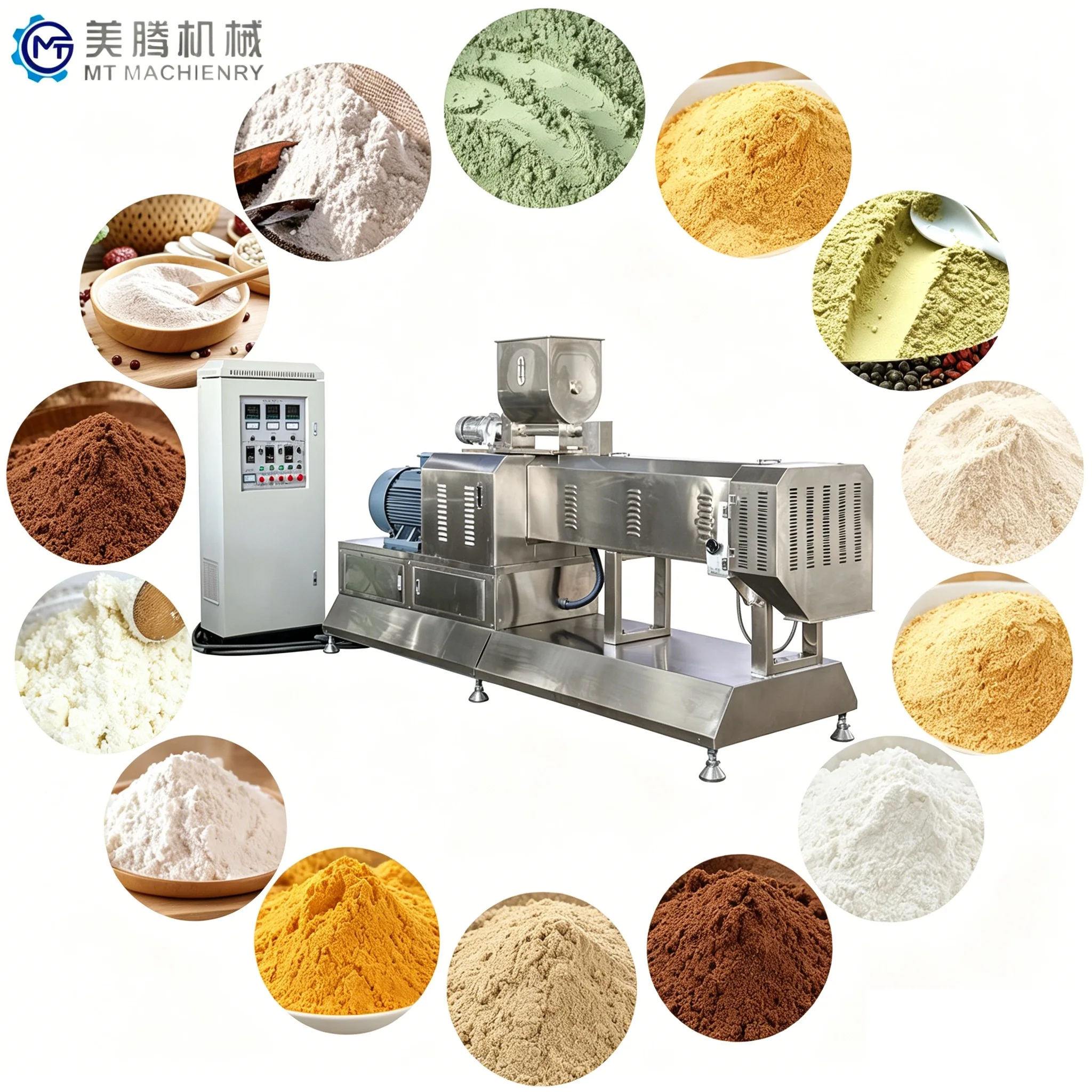
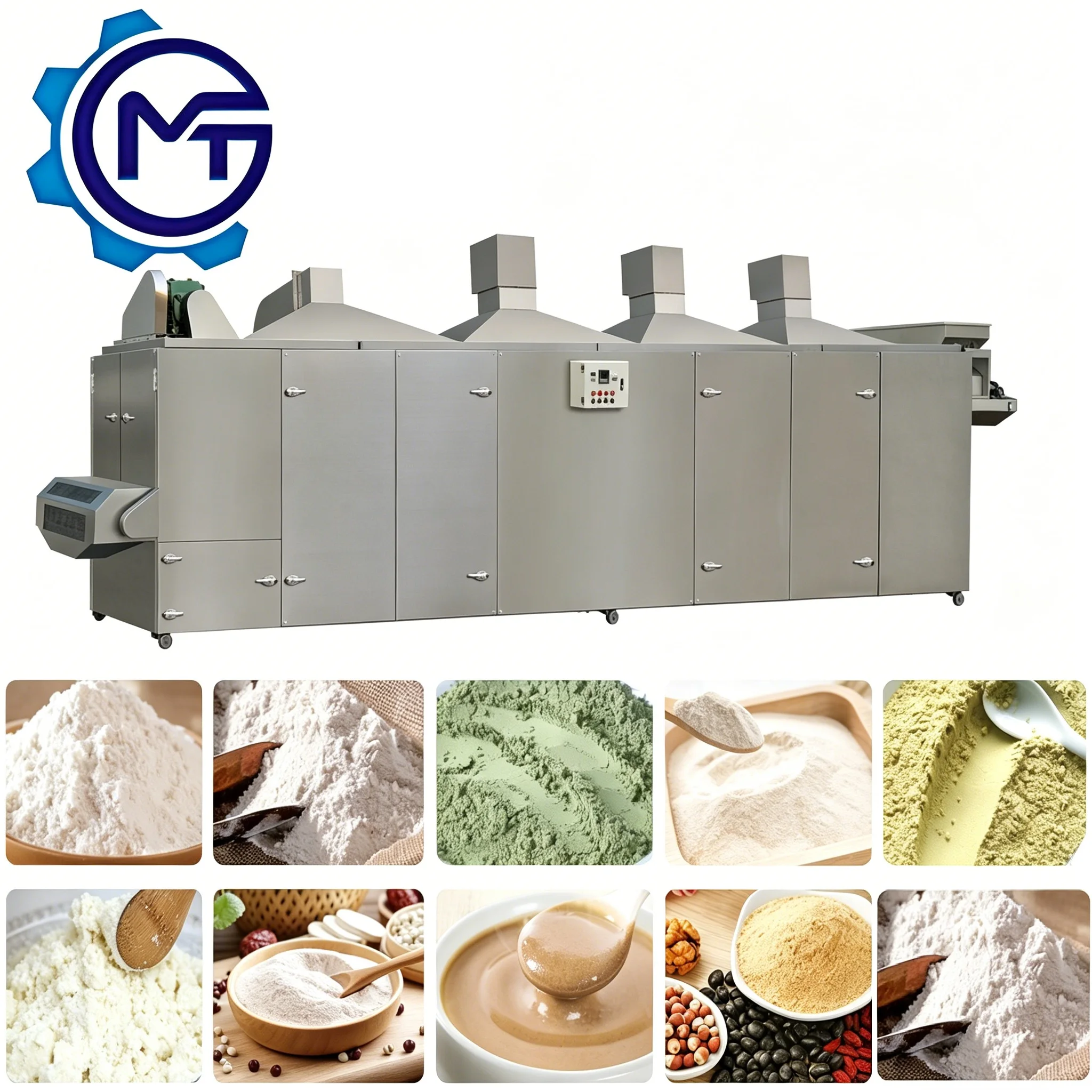


Baby Cereal Nutrition Powder Production Line, 200-500 kg/h, PLC Touch Control, Food-Grade 304 SS — configured as a complete turnkey system from batching through baking to packing, with throughput matched at every station to eliminate bottlenecks. Screw and die design specified to your grain formulation — rice, corn, beans — ensuring consistent texture and nutritional density for infant food applications. Flexible electric, gas, or steam heat source adapts to local utility conditions.
- Pre-shipment trial runs on your raw material verify capacity before installation
- Line layout and electrical schematics confirmed to your factory specifications
- Overseas engineer service available for commissioning and operator training
Description
Integrated Line Engineering — Every station from batching through baking to packing is sized for matched throughput, verified on your grain formulation before the line ships.
Technical Specifications
| Parameter | Value |
|---|---|
| Product Type | Baby Cereal Nutrition Powder Production Line |
| Output Capacity | 200–500 kg/h (basis not stated in source — confirm raw material type, moisture content, and formulation) |
| Control System | PLC with touch control panel and digital system |
| Construction Material | Food-grade 304 stainless steel |
| Heat Source Options | Electric / Gas / Steam |
| Line Stations | Mixing, baking, and additional processing stations |
| Assembly State | Complete production line configuration |
| Warranty | 1 year |
Application Suitability
| Application | Material or Output |
|---|---|
| Infant nutrition powder from grain blends | Rice, corn, beans, and mixed cereals |
| Baby porridge and instant cereal | Formulated grain-based dry mixes |
| Fortified nutrition programme supply | Vitamin- and mineral-enriched cereal powders |
| Weaning food production | Multi-grain blends with optional protein addition |
Why "Rated Capacity" Fails When Your Formula Changes
A baby cereal nutrition powder production line turnkey solution must hold its stated output on the buyer’s actual recipe, not on a reference flour test. When we ran trials for a client last year on standard rice flour, the line performed within expected parameters — but their production formula contained whey protein isolate and trace mineral premix. Gelatinisation temperatures shifted across barrel zones, expansion collapsed in the baking stage, and throughput dropped well below the nominal range.
Every grain formulation behaves differently under heat and shear. A line quoted on one reference material can stall or produce inconsistent density when the buyer switches to a blend with higher fat content, added protein, or different starch ratios. The 200–500 kg/h capacity range listed for this line must be verified against the specific raw material mix, moisture content, and target texture the buyer intends to produce [NEED_CITE: grain formulation effects on gelatinisation and extrusion behaviour]. Without a pre-shipment trial on the actual recipe, capacity remains an estimate rather than a commitment.
Throughput Matching Across Every Processing Station
A turnkey baby cereal nutrition powder production line involves more than the extruder or oven alone. Mixing, baking, conveying, cooling, and packing stations must each handle the same mass flow rate. When equipment is sourced from separate vendors, one station often becomes the constraint — typically the dryer or the cooling conveyor, which cannot keep pace with the baking output. This baby cereal nutrition powder production line turnkey configuration sizes every station to the same throughput target, so material flows continuously without queuing or starvation at any point.
Formula-Specific Trial Runs Before Shipment
The testing workshop allows trial production on the buyer’s actual grain blend before the line leaves the factory. During these runs, screw configuration, barrel temperature profile, and baking parameters are adjusted to match the target product specification — texture, density, moisture content, and nutritional consistency. The trial run report documents the exact settings required, giving the buyer a validated starting point for commissioning rather than forcing product development to begin after installation [NEED_CITE: pre-shipment trial run protocols for food extrusion lines].
Reading the Specifications for Your Production Context
The PLC control system with touch panel allows operators to store and recall recipe parameters, which matters when a facility runs multiple grain formulations across shifts. Consistent batch-to-batch output depends on repeatable temperature and timing control, and digital recipe storage removes the variability of manual adjustment. Food-grade 304 stainless steel construction meets hygiene requirements for infant food manufacturing, where contact surfaces must resist corrosion from cleaning agents and prevent contamination. The heat source options — electric, gas, or steam — allow the line to be configured for local utility availability and cost structure, rather than forcing a single energy type on every installation. Output capacity is listed as 200–500 kg/h, but the actual sustained rate depends on raw material composition and target product density; buyers should treat this as a range to be confirmed through testing.
The Cost of Undersized Supporting Equipment
When a buyer focuses on extruder or oven capacity alone, the downstream stations often cannot match the output. An undersized cooling conveyor forces the line to stop while product accumulates. A dryer that cannot handle the moisture load from baking creates a bottleneck that reduces effective throughput well below the rated extruder capacity. These mismatches are not visible in a spec sheet comparison — they appear only when the line runs under production conditions [NEED_CITE: throughput bottleneck analysis in food processing lines].
Why Procurement Happens Here
The line layout and capacity calculation documents how throughput is balanced across every station, so the buyer sees the engineering basis before ordering. Screw and die configuration records are matched to the target product rather than copied from a generic build. The in-house testing workshop runs the buyer’s actual raw material before shipment, producing a trial report with validated parameters. Electrical schematics include voltage and frequency confirmation aligned to the buyer’s factory supply, preventing commissioning delays. Pre-sales consultation extends through on-site installation, operator training, and ongoing maintenance support.
Documentation & Verification
- Line layout and capacity calculation showing matched throughput across mixing, baking, and packing stations
- Trial run report on buyer’s grain formulation conducted in the testing workshop before dispatch
- Screw and die configuration record specific to target baby cereal product density and texture
- Electrical schematic with voltage and frequency confirmation matched to buyer’s factory supply
- CE declaration of conformity and ISO certificate for the complete line
- Operation and maintenance manual covering all stations from batching through packing
Installation, Commissioning & Support
- Foundation and floor space planning based on the complete line footprint including baking ovens and cooling conveyors
- Power supply verification matching the PLC control system voltage and frequency to local grid specifications
- On-site assembly and station alignment ensuring matched throughput from mixing through packing
- First-run commissioning with parameter setting validated against the pre-shipment trial run report
- Operator training on PLC touch panel recipe management for multiple grain formulations
- Wear parts list with replacement schedule for baking station components and conveyor elements
Preparing Your Inquiry
Share your target product specification — grain blend composition, moisture content, desired texture, and nutritional density requirements. Provide your factory’s available voltage, frequency, and control language preference so the electrical system is configured before production begins. Indicate whether you need a trial run on your raw material in the testing workshop before the line ships.
Frequently Asked Questions
Q: How is the 200–500 kg/h capacity verified on my specific grain formulation?
A: Capacity is confirmed through a trial run on your actual raw material in our testing workshop before shipment. The test records throughput, product density, and texture against your specification, and the results are documented in a trial run report that accompanies the line.
Q: What voltage, frequency, and control language options are confirmed before shipment?
A: Electrical schematics are prepared with your factory’s voltage and frequency requirements confirmed in writing before production begins. The PLC touch panel can be configured in the operator’s preferred language, and all control documentation matches the selected language.
Q: How is throughput balanced between mixing, baking, and packing stations to avoid bottlenecks?
A: Every station is sized based on the same target throughput during the line layout and capacity calculation phase. The engineering documents show the mass flow rate at each station, so no single unit constrains the overall line output.
Q: Can a trial run be performed on my raw material before the line ships?
A: Yes. The in-house testing workshop runs your grain formulation through the line configuration before dispatch. Temperature profiles, screw settings, and baking parameters are adjusted during the trial, and the validated settings are recorded for commissioning.
Q: What spare wear parts are included, and how are replacements sourced after installation?
A: A wear parts list identifies components subject to normal wear in baking and conveying stations. Initial spares ship with the line, and replacement parts remain available through ongoing maintenance support with lead times confirmed at the time of order.
Related products
-
Máquina extrusora automática de alimentos para bebés controlada por PLC de 500 kg/h para el procesamiento de cereales de arroz
¥9,500.00 Add to cart -

Línea de producción de procesamiento de papilla en polvo de nutrición completa para bebés completamente automática para fábrica de nutrición infantil
¥9,500.00 Add to cart -

Línea de Producción Automática Instantánea de Polvo Máquina Extrusora de Polvo Nutricional
¥10,000.00 Select options This product has multiple variants. The options may be chosen on the product page -
Línea de producción de alimentos para bebés en polvo de nutrición fortificada totalmente automática
¥8,238.27 Select options This product has multiple variants. The options may be chosen on the product page