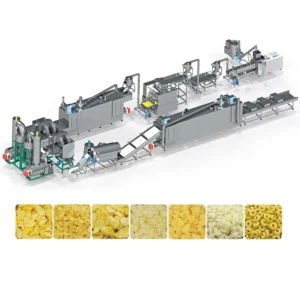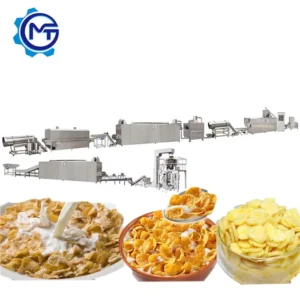
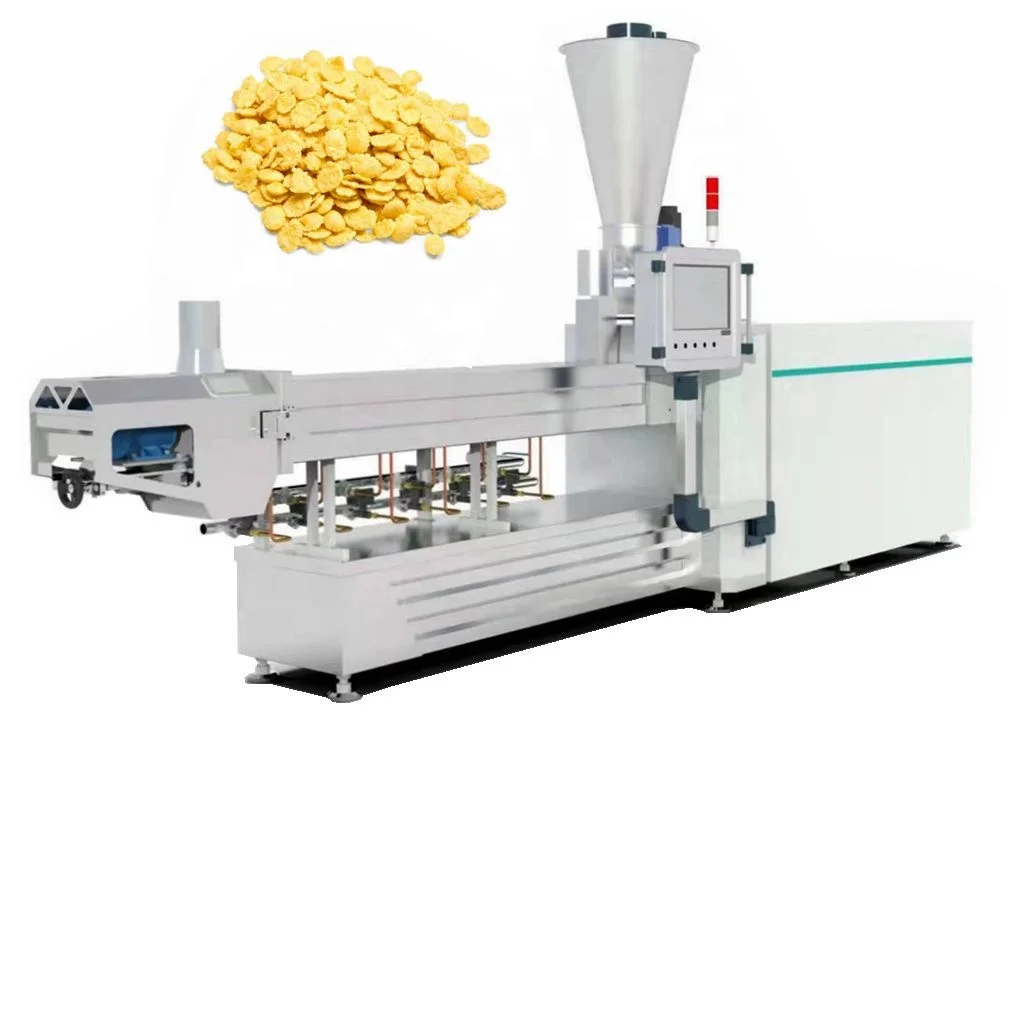
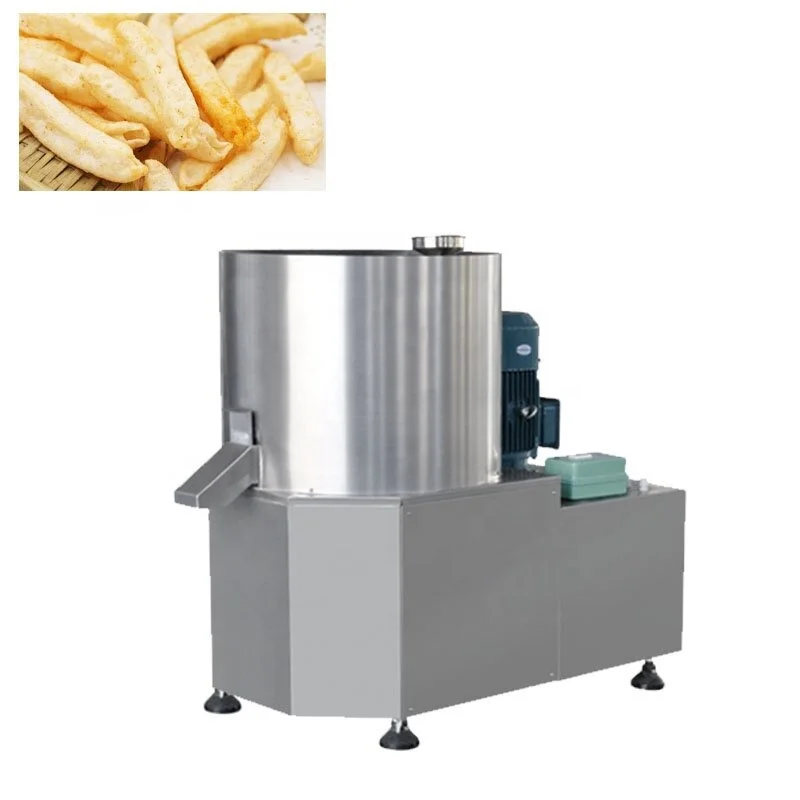
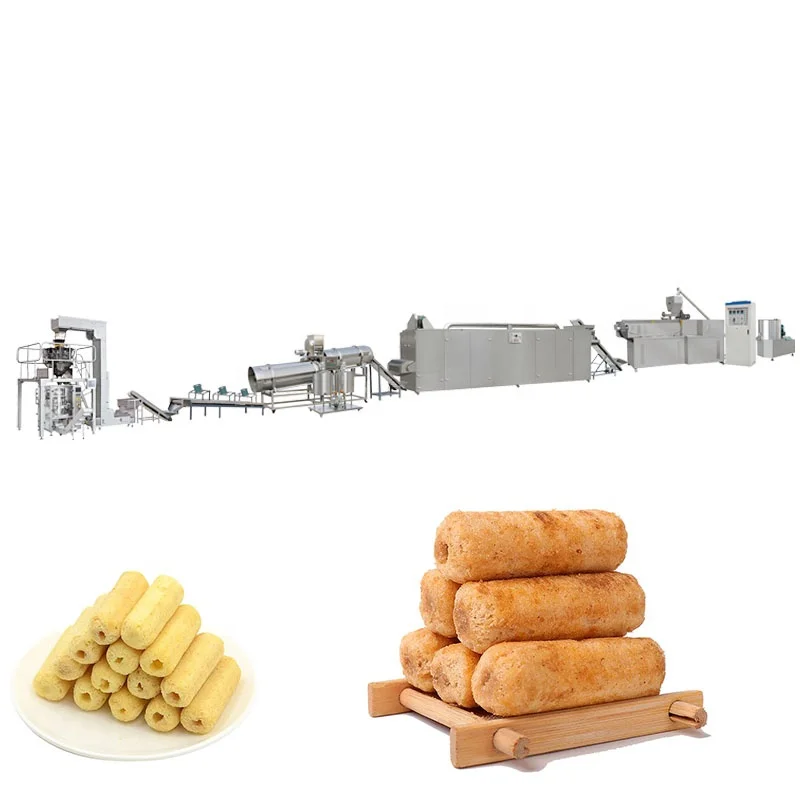
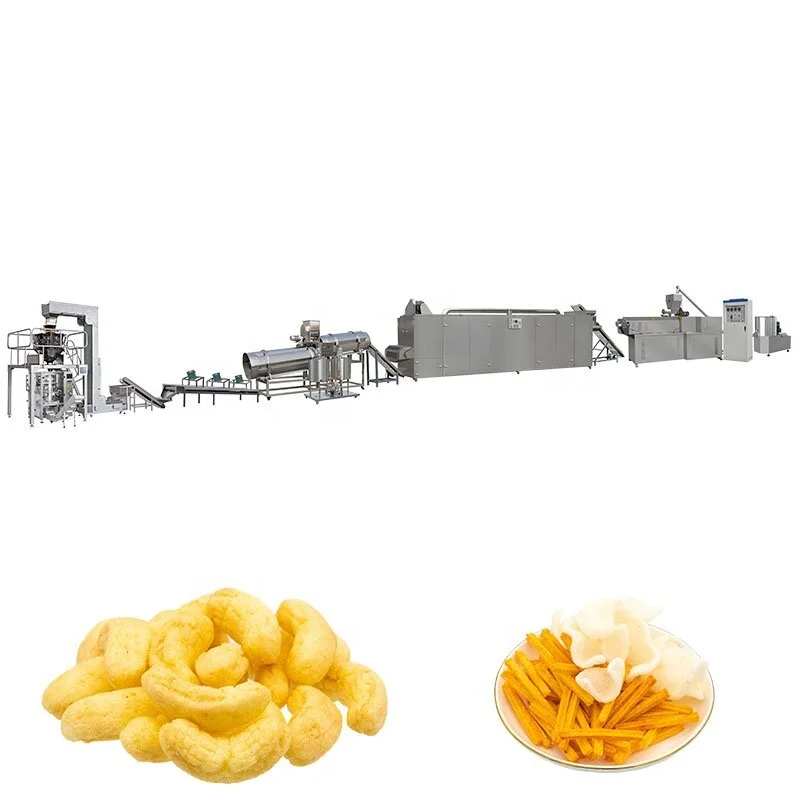
MT70 / MT85 / MT75 Corn Flakes Production Line, Twin-Screw Extruder, PLC Control — engineered as a complete turnkey project from mixing through flaking, hot air roasting and packing.
Screw configuration and die design are matched to your cereal blend, moisture content and target flake density, ensuring uniform expansion and consistent crispness across natural or sugar-coated variants.
- Hydraulic flaking with infrared temperature control
- Hot air roasting with dual circulating fans and cyclone dust removal
- Throughput balanced across every station to prevent bottlenecks
Line layout, capacity calculation and trial run on your raw material are completed in our testing workshop before shipment.
Description
Throughput-matched turnkey design — every station from mixing to packing is sized as one project so the extruder output never overwhelms the flaker or dryer downstream.
Technical Specifications
| Parameter | Value |
|---|---|
| Product Type | Corn Flakes & Breakfast Cereal Extrusion Production Line |
| Models Available | MT70, MT85, MT75 |
| Extruder Type | Twin Screw |
| Screw Configuration | Configured to raw material and target product |
| Control System | PLC control (flaking machinery); MCC and PLC control (line-wide) |
| Installed Power (MT70) | 160 kW |
| Installed Power (MT85) | 190 kW |
| Installed Power (MT75) | 210 kW |
| Power Consumption (MT70) | 120 kW |
| Power Consumption (MT85) | 140 kW |
| Power Consumption (MT75) | 150 kW |
| Capacity (MT70) | 150–200 kg/h (basis not stated in source — confirm raw material and moisture content) |
| Capacity (MT85) | 300–400 kg/h (basis not stated in source — confirm raw material and moisture content) |
| Capacity (MT75) | 300–500 kg/h (basis not stated in source — confirm raw material and moisture content) |
| Overall Dimensions (MT70) | 41 × 1.5 × 2.2 m |
| Overall Dimensions (MT85) | 43 × 1.5 × 3.2 m |
| Overall Dimensions (MT75) | 45 × 1.5 × 3.5 m |
| Dryer Heating Source | Gas or Electric |
| Flaking Machinery | Hydraulic double-roller system; double motors for separate roller driving; infrared sensor temperature control |
| Roasting Oven | Hot air roasting with conciliation burner; two separate circulating fans; cyclone dust removal device; vibrating pan with high-temperature spraying tubes |
| Coating System | Double tumble for sugar melting, elevator, coating drum, spraying nozzle |
| Die Configuration | Interchangeable moulds (ball, tube, stick, ring, fruit loop, star, wheel, flower, heart) |
| Lubrication | Automatic lubricating system |
| Screw Material | Wear-resistant, special technology |
| Standards | CE, ISO |
Application Suitability
| Application | Material or Output |
|---|---|
| Natural corn flakes | Corn grits or corn flour, toasted without sugar coating |
| Sugar-coated corn flakes | Corn base with sugar syrup coating and secondary drying |
| Shaped breakfast cereals | Corn, rice, wheat, oat, barley blends extruded through interchangeable dies |
| Instant porridge | Pre-gelatinised cereal blends for hot-water reconstitution |
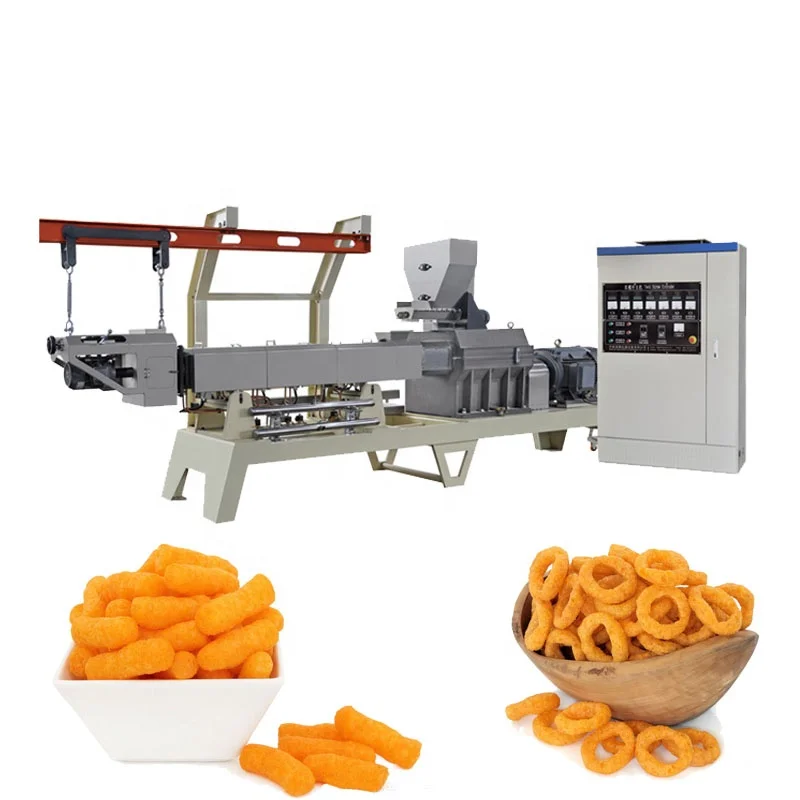
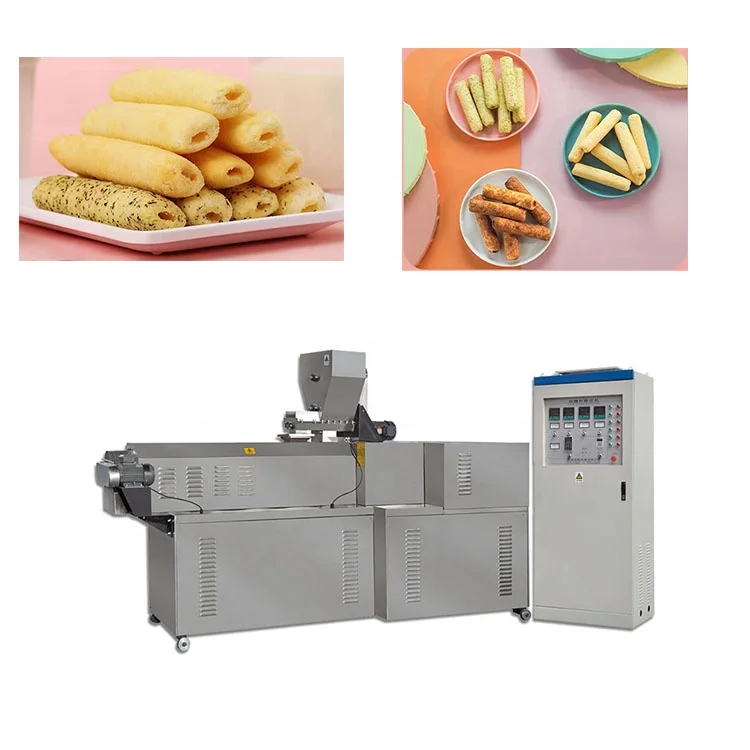
| Puffed snack shapes | Die changes on the same extrusion platform for rings, loops, balls and stars |
What "Nominal Capacity" Hides on a Corn Flakes Line
A capacity figure means nothing until it is tied to the buyer’s actual cereal blend and target flake moisture.
I spent two weeks on a factory floor in Southeast Asia because the corn flakes extrusion line ran perfectly on standard corn flour during the factory test, then choked on the local high-fibre coarse corn grits the buyer actually used. The extruder pushed material through, but the flakes came out hard and could not be pressed flat on the roller mill. The whole first batch was scrapped. That corn flakes production line turnkey project only started working after we rebuilt the screw combination and die from scratch to match the local grain [NEED_CITE: raw material variability in cereal extrusion]. A number on a quotation sheet will not save you from that kind of downtime.
Layout, Throughput and the Single-Source Advantage
When the extruder, flaker, dryer, roasting oven and coating drum all come from one engineering team, the throughput at each station is calculated against the others before metal is cut. A corn flakes production line turnkey project built this way avoids the familiar problem where the extruder pushes more volume than the flaker can flatten, leaving wet pellets piling up on the conveyor. The line-wide MCC and PLC control keeps every section talking to the same logic, so a speed adjustment on the extruder automatically propagates to the dryer belt speed and the roasting oven residence time.
Phased Installation Without Finger-Pointing
A full breakfast cereal line arrives in sections — mixing and batching, extrusion, flaking, drying, roasting, coating, cooling, packing. When one supplier engineers every section, the phased installation schedule accounts for utility rough-ins, floor loading, and the sequence in which each station must be commissioned. If the roasting oven gas supply is not ready when the extruder starts running trial material, the entire timeline shifts. Having one project team responsible for that schedule means there is no gap between the mechanical contractor and the electrical integrator to argue over [NEED_CITE: industrial line commissioning sequencing].
Reading the Spec Sheet for Real-World Impact
The twin-screw extruder across all three models uses a screw configuration matched to the buyer’s cereal blend rather than a generic build. This matters because corn, rice and oat flours gelatinise at different moisture and temperature points; a screw profile that works for corn will undercook oat and leave hard centres in the flake. The hydraulic double-roller flaking machinery uses infrared sensor temperature control to keep the roller surface within a tight band — too cold and the pellet shatters, too hot and it sticks and tears. Installed power ranges from 160 kW on the MT70 to 210 kW on the MT75, and the line-wide power consumption figures (120 kW to 150 kW) reflect the total draw including dryer and roasting oven. The hot air roasting oven uses a conciliation burner with two circulating fans and a cyclone dust removal device, which keeps fine cereal dust from settling back onto the flakes and affecting surface colour.
The Hidden Cost of a Mismatched Die or Dryer
When the die is copied from a generic catalogue rather than matched to the target flake density, the extruded pellet exits at the wrong expansion ratio. Flakes that are too dense sink in milk and fail consumer expectations; flakes that are too thin shatter during the roasting stage and create excessive fines. A dryer that is undersized relative to the extruder output forces the line to slow down, meaning the corn flakes production line turnkey project never reaches the throughput the buyer paid for. I have seen coating drums added as an afterthought, with no elevator or tumble system sized for the upstream volume, leaving operators shovelling material by hand between stations [NEED_CITE: downstream bottleneck in extrusion lines].
Why This Line Is Engineered as One Project
Every station is designed under a single supplier, so throughput is balanced from the batching system through to the packing conveyor rather than assembled from separate vendors who each guarantee only their own machine. The in-house testing workshop runs trial production on the buyer’s actual cereal blend before shipment, producing a trial run report that records screw configuration, die selection, moisture content and flake density. Voltage, frequency and control language are confirmed before production begins, so the PLC interface speaks the operator’s language on day one. Screw and die configuration records are specific to the buyer’s product, not pulled from a generic library. CE and ISO standards are met across the complete line.
Documentation & Verification
- Line layout and capacity calculation matched to your factory footprint and utility plan
- Trial run report on your specific cereal blend recorded before shipment
- Screw and die configuration document tied to your target flake shape and density
- Electrical schematic with voltage, frequency and control language confirmed pre-production
- CE declaration of conformity and ISO certificate for the complete line
- Operation and maintenance manual with wear parts list for extruder screws, dies and flaker rollers
Installation, Commissioning & Support
- Floor plan review against the MT70 (41 m), MT85 (43 m) or MT75 (45 m) line footprint to confirm utility drop points
- Dedicated electrical circuit sized to the selected model’s installed power, from 160 kW to 210 kW
- Section-by-section mechanical assembly with throughput verification at each station before full-line run
- PLC parameter setting and MCC commissioning on the buyer’s actual raw material during the first production shift
- Operator training covering screw changes, die swaps and flaker roller gap adjustment
- Wear parts supply covering twin-screw segments, interchangeable dies and flaker roller surfaces
What to Prepare Before Requesting a Quotation
To size a corn flakes production line turnkey project correctly, share your target cereal blend (corn, rice, oat, barley or a mix), the form of raw material you source locally (flour, grits, coarse meal), and the moisture range you typically receive. Confirm your factory voltage, frequency and available gas supply for the dryer and roasting oven. Specify whether you plan to run natural flakes, sugar-coated variants, or both, and list any die shapes you need beyond standard flakes. If you want a trial run on your material before shipment, send a representative sample to the testing workshop early in the project timeline.
Frequently Asked Questions
Q: How is line capacity verified against my specific cereal raw material and moisture content?
A: Capacity figures on the spec sheet are reference points. Before the quotation is finalised, we request a sample of your actual cereal blend and run it through the extruder and flaker in our testing workshop. The trial run report records throughput, moisture, flake thickness and density, so the capacity you sign off on reflects your material, not a generic benchmark.
Q: How are throughput rates matched between extruder, flaker, dryer and coating drum?
A: Each station is engineered as part of one line rather than sourced separately. The extruder output rate is calculated first, then the flaker roller speed, dryer belt length, roasting oven residence time and coating drum volume are sized to that rate. This prevents the common bottleneck where one section forces the entire line to slow down.
Q: What utility planning is required and how is it confirmed before production?
A: We confirm your local voltage, frequency, gas supply pressure and compressed air availability before the electrical schematic is finalised. The PLC and MCC control panels are built to those specifications, and the gas or electric dryer heating source is selected to match your facility. This avoids rewiring and re-piping after the line arrives on site.
Q: How does the phased installation and commissioning schedule work?
A: The line is installed section by section — mixing, extrusion, flaking, drying, roasting, coating, cooling, packing. Each section is mechanically assembled and utility-connected before the next begins. Commissioning follows the same sequence, with parameter setting on your raw material at each stage, leading to a full-line continuous run before handover.
Q: What operator training and spare wear parts support is included?
A: Training covers daily operation, screw and die changes, flaker roller gap adjustment and PLC parameter access. A wear parts list is supplied with the line, covering twin-screw segments, interchangeable dies and flaker roller surfaces. Replacement parts are available for reorder, and maintenance intervals are documented in the operation manual.
Related products
-
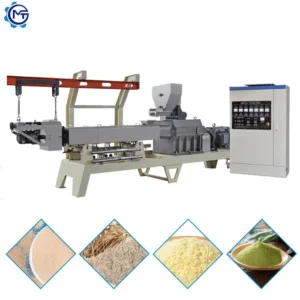
Nueva máquina para hacer comida para bebés en polvo nutricional de cereales instantáneos automática técnica
¥10,000.00 Select options This product has multiple variants. The options may be chosen on the product page -
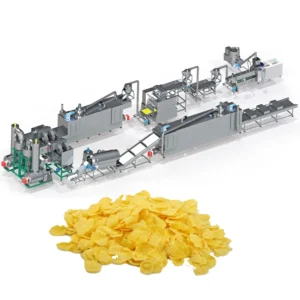
New High Efficiency Electric Corn Flakes Production & Manufacturing Machine
¥7,500.00 Select options This product has multiple variants. The options may be chosen on the product page -
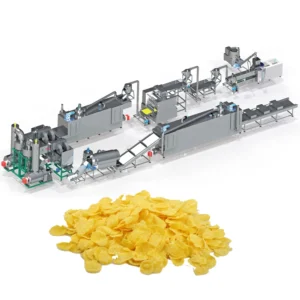
Línea de Producción de Copos de Maíz Inteligente Extrusora de Doble Tornillo para Hacer Copos de Maíz y Cereales de Mañana
¥30.00 Select options This product has multiple variants. The options may be chosen on the product page -
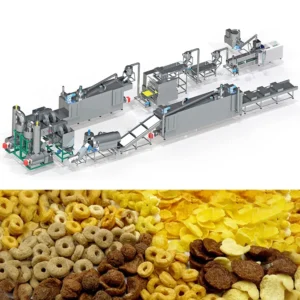
Máquina automática para la fabricación de cereales de desayuno instantáneos y alimentos para bocadillos
¥10,000.00 Select options This product has multiple variants. The options may be chosen on the product page