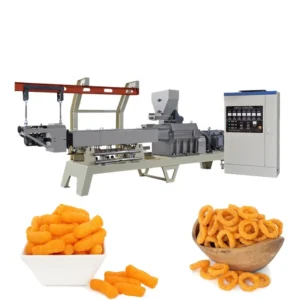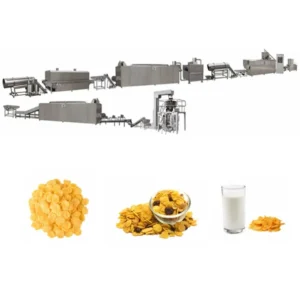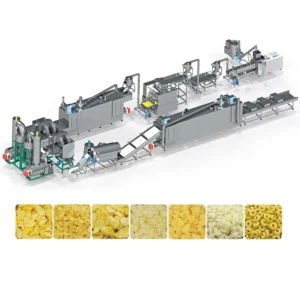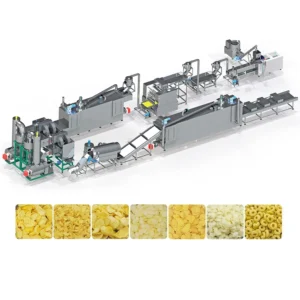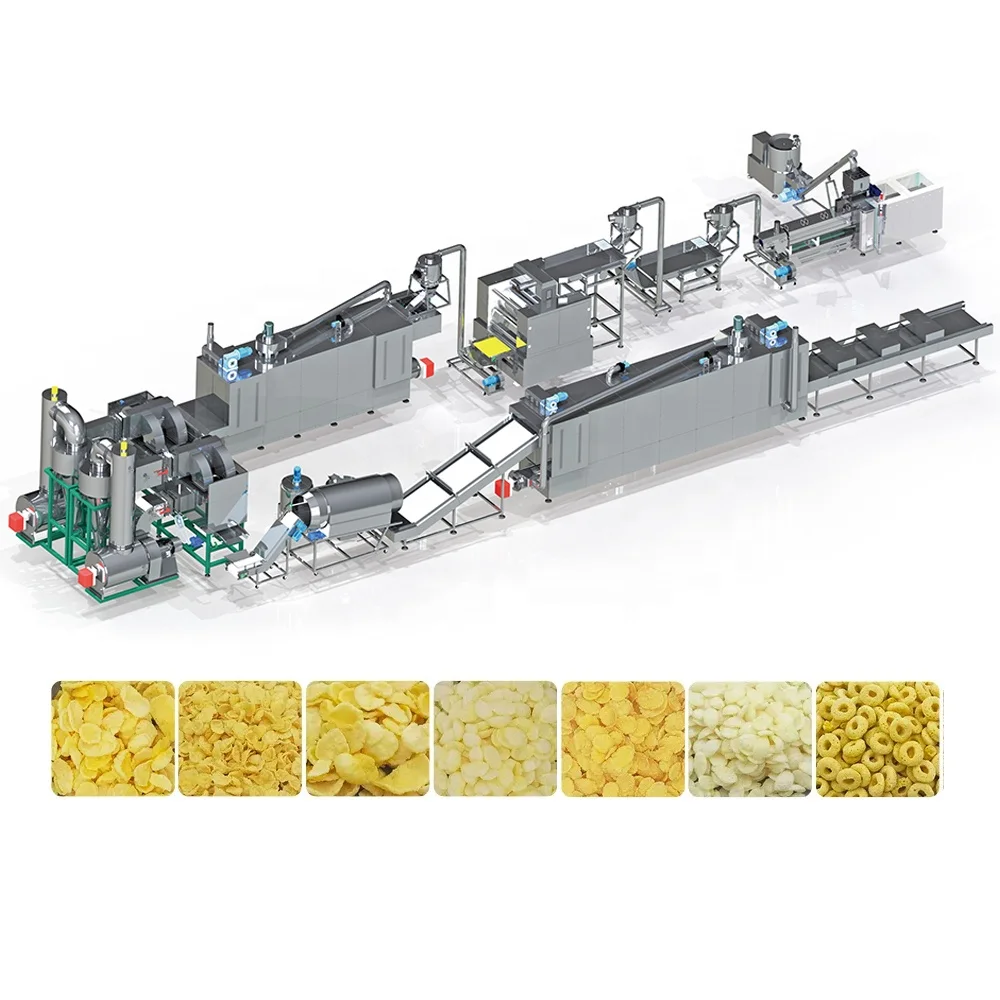
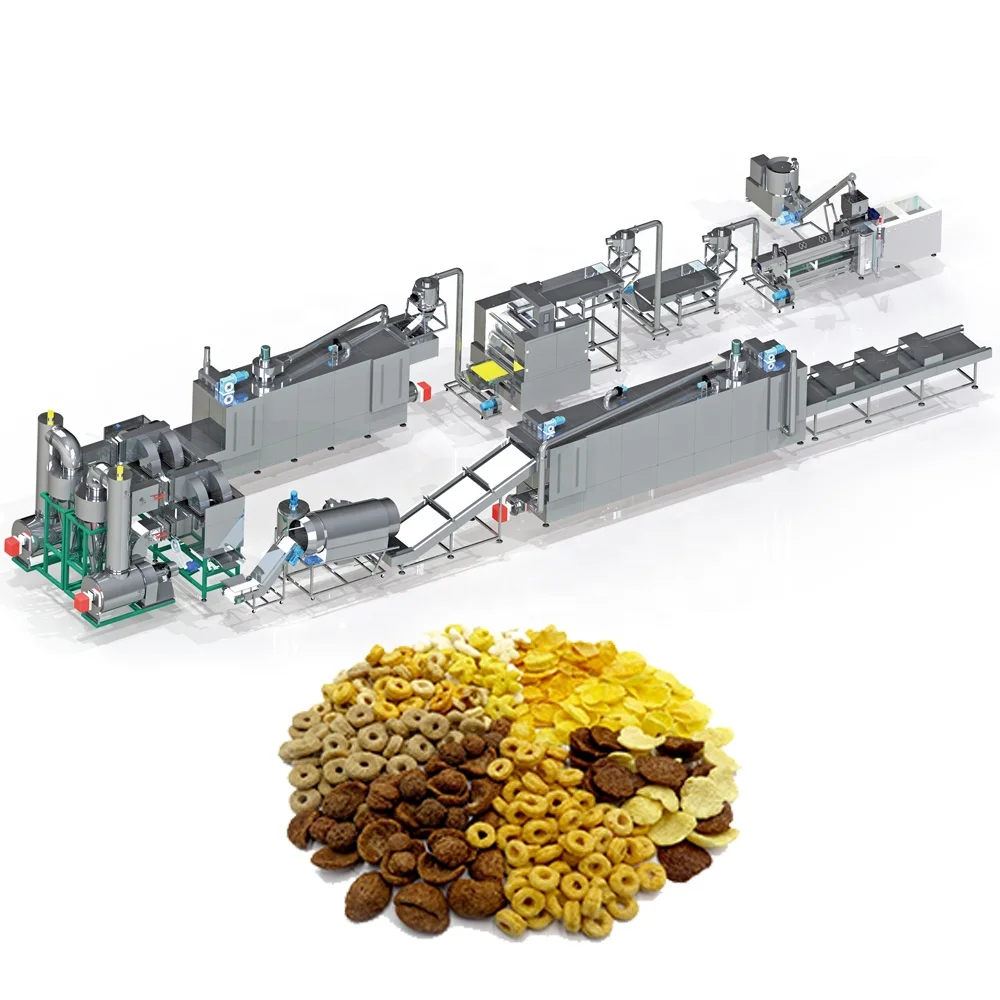
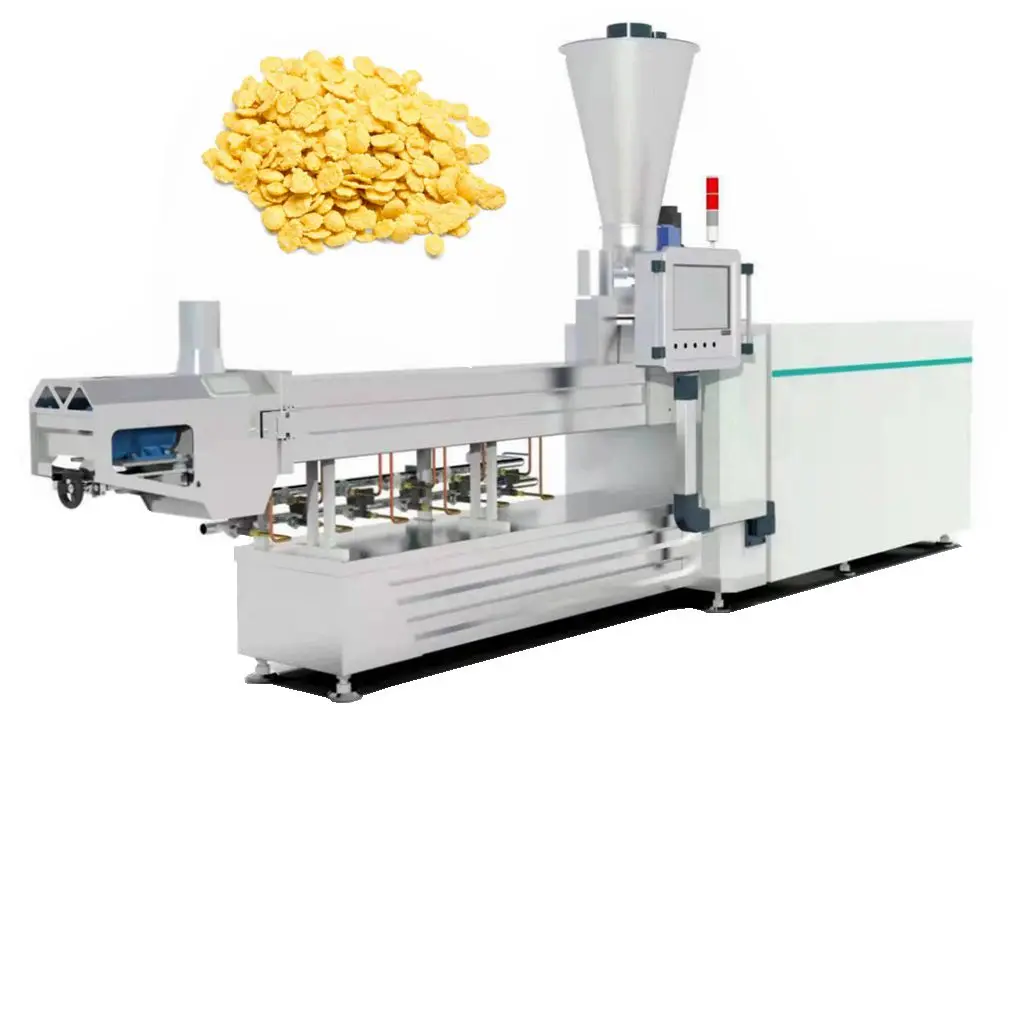
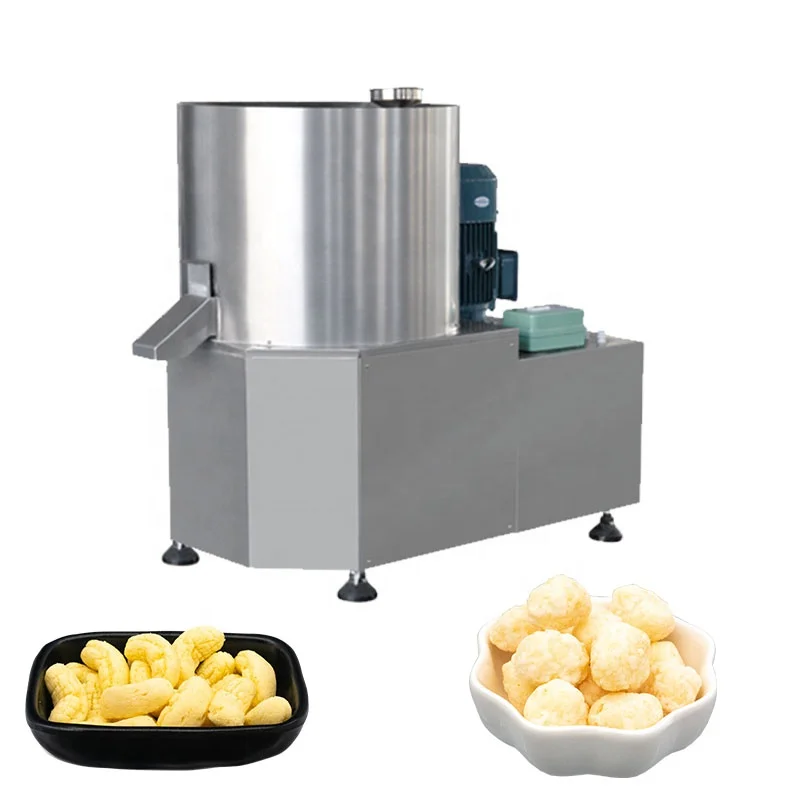
MT70 / MT85 / MT75 Corn Flakes Breakfast Cereal Production Line, Twin-Screw Extrusion, PLC-Controlled Flaking — engineered as a complete turnkey system from mixing through extrusion, flaking, drying, roasting, coating to packing.
- Screw configuration and die design matched to your corn, rice, wheat, oat, or barley blend for target flake density and texture
- Hydraulic double-roller flaking with infrared temperature control ensures consistent flake thickness
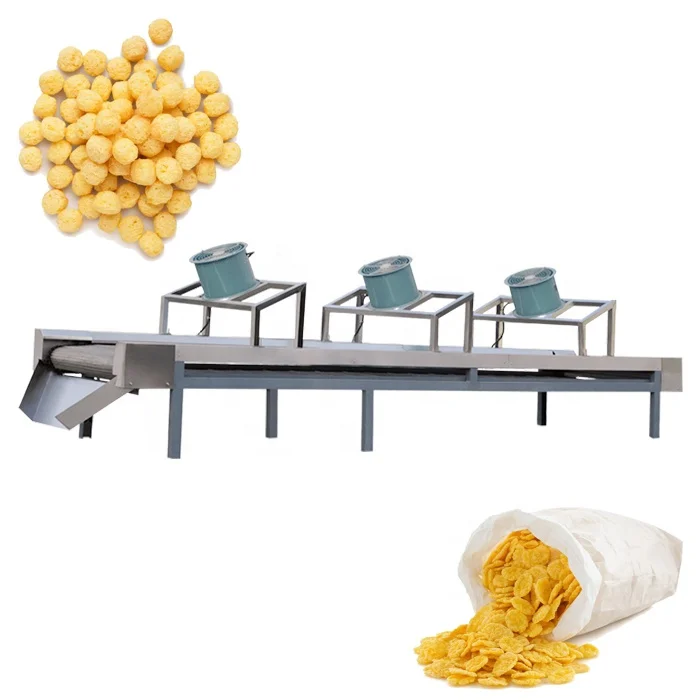
- Hot air roasting oven with dual circulating fans and cyclone dust removal delivers uniform surface bubbling and crispness
- Every station throughput-matched under one supplier to eliminate bottlenecks
Backed by in-house trial runs on your actual raw material before shipment, with full line layout customized to your factory footprint.
Description
Integrated Turnkey Engineering — Every station from batching to packing is throughput-matched under one supplier, preventing the flaker or roaster from bottlenecking the extruder on your corn flakes line.
Technical Specifications
| Parameter | Value |
|---|---|
| Product Type | Corn Flakes Breakfast Cereal Production Line |
| Model | MT70 / MT85 / MT75 |
| Extruder Type | Twin Screw |
| Installed Power | 160 kW (MT70) / 190 kW (MT85) / 210 kW (MT75) |
| Power Consumption | 120 kW (MT70) / 140 kW (MT85) / 150 kW (MT75) |
| Capacity | 150–200 kg/h (MT70) / 300–400 kg/h (MT85) / 300–500 kg/h (MT75) (basis to be confirmed) |
| Overall Dimensions | 41 × 1.5 × 2.2 m (MT70) / 43 × 1.5 × 3.2 m (MT85) / 45 × 1.5 × 3.5 m (MT75) |
| Control System | PLC for flaking machine; MCC and PLC for complete line |
| Raw Materials | Corn, rice, wheat, oat, barley powder |
| Dryer Heating Source | Gas or Electric |
| Certifications | CE, ISO |
Application Suitability
| Application | Material or Output |
|---|---|
| Natural breakfast cereal production | Corn, rice, and blended grain grits processed into plain toasted flakes |
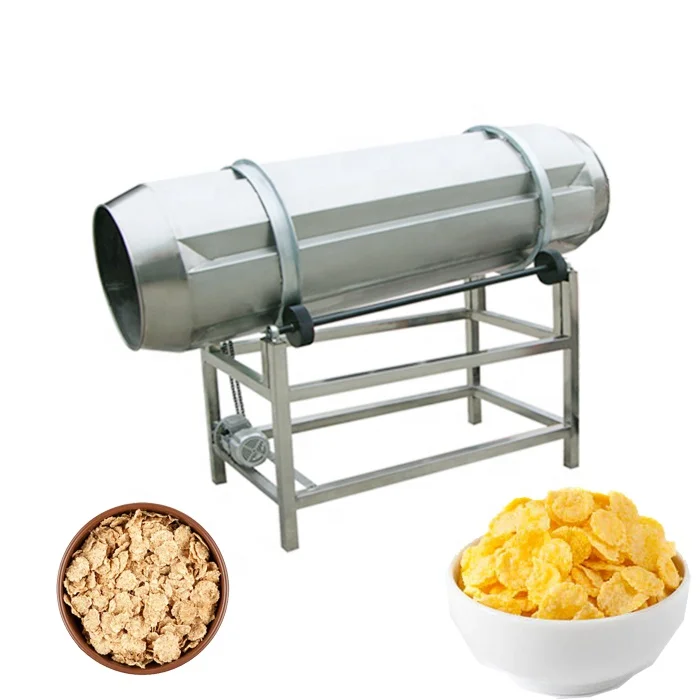
| Sugar-coated corn flakes manufacturing | Extruded corn pellets flaked, roasted, and coated with sugar syrup for retail packaging |
| Multi-shape cereal diversification | Same extrusion platform producing rings, balls, stars, and fruit loops by changing die plates |
| Fortified nutrition programme supply | Vitamin-enriched corn and oat blends processed into institutional breakfast cereal |
What "Nominal Line Capacity" Leaves Out on a Corn Flakes Project
A quoted throughput figure means nothing if the flaker, dryer, or roaster cannot keep pace with the extruder on your specific grain blend.
When buyers evaluate a corn flakes production line turnkey proposal, the extruder output often dominates the conversation. But a twin-screw extruder pushing corn dough at a rated volume will stall if the downstream flaking rollers cannot compress it fast enough, or if the hot air roaster lacks the residence time to achieve proper crispness. I have walked through facilities where the extruder ran at partial load because the roaster created a backlog, turning an otherwise capable line into a bottlenecked system [NEED_CITE: throughput matching across sequential food processing stations]. The real capacity of a corn flakes production line turnkey system is determined by its slowest station, not its fastest.
Screw Configuration and Die Design for Grain Gelatinisation
The twin-screw extruder in this corn flakes production line turnkey system is configured with screw elements and die geometry matched to the buyer’s raw material. Corn grits, rice flour, and oat blends each demand different shear profiles and barrel temperature zones to achieve full starch gelatinisation without over-cooking the dough mass before it reaches the flaking stage.
Hydraulic Flaking with Infrared Temperature Control
Consistent flake thickness depends on roller pressure, gap precision, and dough temperature at the point of compression. The flaking machine uses a hydraulic system driving double rollers independently, with an infrared sensor monitoring surface temperature to maintain the dough in the correct plasticity window. This prevents the flakes from cracking under excessive pressure or remaining too thick to roast evenly.
Reading the Power and Dimension Data Across Models
The three extruder models span different installed power levels from 160 kW to 210 kW, with corresponding power consumption figures that reflect actual energy draw during continuous operation. The overall line length ranges from 41 to 45 metres, which directly affects factory layout planning. The PLC control on the flaking machine and MCC integration across the full line allow operators to coordinate extruder feed rate with flaker speed and roaster temperature from a single interface, maintaining batch consistency across long production runs [NEED_CITE: PLC and MCC control integration in food extrusion lines]. Dryer heating is available in gas or electric configurations, letting buyers match local utility costs and availability.
The Hidden Cost of Mismatched Downstream Equipment
When the dryer or roaster capacity falls short of extruder output, the line accumulates semi-finished product that cools below the temperature required for proper flaking. Operators then slow the extruder to match, running it below its designed throughput and altering the residence time inside the barrel. This shifts the gelatinisation degree and produces flakes with inconsistent texture — some too dense, some too brittle — which the market rejects [NEED_CITE: effect of residence time variation on starch gelatinisation in twin screw extrusion]. The damage is not just lost volume but lost product quality that erodes buyer confidence.
Why Source the Complete Line from One Supplier
The entire corn flakes production line turnkey system — mixing, extruding, flaking, drying, roasting, sugar coating, cooling, and packing — is engineered under one supplier so that throughput calculations account for every station rather than treating each machine as an isolated purchase. Screw configuration and die design are specified to the buyer’s actual grain recipe, not copied from a generic template. The in-house testing workshop runs the buyer’s raw material before shipment, validating flake density and roasting behaviour rather than leaving product development to the installation phase. Pre-sales engineering covers line layout adapted to the factory footprint, and on-site commissioning includes operator training on the PLC and MCC control systems. Wear parts such as screws, dies, and flaking roller surfaces are documented and stocked for scheduled replacement.
Documentation & Verification
- Line layout and capacity calculation showing throughput matching across extruder, flaker, dryer, and roaster
- Screw and die configuration record tied to your corn or multi-grain recipe
- Trial run report on your raw material confirming flake thickness and roasting outcome before dispatch
- Electrical schematic with voltage and frequency confirmation for your facility
- CE declaration of conformity and ISO certificate for import clearance
- Wear parts list covering screws, dies, and flaking roller components
Installation, Commissioning & Support
- Factory floor requires 41 to 45 metres of linear space depending on the selected model configuration
- Dedicated power circuit sized to 160–210 kW installed capacity with confirmed voltage and frequency
- Line arrives in sectional assemblies for sequential installation from mixer through packing station
- Commissioning includes PLC and MCC parameter setup matched to your grain recipe and target flake density
- Operator training covers extruder screw speed, flaker hydraulic pressure, and roaster temperature profiles
- Scheduled replacement intervals documented for screws, dies, and flaking roller wear surfaces
What to Include in Your Inquiry
To configure a corn flakes production line turnkey proposal that matches your actual production conditions, share your primary grain type and any blend ratios, your target hourly output, and your available factory length and ceiling height. Confirm your local voltage, frequency, and preferred control language, and indicate whether you plan to ship a raw material sample for pre-shipment trial runs.
Frequently Asked Questions
Q: How is line capacity verified against my specific corn blend and moisture content?
A: Capacity figures quoted for the MT70, MT85, and MT75 extruders are based on defined raw material conditions. We run your actual corn or grain blend through our in-house testing workshop, measuring extruder throughput, flake thickness, and roasting behaviour under your target moisture content. The trial run report documents achievable output before you commit to production tooling.
Q: Can the screw and die configuration be tailored for multi-grain cereal recipes beyond pure corn?
A: Yes. The twin-screw extruder accepts interchangeable screw elements and die plates. For oat, wheat, rice, or blended grain recipes, we adjust the screw pitch, compression ratio, and die opening to achieve correct starch gelatinisation and pellet shape. Each configuration is recorded so you can reproduce results or switch recipes with documented settings.
Q: How do you ensure the dryer, roaster, and coater capacity matches the extruder output?
A: Every station is sized during the line layout and capacity calculation phase. The hot air roasting oven features dual circulating fans and a reconciliation burner calibrated to the extruder’s maximum output. The sugar coating drum and tumble system are matched to the same throughput, preventing accumulation of semi-finished product between stations.
Q: What is included in the pre-shipment trial run?
A: You send a sample of your raw material to our testing workshop. We configure the screw and die, run the extruder and flaking machine, and roast a batch to target crispness. The trial run report documents extruder parameters, flake dimensions, and roasting temperature so you can validate product quality before the line ships.
Q: How is the line layout adapted to my factory footprint?
A: The overall line length ranges from 41 to 45 metres depending on model selection. We design the layout to your factory dimensions, positioning the mixer, extruder, flaker, dryer, roaster, coater, and packing station to fit your available space while maintaining straight-line material flow and adequate maintenance access around each machine.
Related products
-

Máquina de fabricación de cereales para el desayuno a pequeña escala para la línea de proceso de copos de maíz
¥45,000.00 Select options This product has multiple variants. The options may be chosen on the product page -

Línea de producción de cereales de desayuno inflados de harina de cacao MT - Alta capacidad grande multi-combustible (vapor/gas/electricidad) Nueva origen de Shandong
¥8,000.00 Select options This product has multiple variants. The options may be chosen on the product page -
Máquina para hacer copos de maíz Máquina para hacer puffs de maíz Línea de producción de alimentos para bocadillos
Price range: ¥500.00 through ¥1,200.00 Select options This product has multiple variants. The options may be chosen on the product page -
Línea de producción de copos de maíz automática de 1000 lbs Mezclador de cereales para el desayuno Línea de producción de copos de maíz
¥45,000.00 Select options This product has multiple variants. The options may be chosen on the product page