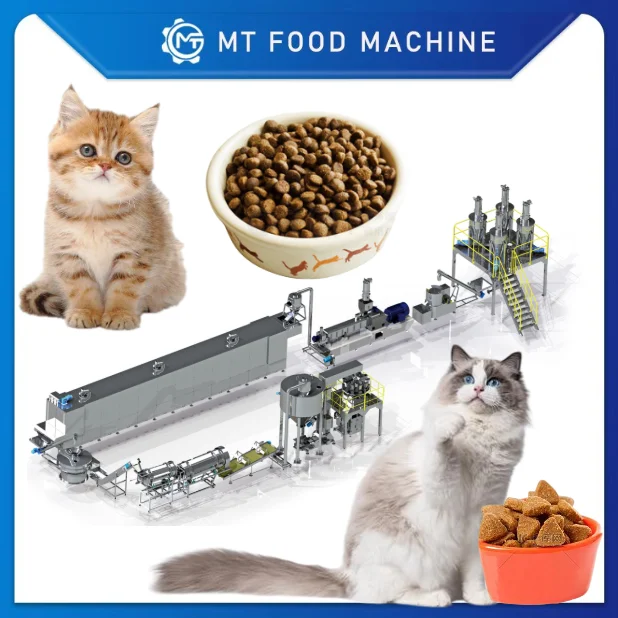


Pet Food Processing Line, 450-550 kg/h, PLC Controlled — configured for multi-species kibble production with throughput-matched stations from batching through extrusion, drying, flavouring, and packing.
- Twin-screw extrusion with screw configuration and die design specified to the buyer’s raw material and target kibble density, ensuring correct texture for cat, dog, and aquatic feed.
- Voltage, frequency, and control language confirmed before shipment, with trial runs on customer raw material completed in-house.
Supported by pre-sales engineering consultation, on-site installation, commissioning, and ongoing wear parts supply for uninterrupted production.
Description
Throughput-Matched Stations — Every section from batching to packing is calculated against your actual raw material formulation so the line holds its rated output without downstream bottlenecks.
Technical Specifications
| Parameter | Value |
|---|---|
| Product Type | Pet Food Extrusion Production Line |
| Output Capacity | 450–550 kg/h (basis not stated in source — confirm raw material, moisture content, and kibble size) |
| Control System | PLC Controlled |
| Line Stations | Batching, extrusion, drying, flavouring, packing |
| Assembly State | Complete processing line |
| Voltage & Frequency | Configurable to destination country (to be confirmed at inquiry) |
| Screw Type | To be specified based on formulation and target product |
| Certification | CE, ISO (certificates available on request) |
Application Suitability
| Application | Material or Output |
|---|---|
| Dry kibble for dogs and cats | Corn, rice, meat meal, bone meal, fish meal blends |
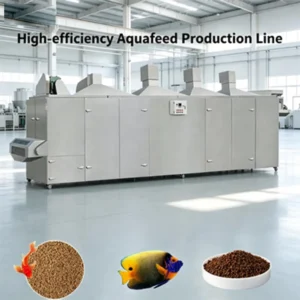
| Floating and sinking aquatic feed | Fish meal, soybean meal, starch-based formulations for catfish, tilapia, shrimp |
| Bird feed pellets | Grain mixes, millet, sunflower meal, vitamin premixes |
| Cattle and livestock supplement feed | Bran, oilseed cake, molasses-bound formulations |
Why "Rated Capacity" Alone Misleads Buyers on a Pet Food Processing Line Turnkey
A quoted capacity figure only matters when tied to your exact raw material, moisture level, and kibble geometry.
I have watched lines arrive on site and immediately underperform because the extruder was rated on one formulation while the buyer runs a completely different recipe. The dryer section falls behind, the coating drum overflows, and the whole pet food processing line turnkey stalls at half its nameplate output [NEED_CITE: common causes of extrusion line throughput shortfall]. The 450–550 kg/h figure here is a starting point for line configuration, not a guarantee until your raw material has been tested through every station.
Line-Level Throughput Balancing Across Every Station
A pet food processing line turnkey is only as productive as its slowest station. When the extruder pushes material faster than the dryer can remove moisture, product backs up and quality degrades. This line is configured so that batching rate, extruder throughput, dryer belt length and airflow, flavouring drum residence time, and packing speed are all calculated together before a single component is built.
Pre-Shipment Trial Runs on Your Actual Formulation
Before any crate leaves the factory, your raw material runs through the testing workshop. The trial confirms screw configuration, die selection, barrel temperature profile, and dryer settings against the specific kibble density and texture your market expects [NEED_CITE: twin-screw extrusion trial run protocols for pet food]. The resulting trial report travels with the shipment so your team can verify settings on day one of commissioning.
Decoding the Specifications That Actually Matter
The PLC control system stores recipe parameters for each species and formulation, so switching from a high-meat dog kibble to a starch-heavy cat treat does not require manual guesswork — operators recall the saved profile and the barrel zones, screw speed, and feeder rates adjust accordingly. Output capacity depends heavily on raw material moisture and kibble cross-section; a dense, large-diameter kibble will run at a lower mass throughput than a small, highly expanded piece on the same screw configuration. The line stations are specified as a complete chain because leaving any section to a separate vendor is the most common source of throughput mismatch in multi-species feed plants. Voltage and frequency must be locked in before production begins, since a motor wound for the wrong supply will burn out within hours of first start-up [NEED_CITE: industrial voltage and frequency standards by export market].
The Hidden Cost of Specifying Stations in Isolation
When the extruder and dryer come from different suppliers, no single party owns the throughput guarantee. I have seen installations where the dryer could not keep pace, forcing the operator to throttle the extruder down and lose days of output every week [NEED_CITE: consequences of unmatched extrusion and drying capacity]. Coating drums that are too small for the extruder output cause uneven flavour distribution and product rejection at quality inspection. These problems do not show up in a brochure — they appear only after the line is bolted to your floor and running on your material.
Why Sourcing the Full Line Under One Scope Matters
Every station is throughput-matched by the same engineering team, so there is no finger-pointing between vendors when output falls short. Screw configuration and die design are specified to your formulation rather than copied from a generic build. The in-house testing workshop runs your raw material before shipment, eliminating the usual weeks of post-installation recipe development. Electrical schematics and PLC language are confirmed to your facility standards before production starts. Ongoing maintenance support and wear parts supply are managed through a single channel for the entire line.
Documentation & Verification
- Line layout and capacity calculation matched to your raw material and target kibble specification
- Screw and die configuration record for each product format in your range
- Trial run report on your actual formulation before dispatch from factory
- Electrical schematic with voltage, frequency, and control language confirmed to destination
- CE declaration of conformity and ISO certificate included with shipment documentation
- Wear parts list with recommended replacement intervals for screws, dies, and dryer belts
Installation, Commissioning & Support
- Foundation plan and utility connection points provided for the full PLC-controlled line footprint
- Voltage and frequency verified against your facility supply before motor and heater sizing
- Extruder barrel, screws, and die assembly aligned and tested on site during commissioning
- PLC recipe parameters loaded and validated for each species formulation you produce
- Operator training covers start-up sequence, recipe changeover, and emergency shutdown procedures
- Wear parts inventory and replacement schedule handed over at project close-out
What We Need to Configure Your Line
Send us your target species list, raw material formulation with moisture content, desired kibble shape and density, daily output target, and available workshop dimensions. Confirm your local voltage, frequency, and preferred PLC interface language. If you have existing upstream or downstream equipment that must integrate with the new line, include those specifications so throughput matching accounts for every station from day one.
Frequently Asked Questions
Q: How is the 450–550 kg/h output capacity verified before I commit to the line?
A: The capacity figure is a configuration starting point, not a blanket guarantee. We run your actual raw material through the testing workshop, measure throughput at every station, and issue a trial report showing real output under your formulation conditions. Only then is the final line specification locked.
Q: How do you match screw and die design to different kibble densities for various species?
A: Screw element arrangement, compression ratio, and die hole geometry are selected based on your target kibble density, expansion ratio, and raw material composition. The PLC stores each configuration as a named recipe so changeover between species requires only a profile recall and physical die swap.
Q: What electrical and control details are confirmed before the line is built?
A: We confirm voltage, phase, frequency, plug type, and PLC interface language with your electrical team before production begins. The electrical schematic is reviewed and signed off so the line arrives ready for connection without transformer or rewiring delays on site.
Q: How is throughput balanced between the extruder, dryer, and coating drum?
A: Each station is sized based on the extruder’s verified output on your material. Dryer belt length, airflow volume, and coating drum diameter are calculated so no section creates a bottleneck, and the entire line runs at rated capacity continuously.
Q: What does on-site installation and commissioning include for this line?
A: Our engineers oversee uncrating, station alignment, utility connections, and first production runs. They load your recipes into the PLC, train operators on changeover and maintenance routines, and hand over the wear parts schedule before leaving your facility.
Related products
-
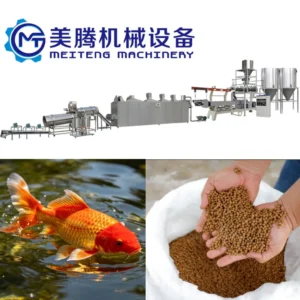
Línea de procesamiento de alimento para peces multi-especies de alta capacidad de 1.0-1.5t/h para producir alimento para peces
¥45,000.00 Select options This product has multiple variants. The options may be chosen on the product page -
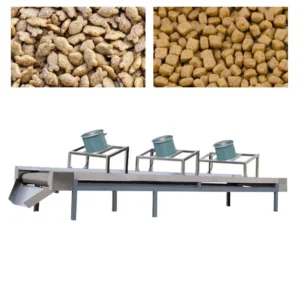
Línea de producción de alimentos para mascotas completamente automática Máquina de extrusión de grano de doble tornillo grande
¥9,500.00 Select options This product has multiple variants. The options may be chosen on the product page -
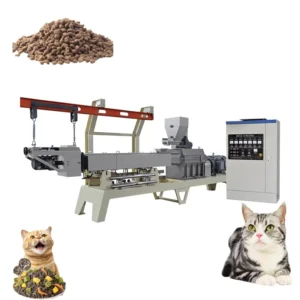
Equipo Premium para Procesamiento de Alimentos para Mascotas Máquina para Fabricar Alimento para Perros y Gatos
¥9,500.00 Select options This product has multiple variants. The options may be chosen on the product page -
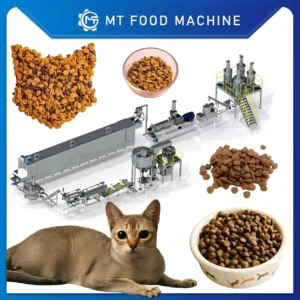
Línea de procesamiento de alimentos para perros de múltiples especies controlada por PLC con capacidad de 200-250kg/h y extrusora MT-70
¥35,000.00 Select options This product has multiple variants. The options may be chosen on the product page