

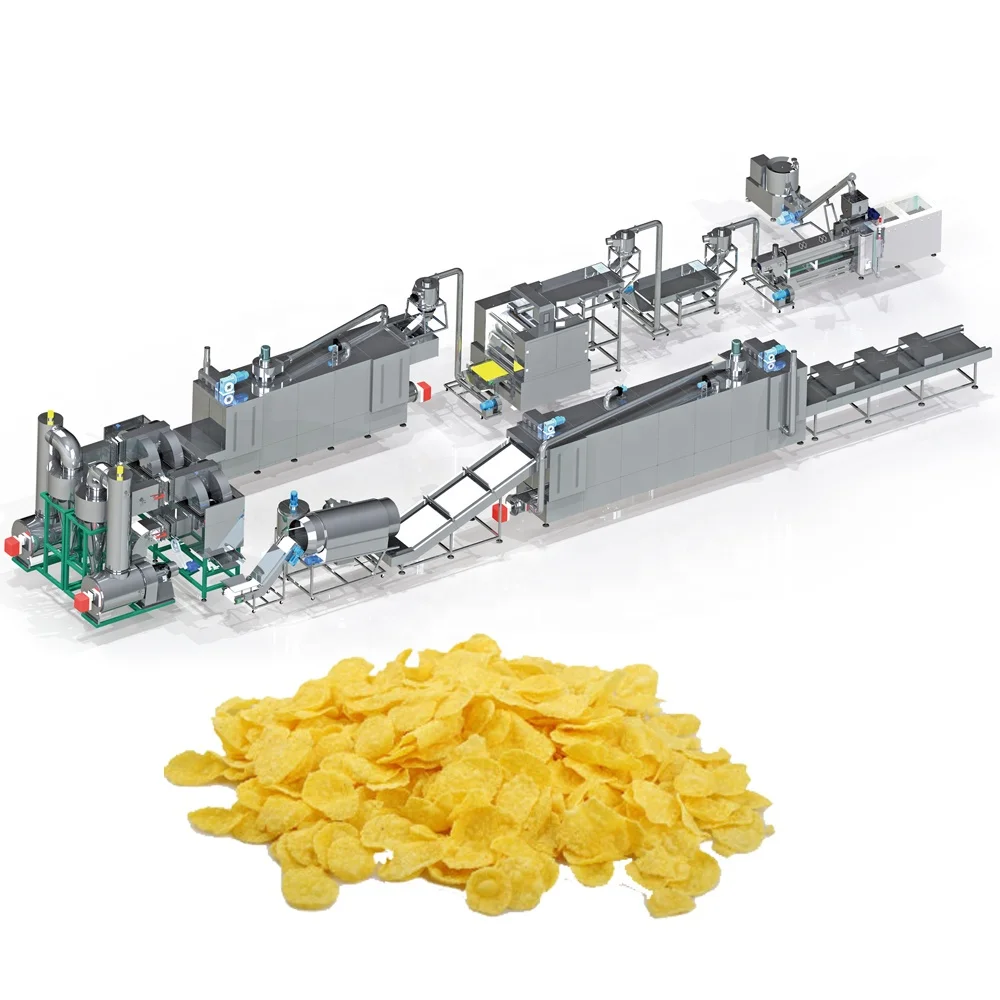
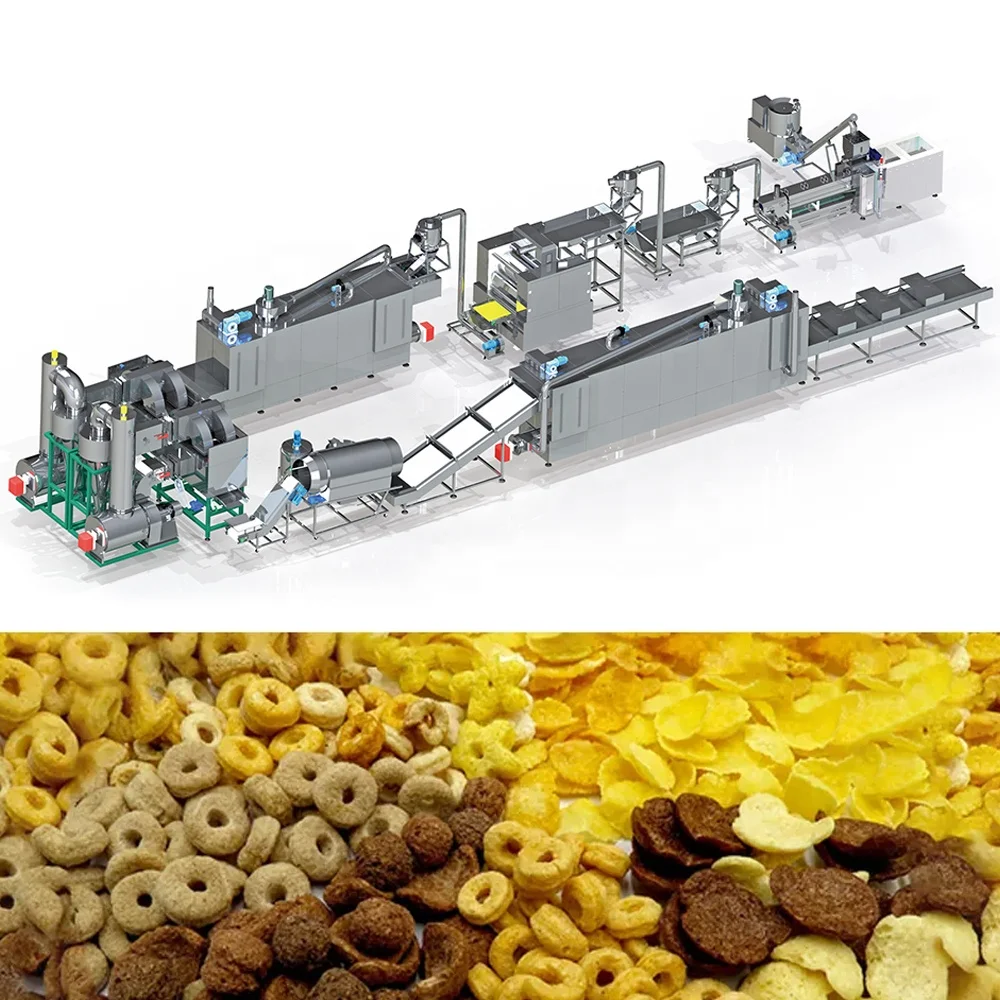
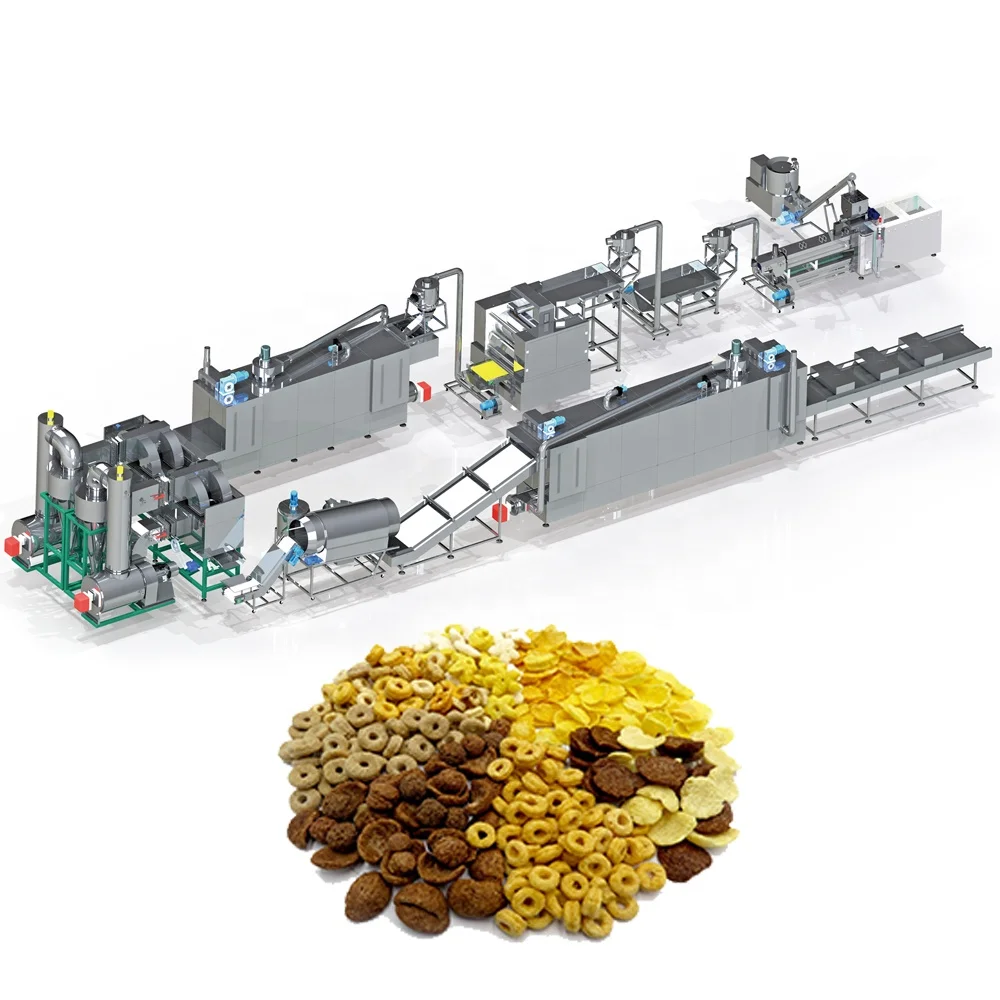
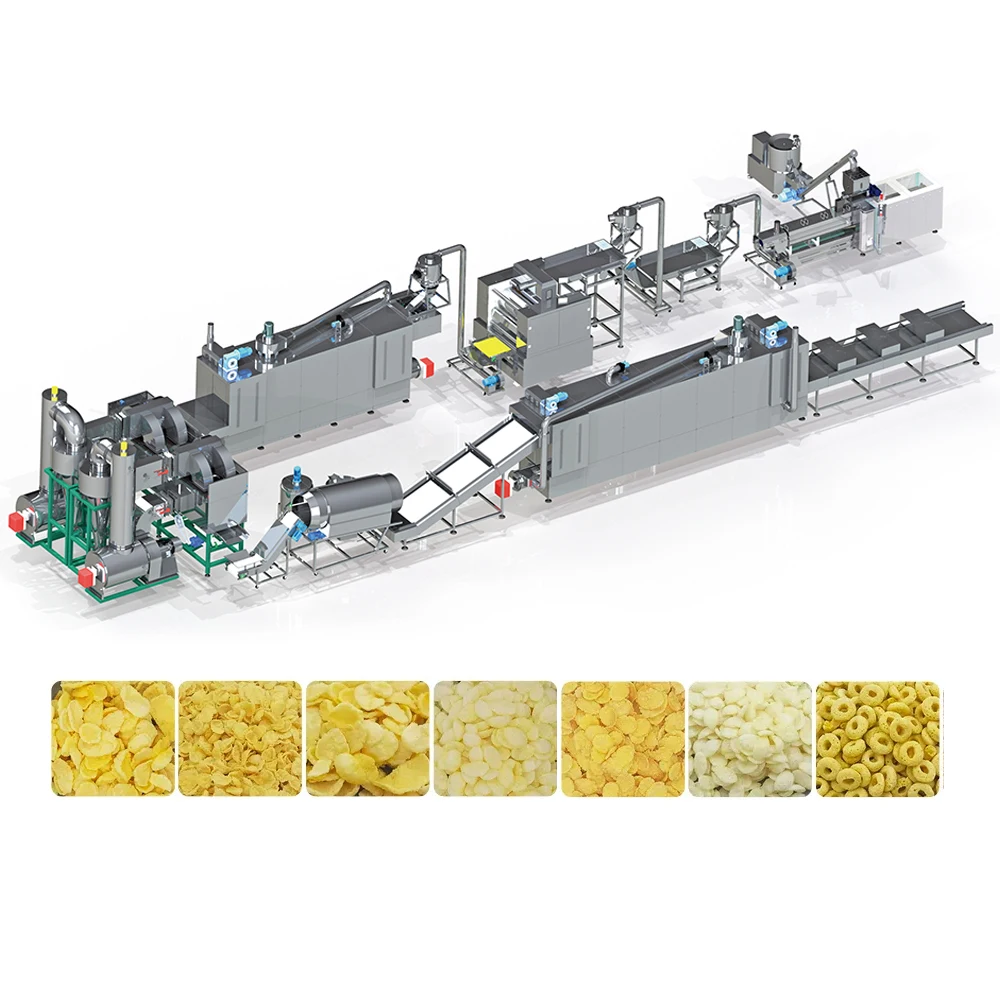
MT70 / MT85 / MT75 Corn Flakes Production Line, Twin-Screw Extrusion, PLC Control — engineered as a complete turnkey system from batching through packing with throughput matched at every station.
- Screw configuration and die design specified to your raw material and target flake density, controlling expansion and texture across natural or sugar-coated formats
- Hydraulic double-roller flaking with infrared temperature control and hot air roasting oven with dual circulating fans ensure uniform thickness and consistent crispness
In-house trial runs on your actual raw material before shipment verify real output against your formulation and moisture level.
Description
Throughput-Matched Line Design — Every station from mixing to packing is sized against the extruder’s real output on your corn formulation, so the dryer or coater never becomes the hidden cap on your shift tonnage.
Technical Specifications
| Parameter | Value |
|---|---|
| Product Type | Corn Flakes Production Line |
| Model | MT70 / MT85 / MT75 |
| Screw Type | Twin Screw |
| Installed Power | MT70: 160 kW / MT85: 190 kW / MT75: 210 kW |
| Power Consumption | MT70: 120 kW / MT85: 140 kW / MT75: 150 kW |
| Output Capacity | MT70: 150–200 kg/h (basis not stated in source); MT85: 300–400 kg/h (basis not stated in source); MT75: 300–500 kg/h (basis not stated in source) |
| Overall Dimensions (L × W × H) | MT70: 41 × 1.5 × 2.2 m / MT85: 43 × 1.5 × 3.2 m / MT75: 45 × 1.5 × 3.5 m |
| Control System | PLC (flaking machinery); MCC and PLC available for line |
| Flaking Machinery | Hydraulic double-roller system; separate double-motor drive; infrared temperature control |
| Dryer Heating Source | Gas / Electric |
| Roasting Oven | Conciliation burner; dual circulating fans; cyclone dust removal |
| Coating System | Double tumble sugar melting; elevator; coating drum; spraying nozzle |
| Raw Materials | Corn, rice, wheat, oat, barley powder |
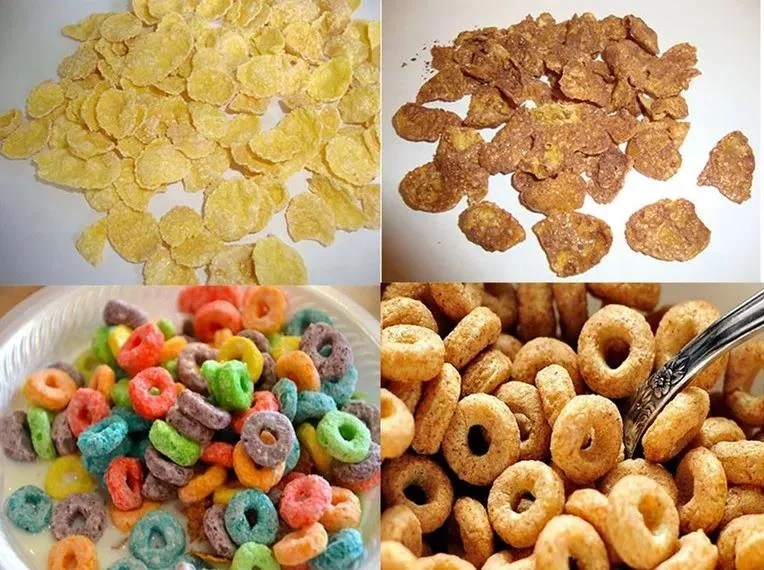
| Final Product Shapes | Ball, tube, stick, ring, fruit loop, star, wheel, flower, heart |
| Extruder Advantage | Automatic lubricating and cooling; wear-resistant screw technology |
| Standards | CE; ISO |
Application Suitability
| Application | Material or Output |
|---|---|
| Natural corn flakes for breakfast cereal market | Corn grits, corn flour |
| Sugar-coated corn flakes with glazed finish | Corn base with sugar spray and tumble coating |
| Shaped breakfast cereals (rings, balls, stars, fruit loops) | Corn, rice, wheat, oat, or barley powder with die change |
| Puffed snack variants on same extrusion platform | Corn and rice blends, multi-grain formulations |
| Fortified cereal production for nutrition programmes | Grain base with vitamin and mineral premix |
Why "Nameplate Capacity" Is the Wrong Number to Buy On
The extruder’s rated output means nothing if your downstream dryer cannot handle it on your actual corn formulation.
A corn flakes production line turnkey proposal often leads with extruder capacity — 300 kg/h, 400 kg/h — and leaves the buyer assuming the entire line runs at that rate. But corn moisture content, particle size, and starch composition vary dramatically between regions. I have stood in plants where the extruder pushed full volume, yet the flaking rollers and hot air roaster could not keep pace because the real throughput on that specific corn was never verified before the line shipped. The result is an extruder that runs at partial feed to avoid pile-ups downstream. [NEED_CITE: impact of raw material moisture variation on extrusion throughput]
How Screw Configuration Controls Flake Density and Bowl Life
The twin-screw extruder is the point where starch gelatinisation and dough conditioning happen. On a corn flakes production line turnkey project, screw element arrangement — conveying sections, kneading blocks, and reverse-flight segments — must be set to the buyer’s corn variety and target flake thickness. A configuration that works for low-moisture dent corn will produce under-expanded, dense pellets on high-moisture flour corn, and those pellets will crack instead of flattening at the flaking rollers. The MT70, MT85, and MT75 extruders allow screw rearrangement so the shear profile matches what your corn actually needs.
What the Flaking and Roasting Stations Must Deliver Together
After extrusion and initial drying, the pellets enter the hydraulic double-roller flaking machinery where infrared temperature control monitors roller surface heat in real time. Separate double-motor driving lets each roller maintain independent speed, which prevents slip marks on the flake surface. The flakes then pass into the hot air roasting oven, where two circulating fans and a cyclone dust removal device create an even airflow that produces the blistered surface and crisp bite that breakfast cereal buyers expect. If the roasting oven airflow is undersized relative to flaking output, you get uneven moisture removal and soft flakes that stale quickly on the shelf. [NEED_CITE: roasting airflow requirements for uniform flake blistering]
Reading the Specs That Actually Determine Line Output
Three parameters on this corn flakes production line turnkey system deserve close attention during specification. Installed power across the three extruder models ranges from 160 kW to 210 kW, with actual consumption between 120 kW and 150 kW — the gap reflects motor loading during start-up versus steady-state extrusion. The overall line length spans 41 m to 45 m, which dictates factory floor planning and utility trench routing well before the equipment arrives. The control architecture pairs PLC logic at the flaking machinery with MCC and PLC options across the full line, meaning motor protection and process sequencing are managed through a unified interface rather than separate vendor panels. These figures shape whether the line fits your building, your electrical supply, and your operators’ familiarity with PLC-based troubleshooting.
The Cost of Skipping Throughput Matching Between Stations
When the coating drum capacity is sized to a generic ratio rather than your specific sugar-coated SKU, the drum becomes a chokepoint — extruded flakes queue up, absorb ambient moisture, and lose the texture the roaster just created. Similarly, if the dryer heating source is specified without confirming your local gas pressure or electrical tariff, you face either under-drying or excessive energy cost per shift. I have walked into facilities where the line was assembled from separate vendors and no one had calculated whether the cooling conveyor could carry the roasted flake volume before packing. These mismatches surface only during commissioning, weeks after the equipment has been paid for. [NEED_CITE: consequences of cross-vendor throughput mismatch in food processing lines]
Why Sourcing the Full Line from One Supplier Changes the Outcome
The MT70, MT85, and MT75 models cover a capacity span that lets you scale from pilot-volume runs to continuous three-shift production on the same platform. Screw configuration and die design are specified against your raw material before the extruder is built, not pulled from a generic template. The in-house testing workshop runs your actual corn, rice, or oat formulation before shipment, so expansion rate and pellet integrity are confirmed while changes are still inexpensive. Every station — mixing, extruding, flaking, drying, hot air roasting, cooling, and packing — is throughput-matched under a single line layout calculation. Pre-sales engineering through on-site installation, commissioning, and operator training stays with the same technical team, so the people who designed the layout are the ones watching the first production run on your floor.
Documentation & Verification
- Line layout with throughput calculation at every station for your corn formulation
- Screw and die configuration record matched to your target flake density
- Electrical schematic confirming voltage, frequency, and control language for your market
- Factory trial run report on your raw material before dispatch
- CE declaration of conformity and ISO certificate included in shipment package
- Wear parts list with screw element and die specifications for reorder
Installation, Commissioning & Support
- Floor space of 41 m to 45 m length requires level concrete slab with utility trenches planned before delivery
- Power supply must match the 120 kW to 150 kW operating draw with dedicated circuit protection at MCC panel
- Line ships in sectioned modules; flaking machinery and roasting oven require overhead crane for positioning
- First commissioning run verifies PLC logic sequences and infrared sensor calibration on your corn batch
- Operator training covers screw configuration adjustment, roller pressure setting, and roasting fan balance
- Wear parts stock includes spare screw elements, die plates, and flaking roller surfaces for scheduled replacement
What We Need to Configure Your Line
Send us your corn or grain type with moisture content and particle size distribution, along with your target daily output and whether you plan to run natural flakes, sugar-coated flakes, or shaped cereal formats. Include your workshop dimensions, ceiling height, and local voltage and frequency so the electrical schematic can be locked before production starts. If you have existing upstream milling or downstream packing equipment, share those specifications so the line interfaces correctly at both ends.
Frequently Asked Questions
Q: How is real line capacity verified against my specific corn formulation and moisture level?
A: We run your actual corn sample in our in-house testing workshop before shipment. The trial confirms expansion rate, pellet density, and achievable throughput on the extruder, then we verify that the flaking rollers, dryer, and roasting oven can sustain that volume continuously. You receive a trial run report with measured outputs tied to your raw material.
Q: How do you ensure the dryer and coating drum throughput matches the extruder on my product?
A: Each station is sized against the extruder’s verified output on your formulation, not a generic ratio. The line layout calculation shows throughput at the flaking machinery, dryer, roasting oven, and coating drum. For sugar-coated SKUs, the double tumble system and spraying nozzle capacity are matched to the roasted flake flow rate so no station bottlenecks the shift.
Q: Can I run a trial on my raw material before the line ships?
A: Yes. Our testing workshop conducts trial runs on your corn, rice, wheat, or oat sample. We adjust screw configuration and die design during the trial until flake density and expansion meet your product specification. The trial run report becomes part of your documentation package and serves as the baseline for commissioning at your facility.
Q: What voltage, frequency, and control language options are confirmed before production?
A: Your local voltage and frequency are confirmed during the specification stage, and the electrical schematic is locked before manufacturing begins. The PLC interface language is set to your operators’ preference. The MCC and PLC control architecture is configured to your market’s electrical standards so commissioning proceeds without rewiring delays.
Q: How are screw and die configurations selected for natural versus sugar-coated corn flakes?
A: Natural flakes require a screw profile that produces denser pellets for clean flattening at the flaking rollers, while sugar-coated variants need slightly higher expansion to hold the glaze. We adjust kneading block placement and die orifice size during the trial run on your corn, recording the final screw and die configuration so you can replicate the result in production and reorder wear parts accurately.
Related products
-

Equipo de producción de extrusión de bocadillos de maíz inflado de alta productividad automático en nueva condición Máquina para hacer alimentos de bocadillos inflados
¥11,050.00 Select options This product has multiple variants. The options may be chosen on the product page -

Máquina Automática de Snacks de Comida Inflada Máquina Eléctrica para Hacer Snacks de Maíz Puff Nueva Condición Producción de Snacks Puff Sabrosos
¥7,550.00 Select options This product has multiple variants. The options may be chosen on the product page -

Máquina de Extrusión Automática de Crujientes de Maíz para Chips de Maíz y Palitos de Maíz en Nueva Condición
¥8,000.00 Select options This product has multiple variants. The options may be chosen on the product page -

Línea de producción de palitos de bocadillo de maíz inflado automático Equipos en nueva condición
¥100.00 Select options This product has multiple variants. The options may be chosen on the product page


