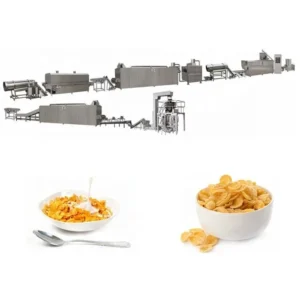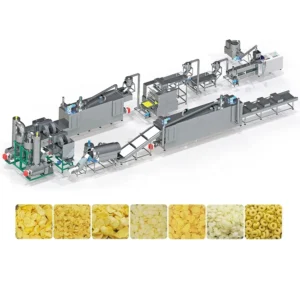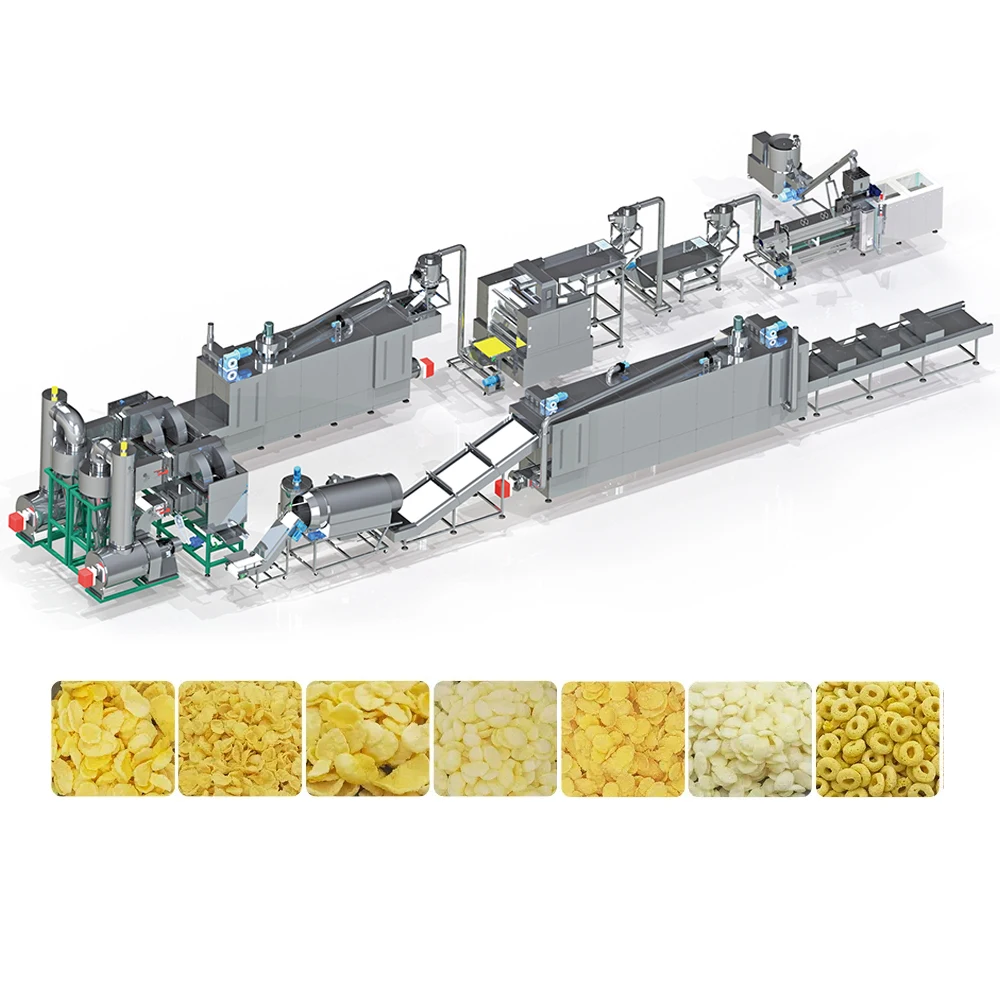
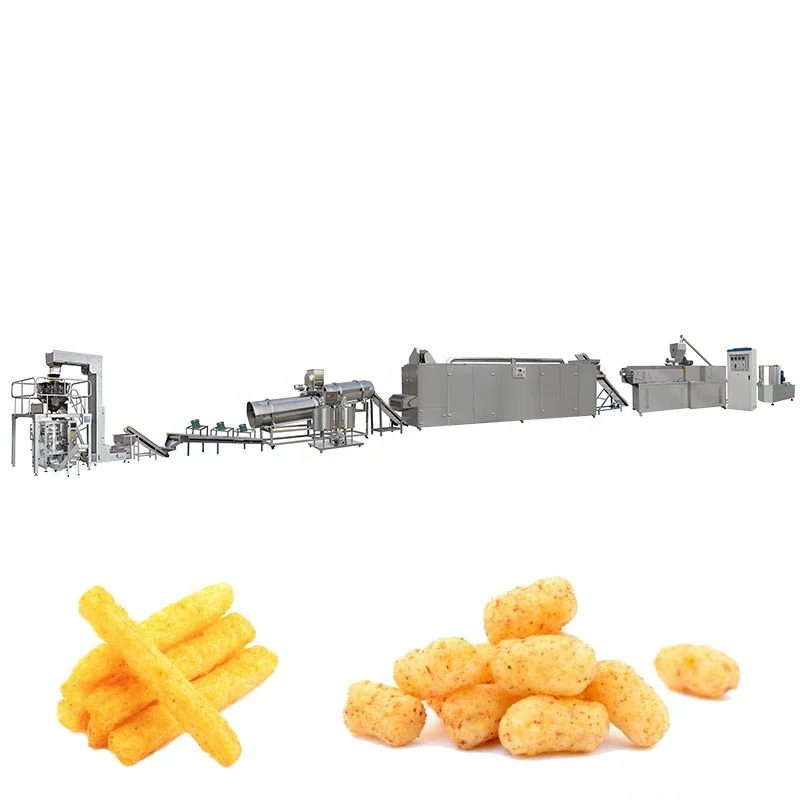

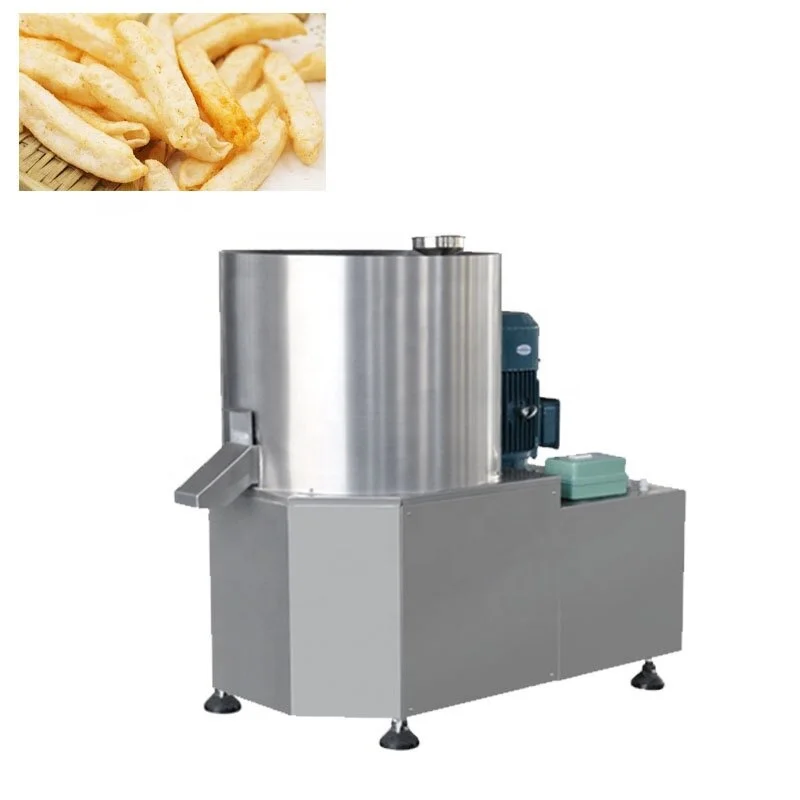


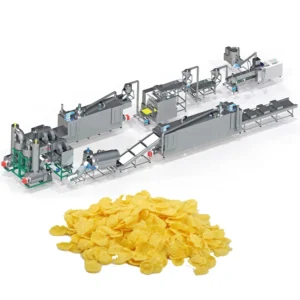
MT75 Twin Screw Corn Flakes Production Line, 150 kW, PLC Control — configured for corn, rice, wheat, oat and barley into natural or sugar-coated flakes. From the turnkey line perspective, every station from mixing through extruding, flaking, drying, roasting and packing is throughput-matched to eliminate bottlenecks, while screw configuration and die design are specified to your raw material formulation and target flake density. Trial runs on your actual material are conducted in-house before shipment, supported by complete layout and capacity documentation for your factory footprint.7827
Description
Screw Configuration Matched to Your Grain — Every MT75 / MT70 / MT85 line ships with screw elements and die geometry selected against the buyer’s actual corn, rice, or multi-grain formulation, not a generic catalog build.
Technical Specifications
| Parameter | Value |
|---|---|
| Product Type | Twin Screw Extruder Corn Flakes Production Line |
| Extruder Model | MT-75 Twin Screw Extruder |
| Screw Type | Twin-screw |
| Installed Power | MT70 — 160 kW; MT85 — 190 kW; MT75 — 210 kW |
| Power Consumption | MT70 — 120 kW; MT85 — 140 kW; MT75 — 150 kW |
| Output Capacity | MT70 — 150–200 kg/hr; MT85 — 300–400 kg/hr; MT75 — 300–500 kg/hr (basis not stated in source — confirm raw material formulation / moisture content / product shape) |
| Extruder Unit Capacity | 200–300 kg/hr (basis to be confirmed against raw material and product format) |
| Overall Dimensions (Line) | MT70 — 41 × 1.5 × 2.2 m; MT85 — 43 × 1.5 × 3.2 m; MT75 — 45 × 1.5 × 3.5 m |
| Control System | PLC control with MCC integration available |
| Flaking Machinery | Hydraulic double-roller system, dual independent motors, infrared sensor temperature control |
| Dryer Heating Source | Gas or electric, configurable to site utility |
| Roasting Oven | Hot air circulation with vibrating pan, dual circulating fans, cyclone dust removal |
| Coating System | Double tumble sugar melting unit, elevator, coating drum, spray nozzle array |
| Raw Materials | Corn, rice, wheat, oat, barley powder |
| Final Product Shapes | Natural corn flakes, sugar-coated flakes, ball, tube, stick, ring, fruit loop, star, wheel, flower, heart (via die change) |
| Production Procedure | Mixing → Extruding → Flaking → Drying → Hot Air Roasting → Sugar Coating (optional) → Cooling → Packing |
| Assembly State | Complete turnkey line from batching to packing |
| Voltage & Frequency | Configured to local site standard |
| Certification | CE, ISO |
Application Suitability
| Application | Material or Output |
|---|---|
| Natural corn flakes for breakfast cereal market | Degerminated corn grits, flaked and roasted to target crispness |
| Sugar-coated corn flakes | Extruded and flaked corn base with double-tumble sugar coating |
| Multi-grain breakfast cereal | Blends of corn, rice, wheat, oat, and barley powder |
| Shaped puffed cereal formats | Rings, balls, stars, fruit loops via extruder die change |
Why "Rated Capacity" Means Nothing Without Your Raw Material
A line that runs 400 kg/hr on the builder’s test corn may stall at half that on your local grits.
I spent years on the assembly floor in the Yangtze Delta manufacturing belt before moving into technical sales. One project stands out: a corn flakes line destined for the Middle East. We ran standard corn flour in our test workshop and the MT-75 twin screw extruder produced perfect flakes. When the line arrived on site, the buyer was using degerminated corn grits with a different moisture and starch profile. Expansion dropped, flakes went soft, and it took a full week of screw recombination and barrel temperature adjustment to recover [NEED_CITE: starch gelatinisation behaviour across corn varieties]. That experience is why every corn flakes production line turnkey project we build now starts with a sample of the buyer’s actual grain.
Throughput Balancing Across Every Station
A corn flakes line is only as fast as its slowest station. If the extruder pushes 300 kg/hr but the dryer handles only 200, product piles up, moisture lingers, and flakes lose crispness before they reach the roasting oven. When we design a corn flakes production line turnkey layout, we calculate residence time and belt load at the flaking rolls, the dryer, and the hot air roaster so each unit accepts the full output of the one before it. The hydraulic double-roller flaking machinery uses independent motors on each roll to maintain gap consistency even as throughput changes, and the infrared sensors hold surface temperature within a tight band so flake thickness stays uniform across the belt width.
Trial Runs Before the Crate Goes Shut
We run the buyer’s raw corn, rice, or multi-grain blend in our in-house testing workshop before the line ships. The trial covers extruder screw configuration, die selection, barrel temperature profile, flaking gap, and roasting time. The resulting trial run report documents the exact settings so installation crews can start commissioning from a known baseline rather than guessing [NEED_CITE: pre-shipment factory acceptance testing standards for food extrusion lines]. This step catches formulation surprises early, when a screw element swap costs hours instead of weeks of on-site downtime.
What the Spec Sheet Actually Means for Flake Quality
Twin-screw extrusion gives operators independent control over shear, residence time, and temperature — variables that directly govern starch gelatinisation and, ultimately, whether a corn flake snaps or crumbles. The MT-75 extruder’s automatic lubricating and cooling circuits keep barrel sections within their set points during long runs, preventing the hot spots that scorch product and force unplanned stops. Installed power ranges from 160 kW on the MT70 line variant up to 210 kW on the MT75, which translates to the torque headroom needed to push viscous, low-moisture corn dough through narrow die apertures without stalling. On the flaking side, the PLC-controlled hydraulic system adjusts roll gap on the fly, so operators can dial in flake thickness between 0.5 and 1.2 mm depending on whether the target is a thin, crisp flake or a thicker, chewier format.
The Hidden Cost of Mismatched Downstream Equipment
When a roasting oven lacks sufficient circulating fan capacity, the surface blistering that gives corn flakes their characteristic appearance stays uneven, and buyers downstream reject entire batches [NEED_CITE: visual and textural grading standards for breakfast cereal flakes]. A coating drum that is too short leaves sugar syrup pooling on some flakes while others pass through bare. These bottlenecks are invisible on a quotation that lists only extruder capacity. We size the hot air roaster with dual fans and a cyclone dust collector to pull moisture evenly from the full belt load, and the double tumble sugar melting unit is rated to keep pace with the line’s peak output so coating coverage stays consistent.
Why Source the Entire Line From One Supplier
Throughput matching is only possible when one engineering team controls every station. We design the mixing, extruding, flaking, drying, roasting, coating, cooling, and packing sections as a single system, so belt widths, motor ratings, and control logic talk to each other from day one. The PLC and MCC architecture lets operators monitor the full line from one HMI instead of walking between standalone panels. Screw configurations and die designs are specified to the buyer’s grain, not pulled from a shelf. An in-house testing workshop validates the recipe before shipment. CE and ISO certification cover the entire assembly, which simplifies customs and local authority approval at the destination site.
Documentation & Verification
- Line layout and capacity calculation showing throughput balance across mixing, extruding, flaking, and roasting
- Trial run report on buyer’s actual corn or multi-grain raw material before dispatch
- Screw and die configuration record matched to target flake density and shape
- Electrical schematic with voltage, frequency, and control language confirmed to site standard
- CE declaration of conformity and ISO certificate for the complete line assembly
- Wear parts list covering screw elements, die plates, flaking roll surfaces, and spray nozzles
Installation, Commissioning & Support
- Foundation plan sized to the 41–45 m line length with anchor bolt schedule for extruder and roasting oven
- Dedicated power circuit matching the 150–210 kW installed load with breaker and cable specification
- Modular station delivery allowing phased uncrating where workshop access is limited
- First-run parameter setting on buyer’s grain covering barrel zones, flaking gap, and roasting temperature
- Operator training on PLC screens, screw element changes, and hydraulic roll adjustment
- Recommended spare inventory of screw segments, die inserts, and infrared sensor units
What to Include in Your Inquiry
Share the type of grain you intend to run — whether degerminated corn grits, whole corn flour, or a multi-grain blend — along with the target moisture content after mixing. Provide your workshop length, width, and clear height so we can draft a layout that fits. Confirm local voltage, frequency, and the control language your operators prefer. If you have existing upstream mixers or downstream packing machines, list their throughput ratings so we can match interfaces.
Frequently Asked Questions
Q: How do you verify line capacity on my specific corn grits formulation?
A: We request a representative sample of your raw material and run it through our in-house testing workshop. The trial covers extruder screw configuration, barrel temperature, flaking gap, and roasting time. You receive a documented trial run report with the exact settings before the line ships, so commissioning starts from a proven baseline.
Q: How is throughput balanced between the extruder, flaking rolls, and roasting oven?
A: Each station is sized during the layout phase so belt load and residence time match the extruder’s verified output. The hydraulic flaking machinery and the dual-fan roasting oven are both rated to accept the peak line throughput without product backlog or moisture retention issues.
Q: What electrical and control details are confirmed before production begins?
A: We obtain your site voltage, frequency, and preferred HMI language before the electrical design is finalised. The schematic, breaker ratings, and cable schedules are then matched to your local standard, and PLC and MCC panels are wired accordingly before factory testing.
Q: Can screw and die geometry be specified to my target flake thickness?
A: Yes. Screw element profile, compression ratio, and die aperture are selected based on your raw material and the flake density you need. The configuration record is included in the documentation package so replacements can be ordered with the same specification.
Q: What does on-site commissioning cover?
A: Our technicians supervise mechanical assembly, connect utilities, load your raw material, and adjust extruder, flaking, and roasting parameters until product meets your specification. Operator training on the PLC interface, screw changes, and routine maintenance is included before handover.
Related products
-
Línea de Producción de Copos de Maíz Máquina de Producción de Cereales para el Desayuno Línea de Maquinaria para la Fabricación de Copos de Maíz
¥59,800.00 Select options This product has multiple variants. The options may be chosen on the product page -
New High Efficiency Electric Corn Flakes Production & Manufacturing Machine
¥7,500.00 Select options This product has multiple variants. The options may be chosen on the product page -
Línea de producción automática de copos de maíz en círculo de trigo para desayuno comercial
¥65,000.00 Add to cart -
Línea de producción de copos de maíz completa Máquina de procesamiento de cereales para el desayuno Componente central del motor Equipo de procesamiento de copos de maíz
¥19,000.00 Select options This product has multiple variants. The options may be chosen on the product page