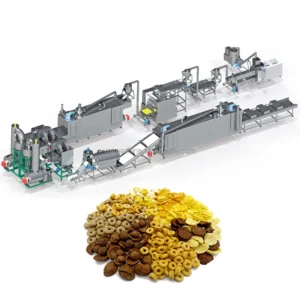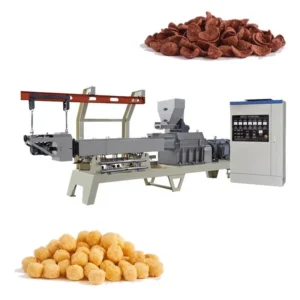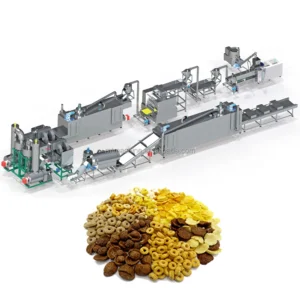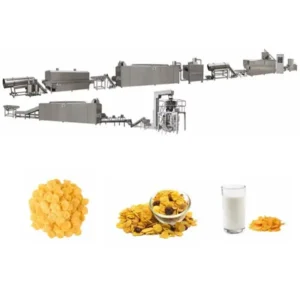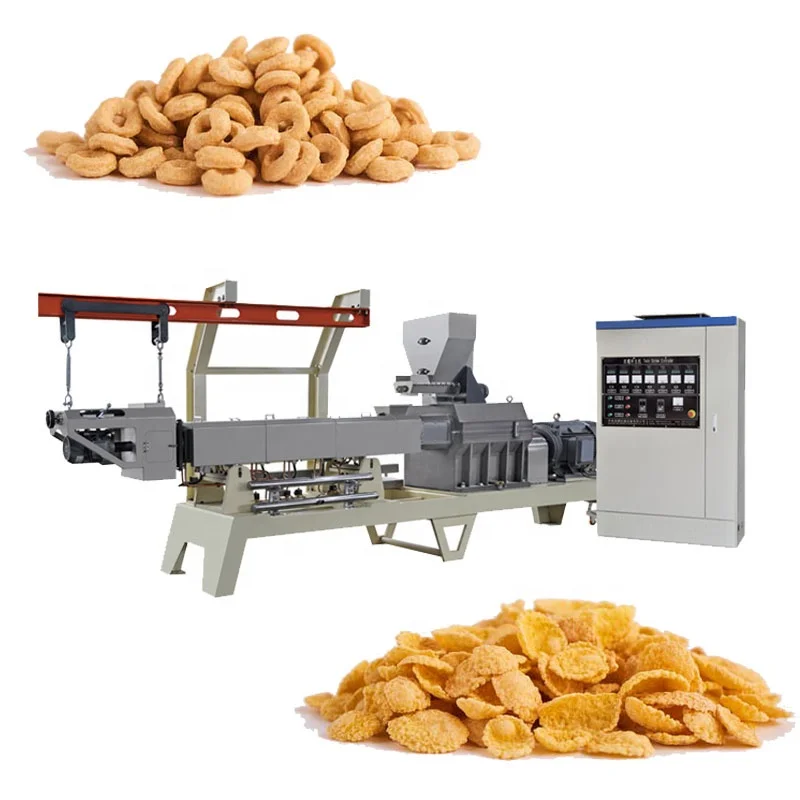


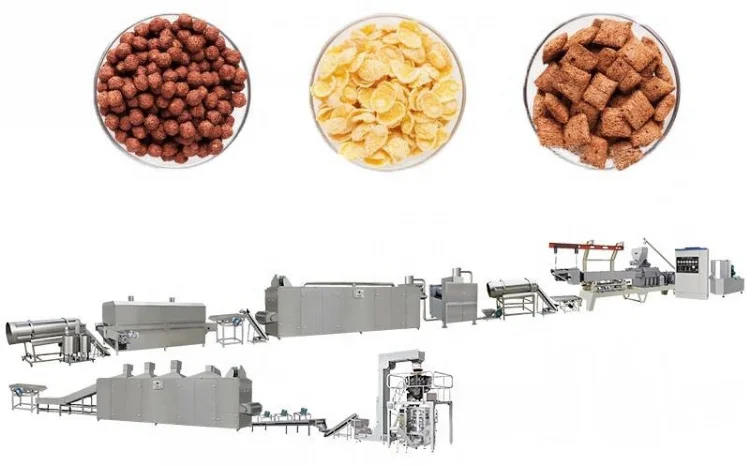

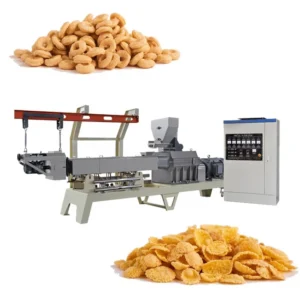
MT-65 / MT-70 / MT-85 / MT-75 Corn Flakes Production Line, Twin-Screw Extruder, Gas-Fired Oven — engineered as a complete turnkey layout from batching through flaking, baking, coating, and packing.
- Co-rotating twin-screw modules with screw configuration and die design matched to your grain type and target flake density, ensuring consistent gelatinisation and expansion
- Adjustable-gap flaking press with integrated cooling delivers the precise thickness your market expects
Backed by in-house trial runs on your actual raw material before shipment, plus on-site commissioning and operator training.
Description
Throughput-Matched Engineering — Every station on this corn flakes production line is sized against the extruder’s real output on your grain, not a catalog nominal figure.
Technical Specifications
| Parameter | Value |
|---|---|
| Product Type | Corn Flakes Production Line |
| Model | MT-65 / MT-70 / MT-85 / MT-75 |
| Installed Power | 84 kW (MT-65) / 132 kW (MT-70) / 239 kW (MT-85) / 186 kW (MT-75) |
| Real Power | 59 kW (MT-65) / 92 kW (MT-70) / 167 kW (MT-85) / 140 kW (MT-75) |
| Output Capacity | 120–150 kg/h (MT-65) / 200–250 kg/h (MT-70) / 300–400 kg/h (MT-85) / 400–500 kg/h (MT-75) (basis not stated in source — confirm raw material type, moisture content, and flake thickness) |
| Overall Dimensions | 21000×1200×2200 mm (MT-65) / 23000×1500×2200 mm (MT-70) / 28000×3500×4300 mm (MT-85) / 24000×1500×2800 mm (MT-75) |
| Screw Type | Twin Screw (co-rotating, sectional modules) |
| Line Stations | Mixer → Screw Conveyor → Twin Screw Extruder → Air Conveyor → Dryer → Hoister → Flavoring Drum & Oil Sprayer → Cooling Machine → Packing Machine |
| Flaking Press Roller | 510×310×1050 mm; adjustable gap; integrated cooling; 16.12 kW (source value — verify against manufacturer catalog) |
| High-Temperature Oven | 4.5×1.4×1.8 m; 3.75 kW; gas-fired; both-side baking (source value — verify against manufacturer catalog) |
| Raw Material Form | Powder (flour) or grits |
| Compatible Raw Materials | Corn, rice, millets, wheat, oat, barley |
| Contact Parts Material | Stainless Steel |
| Control System | Separate Controller Box (basis not stated in source — confirm PLC / MCC / manual) |
| Standards | CE (referenced in source; certificate scope to be confirmed) |
Application Suitability
| Application | Material or Output |
|---|---|
| Classic corn flakes from corn grits | Corn grits, medium to large flake format |
| Multi-grain breakfast flakes | Rice, millets, wheat, oat, barley in powder or grits form |
| Fortified breakfast cereal base | Corn or wheat blends with vitamin and mineral premix |
| Small to mid-scale cereal processing | Batch runs for producers entering or expanding breakfast cereal output |
What "Rated Capacity" Leaves Out When Stations Are Mismatched
A corn flakes production line turnkey rated at a certain kg/h on the extruder means nothing if the downstream flaker or oven cannot absorb that volume — the bottleneck simply moves, and the whole line slows to the weakest station’s pace.
Throughput matching across every station is the only way the quoted output holds on your actual grain recipe.
I spent years watching lines stall not because the extruder failed, but because the dryer or flaking press was spec’d one size smaller to save on the initial quote. The extruder pushes out hot, moist pellets faster than the flaker can press and cool them. Material piles up on the conveyor, surface moisture drops unevenly, and operators end up cutting extruder speed to let the back end catch up. [NEED_CITE: throughput balancing principles in continuous food processing lines] The result is a line that never reaches the capacity the buyer paid for, and a flake texture that varies from the front of the batch to the back.
How the Turnkey Layout Is Sized End to End
The corn flakes production line turnkey begins with throughput calculations that start from the buyer’s target flake weight per liter and raw material moisture. The twin-screw extruder model is chosen so its real power draw and screw speed deliver the pellet output the downstream stations can absorb. The flaking press roller width and gap range are matched to that pellet volume, and the oven belt area is sized so residence time at baking temperature produces uniform crispness without slowing the line.
Why Turnkey Means One Supplier Owns the Timing
When every station comes from a single supplier, the responsibility for belt speeds, conveyor transfer heights, and dwell times sits in one place. There is no finger-pointing between an extruder vendor and a separate dryer vendor when output falls short. The line layout drawing shows each station’s rated throughput against the same raw material basis, so the buyer can verify before production starts that no single machine is the constraint. [NEED_CITE: single-supplier responsibility in turnkey food line projects]
Reading the Specs Against Your Grain Recipe
The twin-screw co-rotating design with sectional modules lets the screw profile be rebuilt for different grains — corn grits require a different compression ratio and barrel temperature sequence than oat flour or barley powder. The installed versus real power gap across the MT-65 through MT-75 range reflects the energy actually consumed during steady-state extrusion, not the motor nameplate peak. The adjustable-gap flaking press with integrated cooling controls flake thickness and prevents the roller surface from overheating and sticking to the starch sheet. Gas-fired both-side baking in the oven addresses the common failure mode where the top of the flake browns while the underside remains damp.
The Hidden Cost of Skipping Line-Level Capacity Planning
Buyers who source the extruder and flaker separately often discover the mismatch during commissioning, when the line is already bolted to the floor. Retracting to swap in a wider flaking press or a longer oven belt means re-doing utility connections, re-pouring foundation pads, and losing weeks of production. [NEED_CITE: cost of post-installation equipment changeovers in food plants] Even when the hardware eventually runs, the operator is left managing a line that requires constant speed adjustments instead of steady-state production, increasing scrap and inconsistent flake density in every batch.
Why Procurement Through This Channel Works
Every station from mixer to packing is engineered under one project scope, so the capacity calculation document shows matched throughput at each transfer point. Screw configuration and die design are specified against the buyer’s actual grain blend and target flake density, not pulled from a generic build. An in-house testing workshop runs the buyer’s raw material through the configured extruder before shipment, generating a trial run report that confirms pellet shape, moisture, and expansion. Pre-sales consultation extends through on-site installation, commissioning, and operator training so the line is not handed over until staff can run it independently. Spare wear parts such as screw modules and die plates are listed and stocked before the first replacement cycle arrives.
Documentation & Verification
- Line layout showing throughput matched at every station for your grain type
- Screw and die configuration record tied to your target flake density
- Trial run report on your raw material from the in-house testing workshop
- Electrical schematic with voltage and frequency confirmed for your market
- Factory test record and packing photographs before crate closure
- Operation and maintenance manual with wear parts replacement schedule
Installation, Commissioning & Support
- Foundation plan aligned with the MT-85 footprint of 28000×3500×4300 mm and total load
- Dedicated power circuit sized for the selected model’s installed power up to 239 kW
- Phased assembly from extruder through flaker, oven, and packing in your facility
- First-run parameter setting for barrel zones, roller gap, and oven temperature
- Operator training covering screw module swaps, gap adjustment, and daily cleaning
- Wear parts list with reorder intervals for screw sections, die plates, and roller surfaces
What to Include With Your Inquiry
Send the specific grain or grain blend you intend to process, the flake thickness your market expects, and your target daily output in kilograms. Include your facility’s available floor length and ceiling height so the layout can be drafted to fit, along with local voltage, frequency, and phase. If you have existing upstream milling or downstream packing equipment, note the interface dimensions and throughput so the line can be matched at the connection points.
Frequently Asked Questions
Q: How is line capacity verified, and what raw material assumptions underlie the quoted kg/h output?
A: The quoted capacity depends on grain type, moisture content, and target flake thickness. Before production, a trial run on your actual raw material is conducted in the testing workshop, generating a report that records real pellet output, expansion ratio, and moisture at the extruder die. The capacity figure you receive references those specific conditions, not a generic catalog value.
Q: How is throughput matched between the extruder, dryer, flaker, and oven so no station bottlenecks the line?
A: Each station’s belt speed, residence time, and transfer volume are calculated from the extruder’s verified output on your grain. The flaking press roller width and gap are matched to the pellet flow, and the oven belt area is sized for the required baking time at your target flake moisture. The layout document shows these figures side by side so mismatches are visible before the line is built.
Q: What does the turnkey commissioning schedule look like — phased installation, operator training, and ramp-up timeline?
A: Equipment arrives in sequence, starting with the extruder and moving through the flaker, oven, flavoring drum, and packing station. Each phase includes utility connection, mechanical alignment, and test runs. Operator training covers parameter setting, screw module changes, and daily maintenance. Ramp-up proceeds from low-speed validation through to sustained production at the agreed capacity.
Q: Can the line be configured for different cereal grains beyond corn, and how does screw configuration change?
A: The twin-screw extruder uses sectional co-rotating modules that can be rearranged for corn, rice, millets, wheat, oat, or barley. Each grain requires a different compression ratio, barrel temperature profile, and die opening to achieve proper pellet formation. The screw configuration record documents the exact module sequence chosen for your grain blend and is referenced during future product changeovers.
Q: What documentation is provided at delivery — layout drawings, electrical schematics, and operation manuals?
A: You receive a line layout with capacity calculations, a screw and die configuration record, an electrical schematic confirmed to your local voltage and frequency, a trial run report from the testing workshop, a CE declaration of conformity, and an operation manual with a wear parts list. These documents support both daily operation and future maintenance planning.
Related products
-
Máquina extrusora de anillos de cereal de trigo crujiente con choco integral / Producción de cereales para el desayuno Corn Flakes y Fruit Loops
¥48,000.00 Select options This product has multiple variants. The options may be chosen on the product page -

Máquina Extrusora de Cereal para Desayuno de 200kg/h Venta Caliente Línea de Producción de Copos de Maíz
¥30,000.00 Select options This product has multiple variants. The options may be chosen on the product page -
Máquina Normal de Fabricación de Cereales para el Desayuno Kelloggs Corn Flakes Línea de Producción de Extrusoras de Cereales para el Desayuno
¥30,000.00 Select options This product has multiple variants. The options may be chosen on the product page -
Máquina de Corn Flakes Línea de Producción de Cereal de Desayuno Corn Flakes Máquina para Hacer Cornflakes
¥85,800.00 Select options This product has multiple variants. The options may be chosen on the product page