

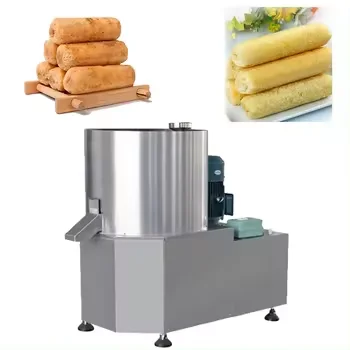
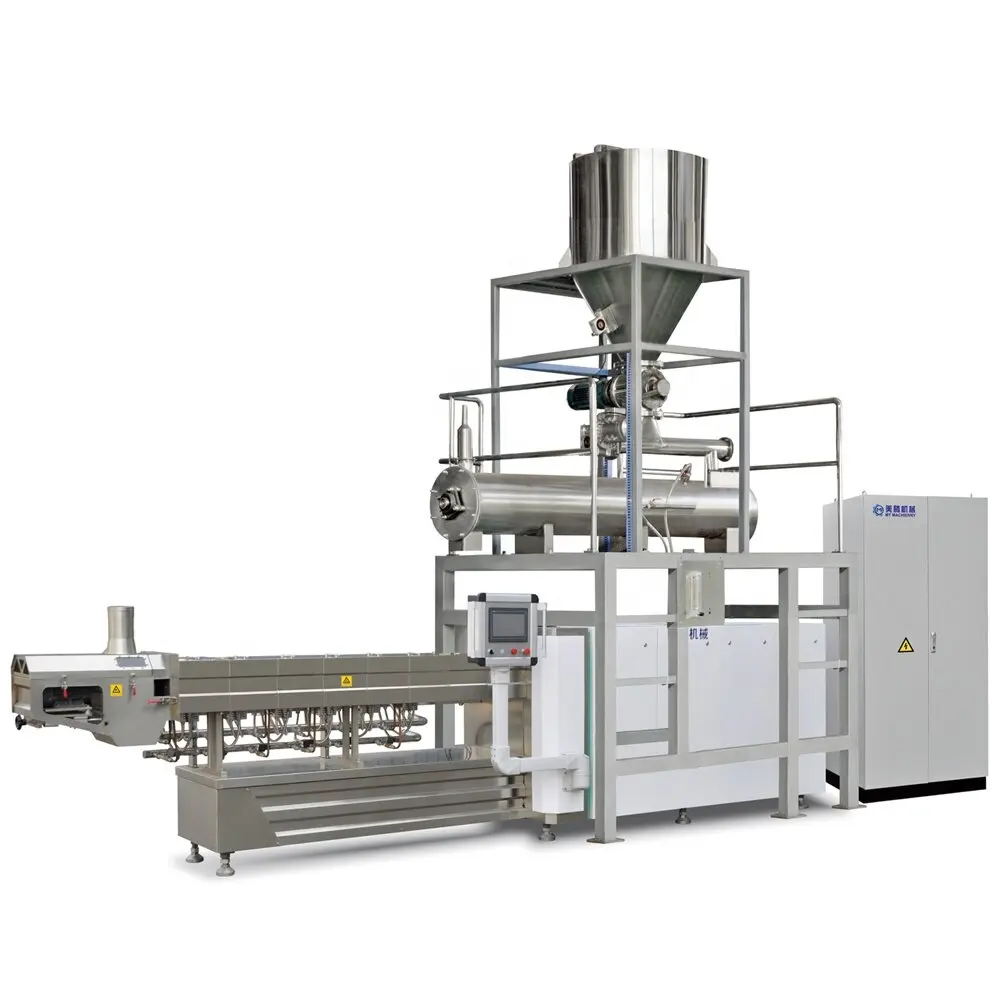
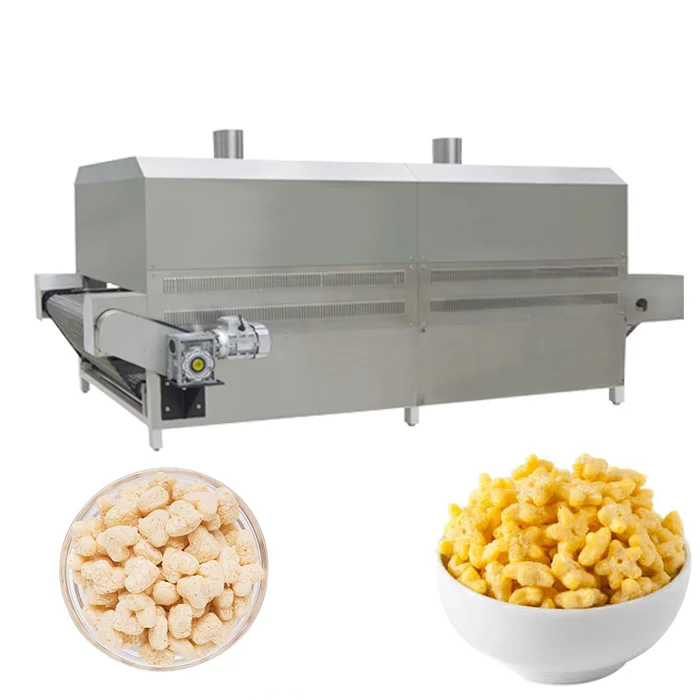
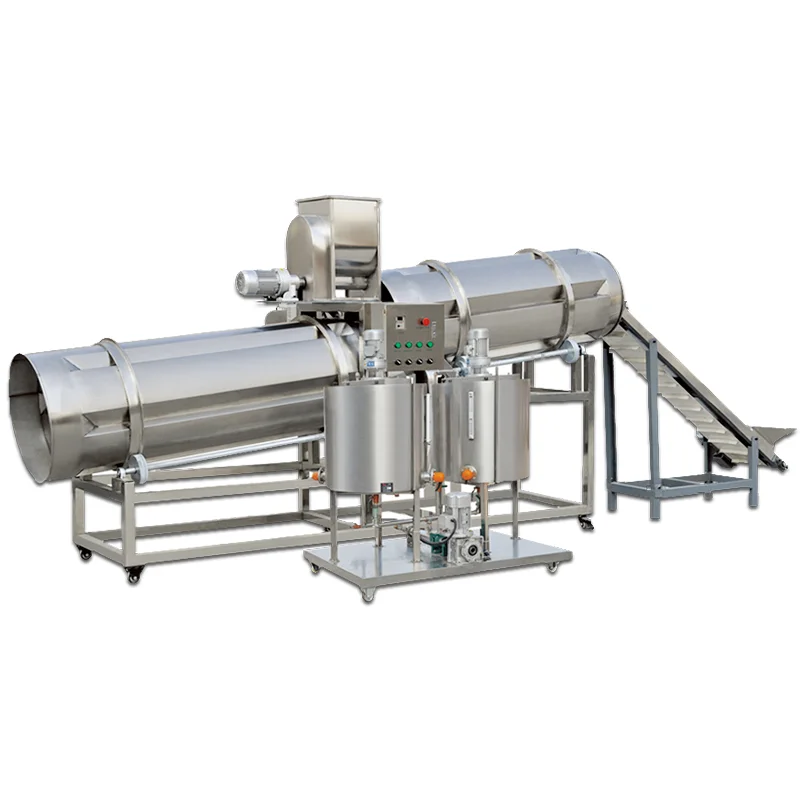

MT65 / MT70 / MT85 / MT100 Twin Screw Puffed Snacks Extrusion Line, 130–240 kW, Frequency Speed Control — complete turnkey production from material batching through extrusion, drying, coating, cooling to packing. Each station is throughput-matched under one supplier to prevent bottlenecks between extruder, dryer and flavoring drum. Screw configuration and die design are specified to your raw material and target snack shape. Layout drawings, utility planning and commissioning support are included with every project delivery.
- Core filling option available with dedicated cutting machine
- Dryer heating configurable to electric, steam or gas per site utility
- Automatic lubrication and cooling for stable continuous operation
- CE and ISO certified with in-house trial run before shipment
Description
Line-Integrated Throughput — Every station from batching to stacking is specified under one supplier, so extruder output, dryer residence time, and flavoring drum turnover stay synchronized on this twin-screw puffed snacks extrusion line.
Technical Specifications
| Parameter | Value |
|---|---|
| Product Type | Twin Screw Puffed Snacks Extrusion Line |
| Model Options | MT65 / MT70 / MT85 / MT100 |
| Installed Power | 130 kW (MT65) / 180 kW (MT70) / 220 kW (MT85) / 240 kW (MT100) |
| Real Consumption | 95 kW (MT65) / 120 kW (MT70) / 130 kW (MT85) / 160 kW (MT100) |
| Output Capacity | 120–150 kg/h (MT65) / 200–300 kg/h (MT70) / 300–500 kg/h (MT85) / 600–800 kg/h (MT100) (basis not stated in source) |
| Screw Type | Twin screw |
| Control System | Frequency speed controlling system |
| Dryer Heating Source Options | Electric / Steam / Gas |
| Line Stations | Batching → Extruding → Drying → Coating or Flavoring → Cooling → Packing → Stacking |
| Core Filling Option | Available with core filling machine and cutting machine |
| Lubrication | Automatic lubricating and cooling |
| Warranty | 1 year |
| Assembly State | Turnkey line (OEM/ODM design available) |
| Standards | CE, ISO |
Application Suitability
| Application | Material or Output |
|---|---|
| Cheese balls and rings | Corn flour, rice flour, wheat flour blends |
| Tubes, sticks, and stars | Corn grits, oat flour, barley flour mixes |
| Fruit loops and wheels | Multi-grain formulations with adjustable moisture |
| Core-filled snack variants | Grain-based shell with cream or paste center filling |
| Breakfast-adjacent puffed formats | Fortified flour blends targeting cereal texture profiles |
Why "Nameplate Capacity" Misses the Real Bottleneck on a Puffed Snacks Line
An extruder that runs 500 kg/h means nothing if the dryer or flavoring drum downstream cannot keep pace.
I have watched snack lines stall because the dryer was sized for a different moisture load, or the flavoring drum could not tumble fast enough for an oily formulation. The extruder keeps pushing product forward while downstream stations pile up, and the operator ends up throttling the screw speed just to prevent a jam. On a turnkey puffed snacks extrusion line, the question is never just how much the extruder can produce — it is whether every station from drying to packing can absorb that volume continuously. [NEED_CITE: throughput matching across food processing line stations]
How Throughput Gets Balanced Across Every Station
A puffed snacks extrusion line only holds its rated pace when the dryer residence time, the flavoring drum volume, and the cooling conveyor length are all calculated against the same material flow. On this line, each station is specified by the same engineering team that sizes the extruder, so the dryer bed area and the drum diameter are chosen to absorb the actual output rather than a generic estimate. Frequency speed control on the extruder gives operators room to fine-tune feed rate when raw material moisture shifts between batches.
Matching Dryer and Flavoring Capacity to Actual Formulations
The moisture content leaving the die directly determines how long the product must stay in the dryer, and the oil or sugar content of the coating determines how the flavoring drum must tumble. A high-moisture corn formulation demands a longer dryer bed or higher air temperature; a high-oil seasoning requires a drum with adjustable tilt and speed to avoid clumping. This puffed snacks extrusion line supports electric, steam, or gas heating for the dryer, allowing the thermal source to align with the site’s available utility infrastructure. [NEED_CITE: dryer heating source selection for food extrusion lines]
Reading the Specs That Actually Shape Output
The twin-screw configuration allows the line to handle a wider range of grain formulations than a single-screw setup, because the intermeshing screws provide more uniform shear and self-cleaning action across varying starch contents. The frequency-controlled drive keeps screw speed stable, which directly affects the expansion ratio and the density of the finished puff — a small speed drift changes the cell structure and alters how the product absorbs seasoning downstream. Automatic lubrication and cooling on the gearbox reduce thermal drift during long production runs, keeping the screw gap consistent over consecutive shifts. The choice of die geometry determines whether the line produces a thin-walled tube or a dense ball, and each shape demands a different dryer profile to reach the target final moisture.
The Hidden Cost of Mismatched Downstream Equipment
When a line is assembled from separate vendors, each station is often quoted on its own nameplate rating without confirming that the upstream feed rate matches. The result shows up as product backing up before the dryer, seasoning pooling at the bottom of the flavoring drum, or the packing station running empty while it waits for cooled product to arrive. These imbalances do not appear on the quotation — they appear on the first production day, when the line cannot reach its expected rhythm and the operator spends hours manually adjusting feed rates to prevent jams at each transition point. [NEED_CITE: food processing line bottleneck diagnosis]
Why This Line Is Specified as One Project
The entire production sequence — batching, extruding, drying, coating, cooling, packing, stacking — is configured by a single engineering team, so throughput calculations are consistent from the first hopper to the last pallet. Screw and die selection is tied to the buyer’s specific grain formulation and target snack shape rather than pulled from a generic catalog. An in-house testing workshop allows trial runs on the buyer’s actual raw material before the line ships, catching texture or density issues before installation begins. Electrical schematics and voltage specifications are confirmed during the design phase so that the control panel matches the factory’s power supply on arrival. The line layout drawing accounts for utility connections, operator walkways, and maintenance access at every station.
Documentation & Verification
- Line layout drawing showing station spacing and throughput calculations for your target snack format
- Screw and die configuration record matched to your grain formulation and product shape
- Trial run report on your raw material confirming expansion, texture, and density before shipment
- Electrical schematic with voltage, frequency, and control language confirmed to your site specification
- Factory test record documenting run-in performance across all stations prior to dispatch
Installation, Commissioning & Support
- Foundation and utility planning based on the MT65–MT100 power range and dryer heating source selected for your site
- Electrical commissioning tied to the confirmed voltage and frequency specification for your local grid
- Dryer thermal profiling during start-up to match your formulation’s moisture curve
- Flavoring drum speed and tilt adjustment calibrated to your seasoning viscosity and oil content
- Operator training covering die changeover, screw speed tuning, and lubrication system checks
- Wear parts schedule listing screws, dies, and heating elements for the first replacement cycle
What We Need to Size Your Line Correctly
To build an accurate layout and throughput calculation, share your target snack shapes, the grain flours or blends you plan to run, and the moisture range of your formulations. Include your site voltage and frequency, the available heating source for the dryer, and the floor area allocated for the full production sequence. If you have an existing packing system upstream or downstream, note its interface requirements so the line endpoints align.
Frequently Asked Questions
Q: How is line capacity verified, and what raw material and die configuration is it based on?
A: Output figures are tied to specific raw material types, moisture levels, and die geometries. Before quoting, we confirm your grain formulation and target snack shape, then run a trial in our testing workshop using your actual material. The resulting report documents the achievable throughput at the tested configuration, so the capacity number reflects your production conditions rather than a generic benchmark.
Q: How is throughput matched between extruder, dryer, flavoring drum, and packing?
A: Each station is sized against the same material flow calculation. The dryer bed area is set to handle the moisture load leaving the die, the flavoring drum volume and speed are matched to the coating formulation, and the cooling conveyor length is calculated to deliver product to packing at the correct temperature. One engineering team specifies every station to prevent imbalances.
Q: What factory layout and utility planning documentation is provided before installation?
A: You receive a scaled line layout drawing showing station positions, utility connection points, operator walkways, and maintenance clearance. Electrical schematics confirm voltage, frequency, and control language. Dryer heating source options — electric, steam, or gas — are selected during design to match your site infrastructure, and all utility requirements are documented before production begins.
Q: What is the commissioning schedule, and does operator training use our formulation?
A: Commissioning follows a phased sequence from individual station checks through full-line runs. Operator training covers screw speed adjustment, die changeover, dryer temperature profiling, and flavoring drum calibration using your actual raw material and target product. Training continues until your team can independently run the line and perform routine maintenance tasks.
Q: How are spare wear parts supplied for the first replacement cycle?
A: A wear parts list is included with the line documentation, identifying screws, dies, and heating elements by specification. Replacement intervals depend on your raw material abrasiveness and production hours. Parts can be ordered in advance so that the first changeover occurs without unplanned downtime, and configuration records ensure replacements match the original geometry.
Related products
-

Nueva Línea de Producción de Máquinas de Snacks Inflados Máquina de Hacer Copos de Maíz Extrusora de Doble Tornillo Capacidad de 100-500kg/h Alimentos
¥8,500.00 Select options This product has multiple variants. The options may be chosen on the product page -

Máquina Extrusora de Maíz Inflado Línea de Producción de Snacks Rellenos de Núcleo Inflado
¥8,500.00 Select options This product has multiple variants. The options may be chosen on the product page -

Máquina de Extrusión Automática de Crujientes de Maíz para Chips de Maíz y Palitos de Maíz en Nueva Condición
¥8,000.00 Select options This product has multiple variants. The options may be chosen on the product page -

Línea de producción de equipos industriales para el procesamiento de cereales de desayuno Crispy Maize Chocos Corn Flakes totalmente automática
¥1,000.00 Select options This product has multiple variants. The options may be chosen on the product page

