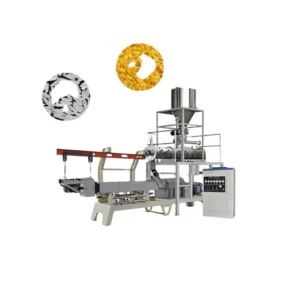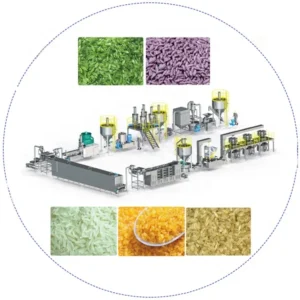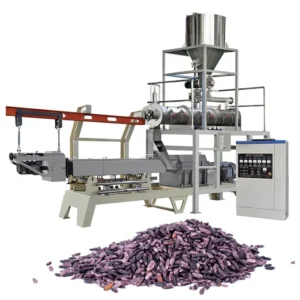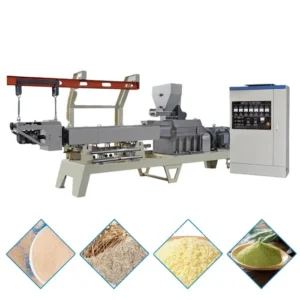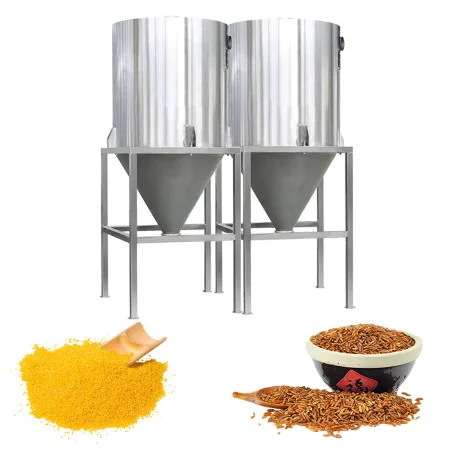

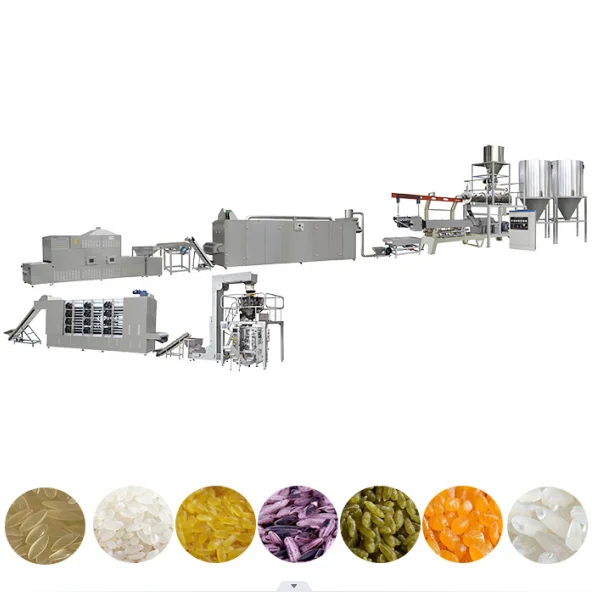
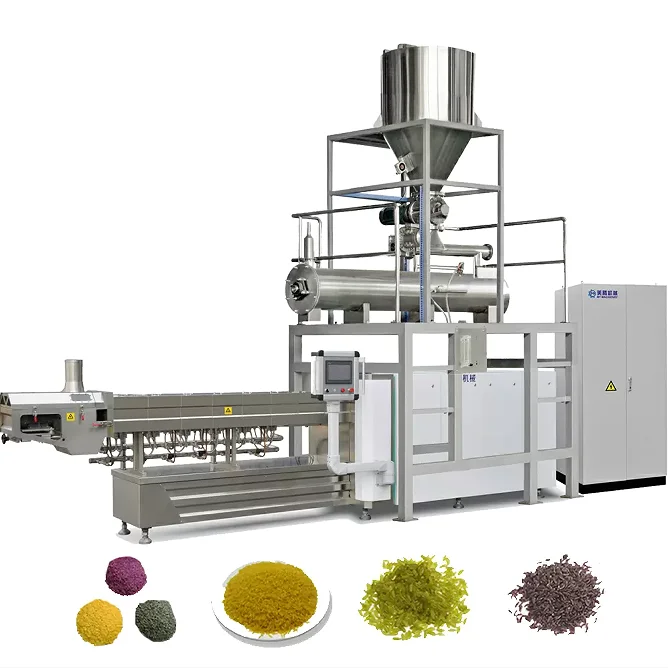
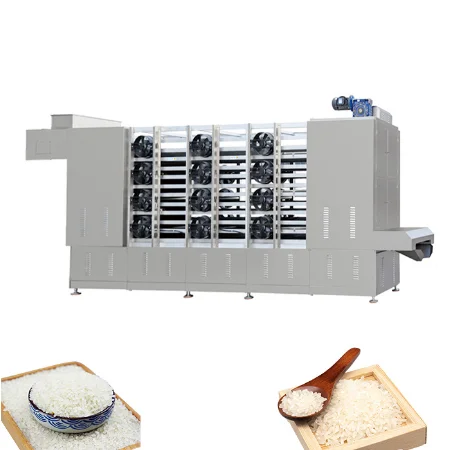
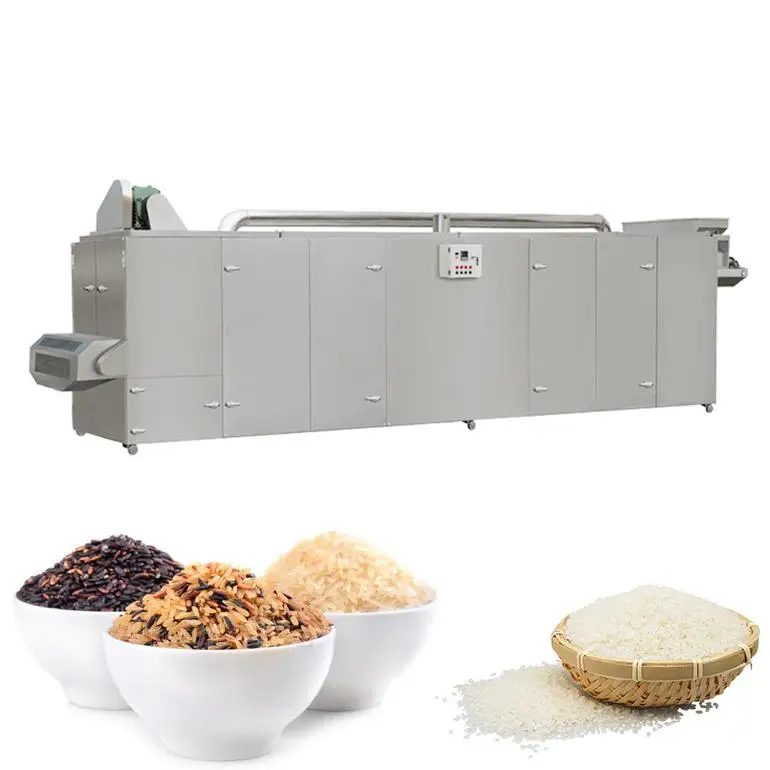
MT65, MT70, MT85, MT75, MT95 Fortified Rice Extruder Production Line, Twin Screw, CE Certified — engineered as a complete turnkey project from batching through extrusion, drying, roasting and packing.
- Screw configuration and die design specified to your raw material blend and target kernel density
- Multi-stage drying and roasting sequence ensures controlled moisture, texture and nutritional retention
- Frequency-controlled speed across all stations for flexible capacity adjustment
Layout, throughput matching and utility planning are completed before installation so every station keeps pace with your target output from day one.
Description
Throughput-matched station design — every mixer, extruder, dryer and roaster in the line is sized against your actual grain formulation so no single unit bottlenecks the run.
Technical Specifications
| Parameter | Value |
|---|---|
| Product Type | Fortified Rice Extruder Production Line |
| Available Models | MT65 / MT70 / MT85 / MT75 / MT95 |
| Installed Power | MT65: 85 kW; MT70: 120 kW; MT85: 235 kW; MT75: 180 kW; MT95: 260 kW |
| Power Consumption | MT65: 60 kW; MT70: 85 kW; MT85: 165 kW; MT75: 135 kW; MT95: 195 kW |
| Output Capacity | MT65: 80–100 kg/h; MT70: 100–120 kg/h; MT85: 200–300 kg/h; MT75: 300–500 kg/h; MT95: 800–1000 kg/h (basis not stated in source — confirm raw material formulation, moisture content and kernel size before quotation) |
| Overall Dimensions (L × W × H) | MT65: 28 × 1.2 × 2.2 m; MT70: 30 × 1.5 × 2.2 m; MT85: 34 × 3.5 × 4.3 m; MT75: 32 × 3.5 × 4.3 m; MT95: 36 × 3.5 × 4.3 m |
| Screw Type | Twin Screw |
| Feeding System | Single or double screw feeding available |
| Control System | Frequency speed controlling with high automation |
| Heating Source | Electric or gas for drying oven |
| Lubrication | Automatic lubricating and cooling system |
| Line Sequence | Mixing → Extruding → Vibrating → Low-Temperature Drying → Cooling → High-Temperature Roasting → Cooling → Packing |
Application Suitability
| Application | Material or Output |
|---|---|
| Vitamin- and mineral-enriched rice kernels | Broken rice, rice bran, corn, millet, wheat, oats, buckwheat, beans, starch with vitamin and mineral premix |
| Artificial rice for nutrition programmes | Rice flour blends with added micronutrients, shaped into natural-grain-look kernels |
| Grain value-added processing | Broken rice and milling by-products converted into reconstituted fortified rice |
| Contract packing for food aid | Shelf-stable fortified kernels packed in bulk or retail sachets |
Why "Rated Output" Means Little Without Your Raw Material
A capacity number only becomes real after the extruder has run your exact flour blend.
I once laid out a line for a buyer who sent us a spec sheet saying their target was 300 kg/h of fortified rice. We ran their broken-rice and millet blend in our testing workshop and the actual throughput was barely half of what a generic calculation suggested. The starch gelatinisation behaviour was completely different from our standard test meal, and the die pressure spiked every twenty minutes. [NEED_CITE: starch gelatinisation temperature variation across grain types] We reworked the screw configuration, adjusted the barrel temperature zones and only then could the line sustain the target rate. That trial run is now standard on every fortified rice extruder production line we ship, because guessing capacity from a catalogue chart is how packaging lines end up sitting idle waiting for upstream output.
How the Turnkey Artificial Rice Processing Line Is Laid Out
The fortified rice extruder production line starts at batching, where raw grain flours and the vitamin-mineral premix are weighed and blended to a set recipe. From there, the mixed feed enters the twin-screw extruder, where moisture, barrel heat and mechanical shear work together to gelatinise the starch matrix and form a dense, continuous strand. The strand is cut into individual rice-shaped kernels at the die face and falls onto a vibrating conveyor that separates them before they enter the first drying stage.
Each station in the turnkey artificial rice processing line is sized so that its maximum throughput matches — or slightly exceeds — the extruder output. The drying oven length, belt speed, cooling conveyor and roasting drum volume are all calculated from the same capacity base, which means no single unit becomes the bottleneck when you ramp up production. [NEED_CITE: line throughput matching principles in food extrusion]
Drying, Roasting and Moisture Control Sequence
After extrusion, kernels still carry enough residual moisture to deform under their own weight if stacked. The low-temperature drying stage removes surface and near-surface moisture gently, preventing case-hardening that would trap steam inside. A cooling conveyor then drops the kernel temperature before the high-temperature roasting stage, where the remaining internal moisture is driven off and the kernel achieves the hard, glassy texture expected of milled rice. A second cooling pass brings the product down to a safe packing temperature.
This multi-stage sequence matters because skipping or shortening any stage changes the final moisture content, which directly affects shelf life and cooking behaviour. Gas-fired and electric oven options are available so the line can be matched to the utility costs at the installation site.
Reading the Spec Sheet Against Your Production Reality
Installed power figures across the model range climb from 85 kW on the smallest unit to 260 kW on the largest, but actual running consumption is lower because heaters, drives and fans do not all draw peak load simultaneously. Power consumption values therefore give a closer picture of day-to-day electricity cost. When you compare models, look at the gap between installed and consumed power; a wider gap means more headroom for start-up surges and future recipe changes.
The twin-screw design allows a longer effective barrel length-to-diameter ratio within a compact footprint, which extends material residence time and improves starch conversion uniformity. Frequency-controlled drives on the main motor and feeder let you fine-tune screw speed and feed rate independently, an essential adjustment when you switch between a high-amylose rice blend and a softer millet or buckwheat formulation. The automatic lubricating and cooling system keeps barrel and screw temperatures stable over long shifts, reducing unplanned stops.
Dimensions grow substantially as capacity increases: the three larger models need a hall width of at least 3.5 m and ceiling clearance above 4.3 m, which rules out many older food-grade workshops without structural modification. Confirm your building envelope early so the line layout can be arranged in a U-shape or straight run accordingly.
The Hidden Cost of a Mismatched Dryer
Buyers who focus their negotiation on the extruder often treat the dryer as commodity equipment. [NEED_CITE: impact of insufficient drying capacity on extruded food shelf life] When the dryer cannot keep pace, the extruder must be slowed to prevent a backlog of wet kernels, which then stick together on the belt and create waste. Worse, partially dried kernels that enter the roasting stage carry uneven moisture, producing some kernels that are over-roasted and brittle while others remain soft and prone to mould in the bag. The result is a product that fails the texture and shelf-life tests your buyer expects, and you end up replacing dryer sections within the first year.
Why Sourcing the Full Line From One Supplier Matters Here
Every station in this artificial rice line is specified against the same capacity target and the same raw material data set, so throughput and utility loads align from day one. The screw and die configuration is chosen after we test your grain blend in the workshop, not copied from a generic build. Electrical schematics and control language are confirmed against your site voltage and operator preference before metal is cut. The testing workshop produces a documented trial run on your actual formulation, giving you a baseline recipe before the machine leaves the factory. Post-shipment support covers installation, commissioning and operator training so the crew running the line on Monday morning already know the parameter ranges.
Documentation & Verification
- Line layout drawing with throughput calculation for every station on your grain blend
- Screw and die configuration record matched to your specific rice and micronutrient ratio
- Trial run report on customer raw material including moisture, density and kernel integrity data
- Electrical schematic with confirmed voltage, frequency and control language for your market
- CE declaration of conformity and ISO certificate for customs and import licensing
Installation, Commissioning & Support
- Foundation plan showing load points for the MT85/MT75/MT95 models requiring 3.5 m hall width
- Dedicated electrical circuit sizing based on confirmed installed power and starting current
- On-site mechanical assembly and belt alignment for the multi-stage drying and roasting conveyors
- First-run parameter setting on your grain formulation with engineer present for full shift
- Operator training covering frequency drive adjustment, screw speed and barrel temperature zones
- Wear parts list with recommended replacement intervals for screws, dies and dryer belt sections
Preparing a Workable Inquiry
To move from a general inquiry to a line configuration that fits your facility, share the grain composition and micronutrient premix details, your target daily output and shift pattern, and the available floor area with ceiling height. [NEED_CITE: voltage and frequency standards by export market] Confirm the local supply voltage and frequency so the motors and heaters can be wound correctly, and specify the preferred control language for the HMI screens. If you already operate upstream milling or downstream packing equipment, provide their throughput figures so the line can be integrated without buffer overflows.
Frequently Asked Questions
Q: How is line capacity verified against my specific raw material formulation and kernel size?
A: We run your actual grain blend through the extruder in our testing workshop before shipment. The trial records throughput, die pressure, barrel temperatures and final kernel moisture. Those results form the baseline configuration document, so the capacity figure in your quotation reflects your material, not a generic test meal.
Q: What voltage, frequency and control language options are confirmed before production?
A: Electrical schematics are drawn to your site voltage and frequency once you confirm them during the specification stage. Motor windings, heater elements and transformer ratings are matched accordingly. The HMI and PLC screens are loaded with the operator language you specify, so commissioning starts without translation delays.
Q: How do you match throughput between the extruder, dryer and roasting stations?
A: Each station is sized from the same capacity calculation based on your confirmed extruder output. Dryer belt length, roasting drum volume and cooling conveyor speed are all proportioned so that no single unit forces the extruder to slow down, preventing wet-kernel backlog and texture inconsistency.
Q: Is a trial run on my raw material performed before shipment, and what does the report cover?
A: Yes. The trial uses your supplied grain blend and premix. The report documents screw speed, barrel temperature profile, die configuration, throughput rate, kernel moisture and density readings at each stage. You receive a copy before the machine is crated, giving your team a starting recipe on day one.
Q: What does on-site installation, commissioning and operator training include?
A: Our engineer supervises mechanical assembly, electrical connection and first-run parameter tuning on your material. Operators are trained on frequency drive adjustment, temperature zone setting, screw and die changeover, and daily maintenance routines. A wear parts list with replacement intervals is handed over at sign-off.
Related products
-
Línea de producción de alimentos para bebés en polvo de nutrición fortificada totalmente automática
¥8,238.27 Select options This product has multiple variants. The options may be chosen on the product page -

Línea de procesamiento de extrusión de arroz en polvo nutricional para bebés de alta precisión 500kg/h
¥8,238.27 Add to cart -
Máquina automática de hacer harina de arroz en polvo de nutrición para bebés de la marca MT de pequeña escala con capacidad de producción de 500 kg/h y control PLC.
¥9,500.00 Add to cart -
Línea de procesamiento de extrusión de arroz en polvo nutricional para bebés de alta precisión 500kg/h
¥9,500.00 Add to cart