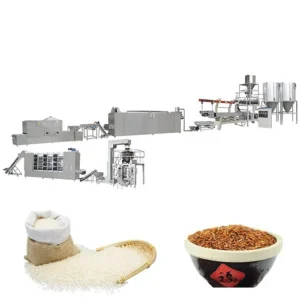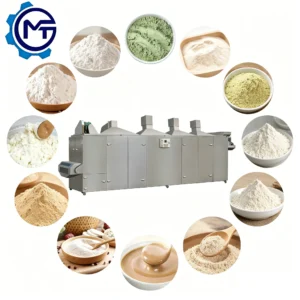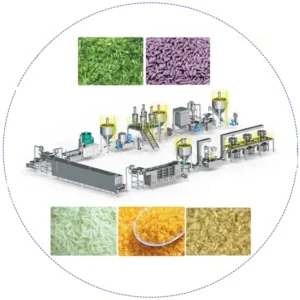
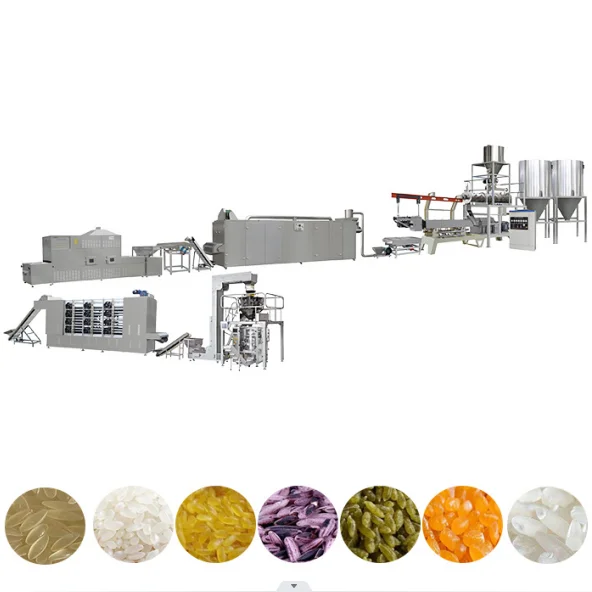

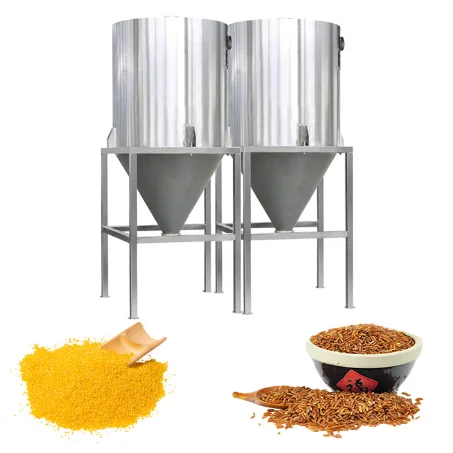
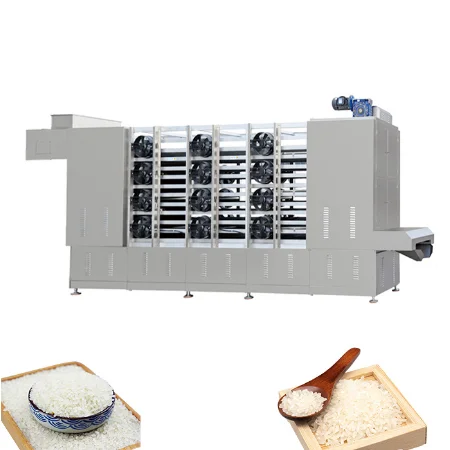

MT65 / MT70 / MT85 / MT75 / MT95 Fortified Rice Processing Line, Twin-Screw Extrusion, PLC Control — designed for turnkey project contractors requiring throughput-matched stations from mixing through extrusion, drying, roasting to packing. Screw configuration and die design are specified to your grain blend and target kernel density, ensuring consistent expansion and moisture control across the full line layout. Includes line capacity calculation, trial run on customer raw material before shipment, and phased commissioning support.
Description
Throughput-matched stations — every mixer, extruder and dryer in the line is sized against your grain blend data, not brochure numbers, before the layout is finalized.
Technical Specifications
| Parameter | Value |
|---|---|
| Product Type | Fortified Rice Processing Line |
| Models Available | MT65 / MT70 / MT85 / MT75 / MT95 |
| Screw Type | Twin-screw (single or double screw feeding selectable by material) |
| MT65 Installed Power | 85 kW |
| MT65 Power Consumption | 60 kW |
| MT65 Output Capacity | 80–100 kg/h (basis not stated in source — confirm raw material / moisture) |
| MT65 Dimensions (L×W×H) | 28 × 1.2 × 2.2 m |
| MT70 Installed Power | 120 kW |
| MT70 Power Consumption | 85 kW |
| MT70 Output Capacity | 100–120 kg/h (basis not stated in source — confirm raw material / moisture) |
| MT70 Dimensions (L×W×H) | 30 × 1.5 × 2.2 m |
| MT85 Installed Power | 235 kW |
| MT85 Power Consumption | 165 kW |
| MT85 Output Capacity | 200–300 kg/h (basis not stated in source — confirm raw material / moisture) |
| MT85 Dimensions (L×W×H) | 34 × 3.5 × 4.3 m |
| MT75 Installed Power | 180 kW |
| MT75 Power Consumption | 135 kW |
| MT75 Output Capacity | 300–500 kg/h (basis not stated in source — confirm raw material / moisture) |
| MT75 Dimensions (L×W×H) | 32 × 3.5 × 4.3 m |
| MT95 Installed Power | 260 kW |
| MT95 Power Consumption | 195 kW |
| MT95 Output Capacity | 800–1000 kg/h (basis not stated in source — confirm raw material / moisture) |
| MT95 Dimensions (L×W×H) | 36 × 3.5 × 4.3 m |
| Control System | Frequency speed control, automatic lubrication and cooling |
| Dryer Heating Source | Electric or gas |
| Dryer Feature | Circulation drying, mesh belt speed controlled by frequency motor |
| Line Sequence | Mixing → Extruding → Vibrating → Low-temperature drying → Cooling → High-temperature roasting → Cooling → Packing |
| Standards | CE, ISO |
Application Suitability
| Application | Material or Output |
|---|---|
| Nutrition programme rice supply | Broken rice and rice bran blended with vitamin and mineral premix, extruded into fortified kernels |
| Instant rice porridge raw material | Rice, millet and oat blends processed into quick-cooking artificial rice grains |
| Cereal processor upcycling | Broken rice and wheat converted into high-nutrition artificial rice for retail or institutional distribution |
| Fortified food contracting | Corn, buckwheat and bean blends with micro-nutrient additives shaped into uniform fortified rice kernels |
When "Rated Capacity" Fails on Your Grain Blend
The Fortified Rice Processing Line turnkey capacity must be verified against your actual formulation before any station is built.
I have watched a line stall for weeks during commissioning because the extruder could not sustain half its quoted output on the client’s high-fiber grain mix. The mixer ran faster than the extruder could accept material, and the dryer sat idle while operators hand-fed batches. [NEED_CITE: throughput mismatch consequences in extrusion line commissioning] A turnkey project only works when throughput at every station — from batching through roasting to packing — is calculated against the buyer’s specific raw material and moisture content.
Phased Layout and Utility Planning for Rice Extrusion Facilities
A Fortified Rice Processing Line turnkey installation starts with the floor plan. Each station — mixer, twin-screw extruder, vibrating conveyor, low-temperature dryer, cooler, high-temperature roaster and packing station — must be positioned so material flows without manual intervention or buffer piling. The layout document specifies utility drop points for electrical feeds, gas lines if the dryer is gas-fired, and compressed air for pneumatic controls. Utility planning happens before equipment fabrication so the contractor can prepare the site in parallel with machine production.
Throughput Alignment Across Every Station on the Line
Matching capacity between stations is where most multi-vendor lines fall apart. The extruder barrel and screw configuration determine output based on the buyer’s grain blend, and every downstream station must handle that exact flow. The circulation dryer uses frequency-controlled mesh belt speed to match extruder throughput, preventing moisture inconsistency that leads to cracked kernels or uneven roasting. The cooling conveyors and roaster are sized to the same calculated rate so no station becomes a bottleneck during continuous production. [NEED_CITE: station throughput alignment in food extrusion lines]
How Screw Configuration and Die Design Shape Fortified Rice Kernels
The twin-screw extruder in this line processes cereal and starch blends under controlled moisture, heat and shear. Screw elements are arranged to achieve the gelatinization level required for artificial rice — enough starch conversion to produce a dense, rehydratable kernel without the expansion you would see in a puffed snack. Die geometry determines kernel shape and size, and the configuration is selected based on whether the formulation leans toward broken rice, wheat or a multi-grain blend with added micro-nutrients. Frequency-controlled screw speed and automatic barrel cooling maintain batch consistency across long production runs, reducing variation between the first and last bag of a shift.
The Hidden Cost of Skipping Material-Specific Configuration
When an extruder is ordered on catalog specs alone, the screw elements and die are typically set to a generic build. On a high-fiber or high-protein grain blend, that generic setup can produce kernels that are either too porous to survive packing or too dense to cook within the target time. The dryer then has to run longer to reach final moisture, cutting effective line output. [NEED_CITE: screw and die mismatch effects on extruded rice kernel quality] Commissioning delays compound when the control language, voltage or frequency has not been confirmed with the installation site before production begins.
Why Project Contractors Choose This Line Build
The Fortified Rice Processing Line turnkey is supplied by one source covering every station from batching to packing, so throughput is calculated across the full sequence rather than assembled from mismatched vendor quotes. Screw configuration and die design are specified to the buyer’s raw material before the order enters production. An in-house testing workshop runs trial batches on the customer’s actual grain blend before shipment, producing a trial run report that confirms output and kernel quality. Pre-sales layout design flows into on-site installation, phased commissioning and operator training, with wear parts such as screws and dies available from the same source when the first replacement falls due. [NEED_CITE: turnkey project documentation standards for food processing lines]
Documentation & Verification
- Line layout with throughput calculation at each station against your target output
- Screw and die configuration record matched to your grain blend formulation
- Trial run report produced on your raw material in the testing workshop before dispatch
- Electrical schematic with voltage, frequency and control language confirmed to your site
- CE declaration of conformity and ISO certificate included in shipment documentation
Installation, Commissioning & Support
- Site preparation drawing showing foundation loads for the MT85 at 34 × 3.5 m footprint
- Dedicated electrical circuit plan based on model installed power up to 260 kW for the MT95
- Phased assembly sequence so extruder, dryer and roaster are positioned before utility connections
- First-run parameter logging with frequency speed settings and barrel temperature profile recorded
- Operator training covering screw element inspection, die cleaning and automatic lubrication checks
- Wear parts list covering screws, dies and mesh belt sections for first-year maintenance planning
What to Include with Your Line Inquiry
Share your grain blend composition, target kernel dimensions and daily output requirement so the layout can be calculated from real material data rather than generic catalog figures. Confirm the installation site voltage, frequency and preferred control language so the electrical schematic is finalized before fabrication. Let us know your available floor space and ceiling height, and whether an in-plant trial run on your raw material is required before shipment.
Frequently Asked Questions
Q: How is line capacity verified against my specific grain blend and moisture content?
A: Before the order is confirmed, your raw material formulation and moisture data are used to calculate throughput at each station. A trial run is then performed in the testing workshop using your actual grain blend, and the output figures from that run — not catalog numbers — are recorded in the trial run report that ships with the line documentation.
Q: How are extruder, dryer and cooler throughput matched so no station bottlenecks the line?
A: Each station is sized to the extruder output calculated from your material data. The circulation dryer uses frequency-controlled mesh belt speed to track extruder flow, and the cooling conveyors and roaster are dimensioned to the same rate so material moves continuously without buffer piling or idle time between stages.
Q: What voltage, frequency and control language options are confirmed before production?
A: The electrical schematic is prepared with your site voltage, frequency and preferred control interface language confirmed in writing before fabrication starts. This prevents the common delay of rewiring or reprogramming panels during on-site commissioning, which typically adds days to the installation schedule.
Q: How is the installation phased and what does the commissioning schedule look like?
A: Installation follows a phased sequence — foundation and utility rough-in, station positioning, mechanical connections, electrical hookup, then dry-run testing before material is introduced. The commissioning schedule covers parameter tuning on your grain blend, throughput verification against the trial run report and operator training on screw inspection, die changes and daily maintenance routines.
Q: Can a trial run be done on my raw material before the line ships?
A: Yes. The testing workshop runs your grain blend through the extruder and downstream stations before dispatch. The trial run report documents kernel density, moisture at each stage and actual throughput, giving you verified performance data rather than estimates before the equipment leaves the factory.
Related products
-
Máquina Automática de Fabricación de Polvo Nutricional Cereal de Arroz Seguro para Bebés
¥30.00 Select options This product has multiple variants. The options may be chosen on the product page -
Línea de producción de alimentos para bebés en polvo de nutrición fortificada totalmente automática
¥8,238.27 Select options This product has multiple variants. The options may be chosen on the product page -
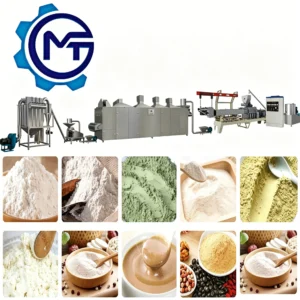
Línea de procesamiento de producción automática de 500 kg/h de polvo de nutrición de arroz para bebés orgánico y sin gluten
¥8,238.27 Add to cart -

Línea de proceso de fabricación de extrusora de polvo de nutrición para bebés de 500 kg/h automática industrial
¥8,238.27 Add to cart