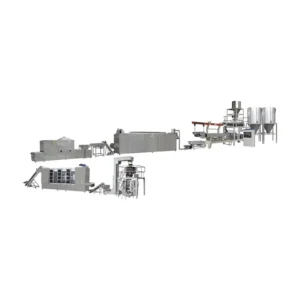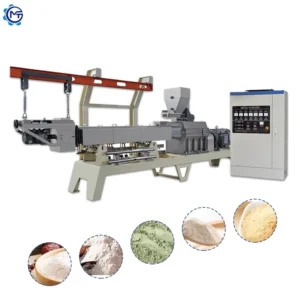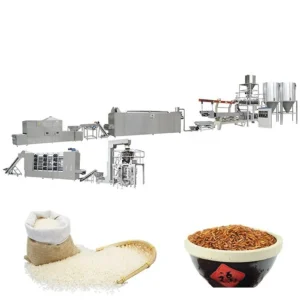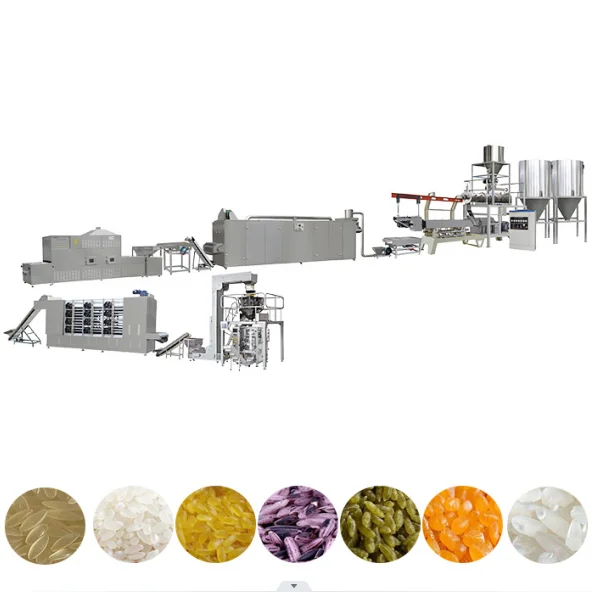


MT65 / MT70 / MT85 / MT75 / MT95 Artificial Fortified Rice Processing Line, Twin-Screw Extrusion, Frequency Speed Control — engineered for complete nutritional rice production from mixing through extrusion, drying, roasting and packing.
- Screw configuration and die design specified to your grain blend and target kernel density
- Throughput matched across every station — extruder, dryer, roaster and packing — to eliminate bottlenecks
- Drying oven with circulation process and mesh belt speed controlled by frequency motor for uniform moisture reduction
Turnkey layout, capacity calculation and trial run on your raw material provided before shipment.
Description
Screw Configuration Matched to Material — Die design and barrel temperature profile specified to your grain blend and target kernel density, not copied from a generic build.
Technical Specifications
| Parameter | Value |
|---|---|
| Model | MT65 / MT70 / MT85 / MT75 / MT95 |
| Product Type | Artificial Nutritional Fortified Rice Processing Line |
| Screw Type | Twin-screw extruder |
| Installed Power | 85 kW (MT65) / 120 kW (MT70) / 235 kW (MT85) / 180 kW (MT75) / 260 kW (MT95) |
| Power Consumption | 60 kW (MT65) / 85 kW (MT70) / 165 kW (MT85) / 135 kW (MT75) / 195 kW (MT95) |
| Output Capacity | 80–100 kg/h (MT65, basis to be confirmed) / 100–120 kg/h (MT70, basis to be confirmed) / 200–300 kg/h (MT85, basis to be confirmed) / 300–500 kg/h (MT75, basis to be confirmed) / 800–1000 kg/h (MT95, basis to be confirmed) |
| Overall Dimensions (L×W×H) | 28×1.2×2.2 m (MT65) / 30×1.5×2.2 m (MT70) / 34×3.5×4.3 m (MT85) / 32×3.5×4.3 m (MT75) / 36×3.5×4.3 m (MT95) |
| Control System | Frequency speed controlling with high automation |
| Drying Oven Heating Source | Electric or gas |
| Drying Oven Feature | Circulation drying, mesh belt speed controlled by frequency motor |
| Lubrication | Automatic lubricating and cooling system |
| Production Procedure | Mixing → Extruding → Vibrating → Low-temperature drying → Cooling → High-temperature roasting → Cooling → Packing |
| Assembly State | Complete turnkey line |
Application Suitability
| Application | Material or Output |
|---|---|
| Fortified food and nutrition programme supply | Vitamin- and mineral-enriched rice kernels from broken rice base with supplementary micronutrients |
| Rice processor value addition | Artificial rice kernels repurposing broken rice and rice bran into uniform, marketable grain |
| Grain blend diversification | Fortified rice formats from corn, millet, wheat, oats, buckwheat and bean blends with starch binder |
| Institutional and government food distribution | Nutritionally standardised kernel batches meeting programme specification for mass feeding |
What "300 kg/h Output" Leaves Out About Fortified Rice Lines
A capacity number without the raw material and moisture basis is not a capacity — it is a guess.
Every fortified rice production line turnkey proposal I have been involved with started with a buyer asking one question first: can this line actually hold the quoted throughput on my grain? When the source material shifts from standard polished rice to local broken rice with a different starch profile, the extrusion behaviour changes entirely. Gelatinisation temperature, residence time in the barrel, and die pressure all respond differently. I have watched commissioning stretch well beyond schedule because the line was sized on a reference material that never matched what showed up at the factory door. [NEED_CITE: starch gelatinisation behaviour across rice varieties in extrusion processing]
How Barrel Temperature Profile Shapes the Kernel
The twin-screw extruder in this line does more than push material through a die. The barrel temperature profile, combined with screw configuration, determines how completely the starch in your grain blend gelatinises before it exits. Incomplete gelatinisation produces kernels that fracture during drying or fail to rehydrate properly when cooked. Each of the five models, from MT65 through MT95, allows the barrel zones to be set independently, matching the thermal behaviour of your specific raw material blend. A fortified rice production line turnkey project succeeds or fails on this thermal control.
Why Throughput Matching Between Stations Decides Actual Output
Extruder capacity means nothing if the downstream dryer cannot remove moisture fast enough, or if the roasting station creates a bottleneck. This line sequences low-temperature drying followed by cooling, then high-temperature roasting and a second cooling pass before packing. Each station is specified to handle the volume the extruder delivers, so material does not pile up between stages. When throughput is mismatched, operators end up running the extruder below its rated speed just to keep the rest of the line from flooding. [NEED_CITE: throughput balancing principles in multi-stage food processing lines]
Reading the Specifications That Actually Matter
The installed power figures — ranging from 85 kW on the MT65 to 260 kW on the MT95 — indicate the motor capacity available to drive the screws through viscous, high-starch dough. Power consumption values sit noticeably lower than installed power, reflecting the actual draw during steady-state operation. The automatic lubricating and cooling system maintains screw and bearing temperatures during continuous runs, preventing the thermal drift that causes kernel density to shift mid-batch. Drying oven options include electric or gas heating, with mesh belt speed controlled by a frequency motor — this allows the drying curve to be adjusted when switching between a high-moisture broken rice formulation and a drier corn or buckwheat blend. The overall line footprint, reaching up to 36×3.5×4.3 m on the MT95, reflects the physical length required for the full procedure from mixing through to packing without compressing any single stage.
The Cost of Skipping a Trial Run
Shipping a line without verifying it against the buyer’s actual grain blend is the most common reason commissioning turns into a rebuild. Screw configuration and die geometry that work on one starch source produce entirely different kernel shapes, densities, and surface textures on another. I have seen lines arrive on site with parameter sheets that had to be discarded entirely because the local raw material behaved nothing like the test material used at the factory. The result is weeks of rework, wasted raw material, and a production start date that keeps slipping. [NEED_CITE: importance of raw material trial runs before extrusion line shipment]
Why Sourcing the Full Line From One Supplier Matters Here
Every station on this fortified rice production line turnkey — mixing, extruding, vibrating, drying, cooling, roasting, and packing — is specified as a single integrated system. Throughput is calculated across all stages rather than assembled from independent vendors who each quote their own nominal capacity. Screw configuration and die design are selected based on the buyer’s raw material formulation, not carried over from a default build. An in-house testing workshop allows trial runs on customer-supplied grain before the line is cleared for shipment. Pre-sales engineering covers line layout and utility planning, and the same team handles on-site installation, commissioning, and operator training through to steady-state production.
Documentation & Verification
- Line layout and capacity calculation showing throughput matching across all stations
- Screw and die configuration record specific to your grain blend and target kernel shape
- Trial run report produced on your raw material in the testing workshop before dispatch
- Electrical schematic with voltage and frequency confirmed for your local grid standard
- Operation and maintenance manual covering all line stations from mixer to packer
- Wear parts list identifying screws, dies, and mesh belts with replacement intervals
Installation, Commissioning & Support
- Foundation and floor space planned to the line dimensions, up to 36×3.5×4.3 m for the MT95 configuration
- Dedicated power circuit sized to the installed power requirement, up to 260 kW at confirmed voltage and frequency
- Drying oven heating source selected as electric or gas based on local utility availability
- First-run parameter setting on your grain blend during on-site commissioning, with barrel temperature and screw speed adjusted to achieve target kernel density
- Operator training covering frequency speed controls, automatic lubrication monitoring, and mesh belt speed adjustment on the drying oven
- Spare screw elements and die plates supplied with the initial shipment to cover the first replacement cycle
What We Need to Configure Your Line
To move from an inquiry to a line proposal, share the grain or starch base you plan to use, including any broken rice, rice bran, or secondary grains in the blend. Specify your target daily or hourly output so the correct model can be matched to your volume. Confirm your local voltage and frequency, and let us know if you require the drying oven configured for gas or electric heating. If you can send a sample of your raw material, a trial run in the testing workshop will verify extrusion behaviour before any equipment is built.
Frequently Asked Questions
Q: How is output capacity verified against my specific raw material and moisture content?
A: Output figures in the specification table are listed with a basis-to-be-confirmed note because actual throughput depends on your grain blend, starch content, and feed moisture. We run your raw material in the testing workshop to establish the real capacity before the quotation is finalised.
Q: How do I choose between MT65, MT70, MT85, MT75 and MT95 based on my grain blend?
A: Selection depends on your target output and raw material characteristics. Smaller models like MT65 suit pilot-scale or nutrition programme batches, while MT95 handles high-volume production. Screw configuration is then matched to your specific grain and target kernel density.
Q: How is throughput balanced between the extruder, dryer, roaster and packing station?
A: Each station is sized during line layout to handle the volume the extruder produces. The drying oven mesh belt speed and roasting cycle are calculated so material flows continuously without queuing between stages or forcing the extruder to run below its working speed.
Q: What voltage, frequency and control language options are available for my country?
A: Voltage and frequency are confirmed during the specification phase before production begins. The control system uses frequency speed controlling, and interface language is set to match your operators. Electrical schematics are provided in the documentation package for local compliance.
Q: Can I send my raw material for a trial run before shipment?
A: Yes. The testing workshop runs your actual grain blend through the extruder to verify screw configuration, die geometry, and barrel temperature settings. A trial run report is generated and shared before the line is approved for dispatch.
Related products
-
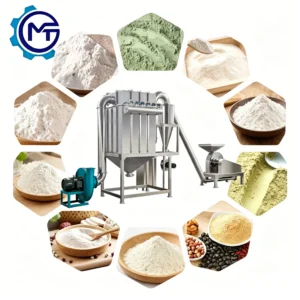
Línea de producción de polvo de nutrición de cereales para bebés automática y compacta con capacidad de 500 kg/h y control PLC
¥9,500.00 Add to cart -
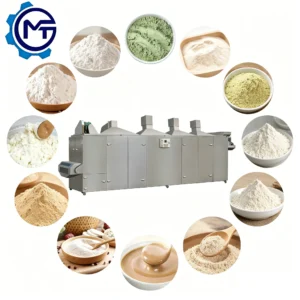
Máquina automática de hacer harina de arroz en polvo de nutrición para bebés de la marca MT de pequeña escala con capacidad de producción de 500 kg/h y control PLC.
¥9,500.00 Add to cart -
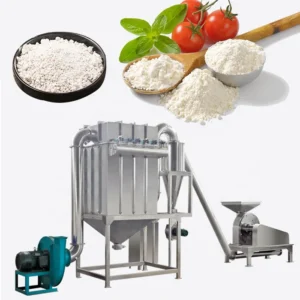
Nueva máquina automática para la producción de polvo nutricional para la línea de producción de alimentos para bebés.
¥20.00 Select options This product has multiple variants. The options may be chosen on the product page -
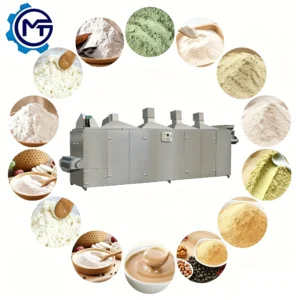
Máquina comercial de mezcla y molienda de polvo de arroz para bebés de acero inoxidable
¥8,238.27 Select options This product has multiple variants. The options may be chosen on the product page