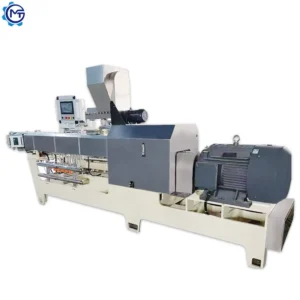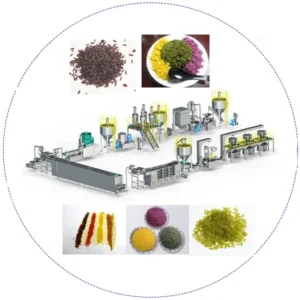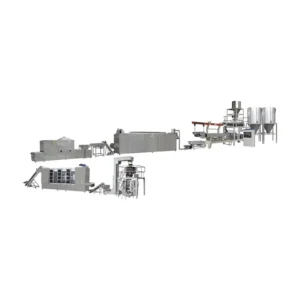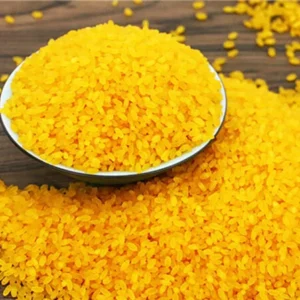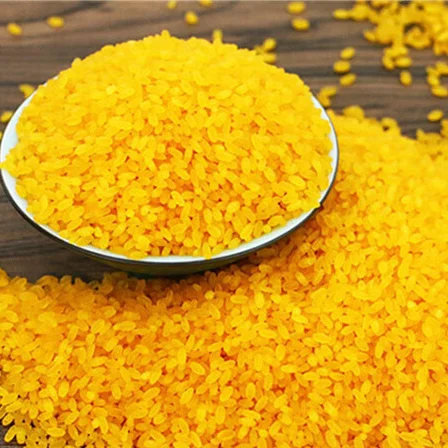
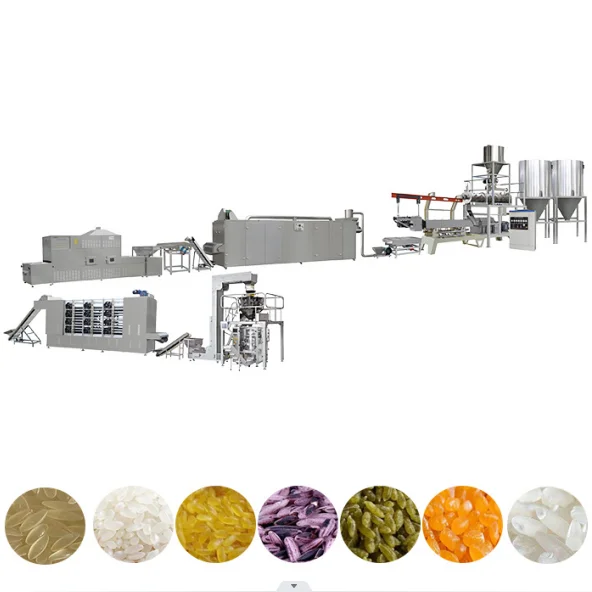

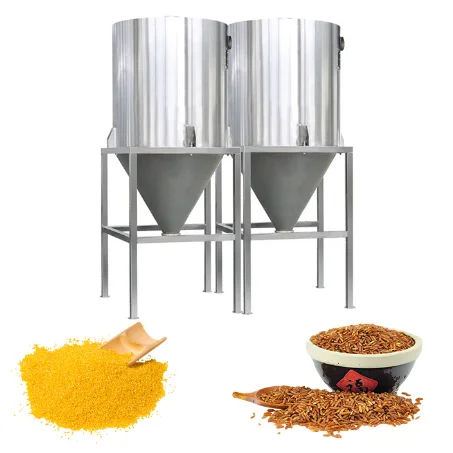
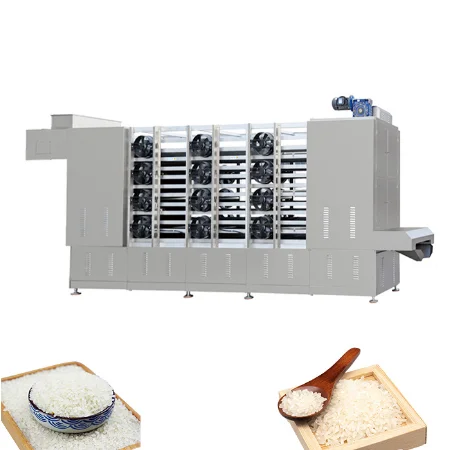

MT65 Fortified Artificial Rice Production Line, Twin-Screw Extruder, 85 kW Installed Power — designed for converting broken rice, corn, millet and starch into nutritionally fortified rice kernels with added vitamins and minerals.
- Screw configuration and die design matched to raw material blend and target kernel density, with selectable single or double screw feeding for material stability
- Complete line from mixing through low temperature drying, high temperature roasting and packing, with throughput balanced across every station
Trial runs on your actual raw material in our testing workshop validate line capacity and product specification before shipment.
Description
Matched Throughput Across Stations — Every segment from batching through extrusion, drying, roasting and packing is sized to the same target output, so no single unit becomes the bottleneck on a nutritionally fortified artificial rice production line.
Technical Specifications
| Parameter | Value |
|---|---|
| Model | MT65 / MT70 / MT85 / MT75 / MT95 |
| Product Type | Nutritionally Fortified Artificial Rice Production Line |
| Installed Power | 85 kW (MT65) / 120 kW (MT70) / 235 kW (MT85) / 180 kW (MT75) / 260 kW (MT95) |
| Power Consumption | 60 kW (MT65) / 85 kW (MT70) / 165 kW (MT85) / 135 kW (MT75) / 195 kW (MT95) |
| Output Capacity | 80–100 kg/h (MT65) / 100–120 kg/h (MT70) / 200–300 kg/h (MT85) / 300–500 kg/h (MT75) / 800–1000 kg/h (MT95) (basis not stated in source — confirm raw material formulation and moisture content) |
| Overall Dimensions (L×W×H) | 28 × 1.2 × 2.2 m (MT65) / 30 × 1.5 × 2.2 m (MT70) / 34 × 3.5 × 4.3 m (MT85) / 32 × 3.5 × 4.3 m (MT75) / 36 × 3.5 × 4.3 m (MT95) |
| Screw Type | Twin screw |
| Feeding System | Single or double screw feeding system selectable based on material |
| Control System | Frequency speed control with high automation |
| Line Stations | Mixing, Extruding, Vibrating, Low temperature drying, Cooling, High temperature roasting, Cooling, Packing |
| Heating Source (Dryer) | Electric or gas |
Application Suitability
| Application | Material or Output |
|---|---|
| Fortified food and nutrition programme supply | Vitamin- and mineral-enriched rice kernels for food security initiatives |
| Broken rice and rice bran conversion | High-nutritional-value artificial rice from milled grain residues |
| Multi-grain fortified rice production | Corn, millet, wheat, oats, buckwheat, and beans blended with starch base |
| Micronutrient-dense kernel manufacturing | Custom vitamin and mineral premixes integrated into grain-based formulations |
Why the Stated Output Rarely Survives Contact with Your Actual Premix
Capacity figures assume a baseline formulation that your specific vitamin and mineral blend may not match.
An artificial rice production line turnkey quotation typically arrives with a clean throughput number, but that number rests on an assumption about raw material behaviour. When you introduce fat-soluble vitamins, mineral salts, or fibre-rich bran into the starch matrix, the melt viscosity inside the barrel changes. The screw set that handled the supplier’s test flour may stall, surge, or produce kernels with uneven density on your premix. I have watched lines in Southeast Asia sit idle for weeks because the extruder was specified to a catalogue capacity that the buyer’s actual formulation could not sustain [NEED_CITE: material formulation impact on extrusion throughput].
The only way to confirm what an artificial rice production line turnkey will actually deliver is to run your material through the exact screw and die configuration before the machine leaves the factory.
How Screw Geometry Handles Fortified Starch Blends
The twin-screw configuration on this line allows the screw elements to be rearranged along the shaft, creating zones of high shear for starch gelatinisation and low shear for gentle mixing of heat-sensitive micronutrients. When a formulation contains a high proportion of mineral premix, the conveying sections need deeper flights to prevent packing, while the metering zone requires tighter clearances to maintain pressure at the die face. An artificial rice production line turnkey configured this way keeps the melt temperature within the narrow window where starch fully gelatinises without degrading the added vitamins.
Matching Dryer and Roaster Capacity to Extruder Output
A frequent failure point in grain processing lines is the dryer falling behind the extruder, forcing the operator to slow the entire line or accept kernels with residual moisture that leads to clumping and mould during storage. The low temperature drying stage on this line removes bulk moisture gently to avoid case hardening, while the high temperature roasting stage drives off the remaining water and develops the final kernel texture. Both stages must be sized so their residence time and thermal capacity absorb the full extruder discharge without accumulation [NEED_CITE: thermal balance between extrusion and drying in grain processing].
What the Power and Dimension Figures Tell You
Installed power across the range spans from 85 kW on the MT65 to 260 kW on the MT95, but actual consumption is lower, reflecting the difference between peak motor rating and steady-state draw. When planning your electrical infrastructure, the consumption figures give a more realistic basis for transformer sizing and cable selection. The footprint grows from a compact 28-metre line for the MT65 to a 36-metre layout for the MT95, with the larger models requiring substantially more width and height to accommodate the multi-pass drying and roasting sections. Frequency speed control across the drive motors allows each station to be tuned independently during commissioning, which matters when your formulation demands a different screw speed than the one used at the factory test.
The Cost of Skipping the Material Trial
When a line ships without a trial run on the buyer’s actual fortified blend, the first weeks of production become an expensive experiment. Operators adjust screw speed, barrel temperature, and die clearance in search of a stable kernel shape, generating off-spec product that must be reprocessed or discarded. In some cases the problem traces back to a feeding system mismatch: a single screw feeder works well for free-flowing grain flour but bridges and starves when the premix contains oily vitamin carriers. Specifying the correct single or double screw feeding system based on your material’s flow characteristics prevents this class of failure from occurring at all [NEED_CITE: feeding system selection for premixed food materials].
Why Procurement Focuses on Line Integration
The line is supplied as a complete sequence from mixing through packing under one equipment source, which means throughput calculations account for every transfer point rather than leaving gaps between independently sourced units. Screw configuration and die design are specified against the buyer’s raw material formulation and target kernel density, not copied from a generic build. An in-house testing workshop allows trial runs on customer-supplied material before shipment, so the parameters recorded in the trial report become the baseline for commissioning rather than a starting guess. Electrical schematics and voltage are confirmed against the destination facility before production begins, eliminating the rewiring delays that plague installations where standard industrial voltage assumptions went unchallenged. Documentation covers the full chain from CE declaration of conformity through operation and maintenance manuals, giving the buyer’s engineering team the references they need for long-term line support.
Documentation & Verification
- Line layout drawing showing throughput balance across every station from mixer to packer
- Screw and die configuration record matched to your fortified grain formulation
- Trial run report produced on your actual raw material blend before dispatch
- Electrical schematic confirming voltage, frequency, and control language for your facility
- Operation and maintenance manual with wear parts list specific to your line configuration
- CE declaration of conformity and ISO certificate for regulatory filing
Installation, Commissioning & Support
- Foundation plan accounts for the 28 to 36 metre line length and vibration isolation at the extruder base
- Dedicated electrical circuit sized to the 60–195 kW consumption range with voltage confirmed before wiring
- Modular station assembly allows phased installation where site access limits full-line delivery
- First-run parameter setting uses the factory trial report as the starting point for your material
- Operator training covers frequency speed adjustment for each station and screw element replacement procedure
- Wear parts list identifies screw sections, die inserts, and dryer belts with recommended stocking quantities
What to Include in Your Line Enquiry
To size an artificial rice production line turnkey accurately, the supplier needs your base grain composition, the specific vitamin and mineral premix you intend to add, and the target kernel dimensions and density. Provide your facility’s available floor area and ceiling height so the layout can be drawn to fit, along with the local voltage and frequency so motors and heaters are wound correctly from the start.
Frequently Asked Questions
Q: How is line capacity verified on my specific raw material blend with added vitamins and minerals?
A: Your formulation is run through the extruder with the proposed screw and die configuration in the testing workshop before shipment. The resulting trial report documents actual throughput, kernel density, and moisture content, giving you a confirmed baseline rather than a catalogue estimate based on generic grain flour.
Q: How do you match dryer and roasting capacity to extruder output to prevent bottlenecks?
A: Each drying and roasting stage is sized based on the extruder’s verified discharge rate and the moisture removal curve of your specific formulation. Residence time and thermal input are calculated so the downstream stations absorb the full output without forcing the extruder to slow down or kernels to accumulate.
Q: What screw and die configuration is specified for my target rice kernel density and texture?
A: The screw element arrangement and die orifice geometry are selected after reviewing your raw material data sheet and target kernel specifications. High-shear zones are positioned for starch gelatinisation while low-shear sections protect heat-sensitive micronutrients, and the die is matched to the expansion ratio your market requires.
Q: Can the complete line layout be customized to my factory footprint and phased installation schedule?
A: The line layout drawing is produced around your facility dimensions, ceiling height, and utility connection points. Stations can be delivered and installed in phases if site readiness or access constraints require it, with each phase commissioned independently before the next segment arrives.
Related products
-
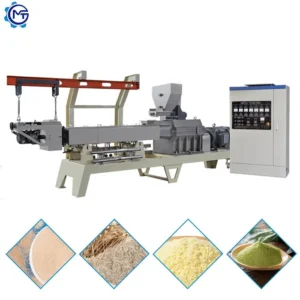
Línea de producción de polvo de reemplazo de comida para bebés segura, saludable y nutritiva en condiciones nuevas de alta productividad.
¥30.00 Select options This product has multiple variants. The options may be chosen on the product page -
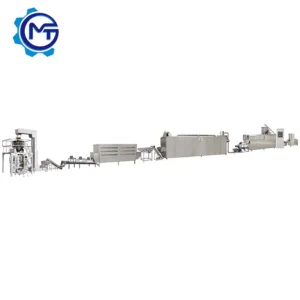
Máquina Automática de Fabricación de Polvo Nutricional Cereal de Arroz Seguro para Bebés
¥30.00 Select options This product has multiple variants. The options may be chosen on the product page -
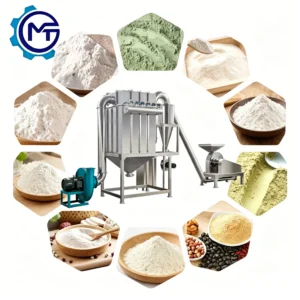
Línea de producción de polvo de nutrición de cereales para bebés automática y compacta con capacidad de 500 kg/h y control PLC
¥9,500.00 Add to cart -
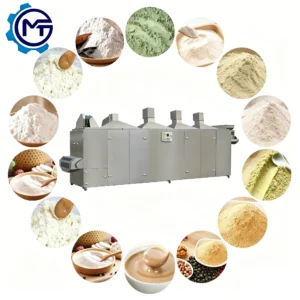
Línea de producción de procesamiento de papilla en polvo de nutrición completa para bebés completamente automática para fábrica de nutrición infantil
¥9,500.00 Add to cart