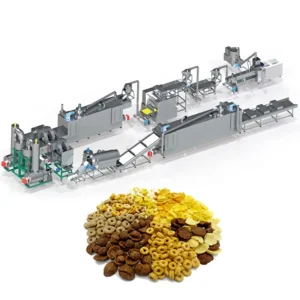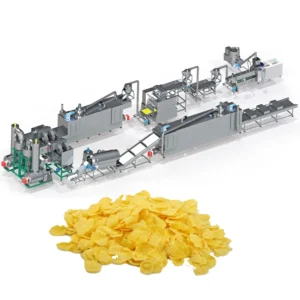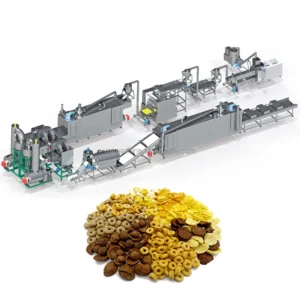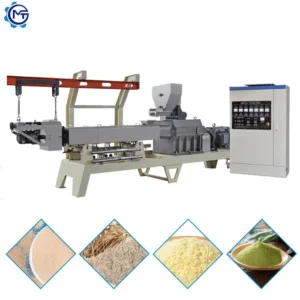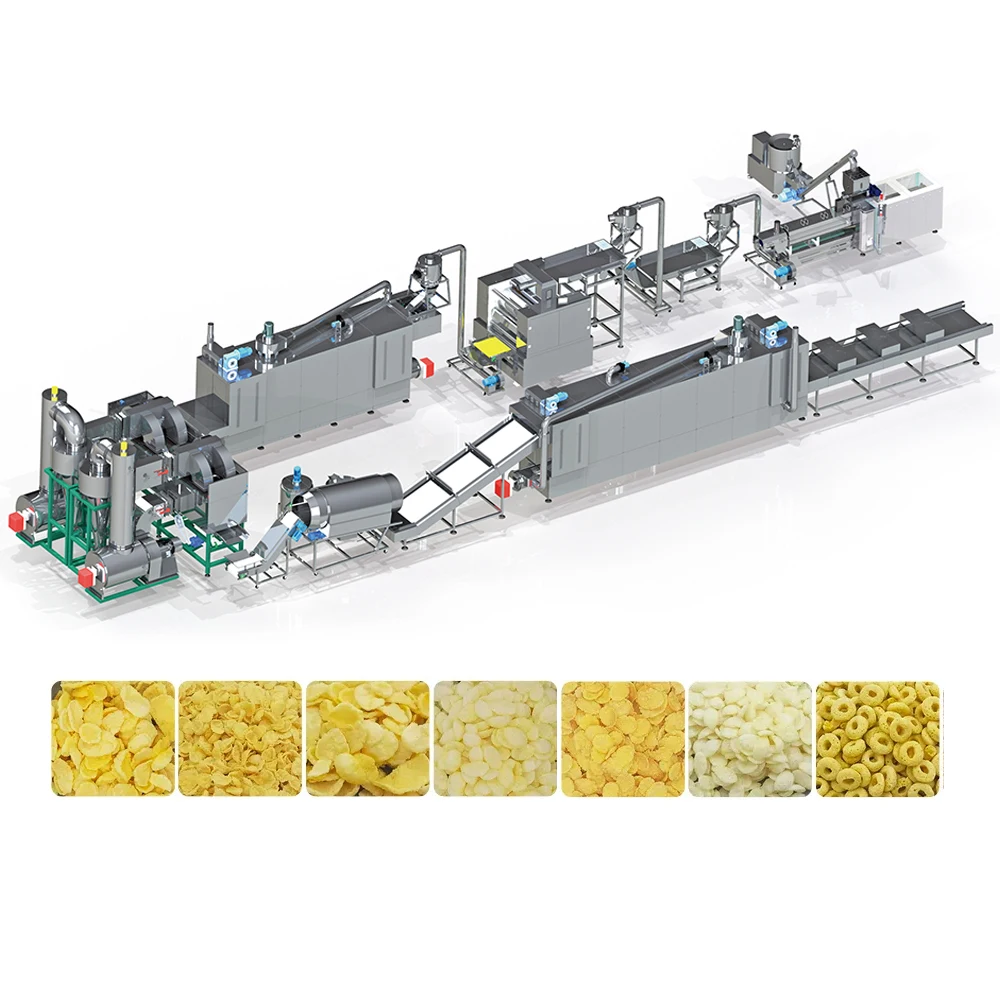


MT70 / MT85 / MT75 Corn Flakes Production Line, Twin-Screw Extrusion, PLC Control — engineered as one turnkey project from batching through extrusion, flaking, roasting to packing.
- Screw configuration and die design matched to your cereal blend, with throughput calculated across every station to prevent bottlenecks
- Hydraulic flaking, hot air roasting and sugar coating integrated with synchronized capacity and utility planning
In-house trial runs on your raw material confirm flake density and expansion before shipment, backed by complete documentation from layout to commissioning schedule.
Description
Throughput-Matched Integration — every station from mixing through roasting and packing is engineered to the same validated output so the extruder never waits on the dryer.
Technical Specifications
| Parameter | Value |
|---|---|
| Product Type | Corn Flakes Production Line (Twin-Screw Extrusion) |
| Available Models | MT70, MT85, MT75 |
| Extruder Screw Type | Twin-screw |
| MT70 Installed Power | 160 kW |
| MT70 Power Consumption | 120 kW |
| MT70 Output Capacity | 150–200 kg/h (basis not stated in source) |
| MT70 Overall Dimensions | 41 × 1.5 × 2.2 m |
| MT85 Installed Power | 190 kW |
| MT85 Power Consumption | 140 kW |
| MT85 Output Capacity | 300–400 kg/h (basis not stated in source) |
| MT85 Overall Dimensions | 43 × 1.5 × 3.2 m |
| MT75 Installed Power | 210 kW |
| MT75 Power Consumption | 150 kW |
| MT75 Output Capacity | 300–500 kg/h (basis not stated in source) |
| MT75 Overall Dimensions | 45 × 1.5 × 3.5 m |
| Flaking Machine Capacity | 200–300 kg/h (basis not stated in source) |
| Flaking Machine Drive | Hydraulic double-roller with separate motor drive |
| Dryer Heating Source | Gas or Electric |
| Control System | PLC |
| Final Product Shapes | Ball, tube, stick, ring, fruit loop, star, wheel, flower, heart |
| Certification | CE |
Application Suitability
| Application | Material or Output |
|---|---|
| Natural corn flakes | Corn powder, corn grits, maize flour |
| Sugar-coated corn flakes | Corn base with sugar glaze or honey coating |
| Multi-grain breakfast cereals | Rice, wheat, oat, and barley powder blends |
| Shaped cereal variants | Fruit loops, stars, rings, and tubes via die changes |
Why Nominal Line Capacity Rarely Survives Contact With Your Actual Grain
A capacity figure without a defined raw material and moisture baseline is not a capacity figure at all.
I spent years on the assembly floor before moving into technical sales, and the most expensive downtime I have witnessed came from lines that ran perfectly on the seller’s test flour but choked on the buyer’s locally sourced coarse grits. The extruder would push material through, but the flakes would come off the roller press as dense, under-expanded chips instead of the light, crisp sheets the market expected. Four days of reconfiguring screw elements and adjusting the moisture gradient at each zone later, the line finally held steady. A corn flakes production line turnkey proposal should always state what grain profile, particle size, and incoming moisture were used to derive the output number [NEED_CITE: cereal extrusion output dependency on raw material particle size and moisture].
How Screw Configuration Shapes the Flake Before It Ever Reaches the Roller
The twin-screw extruder is where the corn flakes production line turnkey project either earns its keep or creates problems downstream. The screw elements — conveying, kneading, and reverse-flight sections — determine how much shear the corn mass receives and how completely the starch gelatinises before the material exits the die. Too little shear and the flake will be raw in the centre; too much and the dough loses the structure needed to hold a thin, even sheet off the flaking rollers. Our engineers specify the screw profile to your exact cereal formulation, whether that is pure corn grits or a multi-grain blend of wheat and oat.
Matching Every Station So the Dryer Never Dictates Your Real Output
A corn flakes production line turnkey is only as fast as its slowest station, and in practice the bottleneck is almost always thermal. The hot air roasting oven uses a conciliation burner with dual circulating fans and a cyclone dust removal system to pull moisture from the flakes evenly. If the dryer is undersized relative to the extruder, you will see a queue of semi-wet flakes building up on the conveyor, sticking together and degrading surface quality. We calculate the residence time and thermal load for each unit so that the flaking machine, dryer, and roasting oven all sustain the same continuous throughput [NEED_CITE: thermal load calculation methodology for cereal roasting ovens].
Reading the Specs That Actually Matter on the Floor
The installed power figures across the MT70, MT85, and MT75 extruders reflect motor sizing for different barrel diameters and throughput ranges, not efficiency differences. The hydraulic double-roller flaking machine uses separate motors for each roller and an infrared sensor for temperature monitoring; this means you can adjust nip pressure and roller gap independently to hit a target flake thickness without one roller dragging behind the other. The PLC control system coordinates feed rate, barrel zone temperatures, and cutter speed so that batch-to-batch density stays within spec. For sugar-coated variants, the double tumble melter feeds a coating drum with spray nozzles that lay down an even glaze before the final drying pass.
What Happens When Line Stations Are Spec’d in Isolation
I have seen projects where the extruder was selected first, and every other station was added from a catalogue without recalculating the mass balance. The result: a flaking machine rated for less wet dough than the extruder could produce, forcing the operator to run the extruder at partial feed. The flakes came out thicker than designed, the roasting oven could not drive off enough moisture in the available residence time, and the final product reached the packing station with a water activity high enough to cause caking in the bag. All of this is avoidable when the corn flakes production line turnkey is engineered as a single throughput model from day one [NEED_CITE: mass balance engineering in food extrusion lines].
Why Sourcing the Full Line From One Engineering Team Matters
Our approach starts with your raw material sample and target flake specification, not a standard catalogue layout. We run trial extrusions in the in-house testing workshop using your actual grain to confirm screw configuration, die geometry, and moisture targets before any steel is cut. The line layout and capacity calculation document shows throughput matching at every station — mixing, extruding, flaking, drying, roasting, coating, cooling, and packing — so there is no hidden bottleneck. Electrical schematics are confirmed for your site voltage and frequency before production begins, and every control panel is labelled in the operator language you specify.
Documentation & Verification
- Line layout showing throughput calculation across every station from mixer to packer
- Screw and die configuration record matched to your grain type and target flake density
- Trial run report from our testing workshop using your actual raw material sample
- Electrical schematic with voltage, frequency, and control language confirmed for your facility
- CE declaration of conformity and factory test record before dispatch
- Wear parts list with screw elements, die plates, and roller surfaces itemised
Installation, Commissioning & Support
- Foundation plan accounts for the 41–45 m line footprint and individual station loads
- Dedicated power circuits sized for up to 210 kW installed extruder draw
- Equipment ships in modular sections for reassembly on your factory floor
- Commissioning includes screw profile fine-tuning on your local grain supply
- Operator training covers PLC interface navigation, roller gap adjustment, and roasting oven temperature profiling
- Spare screw elements, die plates, and flaking roller sleeves stocked for first replacement cycle
- Preventive maintenance schedule aligned with your production shift pattern
Before You Send an Inquiry
To put together a line configuration that actually holds its rated output, we need to know your grain source and particle size distribution, your target flake thickness and whether you plan to run natural or sugar-coated product, and your available floor space and ceiling height. Local voltage and frequency, preferred control language, and whether you have existing upstream mixing or downstream packing equipment all feed into the layout. If you have a specific brand of packaging machine already installed, share the infeed height and conveyor speed so we can match the cooling conveyor exit to it.
Frequently Asked Questions
Q: How is the line capacity verified against my specific cereal formulation and moisture content?
A: We conduct a trial run in our testing workshop using your actual raw material sample at the moisture levels you expect on site. Screw configuration, barrel temperature profile, and die geometry are adjusted during this trial until the flake density, thickness, and expansion meet your target specification, and the results are documented in a trial run report before shipment.
Q: How do you match throughput between the extruder, flaking machine, dryer, and roasting oven?
A: Each station is sized using a mass balance calculation that accounts for moisture loss at every stage. The flaking machine handles the wet dough output from the extruder, the dryer capacity is matched to the moisture removal requirement before roasting, and the oven residence time is set to achieve your final water activity target at the line’s continuous run rate.
Q: What utility requirements need to be planned for the complete line installation?
A: The full line requires electrical supply matching the installed power of the selected extruder model plus all supporting stations, gas or electric supply for the dryer and roasting oven, compressed air for pneumatic controls and actuators, and cooling water for the extruder barrel and hydraulic system. We provide a complete utility schedule with connection points and consumption figures.
Q: How is the screw configuration and die design selected for my target flake thickness?
A: The screw element arrangement — conveying, kneading, and shear zones — is designed around your grain’s starch gelatinisation behaviour. Die aperture and land length are then matched to the dough viscosity at the exit temperature so the extrudate reaches the flaking rollers at the right consistency to press into your specified thickness without tearing or wrinkling.
Q: What does on-site installation and commissioning include for this turnkey project?
A: Our engineers supervise unloading and station positioning according to the approved layout, connect utilities to pre-marked points, and run the line through a staged commissioning sequence. This includes dry runs, wet runs with your grain, and a sustained production run to confirm output and product quality before operator training begins.
Related products
-

Máquina Extrusora de Cereal para Desayuno de 200kg/h Venta Caliente Línea de Producción de Copos de Maíz
¥30,000.00 Select options This product has multiple variants. The options may be chosen on the product page -

Línea de Producción de Copos de Maíz Máquina de Producción de Cereales para el Desayuno Línea de Maquinaria para la Fabricación de Copos de Maíz
¥59,800.00 Select options This product has multiple variants. The options may be chosen on the product page -
Línea de producción de copos de maíz completa Máquina de procesamiento de cereales para el desayuno Componente central del motor Equipo de procesamiento de copos de maíz
¥19,000.00 Select options This product has multiple variants. The options may be chosen on the product page -
Máquina automática para la fabricación de cereales de desayuno instantáneos y alimentos para bocadillos
¥10,000.00 Select options This product has multiple variants. The options may be chosen on the product page