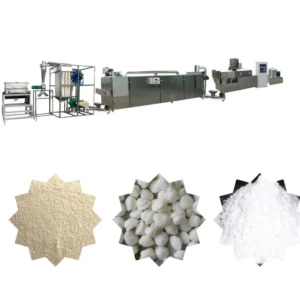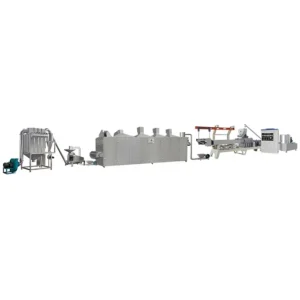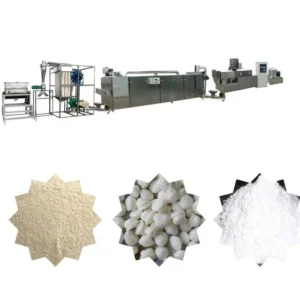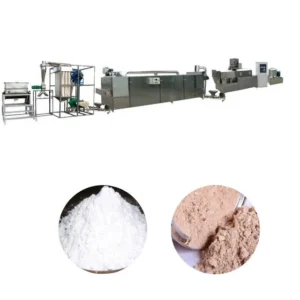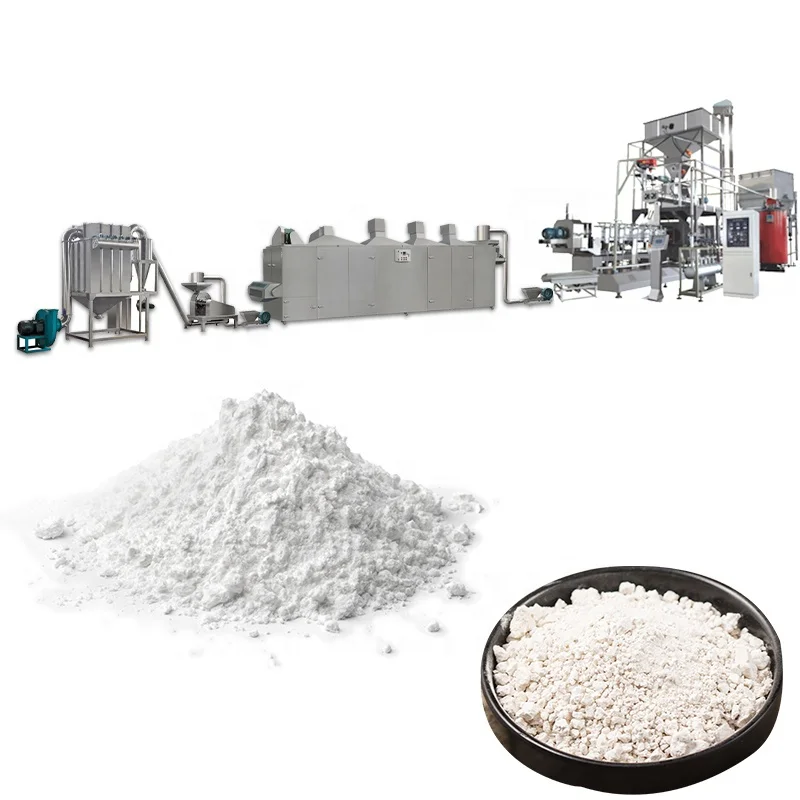


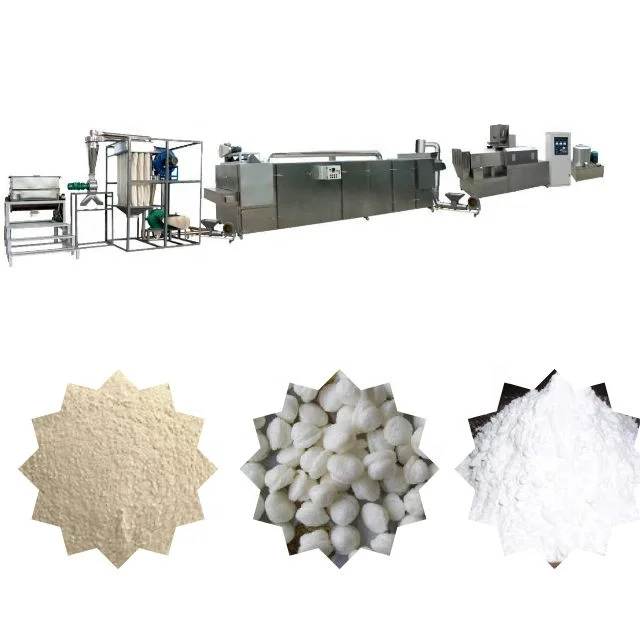

MT65 Twin-Screw Extruder for Modified Starch Production Line, 72 kW Installed Power, PLC & MCC Control — engineered for pre-gelatinized and denatured starch processing with sectional modular screws that allow precise configuration to your raw material and target modification. The complete turnkey line from mixing through extrusion, drying, grinding and packing keeps every station throughput-matched under one supplier, eliminating bottlenecks. Trial runs on your actual raw material are conducted in our testing workshop before shipment to validate capacity and product specification.
- Sectional screw modules configured to alter starch properties for industrial adhesive or food-grade applications
- Barrel and screw design matched to flour/starch input at 60–80 mesh
- CE and ISO certified with food-grade stainless steel contact materials
- Electrical schematic, voltage and control language confirmed before production
Description
Single-supplier integration — Every station from starch batching through extrusion to grinding and packing is engineered as one coordinated line, eliminating the throughput mismatches that occur when equipment is assembled from separate vendors.
Technical Specifications
| Parameter | Value |
|---|---|
| Product Type | Twin-Screw Extruder for Modified Starch Production Line |
| Available Models | MT65 / MT70 / MT85 |
| Screw Type | Co-rotating twin-screw, sectional modular configuration |
| Installed Power | 72 kW (MT65) / 92 kW (MT70) / 108 kW (MT85) |
| Power Consumption | 50 kW (MT65) / 65 kW (MT70) / 75 kW (MT85) |
| Output Capacity | 140–160 kg/h (MT65) / 240–260 kg/h (MT70) / 500–600 kg/h (MT85) (basis to be confirmed — depends on raw material type, moisture content and target starch modification) |
| Overall Dimensions | 2200×1000×2300 mm (MT65) / 2600×1000×2300 mm (MT70) / 4500×1000×2600 mm (MT85) |
| Control System | PLC and MCC integrated automation |
| Line Stations | Mixing → Extrusion → Drying → Grinding → Blending → Packing |
| Raw Material Requirement | Flour or starch particle size 60–80 mesh |
| Barrel and Screw Material | Food-grade stainless steel |
| Screw Design | Sectional modules configurable for pre-gelatinization or denaturation |
| Standards | CE certified, ISO certified |
| Warranty | 24 months with lifetime service support |
Application Suitability
| Application | Material or Output |
|---|---|
| Pre-gelatinized starch for oil drilling fluid | Corn starch or cassava starch, 60–80 mesh |
| Wallpaper adhesive pre-gelatinized starch | Corn flour or rice flour base |
| Food-grade modified starch (thickener, stabilizer, binder) | Corn, rice or potato starch sources |
| Modified starch for paper and textile sizing | Industrial-grade starch feedstock |
| Modified starch for construction and pharmaceutical use | Various starch origins per customer specification |
Why the Modified Starch Production Line Turnkey Must Account for Raw Material Swaps
A line that performs perfectly on corn starch may fail entirely when the buyer switches to cassava or potato starch on-site.
This is not a hypothetical problem. I spent three days on a factory floor in Colombia watching a pre-gelatinized starch line sit idle because the gelatinization temperature window for cassava starch differed from what the screw profile had been configured for. The material came out tacky, clung to the cooling belt, and the downstream grinder could not handle the inconsistent particle size. The modified starch production line turnkey had been quoted on one raw material, but the buyer’s actual production plan required a different one. [NEED_CITE: gelatinization temperature variance across starch sources]
That experience changed how I approach every project. Now, before any modified starch extrusion equipment leaves the workshop, it runs on the exact raw material the buyer intends to use. Screw speed, barrel temperature zones, and die geometry are all set against the real feedstock — not a generic reference material.
Screw Configuration Determines the Starch Modification Outcome
The twin-screw design uses co-rotating sectional modules that can be rearranged along the barrel length. For pre-gelatinized starch, the screw elements are ordered to build heat gradually through shear and compression, rupturing the starch granule structure at a controlled rate. For denatured or chemically modified starch, different element spacing and pitch create the residence time and mixing intensity needed to distribute reagents evenly. The modified starch production line turnkey succeeds or fails based on whether this configuration matches the buyer’s target functional property.
Barrel Temperature Profile and Moisture Control
Each barrel section operates under independent heating zones. The temperature gradient across these zones must align with the specific starch source because corn, cassava, rice, and potato starches each have distinct gelatinization thresholds. Moisture addition at the mixer stage — typically targeting a specific percentage before extrusion — works together with barrel heat to control the degree of starch conversion. Getting this relationship wrong means the extrudate either remains partially raw or degrades into a sticky mass that fouls downstream equipment. [NEED_CITE: starch gelatinization kinetics in twin-screw extrusion]
Reading the Specs That Matter for Starch Processing
The installed power ratings — 72 kW for the MT65, 92 kW for the MT70, and 108 kW for the MT85 — define the mechanical energy available for shear inside the barrel. Higher power allows denser screw configurations and more aggressive modification profiles, which is essential when processing high-amylose starches that resist gelatinization. The co-rotating modular screw design means operators can swap individual screw elements without replacing the full assembly, reducing the cost and downtime when switching between starch types or modification targets. The PLC and MCC control system stores formulation parameters for each product recipe, so when production shifts from drilling-grade to food-grade starch, the temperature zones, screw speed, and feeder rates recall to their validated settings rather than requiring manual recalibration.
The Cost of Skipping Pre-Shipment Material Trials
When a modified starch extrusion line ships without a validated trial run on the buyer’s actual raw material, commissioning becomes an open-ended experiment. Operators adjust parameters on the production floor, consuming raw material and generating off-spec product while searching for a stable process window. The downstream stations — dryer, grinder, blending system — were sized for a specific throughput and particle characteristic. If the extruder output does not match those assumptions, material backs up at one station or starves another, creating a bottleneck that has nothing to do with individual machine capacity. [NEED_CITE: commissioning delays caused by unverified material compatibility]
What Makes This Modified Starch Production Line Turnkey Reliable
The entire line from mixing through packing comes from one engineering team, which means the dryer capacity, grinder throughput, and blending volume are all calculated against the extruder’s actual output on the buyer’s material — not a generic datasheet figure. The screw and die configuration is documented specifically for each project, recorded in the configuration sheet that ships with the machine. Before dispatch, the line runs in the in-house testing workshop using customer-supplied raw material, generating a trial run report that confirms the target modification is achievable. Electrical schematics and voltage specifications are confirmed against the buyer’s facility supply before production begins, preventing the delays that arise when a 60 Hz machine arrives at a 50 Hz site. Food-grade stainless steel contact surfaces meet the requirements for starches destined for food and pharmaceutical applications, while industrial-grade builds serve drilling fluid and adhesive producers.
Documentation & Verification
- Factory test record generated on your specific starch source and target modification grade
- Screw and die configuration record documenting element arrangement matched to your product
- Line layout with capacity calculation showing throughput balance across all six stations
- Electrical schematic confirming voltage, frequency, and control language for your facility
- Trial run report on your raw material demonstrating achievable output before shipment
- CE declaration of conformity and ISO certificate for import clearance
Installation, Commissioning & Support
- Foundation plan accounts for the MT85’s 4500 mm footprint and vibration isolation requirements
- Dedicated power circuit sized to the selected model’s installed power rating of 72 to 108 kW
- Modular screw sections ship assembled, with spare element sets for field reconfiguration
- On-site commissioning includes barrel temperature tuning against your local starch source
- Operator training covers PLC recipe management for switching between modification targets
- Wear parts list with recommended first-order quantities for screws, dies, and barrel liners
How to Scope Your Starch Processing Project
To move from inquiry to line configuration, the most useful information you can share includes the specific starch source and its particle size distribution, the target modified starch type (pre-gelatinized, cross-linked, oxidized, or other), the intended daily or hourly production volume, and your facility’s available voltage and frequency. If you are replacing or expanding an existing line, details on current upstream and downstream equipment help determine integration points. And if your raw material differs from standard corn starch, sending a sample for trial processing in the testing workshop will define the screw configuration before any quotation is finalized.
Frequently Asked Questions
Q: How is the line capacity verified on my specific starch material?
A: Before shipment, we run your raw material through the extruder in our testing workshop. Screw speed, barrel temperatures, and die selection are adjusted until the target modification is achieved. A trial run report documents the output rate, product characteristics, and parameter settings, so the capacity figure in your quotation reflects your actual material rather than a generic benchmark.
Q: How does the screw configuration change between pre-gelatinized and denatured starch?
A: The modular twin-screw elements are rearranged to alter residence time, shear intensity, and mixing pattern. Pre-gelatinization requires a profile that builds heat gradually to rupture granule structure, while denaturation may need more aggressive shear or longer retention. Each configuration is recorded in a dedicated screw and die configuration sheet for your project.
Q: How are the dryer and grinder matched to the extruder output?
A: Because every station in the modified starch production line turnkey comes from one supplier, the dryer belt length, airflow volume, and grinder capacity are calculated against the extruder’s validated throughput on your material. This prevents situations where the extruder produces faster than the dryer can remove moisture or the grinder can reduce particle size.
Q: What electrical details need confirming before production starts?
A: We confirm your facility’s supply voltage, frequency, and phase configuration, then match the motor ratings and control panel components accordingly. The PLC interface language is set to your operators’ preference. All of this is documented in the electrical schematic and voltage confirmation sheet that ships with the line.
Q: What does on-site installation and ongoing support include?
A: Our engineers handle mechanical assembly, electrical connection, and first-run commissioning at your facility. Operator training covers recipe setup on the PLC, screw element changes, and daily maintenance routines. A wear parts list with recommended spare quantities ships with the machine, and replacement screws and dies remain available for reorder throughout the equipment’s service life.
Related products
-
Twin-Screw Extrusion Line for Modified Starch. Producing Pregelatinized Adhesive & Food Grade Powder
¥65.00 Select options This product has multiple variants. The options may be chosen on the product page -
Máquina Automática de Fabricación de Almidón Modificado Línea de Producción de Procesamiento de Almidón para Perforación de Petróleo
¥30.00 Select options This product has multiple variants. The options may be chosen on the product page -
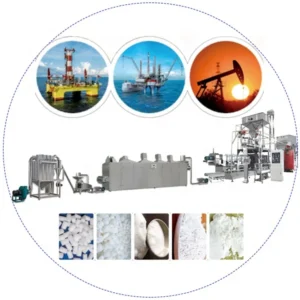
Pre-gelatinized Starch Production Line – Modified Starch Integrated Puffing Equipment
¥65.00 Select options This product has multiple variants. The options may be chosen on the product page -
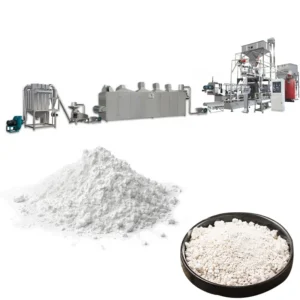
High-Efficiency Customizable Modified Starch Production Line – Automatic Corn Pellet Adhesive Making Equipment
¥65.00 Select options This product has multiple variants. The options may be chosen on the product page