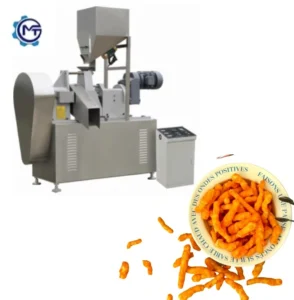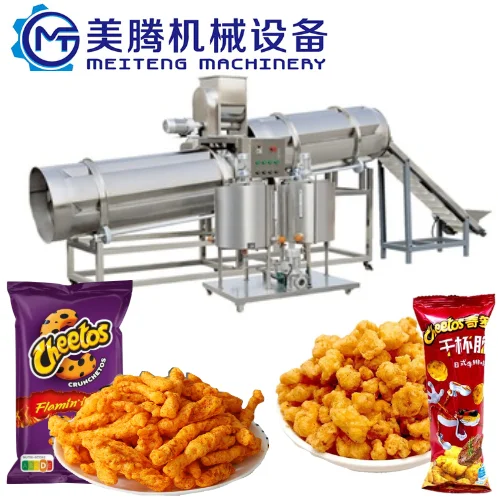
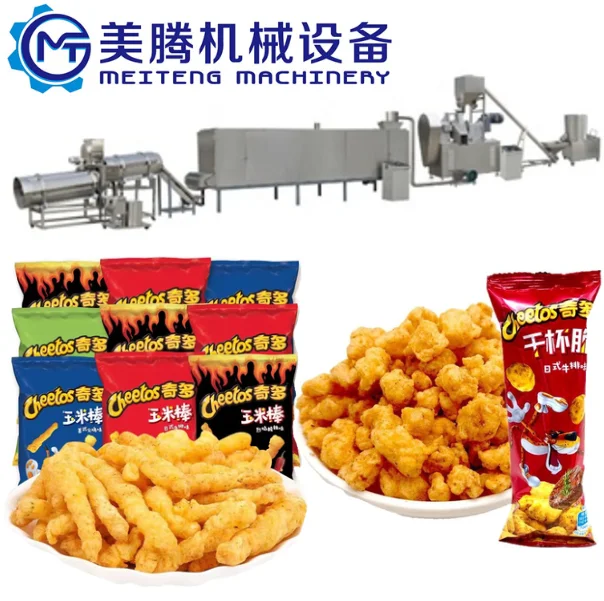
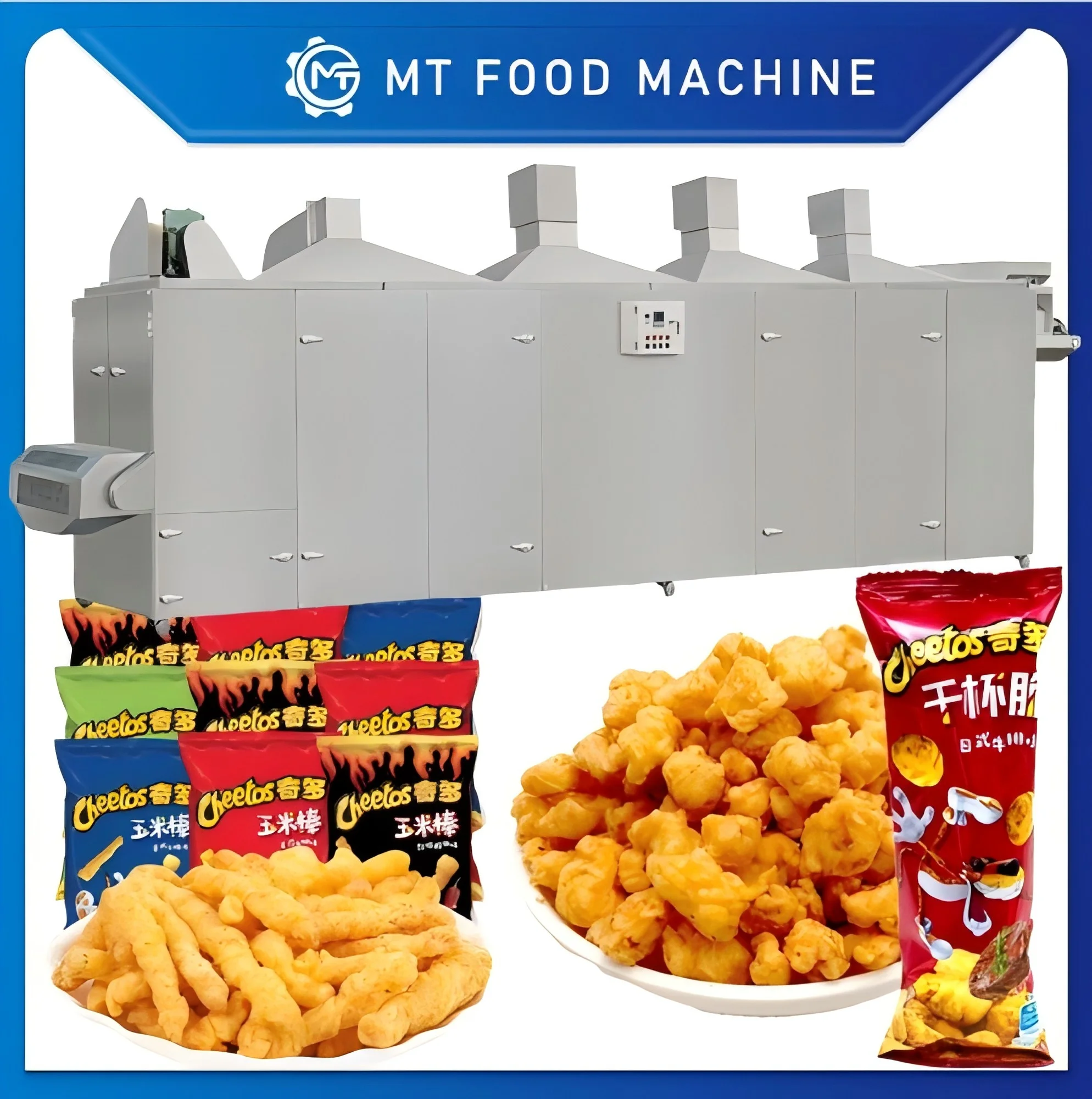


Kurkure Cheetos Snack Processing Line, 120-350 kg/h, 304 Stainless Steel, Fully Automatic — engineered as a complete turnkey project with throughput matched across every station from batching to packing.
- Twin-screw extrusion with die and screw configuration matched to maize or rice grits for consistent expansion and texture control
- Electric heating with coordinated PLC and MCC control to prevent upstream-downstream bottlenecks during continuous operation
Supplied as one integrated line with layout design, raw-material trial run before shipment, and on-site commissioning included.
Description
Single-source responsibility — From batching through extrusion to packing, every station on this Cheetos and Kurkure line is sized to match, so throughput holds end-to-end instead of collapsing at the weakest link.
Technical Specifications
| Parameter | Value |
|---|---|
| Product Type | Cheetos Kurkure Snack Processing Line |
| Output Capacity | 120–350 kg/h (basis not stated in source — confirm raw material, moisture and pellet format) |
| Heat Source | Electric |
| Contact Material | 304 Stainless Steel |
| Automation Level | Fully Automatic |
| Functionality | Multifunctional — Cheetos, Kurkure and similar extruded snack formats |
| Certification | CE |
Application Suitability
| Application | Material or Output |
|---|---|
| Cheetos-style puffed snack production | Maize grits, corn flour, rice grits |
| Kurkure-style extruded snack production | Maize meal, blended cereal bases |
| Small-scale snack manufacturing for regional retail | Multi-format extruded snack SKUs |
| Contract packing — second extruded snack SKU | Existing line integration or standalone cell |
| Product trial and market entry runs | Test batches on buyer’s actual raw material |
What "120–350 kg/h" Actually Means on Your Maize Grits
The number on the nameplate only holds if the line was configured against your exact raw material, not a generic test flour.
I spent a full week on-site in the Middle East because the buyer’s maize grits had a different particle-size distribution from the flour we used during the factory trial. The extruder pushed product, but the density was off and the fryer could not keep pace, so the whole kurkure cheetos making machine turnkey production line bottlenecked downstream [NEED_CITE: particle-size distribution effect on extrusion expansion]. A nominal capacity figure without a raw-material qualifier is a commissioning risk, not a guarantee. That is why the trial run must happen on the buyer’s actual maize or rice grits before the line ships, and why the screw and die configuration has to be locked to that specific material.
Throughput Matching Across the Full Extrusion Cell
A kurkure cheetos making machine turnkey production line only delivers its rated output when every station — mixer, extruder, fryer or dryer, flavouring drum, cooler and packer — is sized for the same mass flow. If the extruder pushes 300 kg/h but the flavouring drum is rated for 200 kg/h, the line stalls at the drum and the extruder has to be throttled back. Each module on this line is specified so the downstream equipment can absorb the upstream output without queuing or starvation, keeping the overall kurkure cheetos making machine turnkey production line running at its intended tempo.
Screw and Die Configuration Tied to Your Snack Format
Cheetos and Kurkure snacks look similar but differ in expansion ratio, surface texture and internal cell structure. The screw profile, compression ratio and die geometry must be matched to the target format and the buyer’s raw material. A generic screw build will produce a puff that is either too dense for the market or too fragile to survive packing [NEED_CITE: twin-screw extrusion die design and expansion control]. The configuration record for this line is generated after the trial run, so the screw combination and die aperture are documented specifically for the Cheetos or Kurkure profile the buyer intends to produce.
How 304 Stainless Steel and Electric Heat Shape Daily Operations
Food-grade 304 stainless steel on every product-contact surface means the line withstands caustic washdown cycles without pitting, and it meets the hygiene expectations of export-market audits. Electric heating delivers a stable barrel temperature profile across all extrusion zones, which is critical for repeatable starch gelatinisation batch after batch. When the heat source fluctuates — common with direct gas firing in regions with uneven supply pressure — the puff density drifts and the fryer oil load changes, forcing operators to chase settings instead of running product.
The Hidden Cost of an Undersized Dryer or Flavouring Drum
When the extruder is specified in isolation, the dryer often becomes the bottleneck. Wet extrudate piles up ahead of a dryer that cannot evaporate moisture fast enough, and product sits long enough to develop surface case-hardening that ruins the final crunch. The same mismatch applies to coating drums: a drum that is too small means snacks tumble too long, picking up excess oil and seasoning, which inflates unit cost and alters the flavour profile the buyer’s market expects [NEED_CITE: extrusion line throughput balancing and downstream bottleneck]. These failures only surface during commissioning, when re-engineering a module on-site is expensive and delays market launch.
Why Source the Entire Line from One Supplier
Specifying a kurkure cheetos making machine turnkey production line from a single source means one party owns the layout, the utility plan and the commissioning schedule. The extruder supplier cannot blame the dryer vendor when throughput drops, because both modules were sized under the same capacity calculation. Electrical schematics and voltage confirmation cover every panel on the line, so the buyer’s electrician does not discover a frequency mismatch during hook-up. Trial-run data, screw configuration records and wear-parts lists arrive as one documentation package, making operator training and first-year maintenance predictable rather than fragmented across multiple vendors.
Documentation & Verification
- Line layout and capacity calculation showing matched throughput at every station
- Trial run report on the buyer’s actual maize or rice grits before shipment
- Screw and die configuration record specific to Cheetos or Kurkure format
- Electrical schematic with voltage, frequency and control language confirmed to destination market
- CE declaration of conformity covering the full processing line
- Operation and maintenance manual with wear-parts list and recommended spare intervals
Installation, Commissioning & Support
- Foundation and floor-space plan aligned to the line layout and extruder footprint
- Dedicated electrical circuit sized for the total connected electric-heating load
- Modular delivery with station-by-station assembly sequence to reduce on-site downtime
- First-run parameter setting on the buyer’s raw material to validate trial-run results
- Operator training covering screw changes, die swaps and flavouring-drum adjustment
- Wear-parts list for screws, dies and fryer baskets with recommended replacement intervals
What We Need to Move Your Inquiry Forward
Share the exact maize or rice grits specification you plan to run, including particle-size range and typical moisture content, so the screw profile can be matched before the trial. Confirm the destination voltage, frequency and the control-panel language your operators will use. Provide the daily output target and the available floor area so the layout can be drafted with realistic station spacing and utility drop points.
Frequently Asked Questions
Q: How is the 120–350 kg/h capacity verified on my specific maize or rice raw material?
A: We run a trial on your actual raw material in the testing workshop before the line ships. The output is measured over a sustained run, and the screw and die configuration is adjusted until density, expansion and texture meet your product specification. A signed trial report accompanies the shipment.
Q: What voltage, frequency and control language are confirmed before production starts?
A: We request the destination electrical standard and the preferred HMI language during the quotation stage. The electrical schematic and panel labels are then built to those specifications, so the line connects directly to the site supply without transformer or relay substitutions on arrival.
Q: How do you ensure extruder output matches dryer and flavouring drum capacity?
A: Every station is sized from the same capacity calculation. The dryer evaporation rate and the flavouring drum dwell time are calculated against the extruder mass flow, so no single module becomes a bottleneck when the kurkure cheetos making machine turnkey production line runs at target tempo.
Q: Can the line switch between Cheetos and Kurkure formats without a full rebuild?
A: Yes. The multifunctional screw and die setup allows format changes by swapping the die plate and adjusting the screw combination. Changeover procedures and the required spare die sets are documented in the operation manual so your team can switch SKUs without external engineering support.
Q: What does on-site installation, commissioning and operator training include?
A: An engineer supervises station assembly, utility connection and first-run parameter setting on your raw material. Operators are trained on daily start-up, screw and die changes, flavouring-drum calibration and routine maintenance. A commissioning certificate is issued once the line holds its verified output for a sustained shift.
Related products
-
Máquina de fabricación de Cheetos Kurkure para snacks fritos Línea de producción con capacidad de 200kg/h
¥8,238.27 Select options This product has multiple variants. The options may be chosen on the product page -
Corn Flakes Production Line for Breakfast Cereal – Turnkey Solution
Read more -
Kurkure Cheetos Making Machine with Electric Heat – Turnkey Solution
Read more -
Turnkey Corn Flake Production Line – Breakfast Cereal Extruder
Read more