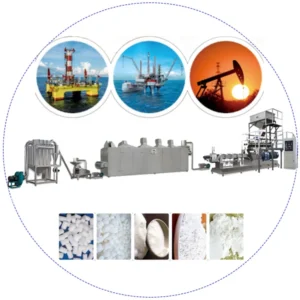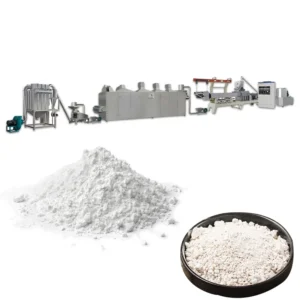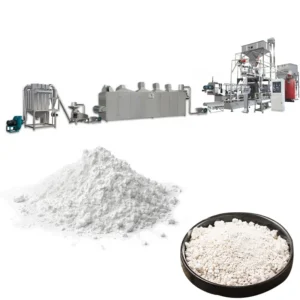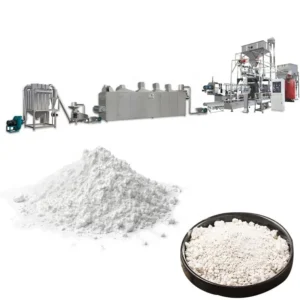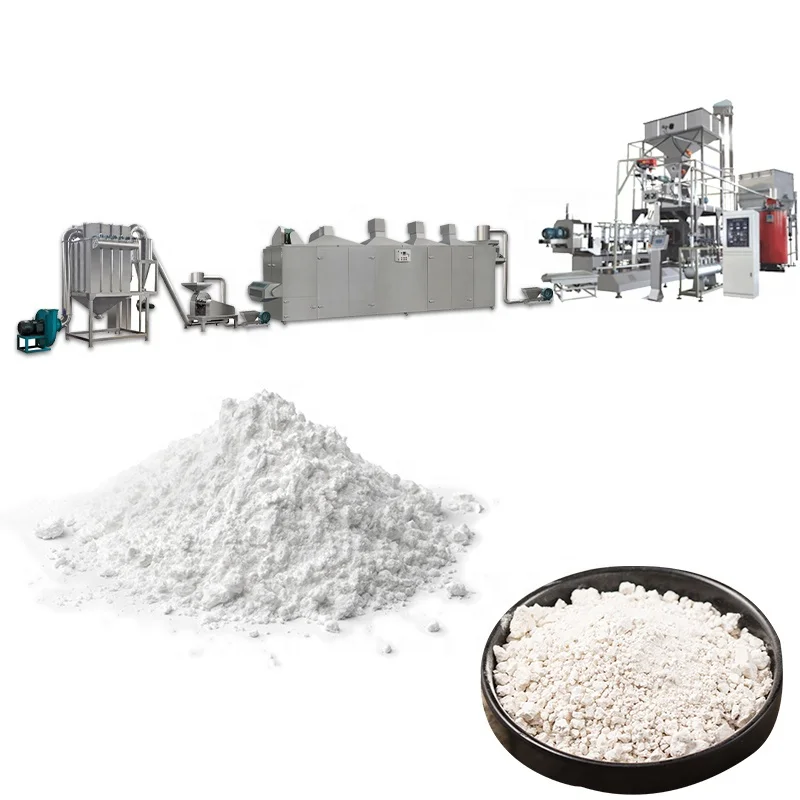


MT70 / MT85 / MT75 Modified Starch Twin-Screw Extrusion Line, 380V/50Hz, 38CrMoAl Screws — covers batching through extrusion, drying, and grinding with every station throughput-matched to prevent bottlenecking at any single machine.
- Twin-screw extruder with barrel cooling system for precise gelatinisation temperature control
- 5-layer dryer with inverter speed control and gas/diesel heating matched to extruder output
- Pulse grinder with speed-controlled auger feeder and cyclone discharge for consistent particle size
- Three line tiers scaling from pilot to full production capacity for phased investment
Trial runs on your specific cassava, corn, or potato starch feedstock before shipment ensure the line performs to spec from day one, backed by in-house testing and screw configuration matched to your raw material.
Description
Integrated Line Throughput Matching — Every station from batching to grinding is sized together, ensuring the modified starch processing line maintains continuous flow without isolated machine bottlenecks.
Technical Specifications
| Parameter | Value |
|---|---|
| Model | MT70 / MT85 / MT75 |
| Product Type | Modified Starch Twin-Screw Extrusion Line |
| Installed Power | MT70: 160 kW; MT85: 190 kW; MT75: 210 kW |
| Power Consumption | MT70: 120 kW; MT85: 140 kW; MT75: 150 kW |
| Output Capacity | MT70: 150-200 kg/h (basis to be confirmed); MT85: 300-400 kg/h (basis to be confirmed); MT75: 300-500 kg/h (basis to be confirmed) |
| Overall Dimensions | MT70: 41000×1500×2200 mm; MT85: 43000×1500×3200 mm; MT75: 45000×1500×3500 mm |
| Voltage & Frequency | 380 V / 50 Hz / Three Phase |
| Extruder Screw Type | Twin-screw |
| Extruder Screw Diameter | 70 mm (MT70 unit) |
| Extruder Screw Length | 1510 mm (MT70 unit) |
| Extruder Screw Material | 38CrMoAl |
| Extruder Main Motor Power | 30 kW (MT70 unit) |
| Extruder Heating Ring | 7×2 kW = 14 kW |
| Mixer Power Options | 4 kW / 7.5 kW / 15 kW |
| Dryer Type | 5-layer baking oven |
| Dryer Heat Source | Gas or diesel |
| Grinder Type | Pulse grinder with cyclone discharge |
| Certification | CE, ISO |
| Assembly State | Complete production line |
Application Suitability
| Application | Material or Output |
|---|---|
| Modified cassava starch production | Raw cassava starch feedstock for industrial use |
| Pregelatinized starch for oil drilling | Fluid loss agents requiring thermal stability |
| Modified corn starch processing | Food-grade and industrial starch derivatives |
| Modified potato starch production | High-viscosity starch for textile and paper applications |
| Chemical modified starch processing | Custom functional starch for specialized industries |
Why Nominal Capacity Figures Mislead Starch Processors
A line rated for a fixed output often fails to deliver that volume when running your specific starch feedstock and moisture content.
We verify throughput on your actual raw material before the line ships.
Many processors sign contracts based on a single capacity number, only to discover their cassava or potato starch reacts differently under heat and shear than the supplier’s test material. The extruder might reach the target output, but the dryer cannot remove moisture fast enough, or the grinder cannot keep up with the volume of extrudate. These mismatches cause constant line stoppages and rework [NEED_CITE: industrial starch gelatinisation behaviour under twin-screw shear].
Screw Profile and Barrel Zoning for Starch Gelatinisation
The modified starch processing line uses a twin-screw extruder with 38CrMoAl screws and a barrel cooling system to manage the precise temperature profile required for starch modification. Gelatinisation depends on maintaining the correct moisture level and shear force as the material moves through the barrel zones. If the temperature spikes in one section, the starch can degrade instead of modifying, ruining the batch viscosity profile.
Throughput Balancing Across Extrusion, Drying, and Grinding
A common failure in starch lines is building the extruder for maximum output while undersizing the dryer and grinder. The MT70, MT85, and MT75 configurations scale the entire line together. The 5-layer dryer with inverter speed control must handle the moisture load exiting the extruder, and the pulse grinder with its speed-controlled auger feeder must process the dried extrudate without creating a backlog [NEED_CITE: moisture removal rates in multi-layer industrial dryers].
How Screw Diameter and L/D Ratio Affect Starch Residence Time
The MT70 extruder features a 70 mm screw diameter and 1510 mm screw length, which sets the residence time inside the barrel. Longer residence time allows more complete gelatinisation but increases the risk of thermal degradation if the barrel temperature is not controlled zone by zone. The 14 kW heating ring array provides independent zone control, while the barrel cooling system prevents hot spots that would scorch the starch. For cassava starch, which gelatinises at a lower temperature than corn starch, this cooling capability is essential to prevent over-processing.
The Hidden Cost of Generic Screw Configurations
A screw and die setup copied from a standard build produces the wrong texture and density for your target starch modification. Cassava, corn, and potato starches have different gelatinisation temperatures and shear sensitivities. Running a generic configuration forces operators to constantly adjust feed rates and temperatures, creating inconsistent product quality and excessive wear on the screw elements [NEED_CITE: screw wear patterns when processing abrasive starch feedstocks].
Why Sourcing the Full Line Under One Supplier Matters
Buying the extruder, dryer, and grinder from separate vendors creates integration gaps. When the modified starch processing line is supplied as a complete project, the throughput between stations is calculated and matched during the engineering phase. The 38CrMoAl screw elements are configured specifically for your starch type and target modification degree, not left as a generic setup. The electrical schematic and voltage are confirmed for your local grid before production begins, avoiding commissioning delays caused by incompatible power supplies.
Documentation & Verification
- Line layout drawing showing throughput matching between extruder, dryer, and grinder
- Screw and die configuration record specified to your starch type and modification target
- Trial run report on your actual cassava, corn, or potato starch feedstock
- Electrical schematic with voltage and frequency confirmed for your local grid
- Factory test record documenting output capacity and product density before dispatch
Installation, Commissioning & Support
- Foundation plan accounting for the MT75 line footprint of 45000×1500×3500 mm
- Power supply confirmation for the 210 kW installed load on a 380 V three-phase circuit
- On-site assembly of the 5-layer dryer and pulse grinder with cyclone ductwork
- Commissioning with your raw material to verify gelatinisation degree and throughput
- Operator training covering screw element inspection and barrel temperature adjustment
- Wear parts list for 38CrMoAl screws and die plates with recommended replacement intervals
What We Need to Configure Your Line
To engineer a modified starch processing line that meets your production target, we need to know your feedstock type (cassava, corn, potato, or blend), the target modification or gelatinisation specification, and your required hourly output based on your actual moisture content. Please also confirm your local voltage and frequency, and whether the dryer should be configured for gas or diesel heating.
Frequently Asked Questions
Q: How is line capacity verified against my specific starch raw material and moisture content?
A: We conduct a trial run in our testing workshop using a sample of your actual cassava, corn, or potato starch. The test confirms the screw configuration and barrel temperature profile achieve your target gelatinisation degree, and documents the real output rate at your specified moisture level before the line ships.
Q: What screw configuration and die design are matched to cassava versus corn versus potato starch?
A: Each starch type has a different gelatinisation temperature and shear sensitivity. Cassava requires lower barrel temperatures and a screw profile that limits shear to prevent degradation, while corn starch can tolerate higher shear. We specify the screw element arrangement and die geometry based on your feedstock sample test results.
Q: How is throughput balanced between the extruder, dryer, and grinder to prevent bottlenecks?
A: The dryer capacity and grinder feed rate are calculated against the extruder output volume and moisture load. The 5-layer dryer uses inverter speed control to match residence time to the extrudate volume, and the pulse grinder auger feeder is sized to process the dried output without material backlog.
Q: What voltage, frequency, and control language options are confirmed before production?
A: We confirm your local power supply specifications and operator language requirements during the engineering phase. The electrical schematic is drawn and approved before production begins, ensuring the motor drives, heating rings, and control interfaces match your site conditions upon arrival.
Q: What does on-site installation, commissioning, and operator training include?
A: Our engineers assemble the full line on your site, verify throughput and product specification using your raw material, and train your operators on screw element inspection, barrel temperature adjustment, and dryer speed tuning. We also provide a wear parts schedule and maintenance procedures specific to your configuration.
Related products
-
Cassava & Pregelatinized Corn Starch Extrusion Equipment – CE Certified Industrial Twin-Screw Modified Starch Line
¥65.00 Select options This product has multiple variants. The options may be chosen on the product page -
Almidón modificado de gran capacidad para uso industrial y aditivos alimentarios
¥50.00 Select options This product has multiple variants. The options may be chosen on the product page -
Pre-gelatinized Starch Production Line – Modified Starch Integrated Puffing Equipment
¥65.00 Select options This product has multiple variants. The options may be chosen on the product page -
Línea de producción automática de almidón de tapioca modificado, molino de harina de acero inoxidable 304 y máquina de panadería
¥30.00 Select options This product has multiple variants. The options may be chosen on the product page