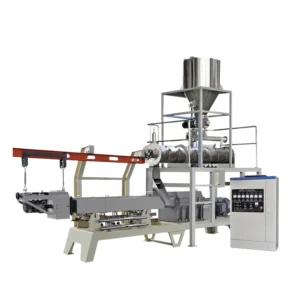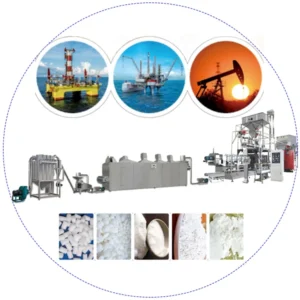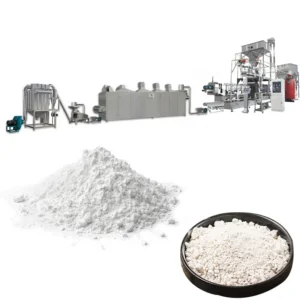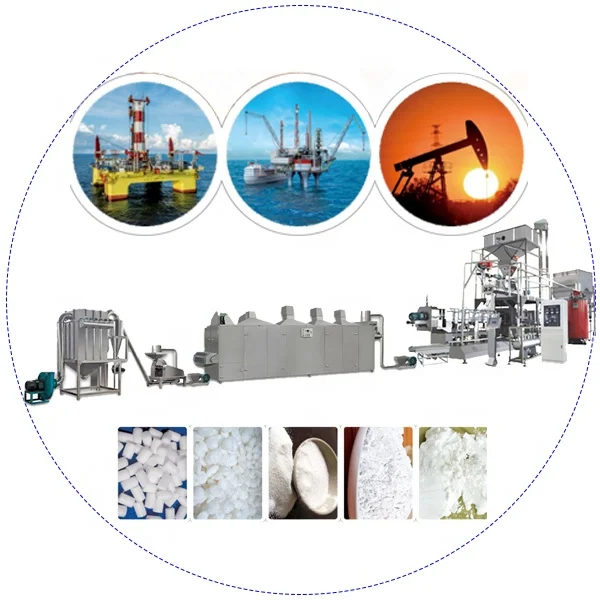
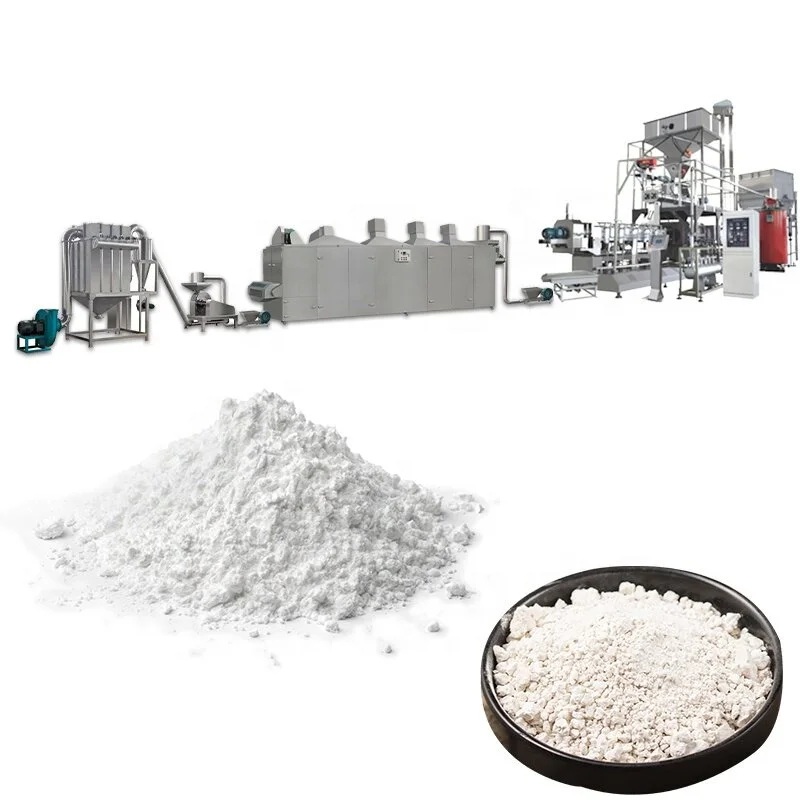
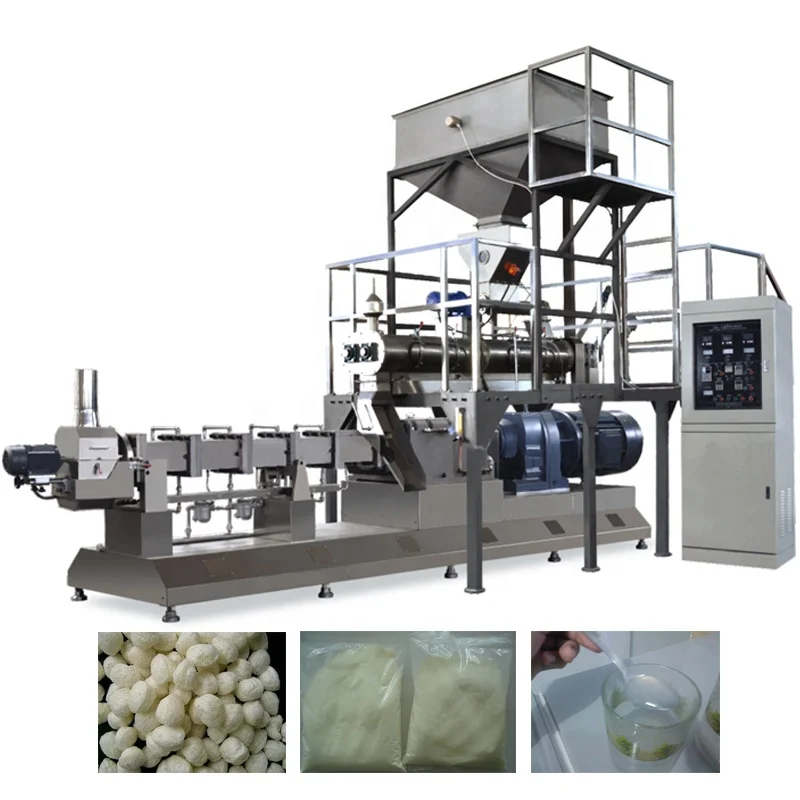
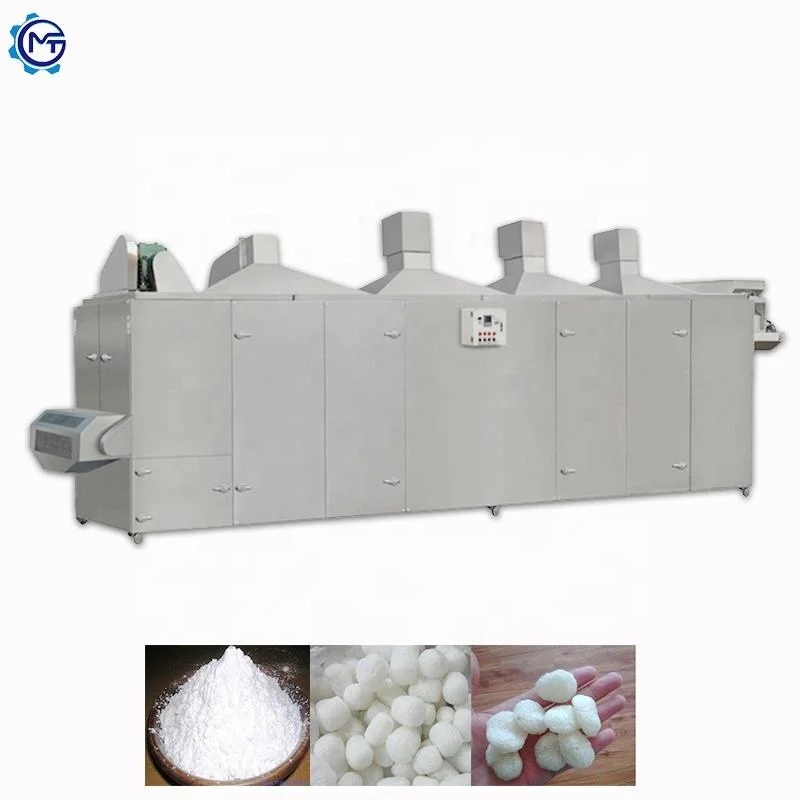
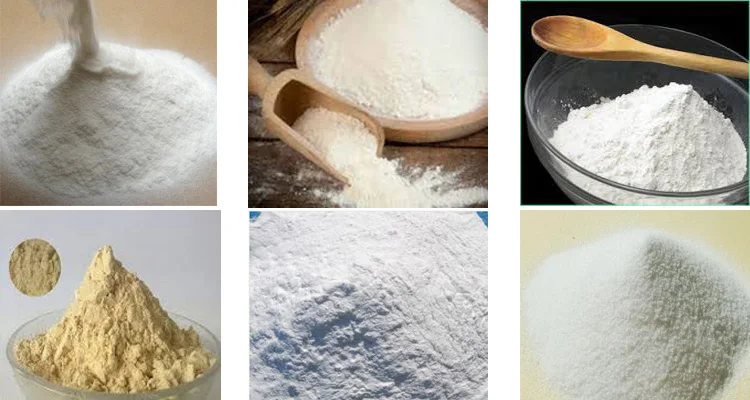
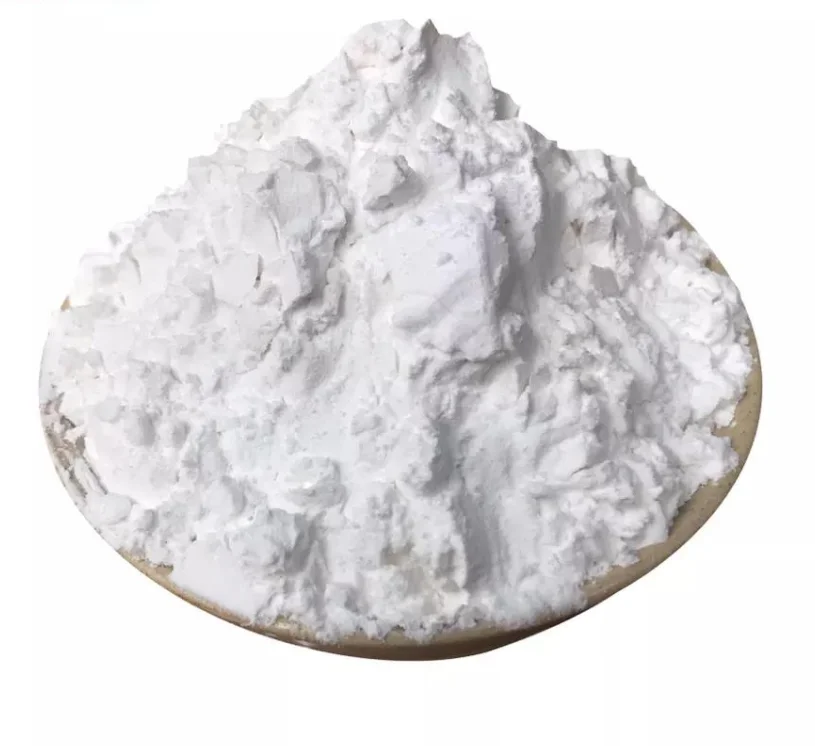
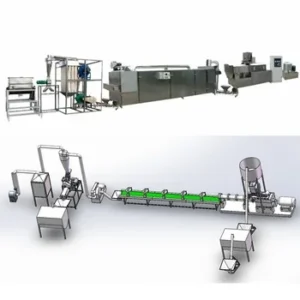
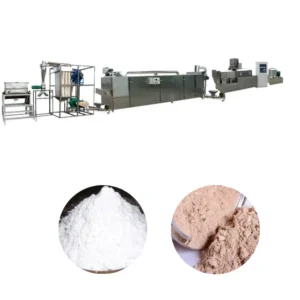
Modified Starch Processing Line, Twin-Screw Extruder, 80–500 kg/h Capacity — engineered for pre-gelatinized starch production from wheat flour, corn starch, or potato starch. Complete process flow from mixing through extrusion, drying, and grinding with food-grade SS304 contact materials and flexible energy options including electric, gas, diesel, or steam heating.
Twin-screw configuration matched to raw material characteristics and target gelatinisation degree ensures consistent starch modification. Station-to-station throughput balancing prevents bottlenecks between extruder, dryer, and grinder.
Line layout documentation and capacity calculations provided with trial run validation on customer’s actual raw material before shipment.
Description
Throughput-matched engineering — every station from mixer to grinder is sized to the extruder’s actual output on your starch raw material, preventing the bottlenecks that stall production.
Technical Specifications
| Parameter | Value |
|---|---|
| Product Type | Modified Starch Processing Line |
| Extruder Type | Twin-screw extruder |
| Capacity Range | 80–500 kg/h (basis not stated in source — confirm raw material type and moisture content) |
| Raw Materials | Wheat flour, corn starch, potato starch |
| Process Flow | Mixer → Screw conveyor → Twin screw extruder → Air conveyor → Dryer → Air conveyor → Conditioning → Conveyor → Grinder |
| Mixer Motor | 4.0 kW |
| Mixer Output | 3.0–4.0 kg per batch |
| Screw Conveyor Motor | 1.1 kW |
| Screw Conveyor Output | 0–150 kg/h |
| Frame Material | Stainless steel 201 |
| Contact Material | Food grade stainless steel 304 |
| Voltage | Three-phase 380V/50Hz, Single-phase 220V/50Hz (customizable to local voltage) |
| Total Electrical Power | approx. 100 kW (electric heating); 50–60 kW (gas or diesel heating) |
| Energy Options | Electricity, gas, diesel, steam |
| Motor Brand | Siemens (China) or top China brand |
| Inverter Brand | Delixi or Delta |
| Control System | Available with PLC or MCC control |
| Assembly State | Complete production line |
| Certification | CE |
Application Suitability
| Application | Material or Output |
|---|---|
| Pre-gelatinized starch for food industry | Wheat flour, corn starch, potato starch |
| Modified starch for paper manufacturing | Corn starch, potato starch |
| Modified starch for other industrial fields | Wheat flour, corn starch, potato starch |
| Fortified food and nutrition programme bases | Starch blends requiring controlled gelatinisation |
When "80–500 kg/h" Means Something Different on Your Raw Material
The capacity number on the nameplate assumes ideal conditions; your actual starch feedstock dictates the real output.
When sourcing a modified starch production line turnkey, buyers often focus on the headline throughput figure and discover only after installation that their specific raw material — high-viscosity potato starch, for instance — cuts effective output considerably. An extruder rated at the upper end of a range on corn starch may deliver substantially less on a modified wheat flour blend with different gelatinisation behaviour. I once configured a twin-screw line for a pre-gelatinized starch plant where the initial screw profile worked fine on standard corn starch but failed to achieve target gelatinisation degree on the client’s higher-amylose variant. Three reformulated screw builds later, the line held steady output, but the lesson was permanent: always verify capacity against the actual material you will run [NEED_CITE: starch gelatinisation behaviour across amylose ratios].
Screw Geometry Determines Your Gelatinisation Outcome
The twin-screw extruder at the heart of this modified starch production line turnkey is configured to the specific raw material and target modification degree. Screw element sequencing — the arrangement of conveying, kneading, and reverse elements along the barrel — controls residence time and shear intensity. Wheat flour demands a different shear profile than potato starch to reach full gelatinisation without degrading the polymer chain. The die design further governs expansion and moisture flash-off at the barrel exit, which directly shapes the downstream drying requirement.
Matching Every Station to Prevent Line Imbalance
A starch processing line fails when any single station runs slower than the extruder pushes. The dryer must handle peak moisture load from the extruder discharge, and the grinder must keep pace with conditioned output without creating a backlog. This modified starch production line turnkey is engineered so the mixer batch cycle, screw conveyor feed rate, drying capacity, and grinding throughput are calculated together. The result is continuous flow from raw material intake through to final milled product, with no station forcing the others into stop-start operation [NEED_CITE: throughput balancing methodology in continuous food processing lines].
Reading the Specifications That Actually Matter
The 4.0 kW mixer motor drives batches of 3.0–4.0 kg, setting the feed rhythm for the entire line. If your formulation requires longer conditioning or higher moisture addition, batch cycle time extends, and the screw conveyor — rated at 0–150 kg/h with its 1.1 kW drive — must be adjusted to smooth the feed into the extruder. The contact surfaces throughout are food grade stainless steel 304, which resists the mild acidity common in modified starch slurries and meets food safety requirements. The frame in stainless steel 201 provides structural rigidity at lower cost where product contact does not occur. Energy flexibility across electricity, gas, diesel, and steam heating allows the dryer to match local utility economics — a significant consideration since thermal energy typically dominates the operating cost of a starch gelatinisation line. The total electrical draw of approximately 100 kW under electric heating drops to 50–60 kW when gas or diesel firing is selected, which changes the transformer and switchgear specification at your facility.
The Hidden Cost of Specifying Stations Separately
When the extruder, dryer, and grinder arrive from different vendors, no single supplier owns the throughput mismatch. The extruder vendor blames the dryer for being undersized; the dryer vendor blames the extruder for discharging higher moisture than expected. I have seen starch processors shut down a newly installed line for weeks while three separate technicians argued over where the bottleneck lived. The grinder choked on material the dryer had not fully conditioned, and the air conveyors between stations were sized for a lower throughput than the extruder could actually produce. These integration failures do not show up in individual machine specifications — they appear only when the full line runs together [NEED_CITE: integration risks in multi-vendor food processing lines].
Why This Line Is Engineered Under One Roof
The complete process flow from mixer through grinder is designed and assembled by a single engineering team, so throughput calculations are internally consistent rather than negotiated between vendors. Screw configuration and die geometry are specified to your raw material and target gelatinisation degree, not copied from a generic starch build. An in-house testing workshop allows trial runs on your actual starch feedstock before the line ships, confirming output and product quality against your specification. Pre-sales line layout and capacity calculation documents show the throughput match at every station, giving you a verifiable engineering basis rather than a nominal capacity claim. Post-installation support covers commissioning, operator training, and wear part supply from the same team that built the line.
Documentation & Verification
- Line layout showing throughput match across mixer, extruder, dryer, and grinder stations
- Screw and die configuration record matched to your starch raw material
- Trial run report on your actual feedstock confirming gelatinisation degree
- Electrical schematic with destination voltage and frequency confirmation
- CE declaration of conformity for the complete assembled line
- Operation and maintenance manual with wear parts list
Installation, Commissioning & Support
- Foundation leveling for the twin-screw extruder and dryer footprint, verified against line layout drawing
- Dedicated three-phase circuit sized to the 100 kW electric heating load or local gas supply for dryer
- Assembled line sections delivered with air conveyor ductwork requiring on-site joining and sealing
- First-run parameter setting covering barrel temperature zones, screw speed, and dryer residence time
- Operator training on PLC or MCC interface, feed rate adjustment, and emergency stop procedures
- Wear parts list covering screw elements, die inserts, and grinder screens with replacement intervals
What We Need to Configure Your Line
To specify a modified starch production line turnkey that matches your operation, share the exact starch type you will process — wheat, corn, potato, or a blend — along with any pre-treatment or moisture content targets. Provide your local voltage, frequency, and preferred control language so electrical panels and the PLC interface are configured before dispatch. If you have existing upstream batching or downstream packing equipment, supply connection heights and throughput expectations so the line interfaces correctly.
Frequently Asked Questions
Q: How is line capacity verified against my specific starch raw material?
A: Your raw material is run through the twin-screw extruder in the testing workshop using the screw and die configuration specified for your product. The trial run measures actual throughput, gelatinisation degree, and moisture at the extruder discharge. A written report documents these results against your target specification before the line is cleared for shipment.
Q: How is throughput balanced between the extruder, dryer, and grinder?
A: Each station is sized during the line layout phase based on the extruder’s verified output on your raw material. The dryer is specified to handle the peak moisture load, and the grinder is matched to the conditioned throughput. Air conveyor diameters and fan ratings are calculated to move material between stations without accumulation or starvation.
Q: What voltage and control options are confirmed before shipment?
A: The standard configuration runs on three-phase 380V/50Hz with single-phase 220V/50Hz for controls, but both are configurable to your local supply. The control system is available with PLC or MCC, and the interface language is set to your operator requirement. Electrical schematics are reviewed with you before panel fabrication.
Q: Can I run a trial on my own raw material before the line ships?
A: Yes. Send a representative batch of your starch feedstock to the testing workshop. The trial uses the exact screw configuration and barrel temperature profile intended for your line. You receive a full report covering throughput, product texture, gelatinisation degree, and recommended operating parameters.
Q: What does the installation and commissioning schedule look like?
A: The line arrives in assembled sections. Installation covers positioning, utility connections, and air conveyor joining. Commissioning includes cold runs, heated test runs with your raw material, and parameter optimisation. Operator training runs concurrently, covering control interface, feed adjustment, and daily maintenance routines.
Related products
-
Máquina Automática de Fabricación de Almidón Modificado Línea de Producción de Procesamiento de Almidón para Perforación de Petróleo
¥30.00 Select options This product has multiple variants. The options may be chosen on the product page -
Línea de producción de polvo de almidón modificado de maíz y yuca Equipos de procesamiento automáticos de 400 kg/h con motor eléctrico Nueva condición
¥65.00 Select options This product has multiple variants. The options may be chosen on the product page -
2025 Nuevo Diseño Almidón Modificado Gran Capacidad Uso Industrial Aditivos Alimentarios Componentes Principales Rodamiento de Motor
¥50.00 Select options This product has multiple variants. The options may be chosen on the product page -
Línea de Producción de Almidón Modificado Línea de Procesamiento de Almidón Modificado Extrusora de Almidón Modificado
¥8,580.00 Select options This product has multiple variants. The options may be chosen on the product page