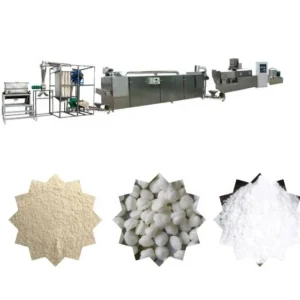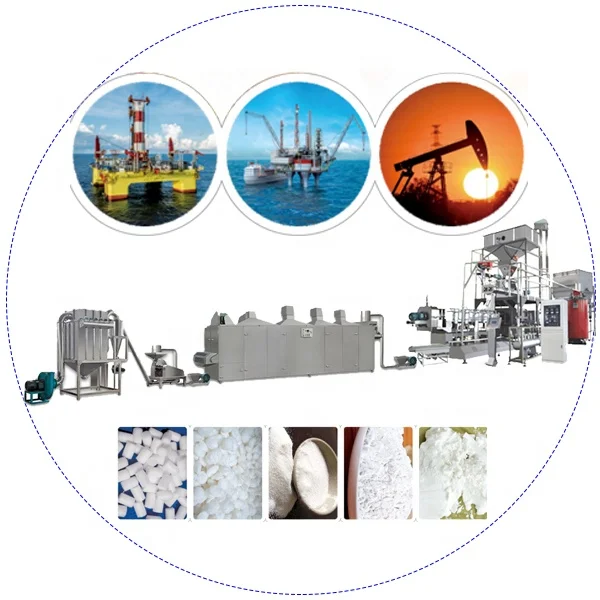


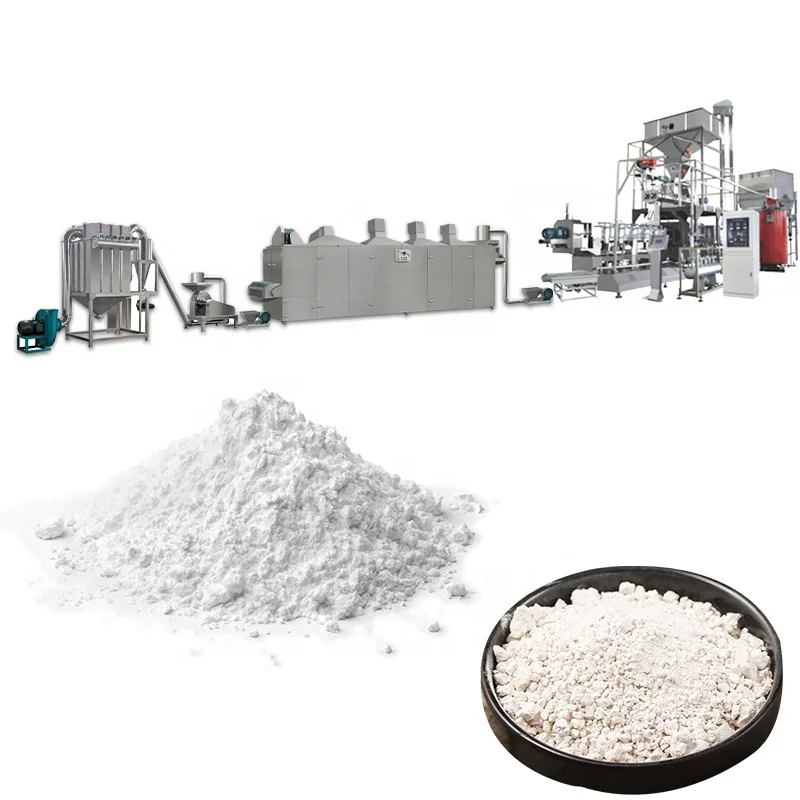
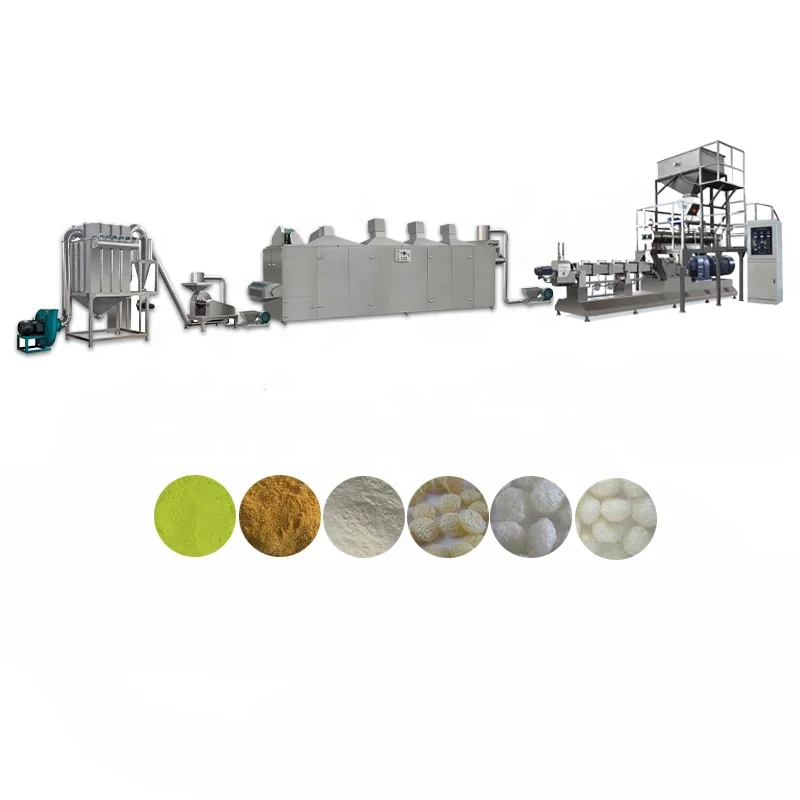

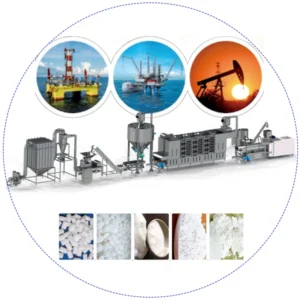
MT70 / MT85 / MT100 Twin-Screw Modified Starch Processing Line, 160-210 kW Installed Power, PLC/MCC Control — engineered for pregelatinized and modified corn starch production across food, textile, and paper applications.
- Screw configuration and die design matched to buyer’s starch type and target gelatinization degree
- Barrel temperature managed via multi-zone heating and cooling for precise starch denaturation control
- Throughput balanced across batching, extrusion, drying, and packing stations to eliminate bottlenecks
Complete line from batching to packing under one supplier, with in-house trial runs on buyer’s raw material before shipment to verify output and modification degree.
Description
Throughput-Matched Line Design — Every station from batching through drying is sized to the extruder’s actual output on your starch, preventing the idle downstream equipment that plagues mismatched projects.
Technical Specifications
| Parameter | Value |
|---|---|
| Product Type | Twin-Screw Extrusion Modified Starch Processing Line |
| Model | MT70 / MT85 / MT100 |
| Installed Power | 160 kW (MT70) / 190 kW (MT85) / 210 kW (MT100) |
| Power Consumption | 120 kW (MT70) / 140 kW (MT85) / 150 kW (MT100) |
| Output Capacity | 150–200 kg/h (MT70) / 300–400 kg/h (MT85) / 300–500 kg/h (MT100) (basis not stated in source — confirm raw material type, moisture content, and target modification degree) |
| Overall Dimensions (L×W×H) | 41000×1500×2200 mm (MT70) / 43000×1500×3200 mm (MT85) / 45000×1500×3500 mm (MT100) |
| Screw Type | Twin-screw |
| Screw Diameter | 70 mm (MT70 detailed unit — verify against MT85 / MT100) |
| Screw Length | 1520 mm (MT70 detailed unit — verify against MT85 / MT100) |
| Main Motor Power | 30 kW (detailed unit — verify against line-level installed power) |
| Heating Ring | 7 × 2 kW = 14 kW |
| Cooling System | Barrel cooling for temperature profile control |
| Voltage & Frequency | 380V 50Hz Three Phase (customizable to 3ph 380V 60Hz, 3ph 415V 60Hz, 3ph 220V 60Hz) |
| Screw Material | 38CrMoAl |
| Contact Material | Food-grade stainless steel |
| Fuel / Heating Options | Gas / Diesel / Electricity / Steam |
| Control System | Available with PLC or MCC control |
| Standards | CE, ISO |
| Warranty | 1 year complete, life-time maintenance |
Application Suitability
| Application | Material or Output |
|---|---|
| Pregelatinized starch for food processing | Corn starch — sauces, bakery, confectionery binders |
| Modified starch for industrial use | Corn starch — textile sizing and paper coating |
| Functional starch for nutritional products | Corn starch — thickening and gelling agents |
| Denatured starch for adhesive applications | Corn starch — corrugated board and labeling |
What "Rated Capacity" Leaves Out About Starch Extrusion
Nominal output means nothing until your specific starch runs through the barrel.
A modified starch processing line turnkey project lives or dies on whether the extruder can hold its quoted throughput on your actual raw material. High-amylose corn starch behaves completely differently from waxy maize — viscosity climbs faster, shear resistance increases, and the screw configuration that works for one will choke on the other. I watched a line lose nearly half its nameplate capacity because the screw profile was copied from a generic build [NEED_CITE: starch gelatinization behavior under twin-screw extrusion]. The dryer sat idle, the packaging line starved, and the plant manager had to explain the shortfall to his board.
When evaluating a modified starch processing line turnkey proposal, the first question should never be about price. It should be: what starch did you test on, and what did the numbers look like?
Barrel Temperature Control and Starch Denaturation
Modified starch production depends on precise thermal management inside the barrel. The multi-zone heating rings, paired with the integrated cooling system, allow operators to build a temperature profile that matches the gelatinization window of the incoming starch. Too cool and the granules pass through partially intact, yielding inconsistent viscosity in the final product. Too hot and you get dextrinization — the molecular chains break down and the starch loses its functional thickening power.
Screw Geometry Decides Your Modification Degree
The twin-screw configuration on the MT70, MT85, and MT100 models is not a fixed design. Screw elements are selected and sequenced based on the target modification degree — whether you need partial pregelatinization for cold-water swelling or full denaturation for high-viscosity industrial binders. The 38CrMoAl screw material handles the abrasion inherent in starch processing while maintaining dimensional accuracy over extended production runs [NEED_CITE: screw wear rates in starch extrusion applications]. Die design works in tandem with screw geometry to control residence time and expansion ratio at the discharge end.
Reading the Power and Capacity Numbers
The installed power across the MT70, MT85, and MT100 ranges from 160 kW to 210 kW, but actual consumption sits between 120 kW and 150 kW — the difference accounts for heater cycling and load variation during startup. Output capacity figures carry a critical caveat: they shift depending on starch moisture content, amylose ratio, and the degree of modification targeted. A line processing standard corn starch for pregelatinization will behave differently than one pushing high-amylose material toward full denaturation. The 30 kW main motor drives the screw assembly, while the 14 kW heating array manages the barrel profile independently. Voltage customization — 380V, 415V, or 220V at 50Hz or 60Hz — ensures the electrical system matches your facility before the line ships.
The Cost of Skipping Configuration Verification
Accepting a generic screw and die package without reviewing the configuration record against your starch specification leads to problems that surface weeks after startup. Viscosity drifts batch to batch. The dryer cannot keep pace because moisture content at the die is higher than designed. Wear parts need replacement sooner because the screw elements are fighting the material rather than processing it [NEED_CITE: downstream bottlenecks from extruder misconfiguration]. These are not warranty claims — they are engineering mismatches that the buyer absorbs.
Why Source This Line Here
Throughput matching across every station means the dryer, cooler, and packaging system are sized to the extruder’s verified output on your starch — not pulled from a catalogue of standard modules. Screw configuration and die design are specified to your raw material and target product properties before production begins. The in-house testing workshop runs your actual starch before shipment, generating a documented trial report rather than a promise. Pre-sales consultation covers line layout, utility planning, and phased installation scheduling. Ongoing support includes operator training, wear parts supply, and maintenance guidance long after commissioning.
Documentation & Verification
- Line layout and capacity calculation specific to your starch type and target output
- Screw and die configuration record matched to your modification degree specification
- Electrical schematic with confirmed voltage, frequency, and control language
- Trial run report on your raw material documenting throughput and product properties
- CE declaration of conformity and ISO certificate for customs and compliance
- Wear parts list with recommended first replacement timeline
Installation, Commissioning & Support
- Foundation and floor space planning based on the 41–45 meter line footprint and station spacing
- Dedicated electrical circuit sized to 160–210 kW installed load with confirmed voltage and phase
- Sequential station assembly from batching through extrusion to drying and packing
- First-run parameter setting including barrel temperature profile and screw speed calibration
- Operator training on PLC or MCC interface in your preferred language
- Spare screw elements, dies, and heating rings staged for the initial replacement cycle
What to Include in Your Inquiry
Provide your starch type, amylose content, and target modification specification so the screw and die package can be configured before quotation. Confirm your facility voltage, frequency, and preferred control language to avoid commissioning delays. If you have existing upstream batching or downstream packaging equipment, share the interface requirements so the modified starch processing line turnkey layout accounts for integration points.
Frequently Asked Questions
Q: How is output capacity verified on my specific starch raw material?
A: We run your actual starch through the extruder in our testing workshop before shipment. The trial run report documents real throughput, moisture at the die, and modification degree achieved. Capacity figures quoted without this test are estimates — we do not ask you to accept them as guarantees.
Q: How do you select screw configuration for my target viscosity?
A: Screw elements are chosen based on your starch type and the gelatinization or denaturation degree your product requires. The configuration record is shared with you before production, so you can verify it matches your specification rather than receiving a generic assembly.
Q: How is downstream capacity matched to the extruder?
A: Dryer, cooler, and packing stations are sized to the extruder’s verified output on your material — not to a nameplate number. This prevents the bottleneck where downstream equipment sits idle waiting for product that the extruder cannot deliver at the quoted rate.
Q: What electrical customization is available for my facility?
A: Voltage and frequency are configurable to 380V, 415V, or 220V at 50Hz or 60Hz. Control language on the PLC or MCC interface is confirmed before production. The electrical schematic is provided for your facility engineer to review prior to shipment.
Q: Can I send raw material for a trial run and what does the report cover?
A: Yes. Send a representative sample of your starch and we run it through the configured line. The report includes measured throughput, product moisture, barrel temperature profile used, screw speed, and observed modification characteristics — everything you need to evaluate before accepting delivery.
Related products
-
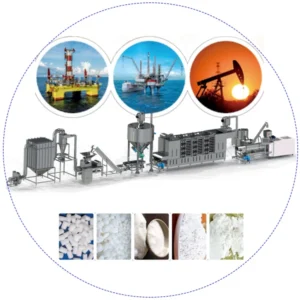
Automatic Pregelatinized Starch Processing Machine – Large-Scale New Condition Modified Starch Production Line
¥65.00 Select options This product has multiple variants. The options may be chosen on the product page -
Máquina Automática de Fabricación de Almidón Modificado Línea de Producción de Procesamiento de Almidón para Perforación de Petróleo
¥30.00 Select options This product has multiple variants. The options may be chosen on the product page -
Línea de Producción de Almidón Modificado Extrusora de Doble Tornillo de Perforación Industrial Acero Inoxidable 304 Molino de Harina de Alta Eficiencia CE
¥50.00 Select options This product has multiple variants. The options may be chosen on the product page -
Máquina de producción de almidón modificado de gran capacidad
¥30.00 Select options This product has multiple variants. The options may be chosen on the product page