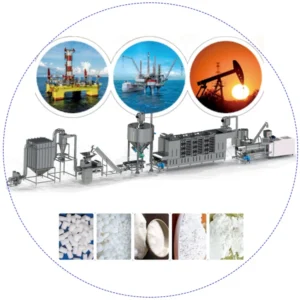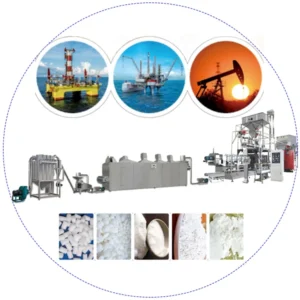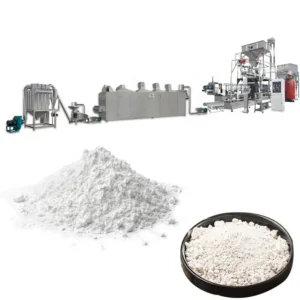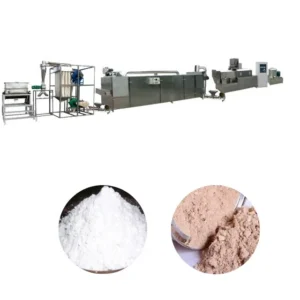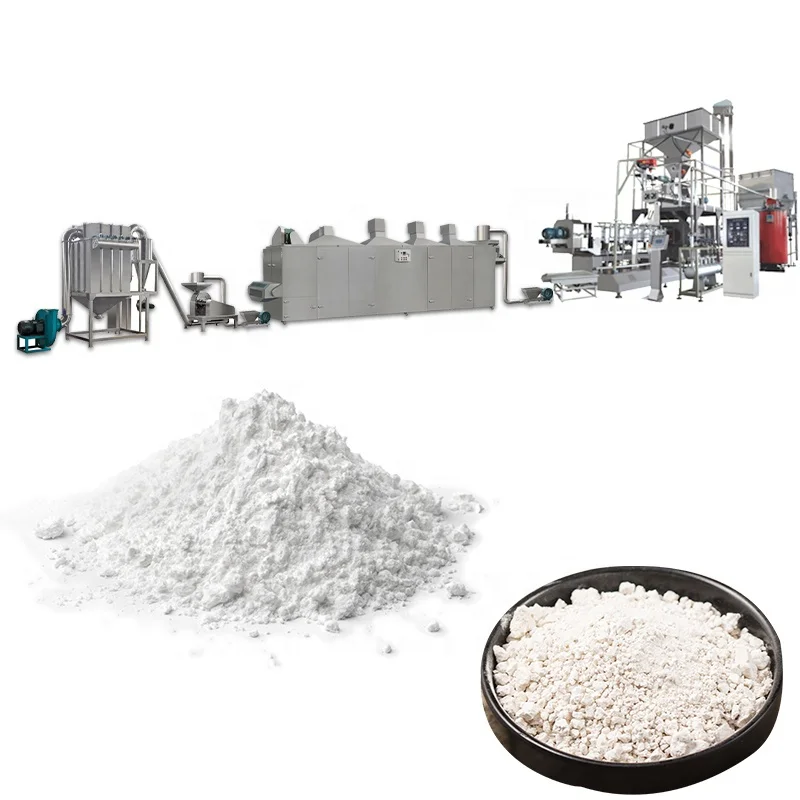


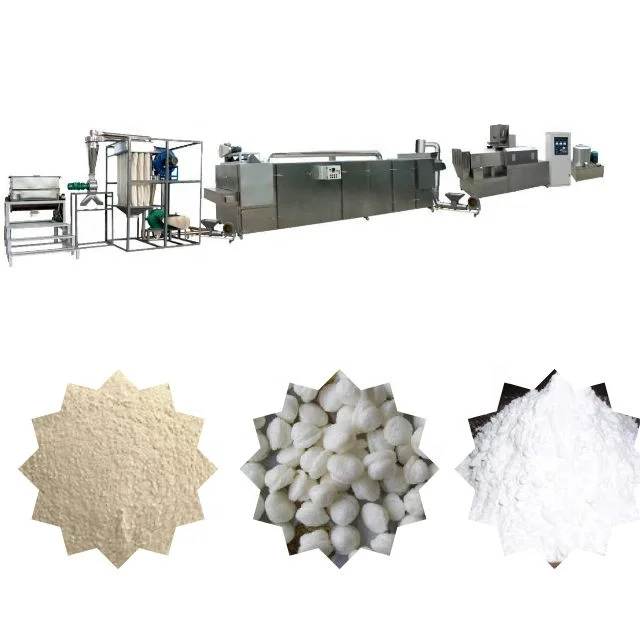

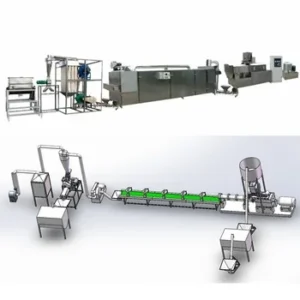
MT65 / MT70 / MT85 Modified Starch Production Line, Twin-Screw Extrusion, PLC & MCC Control — configured with sectional screw and barrel modules to match your target gelatinization degree, viscosity and solubility across pregelatinized or denatured starch applications.
- Line stations from mixing through extrusion, drying, grinding and blending to packing are throughput-matched under one supplier
- Raw material input specified at 60-80 mesh flour or starch for consistent extrusion behaviour
- Screw configuration and die design documented to your product specification
Each line ships only after a trial run on your actual raw material in our in-house testing workshop, with full configuration records and electrical schematics confirmed before production.
Description
Thermodynamic validation on your starch — Every modified starch production line turnkey configuration we ship is trial-run on the buyer’s actual flour at the target mesh size, so the barrel temperature profile and screw speed are locked before the crate leaves Jinan.
Technical Specifications
| Parameter | Value |
|---|---|
| Product Type | Modified Starch Production Line (Twin-Screw Extruder Line) |
| Available Models | MT65 / MT70 / MT85 |
| Extruder Type | Co-rotating twin-screw, sectional barrel and screw modules |
| MT65 Installed Power | 72 kW |
| MT65 Power Consumption | 50 kW |
| MT65 Output Capacity | 140–160 kg/h (basis not stated in source — confirm raw material, moisture, mesh size) |
| MT65 Overall Dimensions | 2200 × 1000 × 2300 mm |
| MT70 Installed Power | 92 kW |
| MT70 Power Consumption | 65 kW |
| MT70 Output Capacity | 240–260 kg/h (basis not stated in source — confirm raw material, moisture, mesh size) |
| MT70 Overall Dimensions | 2600 × 1000 × 2300 mm |
| MT85 Installed Power | 108 kW |
| MT85 Power Consumption | 75 kW |
| MT85 Output Capacity | 500–600 kg/h (basis not stated in source — confirm raw material, moisture, mesh size) |
| MT85 Overall Dimensions | 4500 × 1000 × 2600 mm |
| Raw Material Requirement | Flours and starches, 60–80 mesh |
| Line Stations | Mixing → Extrusion → Drying → Grinding → Blending → Packing |
| Control System | PLC and MCC |
| Mixer Construction | Stainless steel contact parts, safety interlock on top cover and discharge hole |
| Screw Conveyor | Stainless steel roller, 1.1 kW motor, 0–150 kg/h capacity (source value — verify against manufacturer catalog) |
| Cooling Machine | Cooling conveyor for post-drying temperature and moisture reduction |
| Assembly State | Turnkey complete line |
| Certification | CE |
| Warranty | 24 months, lifetime service |
Application Suitability
| Application | Material or Output |
|---|---|
| Industrial pregelatinized starch for oil-well drilling mud | Corn or cassava starch, 60–80 mesh, high cold-water swelling target |
| Wallpaper adhesive and construction-grade starch | Modified cassava or potato starch requiring controlled viscosity |
| Food-grade binder and thickener for bakery and dairy | Waxy maize or tapioca starch, denatured for freeze-thaw stability |
| Paper and textile sizing starch | Corn flour processed for film-forming and adhesion properties |
| Fortified nutritional starch blends | Rice flour or corn flour blended with micronutrients before extrusion |
Why "Nominal Capacity" Wrecks Starch Projects
A capacity number without a raw-material footnote is not a capacity — it is a guess. [NEED_CITE: starch gelatinisation behaviour across different botanical sources]
I watched a European buyer lose two full weeks of commissioning because the line was quoted on a standard corn-starch benchmark, but the buyer’s recipe included a cassava-tapioca blend at a different moisture level. The barrel temperature curve that gave full gelatinisation on corn left the cassava fraction half-cooked, and the downstream grinder choked on the gummy output. The screw speed, barrel zone temperatures, and die geometry all had to be re-mapped from scratch. On a modified starch production line turnkey project, that kind of mismatch does not just waste time — it erodes the buyer’s credibility with their own customers who are waiting for first-article samples. A trial run on the buyer’s actual flour, at the buyer’s target mesh and moisture, is the only way to convert a catalogue number into a dependable shift output.
Screw Geometry Determines What the Starch Becomes
Starch modification is, at its core, a controlled thermo-mechanical treatment. The co-rotating twin-screw extruder in this modified starch production line turnkey system uses sectional screw modules so the conveying, kneading, and shear zones can be re-sequenced without replacing the entire shaft. A buyer targeting high cold-water swelling pregelatinized starch needs a longer gelatinisation residence time with moderate shear, while a buyer making denatured starch for drilling mud may push shear higher to break molecular chains and reduce viscosity. The sectional design lets each target property be addressed by rearranging kneading block angles and pitch lengths rather than buying a different machine.
Throughput Matching Across Every Station
An extruder that pushes material faster than the dryer can handle simply creates a wet bottleneck, and material that enters the grinder above its thermal limit turns into a paste instead of a powder. Each station — mixer, screw conveyor, extruder, dryer, cooling conveyor, grinder, blender, packing — is sized against the extruder’s validated output on the buyer’s specific raw material. [NEED_CITE: throughput balancing methodology in continuous food processing lines] This prevents the familiar situation where the extruder nameplate reads a respectable figure but the packing table sees only a fraction of it because intermediate stations were selected from a generic menu rather than calculated from the actual mass and energy balance of the process.
What the Specs Actually Mean on the Floor
The raw-material mesh requirement of 60–80 is not arbitrary — coarse particles above 80 mesh create uneven moisture penetration inside the barrel, leading to partially gelatinised cores that show up as white specks in the finished powder. Installed power figures across the MT65, MT70, and MT85 reflect the mechanical energy available for shear; actual power consumption sits lower because the motor is sized for peak startup torque rather than continuous load. The PLC and MCC control system allows operators to store barrel-zone temperature profiles and screw-speed recipes for each starch type, so a shift change does not mean re-discovering the settings that gave acceptable gelatinisation degree on the previous run. Stainless-steel contact surfaces in the mixer and screw conveyor reduce iron contamination that would otherwise discolour light-coloured starches and fail food-grade metal-detection checks.
The Hidden Cost of Skipping the Trial
Buyers who waive the pre-shipment trial to save a few weeks on lead time often discover, after installation, that their local flour has a different amylose-amylopectin ratio than the test standard. The extruder runs, the dryer runs, but the end-product viscosity drifts outside specification and the buyer’s customer rejects the first production lot. [NEED_CITE: variability in starch composition across harvest regions and suppliers] Re-engineering the screw configuration and die geometry on-site, without the testing workshop’s instrumentation, stretches commissioning into months instead of days and turns a capital-equipment investment into a running cost problem.
Why Source This Line Here
One supplier covers every station from batching to packing, so accountability for throughput mismatches stays in a single set of hands rather than bouncing between an extruder vendor, a dryer vendor, and a grinder vendor. Screw and die configurations are recorded against the buyer’s raw material and target modification, and that record travels with the machine for future reference. The in-house testing workshop runs the buyer’s own flour before crating, producing a trial-run report that becomes part of the shipping documentation. CE certification is maintained for the complete assembly, not just individual components. Electrical schematics confirm voltage, frequency, and control language before production begins, avoiding the on-site rewiring that delays commissioning in export markets. [NEED_CITE: CE machinery directive requirements for industrial extrusion equipment]
Documentation & Verification
- Line layout and capacity calculation showing mass balance across mixer, extruder, dryer, and grinder
- Screw and die configuration record matched to buyer’s target starch modification
- Trial-run report on buyer’s raw material executed in the testing workshop before shipment
- Electrical schematic with voltage, frequency, and PLC language confirmed for destination market
- CE declaration of conformity covering the complete line assembly
- Operation and maintenance manual with wear-parts list for screw modules and die plates
Installation, Commissioning & Support
- Foundation plan accounts for MT85 overall length of 4500 mm and dynamic load from twin-screw torque
- Dedicated electrical circuit sized for MT85 installed power of 108 kW with soft-start provisions
- Barrel sections and screw modules ship disassembled for container loading and reassemble on-site
- First-run parameter setting uses trial-run report as baseline, reducing commissioning to verification
- Operator training covers PLC recipe recall for different starch modifications and mesh sizes
- Wear-parts list covers screw elements, die plates, and mixer interlock switches for two-year stock planning
Before You Request a Quote
To size the line correctly, share your raw-material type (corn, cassava, waxy maize, or blend), the mesh size you can supply, and your target starch property — cold-water swelling, viscosity, or film-forming behaviour. Specify daily output expectations and shift pattern so the capacity tier (MT65, MT70, or MT85) maps to actual production hours. Confirm the local voltage and frequency at the installation site, along with the PLC display language your operators need, so the control cabinet is built to match before it leaves the factory.
Frequently Asked Questions
Q: How is output capacity verified, and what conditions does it depend on?
A: Capacity depends on the botanical source of the starch, its moisture content at dosing, and the target degree of modification. We run your actual raw material in the testing workshop and record throughput, barrel temperatures, and screw speed. That trial-run report, not a catalogue table, becomes the capacity baseline for your line configuration and quotation.
Q: How do you configure the screw and die for pregelatinized versus denatured starch?
A: Pregelatinized starch requires a longer residence time at moderate shear to achieve full granule swelling without breaking molecular chains, so kneading blocks are spaced further apart. Denatured starch for industrial use tolerates higher shear and shorter residence to reduce viscosity. The sectional screw modules let us rearrange elements for each target without swapping the entire shaft.
Q: Can I send my raw material for a trial before the line ships?
A: Yes. We ask buyers to ship a representative batch of their flour or starch to the testing workshop. We run it through the extruder at the target mesh and moisture, measure gelatinisation degree and output rate, and include the full trial-run report with the shipping documentation so commissioning starts from a known baseline.
Q: What voltage and PLC language options are available?
A: The control cabinet is built to the destination site’s voltage and frequency after we confirm those values during the quotation stage. PLC display and alarm language are configurable to the operator’s working language, and the electrical schematic records the confirmed settings so any future electrical work references the correct standard.
Q: How are the dryer and grinder matched to the extruder?
A: We calculate the mass and thermal load leaving the extruder based on the trial-run data — moisture removed, temperature profile, and actual throughput. The dryer’s residence time and the grinder’s motor rating are then selected so neither station creates a bottleneck. The cooling conveyor between them brings pellet temperature down to a range the grinder can handle without producing a paste.
Related products
-
Línea de Producción de Almidón Modificado Extrusora de Doble Tornillo de Perforación Industrial Acero Inoxidable 304 Molino de Harina de Alta Eficiencia CE
¥50.00 Select options This product has multiple variants. The options may be chosen on the product page -
Línea de producción de polvo de almidón modificado de maíz y yuca Equipos de procesamiento automáticos de 400 kg/h con motor eléctrico Nueva condición
¥65.00 Select options This product has multiple variants. The options may be chosen on the product page -
2025 Nuevo Diseño Almidón Modificado Gran Capacidad Uso Industrial Aditivos Alimentarios Componentes Principales Rodamiento de Motor
¥50.00 Select options This product has multiple variants. The options may be chosen on the product page -

Automatic Industrial Adhesive Starch Modification Production Line – Pre-Gelatinization Extrusion Equipment
¥65.00 Select options This product has multiple variants. The options may be chosen on the product page