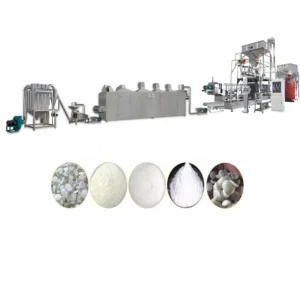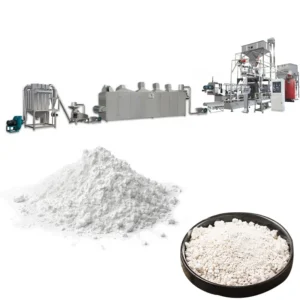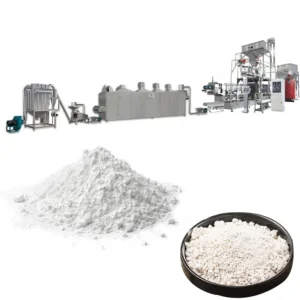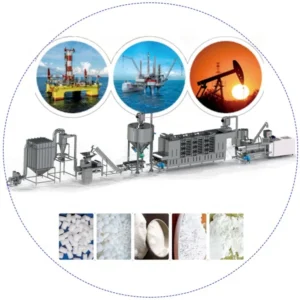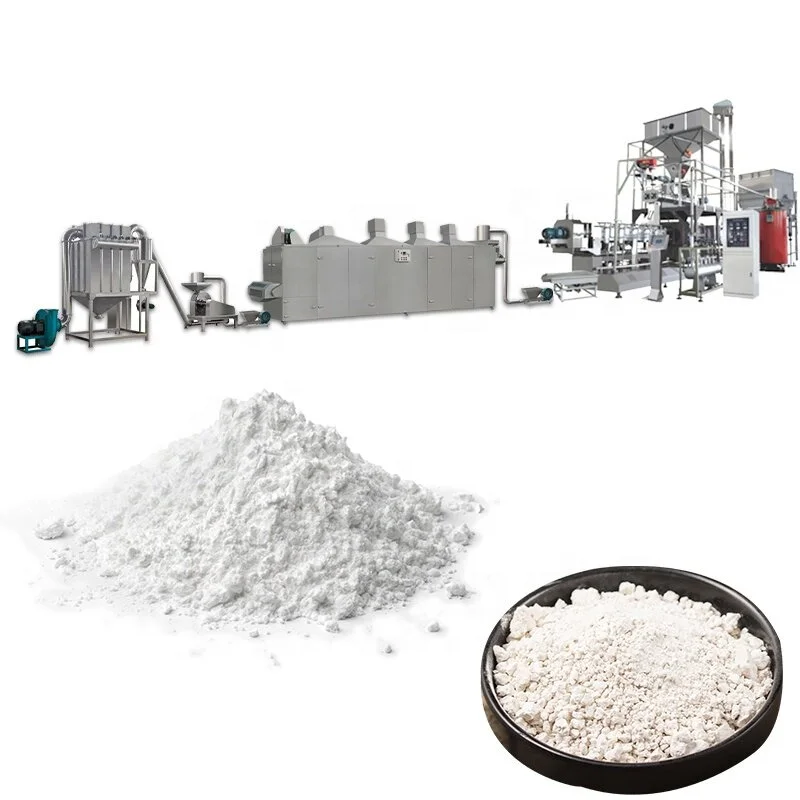
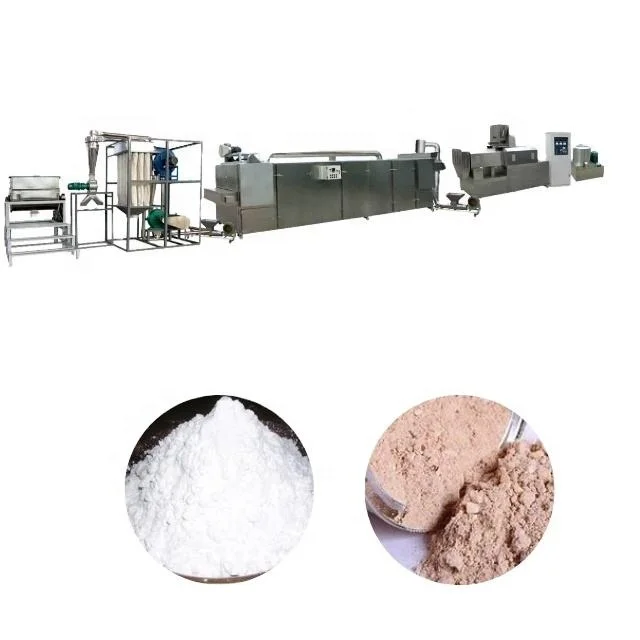
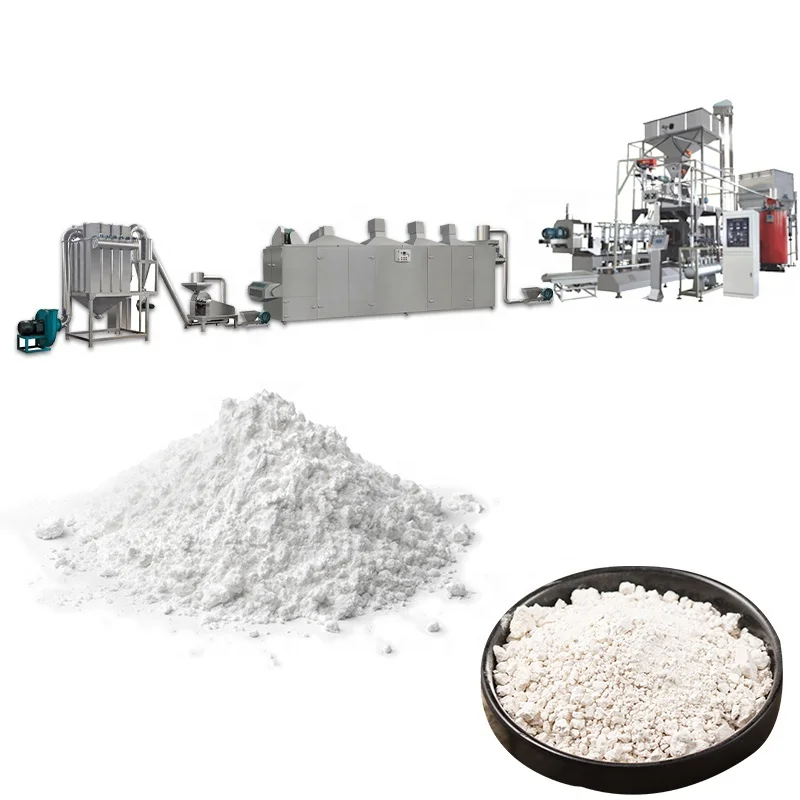
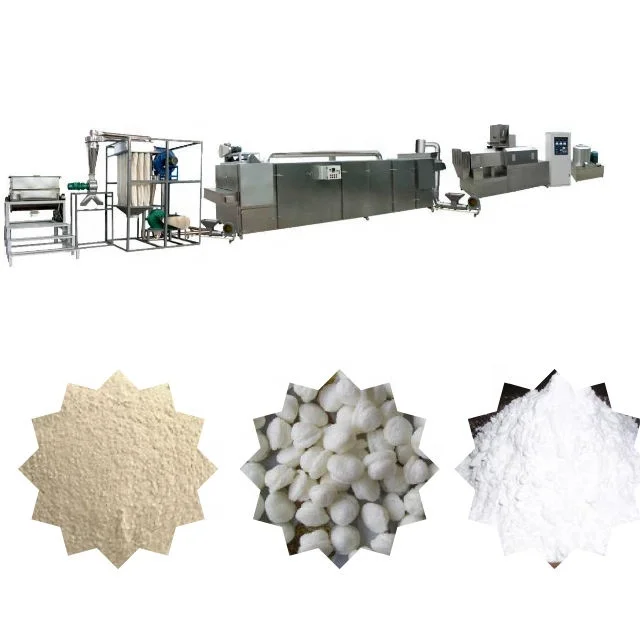
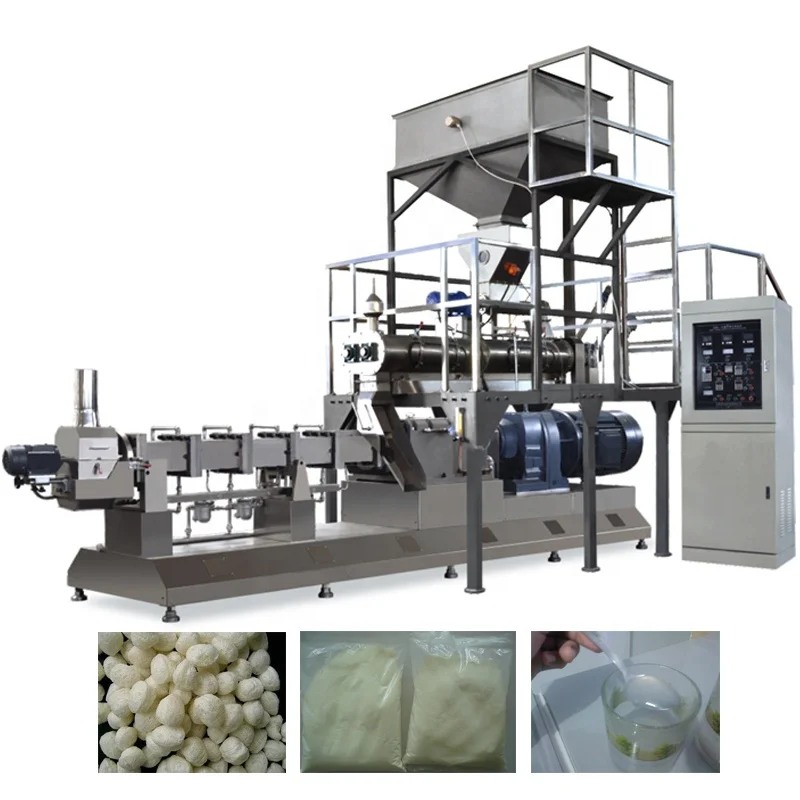

MT65 / MT70 / MT70C / MT75 Twin Screw Extruder Modified Starch Production Line, 84–200 kW Installed Power, PLC Control — complete turnkey line from batching through extrusion, multi-layer drying to pulse grinding, with throughput matched across every station. Screw configuration and die design are specified to your raw starch type and target modification properties, ensuring consistent gelatinisation and viscosity control.
- In-house trial run on your raw material before shipment, with full test report and screw configuration record included
- CE and ISO certified; layout design, commissioning and operator training delivered by factory engineers
- Wear parts list, electrical schematic and voltage confirmation aligned to your site utility supply provided with shipment documentation
Description
Throughput-Matched Line Design — every station from mixing to grinding is balanced to the extruder’s actual output on your starch material, so no single machine bottlenecks the modified starch production line turnkey you invested in.
Technical Specifications
| Parameter | Value |
|---|---|
| Product Type | Twin Screw Extruder Modified Starch Production Line |
| Models Available | MT65, MT70, MT70C, MT75 |
| Installed Power | MT65: 84 kW; MT70: 160 kW; MT70C: 190 kW; MT75: 200 kW |
| Power Consumption | MT65: 59 kW; MT70: 120 kW; MT70C: 140 kW; MT75: 145 kW |
| Output Capacity | MT65: 100–150 kg/h (basis to be confirmed); MT70: 150–200 kg/h (basis to be confirmed); MT70C: 200–250 kg/h (basis to be confirmed); MT75: 250–300 kg/h (basis to be confirmed) |
| Overall Dimensions (L×W×H) | MT65: 41000×1500×2200 mm; MT70: 41000×1500×2200 mm; MT70C: 41000×1500×3200 mm; MT75: 45000×1500×3500 mm |
| Screw Type | Twin-screw |
| Screw Material | 38CrMoAlA alloy steel |
| Barrel Material | 45# steel |
| Screw Length | 1050 mm, 1520 mm, 1699 mm (varies by model) |
| Main Motor | 22 kW, 30 kW, 45 kW (varies by model) |
| Feeding System | Frequency-controlled feeding motor with variable frequency drive |
| Main Spindle Drive | Frequency-controlled inverter |
| Control System | Control cabinet with frequency converters; MCC and PLC available |
| Frame Material | Carbon steel |
| Outer Sealing Plate | Stainless steel 201 or 304 |
| Mixer Power | 4 kW / 7.5 kW / 15 kW |
| Mixer Capacity | 20–30 kg/batch, 70–80 kg/batch, 170–180 kg/batch |
| Mixer Voltage | 380 V, 50 Hz, three-phase (standard) |
| Dryer Type | Multi-layer oven (electric / fuel oil / gas) |
| Dryer Temperature Range | 0–200 °C (electric model, adjustable via control cabinet) |
| Dryer Configuration Options | 3 layers × 5 m, 5 layers × 5 m, 5 layers × 7 m, 7 layers × 10 m, 5 layers × 12 m |
| Dryer Mesh Belt | Stainless steel double-layer mesh |
| Grinding Equipment | Pulse grinder with cyclone discharge and dust collector |
| Line Stations | Mixer → Twin-screw extruder → Dryer → Pulse grinder |
| Delivery Lead Time | 15–35 working days after deposit |
| Warranty | 1 year; lifetime maintenance service |
| Certification | CE (since 2014); ISO certified |
Application Suitability
| Application | Material or Output |
|---|---|
| Food-grade modified starch | Native corn, cassava, potato, or wheat starch processed for food thickeners and instant food applications |
| Pre-gelatinized starch | Starch modified through twin-screw extrusion for instant pudding, soup bases, and pharmaceutical excipients |
| Industrial binders and sizing agents | Starch processed for paper sizing, textile auxiliaries, and adhesive formulations |
| Nutritional and specialty starches | Physically, chemically, or enzymatically modified starch for fortified food and nutrition programmes |
Why Nominal Capacity Fails When the Raw Material Changes
A line rated on paper rarely sustains that output once your specific starch enters the barrel.
When I was commissioning a modified starch production line turnkey project in South Asia, the client had sourced an extruder rated for a certain hourly throughput — based on wheat starch at a fixed moisture level. Their actual feedstock was cassava starch, with different gelatinisation behaviour and higher fibre content. The extruder ran, but output dropped noticeably, and the downstream dryer could not be fully utilised. Every line we configure is validated through a trial run on the buyer’s actual raw material in our testing workshop before the machines leave the factory [NEED_CITE: twin-screw extrusion behaviour on different starch types]. That trial run is what separates a specification sheet from a working production line.
Matching the Screw Profile to Your Starch Chemistry
The twin-screw configuration on the MT series is not a fixed build. Screw elements — kneading blocks, conveying sections, and reverse-flight segments — are arranged based on the raw starch type and the target modification. Cassava starch requires different shear intensity and residence time than corn starch to reach the same degree of gelatinisation. A modified starch production line turnkey project succeeds or fails at this stage, because the screw profile determines thermal viscosity, freeze-thaw stability, and gel strength in the finished product.
Dryer Sizing as a Function of Extruder Throughput
The multi-layer oven is available in multiple tier and length combinations — from 3 layers at 5 metres up to 5 layers at 12 metres — selected so the dryer does not become the constraint. If the extruder pushes material faster than the belt can dry it to specification, the entire modified starch production line turnkey backs up. We size the dryer based on the validated extruder output from the trial run, not on a generic ratio [NEED_CITE: multi-layer dryer capacity calculation for starch products].
What the Core Parameters Actually Mean on the Floor
The 38CrMoAlA alloy steel screw and 45# steel barrel combination provides wear resistance necessary for continuous starch processing, where abrasive raw material gradually erodes softer alloys. The screw length varies across models — 1050 mm on the MT65, up to 1699 mm on larger units — and directly affects residence time inside the barrel, which in turn determines how completely the starch granules gelatinise under heat and shear. The frequency-controlled inverter on both the feeding motor and main spindle allows operators to adjust throughput and screw speed independently, giving precise control over the modification process without changing hardware.
What Happens When Stations Are Sourced Separately
I once saw a modified starch line in West Africa where the buyer added a second extruder to an existing setup without upgrading the mixer or grinder. The extruder produced more output than the upstream batching system could supply, so the barrel frequently starved, causing uneven gelatinisation and off-spec product. The pulse grinder downstream could not keep up either, creating a backlog of dried but unground starch that sat exposed to humidity [NEED_CITE: effects of humidity exposure on pre-gelatinized starch quality]. A single-supplier line avoids this by matching every station to a common throughput target from the start.
Why This Line Is Built as One Project
Every station — mixer, twin-screw extruder, multi-layer dryer, and pulse grinder with cyclone discharge — is specified under one layout document, so throughput is balanced across the entire chain rather than assembled from independent vendors. Screw configuration and die design are documented against your raw material and target starch properties, not pulled from a generic template. The in-house testing workshop runs your starch before shipment, so the trial run report becomes a baseline for commissioning rather than a discovery phase. Electrical schematics, voltage, and frequency are confirmed against your site supply before production starts. The pulse grinder with dust collector completes the chain from raw starch input to finished powder, eliminating a separate sourcing step.
Documentation & Verification
- Line layout and capacity calculation showing matched throughput at mixer, extruder, dryer, and grinder stations
- Screw and die configuration record tied to your specific starch type and target modification properties
- Trial run report from the in-house testing workshop conducted on your raw material before dispatch
- Electrical schematic with voltage and frequency confirmed against your site utility supply
- CE declaration of conformity and ISO certificate included with shipment documentation
- Wear parts list covering screws, dies, and mesh belt segments with packing photographs
Installation, Commissioning & Support
- Foundation and floor space planned around the full line footprint, up to 45000×1500×3500 mm for the MT75 configuration
- Power supply verified against installed power ranging from 84 kW to 200 kW, with dedicated circuit recommendations per model
- Machines shipped in sectional assemblies and reassembled on-site by factory engineers during commissioning
- First production run uses trial run parameters as a baseline, with adjustments made to frequency drives and dryer temperature
- Operator training covers screw speed adjustment, feeding rate control, and dryer belt temperature monitoring
- Wear parts list with replacement schedule for 38CrMoAlA screws and stainless steel mesh belt sections
What We Need to Configure Your Line
To move from an inquiry to a line layout, we need your raw starch type — corn, cassava, potato, or wheat — along with the target modification and end-use application. Provide your local voltage and frequency, available workshop floor area and ceiling height, and whether you require PLC or standard frequency converter control. If you can ship a sample of your raw material, we will run it in the testing workshop and include the results with the proposal.
Frequently Asked Questions
Q: How is output capacity confirmed for my specific starch material?
A: Output capacity depends on raw starch type, moisture content, and the target degree of modification. We conduct a trial run on your actual material in our in-house testing workshop before shipment. The results — including throughput, product texture, and gelatinisation level — are documented in a trial run report that becomes the commissioning baseline for your modified starch production line turnkey installation.
Q: How are screw configuration and dryer size selected for different starches?
A: Cassava, corn, potato, and wheat starch each respond differently to shear and temperature inside the barrel. We select screw element arrangement and die design based on your target properties — gelatinisation temperature, thermal viscosity, or freeze-thaw stability. The dryer tier count and belt length are then sized to the validated extruder output so no station constrains the next.
Q: What prevents the mixer or grinder from bottlenecking the extruder?
A: Every station in the line — mixer capacity in kg per batch, extruder throughput, dryer belt speed, and pulse grinder discharge rate — is calculated against a single throughput target. The layout document specifies this balance so that no station starves or overfeeds the next. This matching is validated during the factory trial run.
Q: What does the in-house trial run involve?
A: We process your raw starch through the configured extruder, dryer, and grinder in our testing workshop. The trial run confirms throughput, product quality, and equipment settings under real conditions. Results are recorded in a formal report shared with you before shipment, so commissioning on-site starts from a known baseline rather than from scratch.
Q: What is included in on-site installation and operator training?
A: Factory engineers handle assembly, utility connection verification, and first-run commissioning. Operator training covers frequency drive adjustments for feeding and spindle speed, dryer temperature management within the 0–200 °C range, and pulse grinder operation with the cyclone discharge system. A wear parts schedule is provided for ongoing maintenance planning.
Related products
-
Pregelatinized Low-Cost Modified Starch Line – High-Efficiency Automated Starch Processing Machine
¥65.00 Select options This product has multiple variants. The options may be chosen on the product page -
Línea de Almidón Pregelatinizado Estándar API para Fluidos de Perforación en Campos Petroleros. Equipos de Almidón Modificado de Alto Rendimiento
¥65.00 Select options This product has multiple variants. The options may be chosen on the product page -
Modified Starch for Construction Adhesives Production – Custom Built Double Screw Extruder Line
¥65.00 Select options This product has multiple variants. The options may be chosen on the product page -
Máquina automática de fabricación de almidón de maíz modificado de acero inoxidable 304 TORNILLO DOBLE 500kg/h Capacidad Línea de producción de procesamiento de almidón
¥50.00 Select options This product has multiple variants. The options may be chosen on the product page