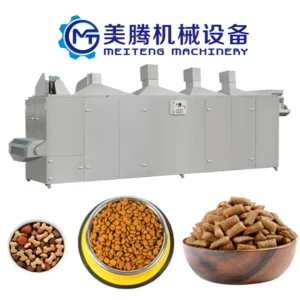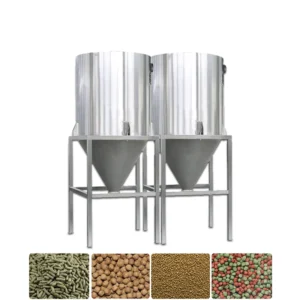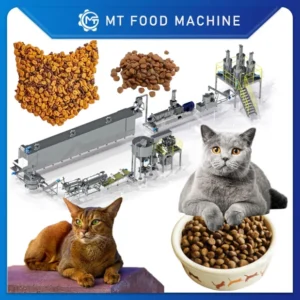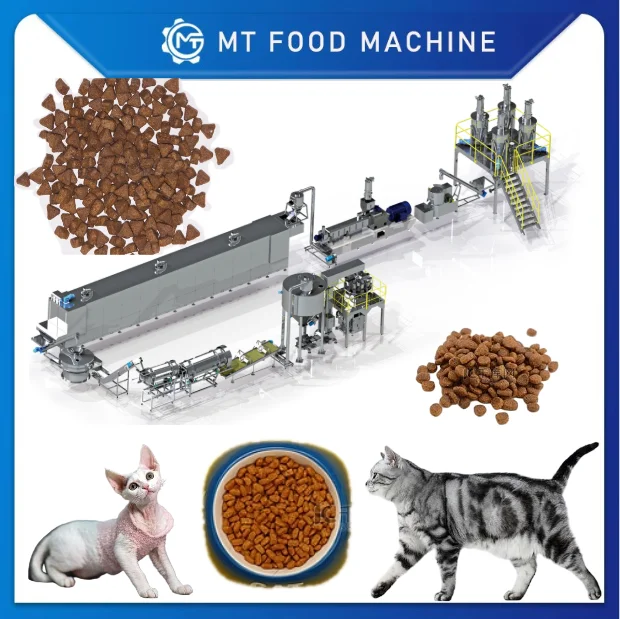


Multi-Species Cat Food Processing Line, PLC Controlled, Twin-Screw Extrusion — complete turnkey solution from batching through extrusion to packing, with throughput matched across every station to eliminate bottlenecks.
- Screw configuration and die design specified to your raw material formulation and target kibble density
- In-house trial runs on your actual raw material before shipment ensure consistent texture and expansion
One supplier delivers the entire line layout, capacity calculation, and commissioning support so every station performs to spec from day one.
Description
Throughput-matched line design — Every station from the batching system through the MT100 extruder to the packing belt is calculated as one continuous flow, so a bottleneck at the dryer or coating drum never starves the output you were promised.
Technical Specifications
| Parameter | Value |
|---|---|
| Product Type | Pet Food Extrusion Production Line |
| Line Configuration | Batching, mixing, extrusion, drying, coating, cooling, packing |
| Control System | PLC Controlled |
| Applicable Species | Cat, dog, fish, bird, cattle feed |
| Output Capacity | 1.5-2.0 t/h (basis not stated in source — confirm raw material formulation / moisture content / kibble size) |
| Alternative Capacity Claim | up to 550 kg/h (basis not stated in source — reconcile with primary capacity claim) |
| Screw Type | Twin-screw (verify against final quotation) |
| Voltage & Frequency | Configurable to buyer’s local grid (confirm before production) |
| Certification | CE (verify certificate validity for specific line configuration) |
Application Suitability
| Application | Material or Output |
|---|---|
| Dry kibble for cats and dogs | Poultry meal, meat and bone meal, corn, wheat, soy, rice bran, vitamin premix |
| Floating and sinking aquatic feed | Fish meal, soy protein concentrate, starch binder, lipid coating for catfish, tilapia, and shrimp |
| Bird and small animal feed | Millet, corn grits, sunflower meal, calcium carbonate |
| Cattle feed supplement pellets | Soy hulls, wheat middlings, urea, mineral premix |
Why "Rated Capacity" Means Nothing Without Your Raw Material Formula
The real output of a pet food processing line turnkey project is determined by the lowest-throughput station running on your exact formulation, not by the extruder nameplate.
I learned this the hard way on a Middle East project. We configured a line quoted at 1.5-2.0 t/h, but the buyer’s actual recipe carried nearly double the meat meal ratio we had used during factory trials. The screws could not feed fast enough, and the line ran at roughly half the expected rate for the first month. That single mismatch cascaded — the dryer ran half-empty, the coating drum tumbled product too long, and kibble density drifted outside the buyer’s market specification [NEED_CITE: extruder throughput dependency on raw material bulk density and moisture]. When you evaluate a pet food processing line turnkey proposal, the capacity number on the cover page is only a starting conversation. The document that actually matters is the line layout and capacity calculation that shows every station’s throughput verified against your specific ingredient list and target kibble size.
Screw Geometry Dictated by Recipe, Not by Catalogue
A twin-screw extruder configured for high-starch corn kibble will stall or surge when fed a recipe heavy in meat meal and animal fat. The flight depth, compression ratio, and kneading block arrangement must be selected against the buyer’s actual formulation before metal is cut. On this line, the screw and die configuration record is documented and locked to your recipe, ensuring the shear profile and residence time produce the kibble density and texture your market expects.
Matching the Dryer and Coater to Extruder Surge
An extruder that pulses or surges will overwhelm a downstream dryer sized only to its average output. Every station on this line — mixing, conveying, drying, flavouring, cooling, packing — is throughput-matched so that peak extruder output never creates a backlog the dryer cannot clear. This is the discipline that separates a functioning pet food processing line turnkey installation from a collection of individual machines that fight each other on the factory floor [NEED_CITE: sequential station throughput balancing in extrusion lines].
Reading the Specs That Actually Shape Your Product
The control system governs how tightly barrel temperature and screw speed hold steady across an eight-hour shift, which directly determines whether kibble density stays inside specification from the first bag to the last. The PLC-controlled architecture on this line allows recipe storage and recall, so changeovers between cat and dog formulations are repeatable without relying on operator memory. The applicable species range — cat, dog, fish, bird, cattle — means die plates and screw profiles must be swapped when you move between categories, and the line layout accounts for that changeover time. Voltage and frequency are left configurable because a 50 Hz motor running on a 60 Hz grid will overspeed the extruder, altering shear and product texture in ways that no amount of PLC tuning can correct [NEED_CITE: motor speed and frequency mismatch effects on extrusion consistency]. Confirming your local grid with the supplier before production avoids a commissioning delay that no one planned for.
The Hidden Cost of Assembling a Line from Separate Vendors
When the extruder, dryer, and coating drum arrive from three different suppliers, no single party owns the throughput gap between them. The extruder vendor blames the dryer for being undersized, the dryer vendor blames the extruder for surging, and the buyer pays for an extra shift to hit the daily target. This fragmentation is the most common reason a pet food processing line turnkey project overruns its commissioning schedule [NEED_CITE: multi-vendor integration risks in food processing lines]. Specifying the complete line under one supplier means one party is accountable for the output number at the packing station.
What We Bring to the Table Beyond the Machine
Every station from batching to packing is designed and supplied together, so throughput matching is an engineering calculation, not a hope. The screw configuration and die design are specified against your raw material and target kibble, not copied from a generic build. An in-house testing workshop runs your actual formulation before the line ships, generating a trial run report you can review before accepting delivery. The line is backed by pre-sales consultation, engineer layout design, on-site installation, commissioning, operator training, and ongoing wear parts supply — a single chain of accountability from first inquiry to steady-state production.
Documentation & Verification
- Line layout and capacity calculation showing matched throughput at every station for your recipe
- Screw and die configuration record locked to your target kibble density and species
- Trial run report on your raw material formulation conducted before shipment
- Electrical schematic with voltage, frequency, and control language confirmed pre-production
- CE declaration of conformity and ISO certificate for customs and local compliance
- Operation and maintenance manual with wear parts list specific to your line configuration
Installation, Commissioning & Support
- Foundation plan and utility drop points matched to the PLC-controlled line footprint and rated power draw
- Voltage and frequency verified against local grid before the extruder motor is energized at commissioning
- Phased station-by-station startup sequence so the extruder, dryer, and coater are balanced before full-speed runs
- Operator training covering recipe storage, screw changeover between species, and daily wear part inspection
- Spare screws, dies, and barrel liners shipped with the line so first replacement never halts production
- Scheduled maintenance intervals tied to actual running hours logged by the PLC control system
What We Need to Build Your Line Correctly
Send us your target kibble specification — species, size, density range, and ingredient list with approximate ratios. Confirm your local voltage, frequency, and preferred control language so the electrical package is right the first time. If you have existing upstream or downstream equipment that must tie into this line, share the interface dimensions and throughput so we can match the connection points before fabrication begins.
Frequently Asked Questions
Q: How is the line’s output capacity verified on my actual raw material?
A: We run your specific formulation — with your exact meat meal ratio, starch content, and moisture level — in our in-house testing workshop before the line ships. You receive a trial run report documenting actual throughput, kibble density, and texture against your target specification, so there are no surprises at commissioning.
Q: How do you prevent bottlenecking between the extruder and downstream stations?
A: Every station — dryer, coating drum, cooler, packing belt — is throughput-calculated against the extruder’s peak output on your formulation, not its catalogue average. The line layout document you receive with your quotation shows the matched capacity at each point, so no single station constrains the others.
Q: What does the pre-shipment trial run actually cover?
A: The trial run uses your raw material to produce kibble in your target size and density range. We document screw speed, barrel temperature profile, moisture addition, die selection, and the resulting product specification. You review the report and approve it before the line is crated for dispatch.
Q: How is the screw configuration chosen for multi-species production?
A: Each species and kibble format demands a different shear profile and compression ratio. We document the screw element arrangement and die geometry for every product in your range, and the line layout includes changeover procedures so you can switch between cat, dog, or aquatic formulations within a planned downtime window.
Q: What documentation ships with the line for installation and compliance?
A: You receive a complete package: line layout and capacity calculation, electrical schematic with confirmed voltage and frequency, screw and die configuration record, trial run report, CE declaration of conformity, ISO certificate, operation manual, and a wear parts list specific to your configuration.
Related products
-
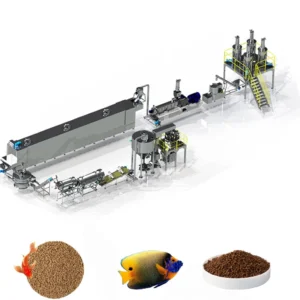
Máquina de Línea de Producción de Alimento para Peces Automática Fabricación de Pellets Flotantes y Hundidos Diseño de Alta Capacidad y Ahorro de Energía
¥9,500.00 Select options This product has multiple variants. The options may be chosen on the product page -
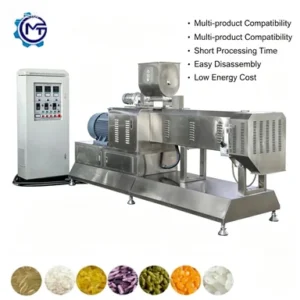
Equipo de producción para el procesamiento de alimento acuático para peces de hundimiento y flotación con extrusora de doble tornillo de acero inoxidable duradera.
¥65.00 Select options This product has multiple variants. The options may be chosen on the product page -
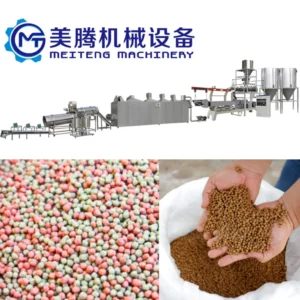
Línea de procesamiento de alimentos para peces de alta capacidad de 2-3t/h para producir alimento para peces
¥55,000.00 Select options This product has multiple variants. The options may be chosen on the product page -
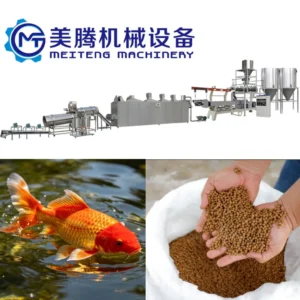
Línea de procesamiento de alimento para peces multi-especies de alta capacidad de 1.0-1.5t/h para producir alimento para peces
¥45,000.00 Select options This product has multiple variants. The options may be chosen on the product page