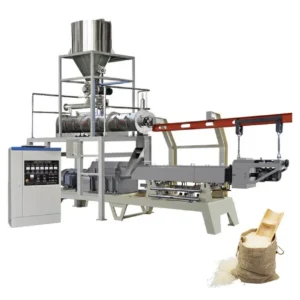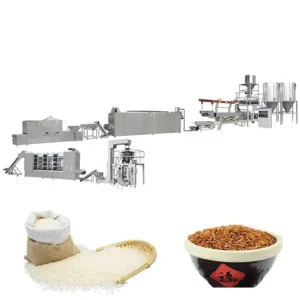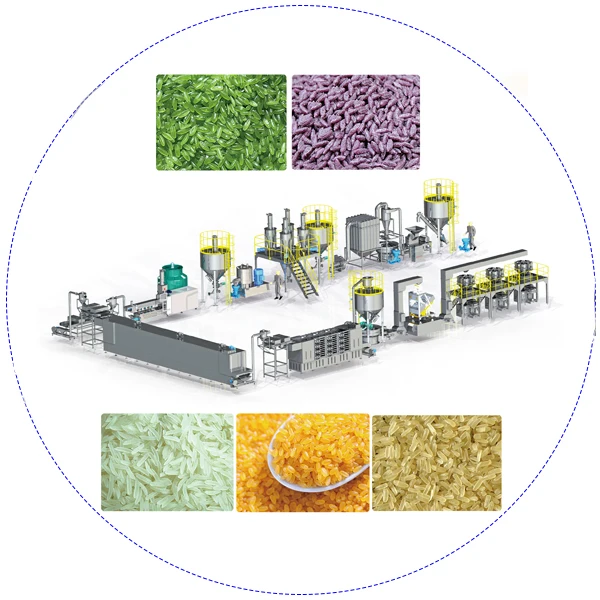

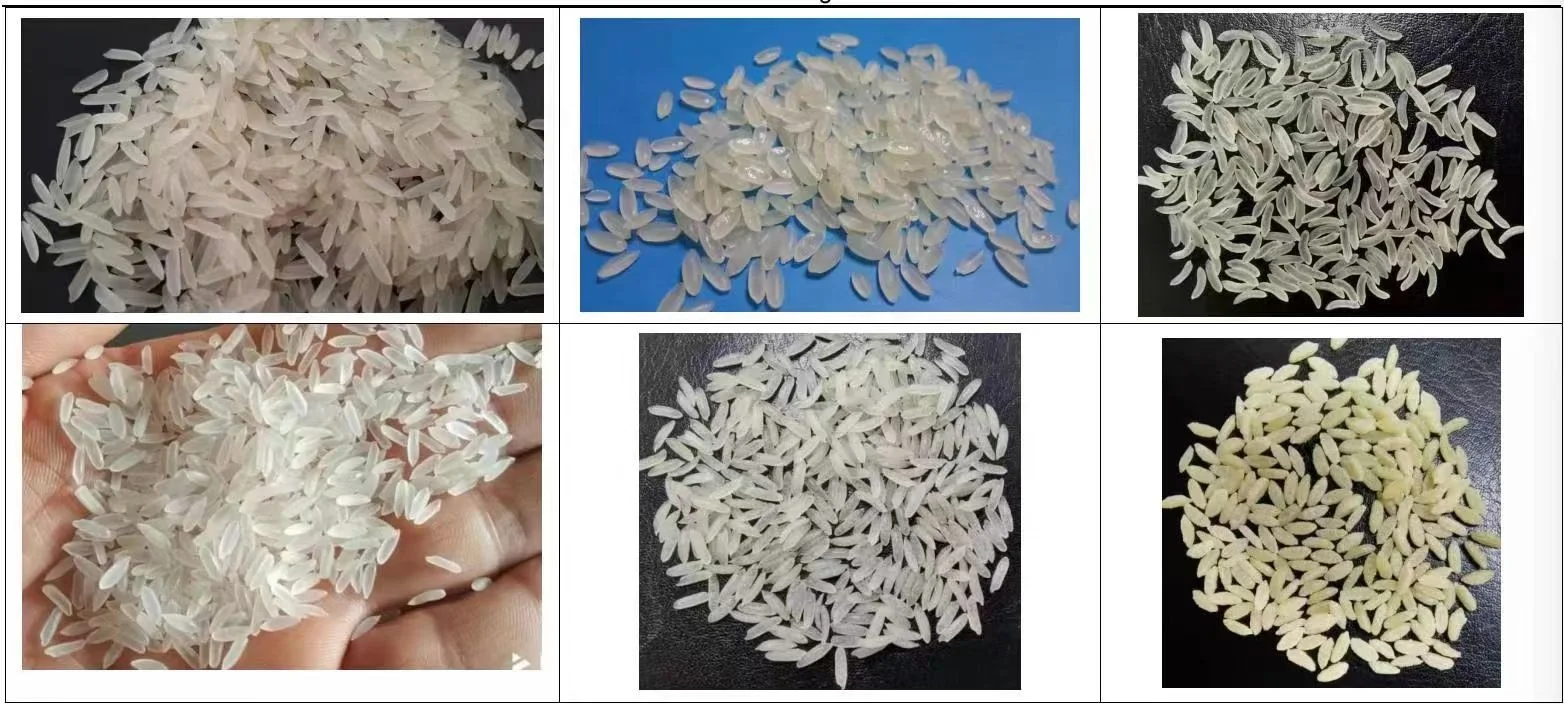
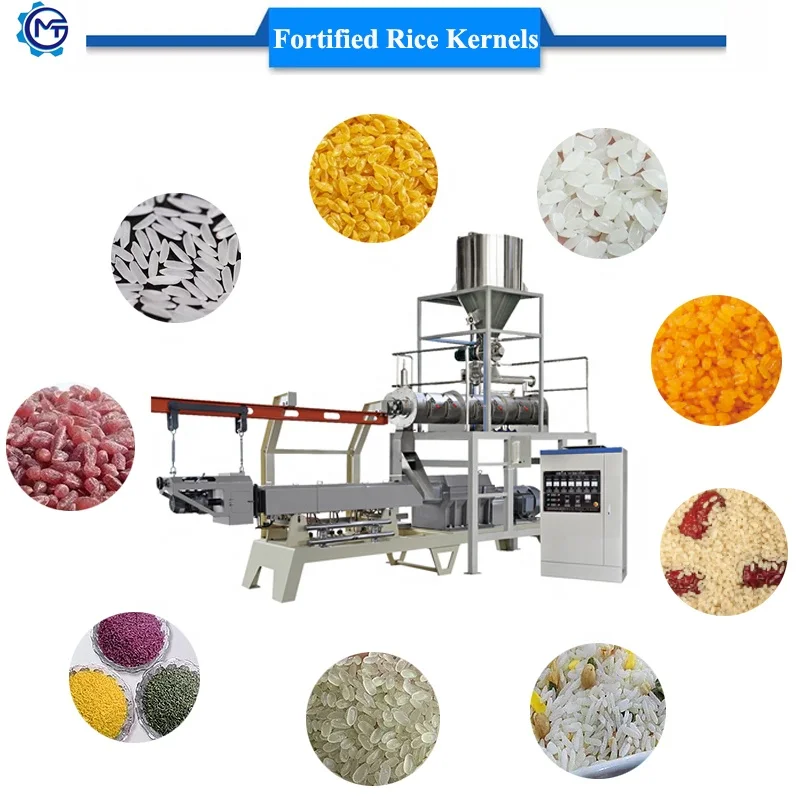

Nutritional Fortified Rice Processing Line, Twin-Screw Extrusion, PLC Control — complete turnkey plant from mixing and extruding through low-temperature drying, roasting and packing. Screw configuration and die design are specified to your raw material blend of broken rice, cereal grains and starch with vitamin-mineral premix, ensuring target kernel density and consistent expansion. In-house trial runs on your exact formula are completed before shipment, with full line layout and capacity calculation provided to confirm matched throughput at every station.
Description
Turnkey Line Matching — Every station from mixing to packing is balanced against the extruder’s actual output on your raw material formula, not assembled from catalog defaults.
Technical Specifications
| Parameter | Value |
|---|---|
| Product Type | Nutritional Fortified Rice Processing Line |
| Screw Type | Twin-screw |
| Available Models | MT65 / MT70 / MT85 / MT75 / MT95 |
| Installed Power (MT65 / MT70 / MT75 / MT85 / MT95) | 85 / 120 / 180 / 235 / 260 kW |
| Power Consumption (MT65 / MT70 / MT75 / MT85 / MT95) | 60 / 85 / 135 / 165 / 195 kW |
| Output Capacity (MT65) | 80–100 kg/h (basis to be confirmed) |
| Output Capacity (MT70) | 100–120 kg/h (basis to be confirmed) |
| Output Capacity (MT75) | 300–500 kg/h (basis to be confirmed) |
| Output Capacity (MT85) | 200–300 kg/h (basis to be confirmed) |
| Output Capacity (MT95) | 800–1000 kg/h (basis to be confirmed) |
| Overall Dimensions (MT65 / MT70) | 28 × 1.2 × 2.2 m / 30 × 1.5 × 2.2 m |
| Overall Dimensions (MT75 / MT85 / MT95) | 32–36 × 3.5 × 4.3 m |
| Control System | PLC with frequency speed control, automatic lubrication and cooling |
| Feeding System | Single or double screw feeding depending on material |
| Dryer Heating Source | Electric or gas |
| Dryer Control | Frequency motor controls mesh belt speed |
| Line Stations | Mixing, extruding, vibrating, low-temperature drying, cooling, high-temperature roasting, cooling, packing |
| Assembly State | Complete turnkey line |
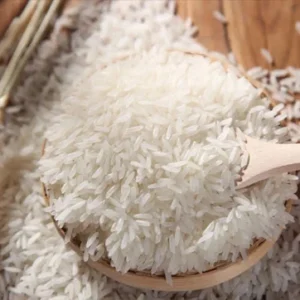
| Raw Material Range | Broken rice, rice, corn, millet, wheat, oats, buckwheat, bean, starch; vitamins and minerals as supplement |
| Certification | CE |
Application Suitability
| Application | Material or Output |
|---|---|
| Government and NGO food fortification programmes | Fortified rice kernels with precise vitamin and mineral dosing from broken rice and rice bran base |
| Commercial rice milling value-added processing | Artificial rice kernels reconstituted from broken rice, rice bran, and starch blends |
| Institutional and retail fortified grain manufacturing | Nutritional rice products incorporating corn, millet, wheat, oats, buckwheat, and bean flour with micro-nutrient premix |
| Infant and supplementary feeding programmes | Pregelatinised fortified rice kernels with controlled density for rapid cooking and consistent nutrient delivery |
What "Rated Capacity" Leaves Out When Stations Are Sized by Catalog Defaults
A fortified rice production line turnkey project only holds its nameplate throughput when every downstream station is matched to the extruder’s real output on your exact raw material blend.
I once watched a line stall because the dryer was one frame size below what the extruder was actually pushing through. Wet kernels backed up on the vibrating conveyor while the mesh belt dryer ran at full speed, unable to drop moisture fast enough. The operator had no choice but to throttle the feeder, which meant the whole plant ran below the number on the quotation. That gap between a catalog number and a real production rate is where fortified rice projects quietly lose their economics. When the raw material is a blend of broken rice, starch, and a micro-nutrient premix, the moisture profile leaving the die is different from what a generic rice flour run would produce. [NEED_CITE: moisture removal requirements for starch-based extruded kernels]
Throughput Balancing Across the Extrusion, Drying and Packing Stages
A fortified rice production line turnkey layout must treat the extruder, dryer, and packing station as one continuous flow problem rather than three separate purchases. The twin-screw extruder’s output is governed by screw configuration, die geometry, and the moisture content of your specific premix. If the dryer’s belt width and residence time cannot absorb that output at the target exit moisture, the line bottlenecks regardless of extruder motor size. Meiteng engineers size each station against the calculated output of the selected model so that the vibrating conveyor, low-temperature drying zone, cooling belt, and packing weigh-bridge all operate within their rated envelope.
Die Geometry, Kernel Density and Cooking Behaviour in the End Market
The die plate on a twin-screw extruder determines kernel shape, wall thickness, and internal void structure — all of which affect how the fortified rice rehydrates during household cooking. A kernel that is too dense will crack before it cooks through; one that is too expanded will disintegrate in boiling water. Meiteng specifies die orifice diameter and land length to the buyer’s target kernel density, then validates the result during an in-house trial run on the customer’s actual raw material formula before the line ships. [NEED_CITE: die design parameters for extruded rice kernel rehydration behaviour]
Reading the Power, Dimension and Control Specifications for a Fortified Rice Plant
Installed power across the five available models spans 85 kW on the MT65 to 260 kW on the MT95, reflecting the increasing barrel length and screw torque required at higher throughputs. Power consumption figures — 60 kW through 195 kW — represent typical running loads and should be matched against the site’s transformer capacity and dedicated circuit planning. The overall line footprint stretches from 28 metres on the pilot-scale MT65 to 36 metres on the MT95, with a width of 3.5 metres and height of 4.3 metres on the three larger configurations; bay depth and overhead clearance must account for dryer exhaust ducting and maintenance access above the barrel. PLC control with frequency speed adjustment on every motor gives operators the ability to fine-tune feeder rate, screw RPM, and dryer belt speed from a single panel, and automatic lubrication reduces bearing wear during continuous shifts. The choice between electric and gas heating on the dryer section depends on local energy cost structures and whether the site already has a gas supply infrastructure in place.
The Hidden Cost of Skipping the Trial Run Before Shipment
When a line goes straight from the assembly floor into a container without being tested on the buyer’s specific raw material, the first weeks of commissioning become an expensive trial-and-error exercise. Screw elements may need reconfiguration, die land length may need adjustment, and dryer temperature zones may require re-tuning — all while the buyer’s production target is already overdue. In my experience managing installation schedules, the projects that skipped the pre-shipment trial consistently required extra engineer visits and extended ramp-up periods. The cost is not only the airfare and hotel nights; it is the revenue lost while the line sits idle waiting for a screw configuration that matches the local grain blend. [NEED_CITE: typical commissioning delays when extrusion lines skip pre-shipment material trials]
Why a Fortified Rice Project Sourced Here Performs Differently
Every station in this fortified rice production line turnkey system is sourced from a single supplier, so throughput calculations run end-to-end rather than relying on assumptions between vendors. Screw configuration and die design are specified to the buyer’s raw material blend and target kernel density, not pulled from a generic template. An in-house testing workshop allows the customer’s formula to be extruded, dried, and measured before the equipment leaves Jinan, producing a trial run report that becomes part of the shipping documentation. The PLC control system, electrical schematics, and voltage confirmation are finalised against the destination market’s standards before production begins. Installation, commissioning, operator training, and ongoing wear-parts supply are handled by the same engineering team that configured the line.
Documentation & Verification
- Line layout and capacity calculation showing matched throughput at each station for your target output
- Trial run report on your raw material formula produced in the testing workshop before shipment
- Screw and die configuration record matched to your material blend and kernel density specification
- Electrical schematic with confirmed voltage, frequency, and control language for your market
- CE declaration of conformity and ISO certificate included in the shipping documentation package
- Wear parts list with dimensional drawings for screws, dies, and dryer mesh belt segments
Installation, Commissioning & Support
- Foundation plan accounts for the 28–36 m line length and dynamic loads from the twin-screw extruder gearbox
- Dedicated circuit sized to the model’s installed power rating, from 85 kW on the MT65 to 260 kW on the MT95
- Stations ship in modular sections; the 4.3 m height on larger models requires overhead clearance planning for dryer exhaust routing
- PLC panel is programmed in the confirmed control language and tested on-site during the commissioning window
- Operator training covers screw speed, feeder rate, and dryer belt frequency adjustment for consistent kernel moisture
- Wear parts list covers screws, die plates, and mesh belt links; first replacement set ships with the line
What to Include in Your Initial Enquiry
To size a fortified rice production line turnkey project accurately, share the raw material composition — base grain, starch ratio, and micro-nutrient premix details — along with your target hourly output and kernel specification. Provide the workshop bay dimensions, ceiling height, and local voltage and frequency so that the layout, dryer configuration, and electrical package can be confirmed before the quotation stage. If you can send a sample of your raw material blend, a trial run in the testing workshop will validate the screw configuration and die design before you commit to production.
Frequently Asked Questions
Q: How is line capacity verified against my specific raw material formula?
A: Before shipment, your raw material blend is run through the extruder in the in-house testing workshop. Output rate, kernel density, and moisture content after drying are measured and recorded in a trial run report. If the result falls outside your specification, screw configuration or die design is adjusted and re-tested until the target is met.
Q: How do you ensure extruder output matches dryer and packing station throughput?
A: Each station is sized using the extruder’s calculated output on your material rather than a catalog default. The dryer belt width and residence time, cooling conveyor length, and packing weigh-bridge speed are all specified so that no single station creates a bottleneck under continuous running conditions.
Q: What voltage, frequency and control language options are confirmed before shipment?
A: The electrical schematic is finalised against your site’s supply — voltage, phase, and frequency — before production begins. The PLC panel and HMI are configured in your preferred control language, and this configuration is documented in the specification sheet shipped with the line.
Q: Can I send my raw material for a trial run before placing the order?
A: Yes. You can ship a sample of your raw material formula to the testing workshop. Engineers will run the formula through the selected extruder model, adjust screw and die settings as needed, and produce a trial run report with kernel samples for your evaluation before you decide on the final configuration.
Q: What does phased installation and commissioning look like for a complete turnkey line?
A: Equipment arrives in modular sections. The installation team positions and levels each station, connects utilities, and then runs the line through a staged commissioning sequence — dry run, material run, and continuous production test — with operator training conducted on the buyer’s actual formula before handover.
Related products
-
Línea de Producción de Alimentos Saludables para Bebés Equipos de Polvo Nutricional para Suplementos Alimenticios para Bebés para Maquinaria de Procesamiento de Harina
¥8,500.00 Select options This product has multiple variants. The options may be chosen on the product page -

Línea de proceso de fabricación de extrusora de polvo de nutrición para bebés de 500 kg/h automática industrial
¥8,238.27 Add to cart -
Línea de procesamiento de producción automática de 500 kg/h de polvo de nutrición de arroz para bebés orgánico y sin gluten
¥8,238.27 Add to cart -

Línea de Extrusión y Secado de Polvo de Nutrición para Bebés de 500kg/h Totalmente Automática con Control PLC
¥9,500.00 Add to cart