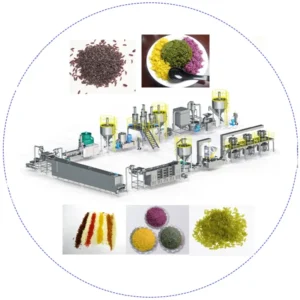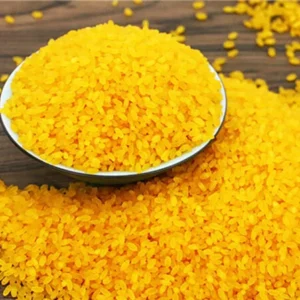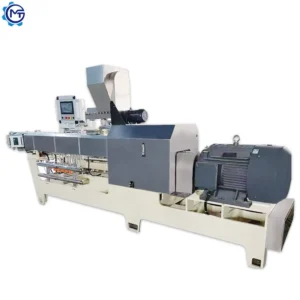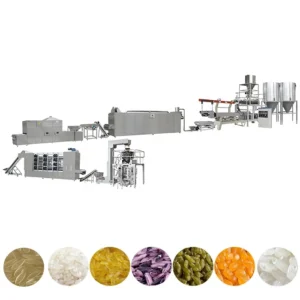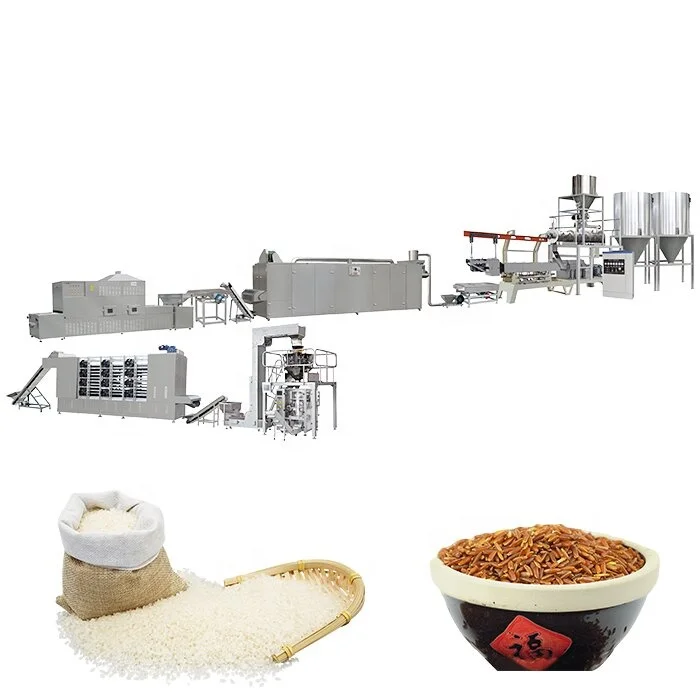
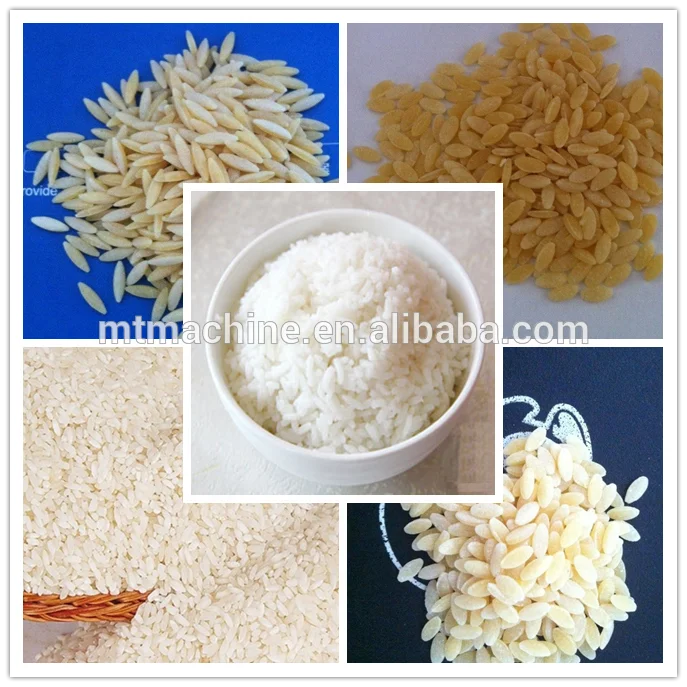
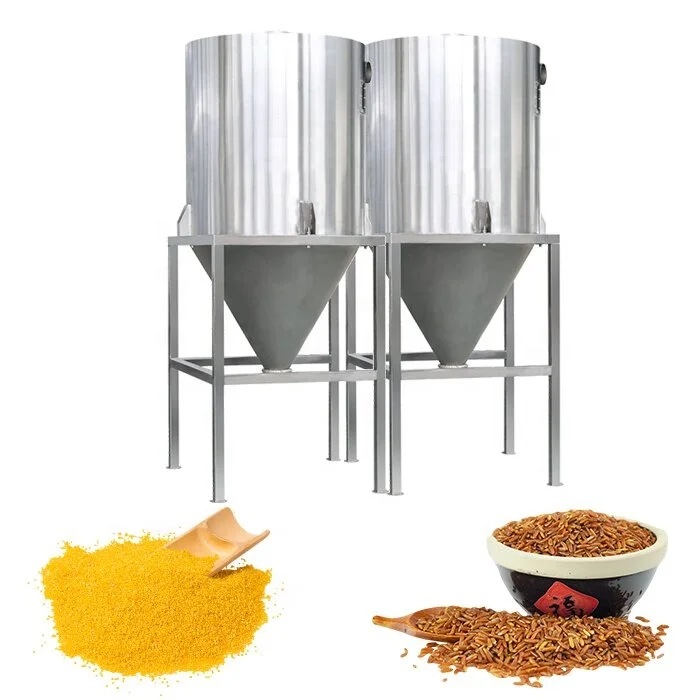
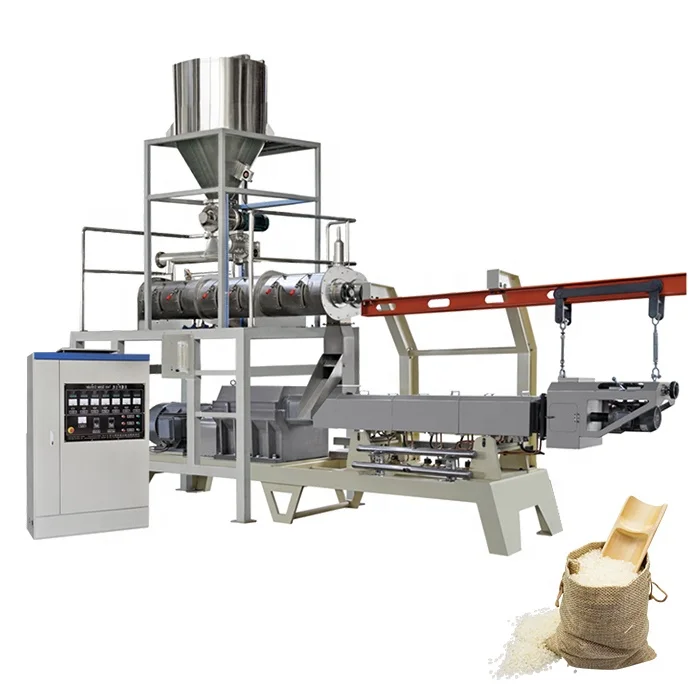
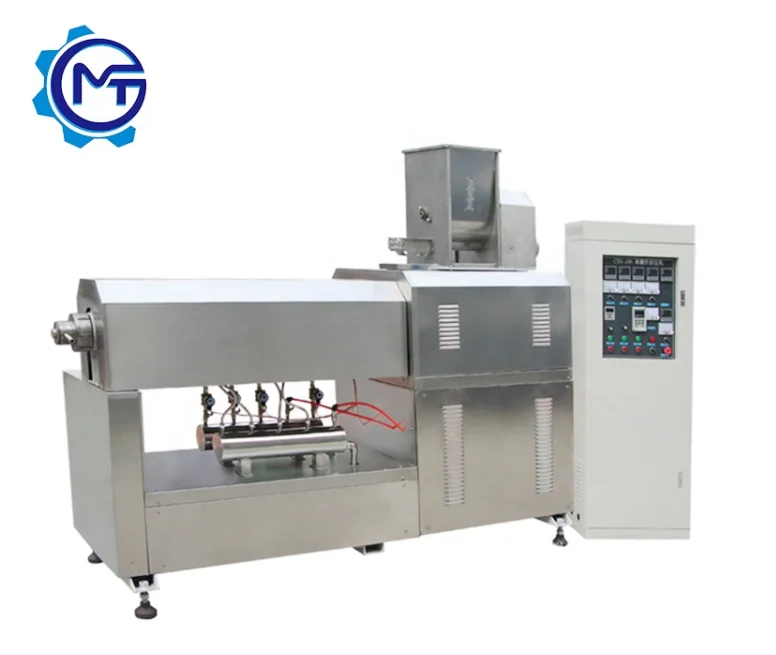
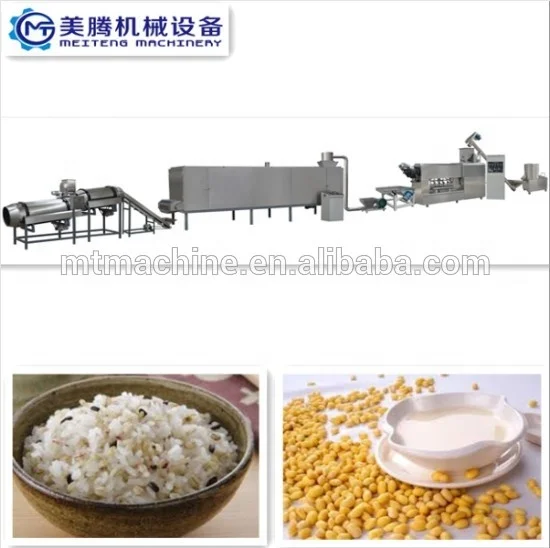
MT65 / MT70 / MT85 / MT75 / MT95 Fortified Rice Kernel Extrusion Line, Twin-Screw, PLC & MCC Control — engineered as one integrated turnkey project from batching through extrusion, drying, roasting, and packing.
- Screw configuration and die design specified to your raw material blend and target kernel density
- Throughput matched across every station — mixing, vibrating, low-temperature drying, cooling, high-temperature roasting — to prevent bottlenecks
- Frequency motor-controlled mesh belt dryer with circulation process for uniform moisture reduction
Layout, capacity calculation, and in-house trial runs on your actual raw material are completed before shipment, ensuring the line performs to specification from day one.
Description
Integrated line engineering — Throughput at every station from batching to packing is calculated together so the extruder never outpaces the dryer or roaster on your specific grain blend.
Technical Specifications
| Parameter | Value |
|---|---|
| Product Type | Fortified Rice Kernel Extrusion Production Line |
| Models Available | MT65 / MT70 / MT85 / MT75 / MT95 |
| Extrusion Type | Twin-screw |
| Installed Power | MT65: 85 kW; MT70: 120 kW; MT85: 235 kW; MT75: 180 kW; MT95: 260 kW |
| Power Consumption | MT65: 60 kW; MT70: 85 kW; MT85: 165 kW; MT75: 135 kW; MT95: 195 kW |
| Output Capacity | MT65: 80–100 kg/h; MT70: 100–120 kg/h; MT85: 200–300 kg/h; MT75: 300–500 kg/h; MT95: 800–1000 kg/h (basis not stated in source — confirm raw material formulation and moisture content) |
| Overall Dimensions (L×W×H) | MT65: 28 × 1.2 × 2.2 m; MT70: 30 × 1.5 × 2.2 m; MT85: 34 × 3.5 × 4.3 m; MT75: 32 × 3.5 × 4.3 m; MT95: 36 × 3.5 × 4.3 m |
| Control System | PLC and MCC with frequency speed controlling (source value — verify against manufacturer catalog) |
| Screw Material | Wear-resistant alloy (source value — verify against manufacturer catalog) |
| Lubrication | Automatic lubricating and cooling system |
| Feeding System | Single or double screw feeding, selectable based on material |
| Dryer Heating Source | Electric or gas |
| Dryer Feature | Circulation drying with frequency motor-controlled mesh belt speed |
| Line Stations | Mixing → Extruding → Vibrating → Low-temperature drying → Cooling → High-temperature roasting → Cooling → Packing |
| Raw Materials | Broken rice, rice, corn, millet, wheat, oats, buckwheat, bean, starch; vitamins and minerals as supplementary ingredients |
| Voltage & Frequency | Customized to local voltage (source value — verify against manufacturer catalog) |
| Assembly State | Complete turnkey production line |
| Standards | CE, ISO |
Application Suitability
| Application | Material or Output |
|---|---|
| Fortified rice kernel production for government and NGO nutrition programmes | Rice flour and broken rice blended with vitamin and mineral premix |
| Artificial nutritional rice for retail and institutional markets | Broken rice, rice bran, corn, millet with micro-nutrient fortification |
| Instant rice processing | Rice and starch blends configured for rapid rehydration |
| Value-added processing of broken rice and rice bran | Milled rice by-products reconstituted into uniform high-nutrition kernels |
What "Nominal Capacity" Hides About Your Grain Blend
The rated throughput on a nameplate assumes a reference formulation that almost never matches your actual raw material.
A fortified rice production line quoted at a round number often cannot sustain that output once your specific blend of broken rice, starch, and mineral premix enters the barrel. The extruder may be sized correctly, but if the low-temperature dryer or the roasting station was selected from a generic chart rather than calculated against your moisture curve, the line bottlenecks downstream. I have seen turnkey artificial rice extrusion line projects where the extruder ran at full speed for twenty minutes before the dryer backed up, forcing the operator to throttle the feed and run the whole shift below the contracted capacity [NEED_CITE: throughput matching principles in multi-station extrusion lines].
Phased Layout Engineering for Fortified Rice Kernels
A turnkey artificial rice extrusion line must be engineered as a single system rather than assembled from standalone machines. Each station — mixing, extruding, vibrating, low-temperature drying, cooling, high-temperature roasting, and packing — is sized so that the mass flow leaving one stage matches the intake capacity of the next. This prevents the common scenario where an oversized extruder floods an undersized dryer, causing uneven moisture content across the batch and inconsistent kernel density.
Screw and Die Configuration Matched to Your Premix
The twin-screw configuration is specified after reviewing the buyer’s exact ratio of rice flour to starch binder and the particle size of the vitamin-mineral premix. Screw element spacing, compression ratio, and die aperture together determine how thoroughly the micro-nutrients disperse through the dough before the kernel is cut. A generic screw build copied from a standard snack formula will either shear the premix too aggressively, degrading heat-sensitive vitamins, or fail to incorporate it evenly, leaving nutrient hot spots that fail laboratory assay [NEED_CITE: twin-screw shear profiles and nutrient retention in fortified grain products].
Reading the Spec Sheet Against Your Factory Conditions
Installed power ranges from 85 kW on the MT65 to 260 kW on the MT95, and actual power consumption sits roughly 25–30 percent below those figures during steady-state running. The frequency-controlled feeding system allows the operator to dial in feed rate independently of screw speed, which is critical when switching between a high-starch formulation and one loaded with fibrous bran. The automatic lubricating and cooling system maintains barrel temperature zones within the tolerance needed for consistent starch gelatinisation — a parameter that directly affects whether the finished kernel survives cooking without disintegrating. Dryer heating is available in electric or gas; the choice affects both running cost and the moisture gradient across the mesh belt, especially in regions with high ambient humidity.
The Cost of Skipping the Trial Run
When a fortified rice production line ships without a trial run on the buyer’s actual raw material, the first week of commissioning becomes an expensive experiment. Screw elements may need replacing, die apertures re-cut, or dryer belt speed re-mapped — all while the production schedule slips. In one project I supported, the absence of a pre-shipment test meant the roasting station charred the kernel surface because the moisture entering that stage was two points higher than the generic parameter assumed. That kind of mismatch is only discovered when your material is actually running through the line [NEED_CITE: commissioning delays caused by untested raw material formulations].
Why Source the Full Line From One Supplier
Every station from batching to packing is engineered under one roof, so throughput calculations are cross-referenced rather than estimated in isolation. Screw configuration and die design are documented against your specific raw material blend, not borrowed from a default build. The in-house testing workshop runs your grain formulation before the line ships, producing a trial report that locks in the parameters your operators will use on day one. PLC and MCC controls are programmed to the voltage and frequency confirmed in writing before production starts, eliminating the on-site rewiring delays that push back commissioning. Wear parts — screws, dies, mesh belt sections — are listed and packed with the first shipment so the line does not sit idle waiting for replacements.
Documentation & Verification
- Line layout with throughput calculation for each station matched to your grain blend
- Screw and die configuration record specifying element spacing and aperture for your premix
- Trial run report on your raw material from the in-house testing workshop before dispatch
- Electrical schematic with voltage and frequency confirmation aligned to your local supply
- CE declaration of conformity and ISO certificate included with shipping documentation
Installation, Commissioning & Support
- Foundation plan referencing overall dimensions up to 36 × 3.5 × 4.3 m for the MT95 layout
- Dedicated power circuit sized to installed power up to 260 kW with confirmed voltage and frequency
- Phased assembly schedule covering station-by-station mechanical and electrical connection
- First-run parameter setting using the trial run report as the baseline reference
- Operator training on PLC interface, frequency speed controls, and feeding system selection
- Wear parts list covering screws, dies, and dryer belt sections included with initial shipment
Preparing Your Inquiry
To move a fortified rice production line project forward, the most useful starting information includes the exact raw material formulation with moisture content, the target daily output, and the available factory floor area with ceiling height clearance. Local voltage and frequency should be confirmed early so the electrical schematic and motor specifications are locked before fabrication begins.
Frequently Asked Questions
Q: How is line capacity verified against my specific raw material blend and moisture content?
A: The buyer sends a representative sample of the grain blend, including the vitamin-mineral premix, to the in-house testing workshop. A trial run is conducted on the matched extruder model, and output is measured at steady state. The resulting trial report documents the achievable throughput, moisture reduction curve, and kernel density, forming the baseline for the final quotation.
Q: How are throughput and station sizing matched across the entire line to prevent bottlenecks?
A: Each station — extruder, dryer, roaster, cooler, packer — is selected by calculating the mass flow from the preceding stage. Dryer belt length and roasting chamber volume are sized so that residence time at the required temperature is met without material queuing. This matching is documented in the line layout and capacity calculation provided before order confirmation.
Q: What does the phased installation and commissioning schedule look like for a complete turnkey line?
A: Mechanical installation proceeds station by station, starting with the mixing and extrusion section, followed by dryer and roaster assembly. Electrical connection and PLC programming follow, then dry runs without material. Wet commissioning uses the buyer’s raw material to validate the parameters from the pre-shipment trial report. Operator training runs in parallel during the final days on site.
Q: What documentation is provided with the line?
A: Documentation includes the line layout with capacity calculation, screw and die configuration record, electrical schematic with voltage confirmation, trial run report on the buyer’s raw material, CE declaration of conformity, ISO certificate, factory test record, operation and maintenance manual, wear parts list, and packing photographs for customs reference.
Q: How do you handle voltage, frequency, and control language confirmation for different target markets?
A: Before production begins, the buyer confirms local supply voltage, frequency, and preferred control panel language in writing. The electrical schematic and PLC programme are built to those specifications. Motors, heaters, and control components are sourced to match, so no on-site rewiring or transformer installation is required when the line arrives.
Related products
-

Máquina Extrusora de Doble Tornillo Automática Controlada por PLC de Alta Calidad de 500kg/h para Polvo de Nutrición de Arroz para Bebés
¥8,238.27 Add to cart -

Línea de producción de polvo de nutrición de cereales para bebés automática y compacta con capacidad de 500 kg/h y control PLC
¥9,500.00 Add to cart -

Línea de producción de polvo de reemplazo de comida para bebés segura, saludable y nutritiva en condiciones nuevas de alta productividad.
¥30.00 Select options This product has multiple variants. The options may be chosen on the product page -

Línea de proceso de fabricación de extrusora de polvo de nutrición para bebés de 500 kg/h automática industrial
¥8,238.27 Add to cart