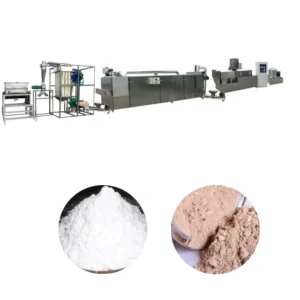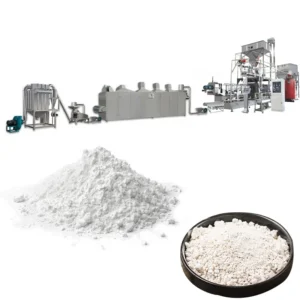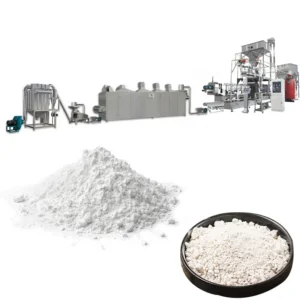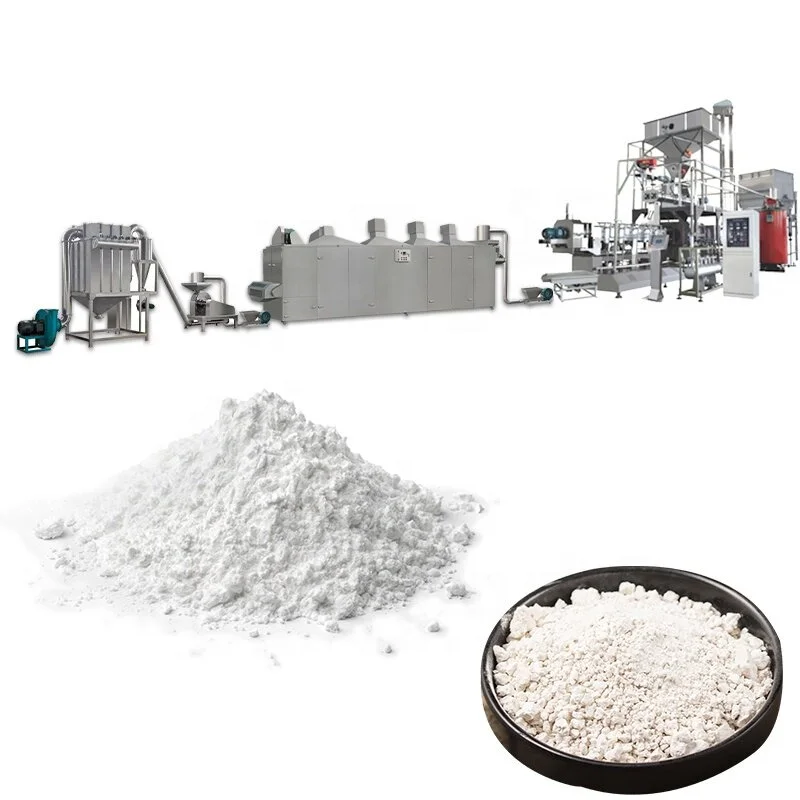


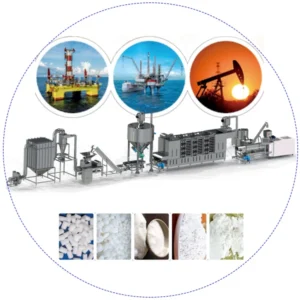
MT70 / MT85 / MT75 Pre-Gelatinized Modified Starch Processing Line — twin screw extrusion with barrel cooling, 38CrMo alloy steel screws, 5-layer gas/diesel dryer, pulse grinder with cyclone discharge, and PLC-controlled batching-to-packing stations.
- Throughput matched across mixer, extruder, dryer and grinder under one supplier, with screw-and-die configuration specified to your starch feedstock and target gelatinisation degree.
- In-house trial run on your raw material before shipment verifies output and product properties under actual conditions.
Description
Matched Extrusion and Drying Stations — throughput across the modified starch processing line turnkey is calculated so the 5-layer dryer residence time and pulse grinder feed rate hold pace with the twin-screw extruder at rated output.
Technical Specifications
| Parameter | Value |
|---|---|
| Product Type | Pre-Gelatinized Modified Starch Processing Line (Twin Screw Extrusion Line) |
| Extruder Models | MT70 / MT85 / MT75 |
| Screw Configuration | Twin Screw (double-screw with integrated barrel cooling system) |
| Screw Material | 38CrMo alloy steel |
| Installed Power | MT70: 160 kW | MT85: 190 kW | MT75: 210 kW |
| Power Consumption | MT70: 120 kW | MT85: 140 kW | MT75: 150 kW |
| Output Capacity | MT70: 150–200 kg/h (basis not stated in source) | MT85: 300–400 kg/h (basis not stated in source) | MT75: 300–500 kg/h (basis not stated in source) |
| Overall Dimensions (L×W×H) | MT70: 41000×1500×2200 mm | MT85: 43000×1500×3200 mm | MT75: 45000×1500×3500 mm |
| Voltage & Frequency | 380 V, 50 Hz, Three Phase (verify against destination site) |
| Mixer Batch Capacity | 20–30 kg / 70–80 kg / 170–180 kg (matched to extruder model) |
| Mixer Contact Material | 201 SS or 304 SS |
| Dryer Type | 5-layer baking oven |
| Dryer Heating Source | Gas or diesel fired |
| Dryer Dimensions | 5.0×1.2×2.3 m |
| Dryer Drive | Inverter speed control |
| Grinder Type | Pulse grinder with variable-speed auger feeder, rotor/stator assembly, classifier, cyclone discharge, and dust collector |
| Assembly State | Complete line, shipped as integrated set |
| Certification | CE |
Application Suitability
| Application | Material or Output |
|---|---|
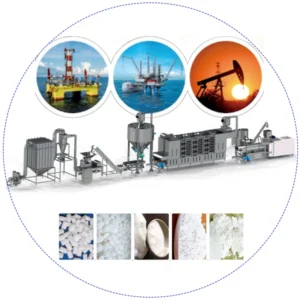
| Oil drilling fluid loss agents | Pre-gelatinized modified starch replacing bacterial-degradable additives in water-based drilling fluids |
| Textile warp sizing and paper coating | Denatured starch with controlled viscosity and film-forming properties from corn or potato feedstock |
| Food-grade modified starch production | Pre-gelatinized corn and potato starch derivatives for food processing with traceability documentation |
Why Nominal Capacity Figures Fail on Actual Starch Feedstock
A modified starch processing line turnkey quoted on a generic capacity number often cannot sustain that output once the buyer’s specific corn, potato, or cassava starch enters the hopper — because gelatinisation temperature, moisture absorption, and shear sensitivity differ between starch sources and directly govern how fast the extruder can run. Capacity is only meaningful when tied to the raw material type, moisture content, and target gelatinisation degree used during testing. I once watched a pre-gelatinized starch line ship with parameters dialled in on corn starch, only for the buyer to run cassava starch on arrival — viscosity climbed, expansion collapsed, and the entire barrel temperature profile had to be rebuilt from scratch on the factory floor [NEED_CITE: starch gelatinisation behaviour by botanical source]. That commissioning delay could have been avoided with a pre-shipment trial on the actual feedstock.
Barrel Temperature Profiling Through Starch Gelatinisation
Starch gelatinisation does not happen at a single temperature point — it progresses through granule swelling, amylose leaching, and viscosity peak across a defined thermal window. The twin-screw extruder in this modified starch processing line turnkey carries an integrated barrel cooling system that allows independent temperature control at each zone. This means operators can hold the feed section cool enough to prevent premature gelatinisation while ramping the metering and high-shear zones to the precise thermal threshold the target starch requires. Without that zone-by-zone control, the material either under-gelatinises — leaving raw crystalline regions that compromise functionality — or overheats into dextrinisation, breaking molecular chains and destroying the viscosity profile the buyer’s market demands.
Matching Dryer Residence Time to Extruder Throughput
The 5-layer dryer downstream of the extruder must remove moisture at a rate that keeps pace with extruder output without over-drying the outer layer of the starch particles. Gas or diesel heating provides the thermal mass needed for continuous operation, while inverter-driven belt speed adjusts residence time to the moisture load entering the oven. If the dryer is undersized relative to the extruder, material backs up at the extruder die — a bottleneck that forces the entire line to run below its mechanical capacity. Conversely, an oversized dryer wastes fuel and risks case-hardening the starch granule surface, trapping internal moisture that later causes clumping during storage [NEED_CITE: drying curve requirements for pre-gelatinized starch granules].
Screw Geometry, L/D Ratio, and Shear Energy
The 38CrMo alloy steel twin screws generate the mechanical shear that, combined with barrel heat, ruptures starch granules and drives the gelatinisation reaction. The screw configuration — element spacing, kneading block angle, and reverse-flight sections — determines how much shear energy the material absorbs per pass. A configuration designed for low-amylose corn starch will under-process high-amylose potato starch, leaving incomplete gelatinisation. The specification record for each build documents the screw element arrangement matched to the buyer’s declared feedstock, so replacement wear parts maintain the same processing geometry rather than reverting to a generic configuration.
What Happens When the Grinder Is Underspecified
Pre-gelatinized starch must be ground to a tight particle-size distribution — oversize particles hydrate unevenly in the buyer’s end application, while excessive fines create dust handling problems and increase moisture absorption during storage. The pulse grinder in this line uses a variable-speed auger feeder to meter material into the rotor-stator chamber at a controlled rate, while the classifier returns oversize particles for re-grinding. When a line is assembled from separate vendors and the grinder is specified on a generic throughput figure, the classifier may be overwhelmed at full extruder output, allowing unclassified material to bypass into the packing station [NEED_CITE: particle size distribution standards for modified starch products]. The cyclone discharge and dust collector must also be sized to the actual grinding volume, or the workshop air quality deteriorates rapidly.
Why Sourcing the Full Line Under One Supplier Matters
A modified starch processing line turnkey assembled from an extruder vendor, a dryer vendor, and a grinder vendor places the throughput-matching burden on the buyer. Each supplier guarantees their own station’s nominal capacity, but no single party owns the responsibility when the extruder output exceeds the dryer’s moisture removal rate. Sourcing the complete line — mixer, twin-screw extruder, 5-layer dryer, pulse grinder with cyclone and dust collector — from one supplier means throughput calculations span every station. The line layout and capacity calculation document confirms that mixer batch size, extruder output, dryer residence time, and grinder throughput are balanced before fabrication begins. Pre-shipment trial runs on the buyer’s actual starch feedstock validate gelatinisation degree and sustained output rate under real conditions, not catalogue assumptions.
Documentation & Verification
- Line layout confirming throughput balance across mixer, extruder, dryer, and grinder stations
- Trial run report on buyer’s specific starch source recording gelatinisation degree and output rate
- Screw and die configuration record documenting element arrangement for declared feedstock
- Electrical schematic with voltage and frequency confirmed against destination site infrastructure
- CE declaration of conformity and factory test record before dispatch
- Wear parts list specifying 38CrMo screw elements and replacement intervals
Installation, Commissioning & Support
- Foundation planning for line footprint up to 45000×1500×3500 mm including dryer and grinder stations
- Dedicated electrical circuit sized to installed power up to 210 kW with voltage and frequency verification
- Complete line arrives as integrated set with staged assembly sequence and utility connection plan
- Commissioning includes barrel temperature profiling and screw speed calibration on buyer’s actual starch
- Operator training covers inverter dryer speed adjustment, pulse grinder classifier tuning, and dust collector maintenance
- Wear parts programme for 38CrMo twin-screw elements with first replacement scheduling
What to Include in Your Enquiry
To receive a line configuration that matches your production target, share your starch source (corn, potato, cassava, or other), target gelatinisation degree, and required daily output. Confirm the voltage, frequency, and control language available at your facility, along with the workshop floor area and ceiling height for the line layout. If you have specific particle-size requirements for the finished powder, include the mesh or micron specification so the pulse grinder classifier can be set accordingly.
Frequently Asked Questions
Q: How is line capacity verified before shipment?
A: A trial run is performed on the buyer’s actual starch raw material in the testing workshop, not on a generic reference starch. The trial run report records the gelatinisation degree achieved, the sustained output rate, and the barrel temperature profile used. This ensures the capacity figure quoted reflects real processing conditions rather than catalogue assumptions that may not apply to your feedstock.
Q: Can the screw configuration match a specific starch source and gelatinisation target?
A: Yes. The screw element arrangement — including kneading block angles, element spacing, and shear zone positioning — is specified to the buyer’s declared starch source and target gelatinisation degree. The configuration record is documented so that replacement wear parts replicate the same geometry, preventing a drift back to generic settings that compromise product quality.
Q: How is dryer capacity matched to extruder output?
A: The 5-layer dryer is sized so its moisture removal rate and residence time align with the extruder’s sustained output at the target moisture content. Inverter-controlled belt speed allows fine-tuning of residence time. The line layout document confirms this throughput balance across both stations, preventing the extruder from running below capacity due to a dryer bottleneck.
Q: What electrical details must be confirmed before production starts?
A: The destination site’s voltage, frequency, and phase configuration must be verified against the line’s electrical design — the standard build runs on 380 V, 50 Hz, three phase. Control system language and PLC interface requirements should also be confirmed so operators can navigate the system without translation barriers during commissioning and daily production.
Q: What does on-site installation and operator training cover?
A: Installation includes positioning all stations within the confirmed footprint, utility connections, and staged commissioning starting with the mixer and progressing through extruder temperature profiling, dryer calibration, and grinder classifier tuning. Operator training covers parameter adjustment for different starch batches, routine maintenance of the 38CrMo screw elements, pulse grinder stator inspection, and dust collector filter cleaning schedules.
Related products
-
Máquina Automática de Fabricación de Almidón Modificado Línea de Producción de Procesamiento de Almidón para Perforación de Petróleo
¥30.00 Select options This product has multiple variants. The options may be chosen on the product page -
Twin-Screw Extrusion Line for Modified Starch. Producing Pregelatinized Adhesive & Food Grade Powder
¥65.00 Select options This product has multiple variants. The options may be chosen on the product page -
Automatic Deep Processing Machine – Food Grade Modified & Pregelatinized Starch Manufacturing Line
¥65.00 Select options This product has multiple variants. The options may be chosen on the product page -
Automatic Pregelatinized Starch Processing Machine – Large-Scale New Condition Modified Starch Production Line
¥65.00 Select options This product has multiple variants. The options may be chosen on the product page