



**
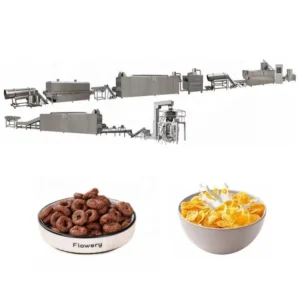
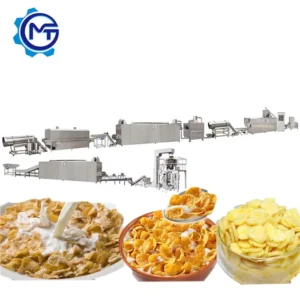
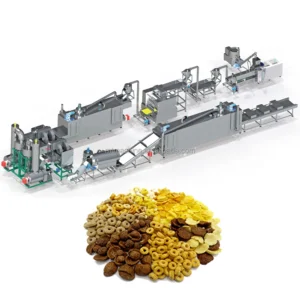
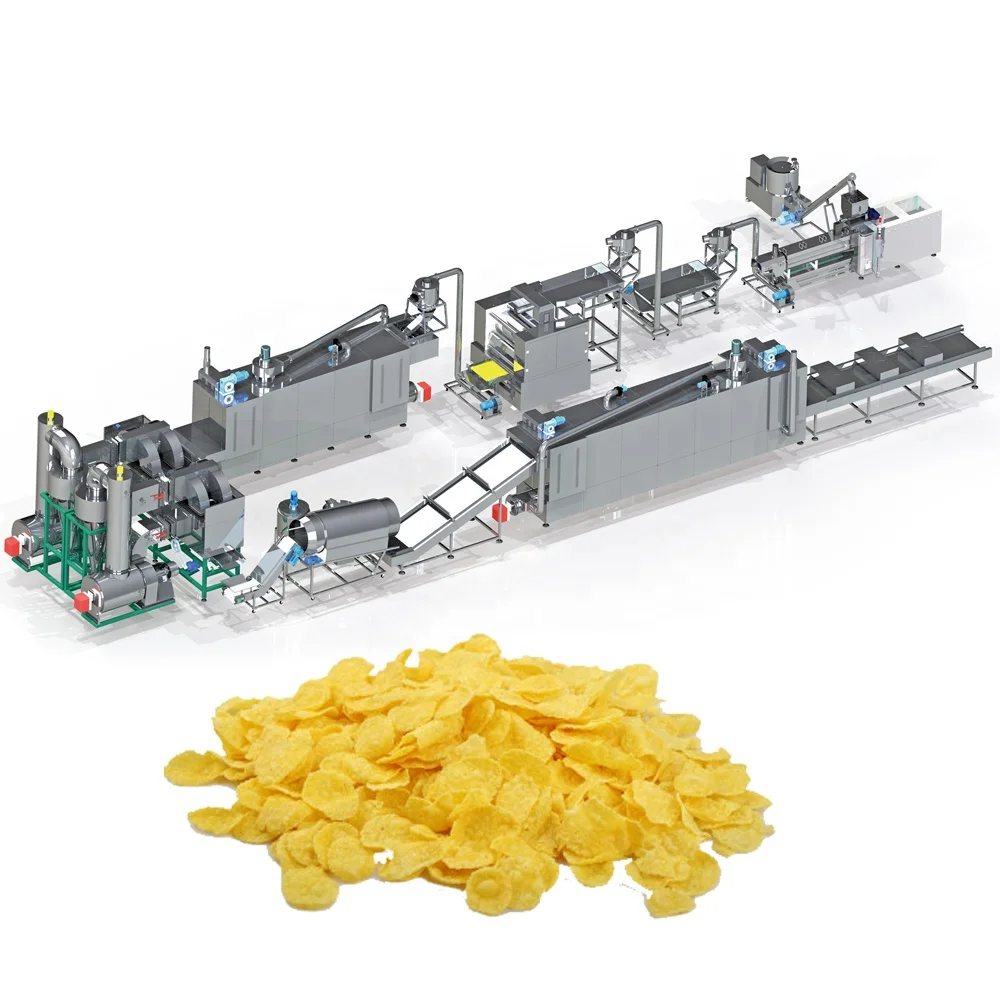
Corn Flakes Production Line, Up to 750 kg/h Output, Twin-Screw Extrusion, PLC Control — engineered as a single turnkey project where every station from mixing and extrusion through flaking, toasting, coating, and packing is throughput-matched and laid out to your factory footprint.
- Natural, sugar-coated, and multi-shaped breakfast cereals from one line
- Screw configuration and die design specified to your raw material and target texture
- Trial run on your actual raw material in our testing workshop before shipment, with line layout and capacity calculation documented for your review
Description
Engineered Throughput Matching — Every station from mixing to packing is calculated against the same raw material basis, so a corn flakes production line turnkey project runs at its stated rate without one machine starving or flooding the next.
Technical Specifications
| Parameter | Value |
|---|---|
| Product Type | Corn Flakes Production Line / Breakfast Cereal Processing Line |
| Output Capacity | Up to 750 kg/h (basis not stated in source — confirm raw material, moisture content, and product format) |
| Extrusion Technology | Twin-screw extrusion with configurable screw profile and die geometry |
| Control System | Available with PLC or MCC control; interface language configurable |
| Line Stations | Mixing, extrusion, flaking, drying, toasting, coating, cooling, packing |
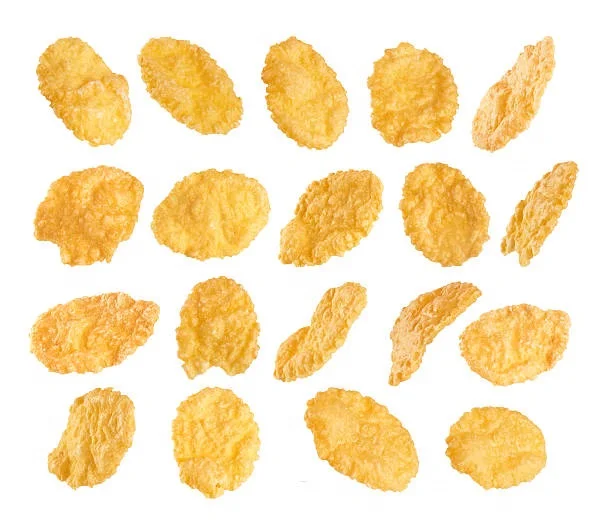
| Product Range | Natural corn flakes, sugar-coated flakes, various shaped breakfast cereals |
| Line Layout | Customizable engineered drawings tailored to specific factory dimensions |
| Voltage & Frequency | Configurable to target market standard (to be confirmed at inquiry) |
| Certification | CE, ISO (verify applicability to specific line configuration) |
Application Suitability
| Application | Material or Output |
|---|---|
| Natural corn flake breakfast cereal | Maize or corn grits processed through cooking, flaking, and toasting |
| Sugar-coated and honey-coated flakes | Corn flakes passed through coating drum with syrup or honey application |
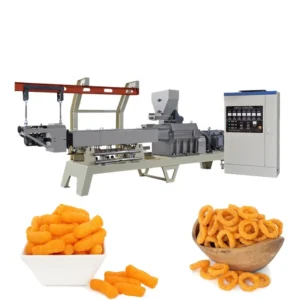
| Extruded multi-shaped cereals | Balls, rings, and stars formed at the die plate before drying |
| Fortified breakfast cereal | Vitamin and mineral premix blended at the batching station before extrusion |
| Multi-grain and granola cereal | Blended oats, wheat, rice, and maize processed on the same line with screw adjustment |
What a Nominal Capacity Figure Leaves Out of a Corn Flakes Line
A capacity number without a raw material basis and moisture specification is just a motor rating dressed up as a promise.
I have stood in a humid workshop watching a freshly installed cereal line choke on high-amylose corn grits because the extruder was sized for a different starch profile entirely. The dryer downstream sat idle while the extruder operator adjusted moisture and screw speed in small increments, hoping the flakes would hold shape. When one station in a corn flakes production line turnkey project is quoted on a different basis than the rest, the bottleneck migrates every time you change a recipe. [NEED_CITE: starch gelatinisation temperature and moisture dependence in twin-screw extrusion]
Laying Out the Line to the Building, Not the Catalogue
A corn flakes production line turnkey project starts with your factory floor, not a standard drawing. We place the mixer near the raw material store to cut conveying distance, route the extruder discharge directly into the flaking rolls to preserve dough temperature, and position the coating drum with enough clearance for syrup preparation stations. Every utility drop — steam, compressed air, electrical panels — is plotted against your existing hookups so installation does not stall waiting for a new transformer.
Matching Every Station to the Same Throughput Basis
The extruder, dryer, flaking rolls, and toasting oven must all agree on what 750 kg/h means in practice. If the dryer holds only half the extruder output at the moisture level corn flakes require, the line stalls or the product ships under-dried and goes soft in the bag. We calculate residence time in the dryer and toasting oven against the specific flake thickness and target final moisture, then match the coating drum volume to the batch cycle. [NEED_CITE: residence time calculation for belt dryers in breakfast cereal processing]
Reading the Specs That Actually Determine Flake Quality
Twin-screw extrusion gives the operator control over shear, residence time, and cooking degree that a single screw cannot match on corn grits. The screw configuration — how many conveying, kneading, and reverse elements are stacked — determines whether the starch fully gelatinises before the dough reaches the die. Die geometry sets the pellet shape and size before flaking, which in turn controls how evenly the flake toasts. PLC control with recipe storage means the operator can recall exact screw speed, barrel temperature zones, and feeder rates for each product format, keeping batch-to-batch density within a tight band. Voltage and frequency confirmation before build avoids the commissioning delay that happens when a 50 Hz motor arrives in a 60 Hz market.
The Hidden Cost of Skipping the Trial Run
I once spent four days in a Dhaka workshop adjusting screw combinations and moisture levels because the client was blending local broken rice into corn flour and the expansion would not stabilize. The line had been shipped without a trial run, so product development started on the production floor with commercial deadlines pressing. When a corn flakes production line turnkey project skips pre-shipment testing on the buyer’s actual raw material, the commissioning period stretches from days into weeks, and the first production batches often go to waste. [NEED_CITE: raw material variability in extrusion-based cereal processing]
Why This Line Is Built as One Project
Throughput is calculated across every station — mixer, extruder, flaking rolls, dryer, toasting oven, coating drum, cooling conveyor, and packing — so no single machine gates the line below its design rate. The screw configuration and die design are specified to your raw material and target flake texture rather than copied from a generic build. An in-house testing workshop runs your actual raw material before shipment, confirming product shape, density, and crunch before the machines leave the factory. Layout drawings are engineered to your building dimensions and utility positions, not pulled from a catalogue. Pre-sales consultation, on-site installation, commissioning, operator training, and wear parts support all come from the same technical team that configured the line.
Documentation & Verification
- Line layout and capacity calculation showing throughput match across every station
- Trial run report on your specific raw material from the in-house testing workshop
- Screw and die configuration record mapped to your target flake product
- Electrical schematic with voltage and frequency confirmed for your market
- Machine specification sheet covering all line stations and utility requirements
- Packing photographs and customs documentation support for shipment
Installation, Commissioning & Support
- Foundation and floor loading plan matched to extruder and dryer weight distribution
- Dedicated electrical circuit sizing based on total line rated power and startup surge
- Phased station-by-station assembly with extruder barrel alignment verified before flaking roll installation
- First-run parameter setting including barrel temperature profile, screw speed, and dryer residence time
- Operator training on PLC recipe recall, screw configuration changes, and die swap procedures
- Wear parts list covering screws, dies, and flaking roll surfaces with recommended replacement intervals
What to Prepare Before Requesting a Quotation
Send the raw material specification — corn variety, grit size, moisture content, and any secondary grains you plan to blend. Confirm your target daily output and the product formats you want from a single line, whether plain flakes, coated flakes, or extruded shapes. Share your factory floor dimensions with existing utility points and the local voltage and frequency standard so the line is configured correctly before production starts.
Frequently Asked Questions
Q: How is the output capacity verified, and on what raw material basis?
A: Capacity figures are confirmed only after a trial run on your actual raw material in our testing workshop. We document the corn grit specification, moisture content, screw speed, and product format used during the test, and that report becomes the baseline for your line’s rated output.
Q: How do you match throughput between the extruder, dryer, flaking rolls, and coating drum?
A: Each station is calculated against the same production rate, product moisture at that stage, and residence time requirement. The dryer belt length, flaking roll width, and coating drum volume are all sized so no station forces the others to slow down or accumulate buffer stock.
Q: Can the line layout be adapted to an existing factory with fixed utility points?
A: We engineer the layout from your building drawing, placing stations around existing steam lines, electrical panels, and drainage. If floor space is constrained, we adjust conveying routes and stack cooling sections vertically to fit the available footprint.
Q: What does the installation and commissioning schedule look like?
A: Stations are assembled in sequence — extruder and flaking section first, then drying and toasting, then coating and packing. Commissioning runs each station individually before linking them, with the full line running your raw material before operator handover.
Q: Is the control interface available in our local language?
A: The PLC or MCC control system is configured with the operator interface language you specify at the ordering stage. We confirm the language during the electrical specification review so the HMI is ready at first power-up.
Related products
-
Línea de Producción de Copos de Maíz Máquina de Producción de Cereales para el Desayuno Línea de Maquinaria para la Fabricación de Copos de Maíz
¥59,800.00 Select options This product has multiple variants. The options may be chosen on the product page -
Línea de producción de copos de maíz completa Máquina de procesamiento de cereales para el desayuno Componente central del motor Equipo de procesamiento de copos de maíz
¥19,000.00 Select options This product has multiple variants. The options may be chosen on the product page -
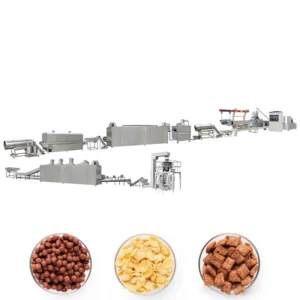
Máquina Normal de Fabricación de Cereales para el Desayuno Kelloggs Corn Flakes Línea de Producción de Extrusoras de Cereales para el Desayuno
¥30,000.00 Select options This product has multiple variants. The options may be chosen on the product page -
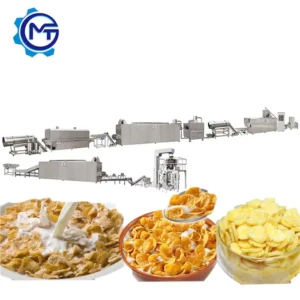
Máquina automática de fabricación de copos de maíz de 500 kg/h Nueva condición Alta productividad Línea de procesamiento de cereales dulces para el desayuno Desde la fábrica
¥8,500.00 Select options This product has multiple variants. The options may be chosen on the product page