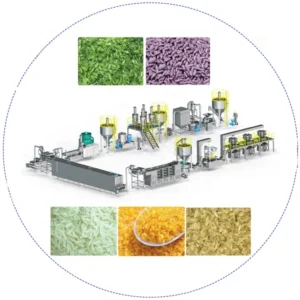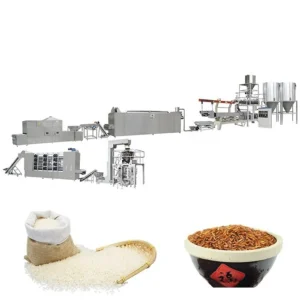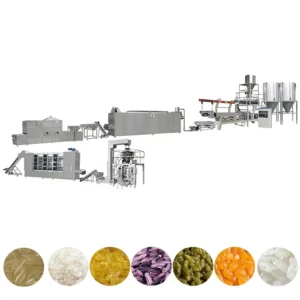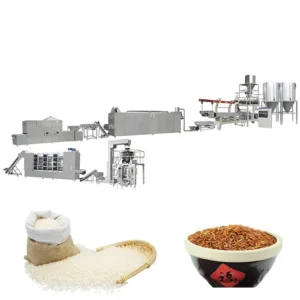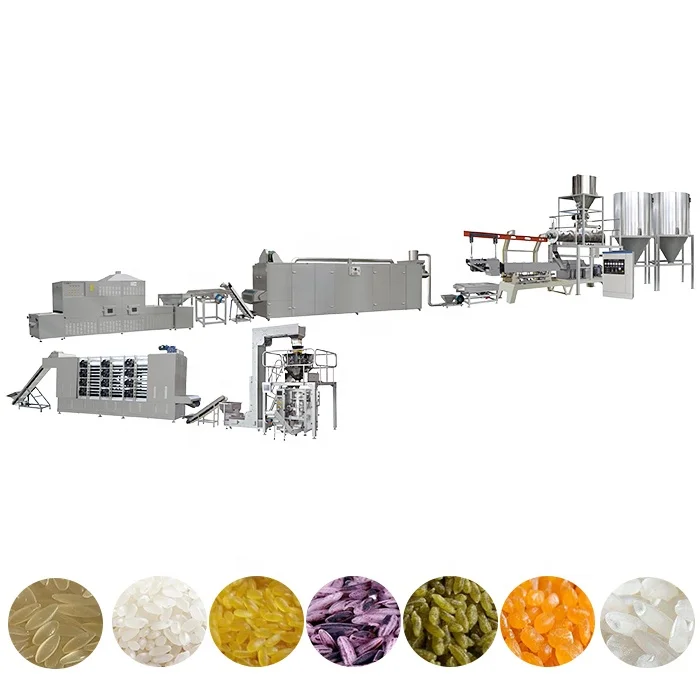


Fortified Rice Production Line, Twin-Screw Extrusion, PLC Control — integrates mixing, extruding, screening, drying, cooling and packing into one continuous turnkey layout.
Screw configuration and die design are matched to your flour blend and target grain shape, controlling expansion and density through barrel temperature and moisture profile. Trial runs on your actual raw material are completed in our testing workshop before shipment, with full documentation covering line layout, electrical schematics and configuration records.
Description
Turnkey Integration — every station from batching to packing is throughput-matched under one supplier, eliminating the dryer bottleneck that stalls extruder output on nutrition contracts.
Technical Specifications
| Parameter | Value |
|---|---|
| Product Type | Fortified Rice Production Line |
| Screw Type | Twin-screw |
| Control System | PLC (basis not stated in source — confirm whether PLC or MCC included) |
| Line Stations | Mixing → Feeding → Extruding → Screening → Drying → Cooling → Packing |
| Mixing System | Powder mixer with preset ratio blending |
| Screening System | Vibrating screen with fan |
| Drying System | Drying box with moisture control |
| Conveying System | Feeder, air conveyor, lifting machine |
| Output Capacity | (basis not stated in source — confirm raw material, moisture content and product format) |
| Voltage & Frequency | (basis not stated in source — confirm target market electrical standard) |
| Overall Dimensions | (basis not stated in source — confirm line footprint) |
| Net Weight | (basis not stated in source — confirm total line weight) |
| Assembly State | Fully integrated production line |
| Certification | CE, ISO |
Application Suitability
| Application | Material or Output |
|---|---|
| Fortified rice for government nutrition programmes | Blended grain flour with added vitamins and minerals |
| Artificial rice from broken or low-grade grain | Rice flour, corn flour, wheat flour blends |
| Nutritional rice for NGO relief contracts | Multi-grain formulations with protein or micronutrient enrichment |
| Reformed grain products for retail brands | Starch-based blends shaped to natural rice grain geometry |
Why a "Per-Hour" Rating Fails on Fortified Rice Blends
A capacity number tied to standard corn starch means nothing when your formula runs 40% legume flour.
I planned a fortified rice line for a South Asian client two years ago. The extruder was quoted at its nameplate throughput, but their actual raw material — a high-protein lentil and rice flour blend — behaved completely differently under heat and shear. The real output was roughly half of what the proposal stated, and the client missed their first government delivery window. That job changed how I approach every fortified rice production line turnkey project since: no capacity figure goes into a proposal without a trial run on the buyer’s specific formulation first [NEED_CITE: raw material variability in extrusion throughput].
Screw Geometry Dictates What Your Formula Can Actually Run
The twin-screw configuration on this line is not a fixed arrangement. Screw elements — conveying, kneading, and reverse-flight sections — are assembled in a sequence that matches your exact flour blend and the rice grain shape you need. A high-starch formula gelatinises quickly and needs shorter residence time; a protein-heavy blend demands more kneading blocks and a longer barrel. This is the core of extrusion engineering on a fortified rice production line turnkey installation, and it is where generic builds fail the hardest.
Matching the Dryer to the Extruder, Not the Other Way Around
The drying box and vibrating screen with fan exist to handle the moisture load the extruder puts out at your verified throughput. If the extruder pushes more wet product than the dryer can process in a single pass, rice grains stick together and final moisture content drifts outside specification. On this line, the dryer capacity is calculated against the extruder’s actual output on your raw material, not its theoretical maximum.
Reading the Specs That Matter for Grain Forming
The powder mixer with preset ratio blending sets the upstream consistency — if vitamin premix or protein concentrate is not distributed evenly before the feeder, every grain downstream carries a different nutritional load. The air conveyor and lifting machine between stations must move product without crushing partially dried grains, which is why pneumatic conveying is specified rather than mechanical belts at the screening-to-dryer transfer. The PLC control system coordinates barrel temperature zones and screw speed to hold gelatinisation within a tight band, which directly controls whether the final grain holds its shape during cooking or disintegrates [NEED_CITE: starch gelatinisation control in twin-screw extrusion].
The Cost of Skipping the Trial Run
Buyers who accept a line based on brochure capacity often discover the problem after installation, when the first production run cannot meet contract volumes. The extruder runs, but the downstream cooling and packing stations sit idle waiting for product, or the dryer overloads and rice grains fuse into clumps. Rectifying this after commissioning means either replacing the dryer, re-gearing the extruder down, or renegotiating delivery schedules with the programme buyer — all of which cost far more than a pre-shipment trial [NEED_CITE: post-installation line modification costs].
What This Supplier Brings to a Nutrition Line Project
Complete station matching means the mixer output, extruder throughput, dryer residence time, and packing speed are calculated as one system rather than sourced separately. Screw and die configurations are documented per project, so reorders or formulation changes start from a known baseline. The in-house testing workshop runs your actual raw material before the line ships, producing a trial report that locks in verified capacity. Electrical schematics and voltage are confirmed against your facility’s supply before fabrication starts, avoiding on-site rewiring delays. Pre-sales engineering through commissioning and operator training is handled by the same team, so the people who designed the layout are present when the first grain comes off the die.
Documentation & Verification
- Line layout drawing showing throughput matching at every station from mixer to packer
- Trial run report on your flour blend confirming verified output and grain integrity
- Screw and die configuration record specific to your target rice grain shape
- Electrical schematic with voltage and frequency confirmed to your site supply
- Factory test record with photographic evidence before crating
- CE declaration of conformity and ISO certificate for the complete line
Installation, Commissioning & Support
- Foundation plan showing floor loading and anchoring points for the twin-screw extruder
- Dedicated circuit specification matching confirmed voltage and frequency for PLC cabinet
- Line arrives in modular sections for staged assembly inside your facility
- First-run commissioning includes screw speed and barrel temperature profiling on your blend
- Operator training covers die changes, screen cleaning, and moisture adjustment at the dryer
- Wear parts list with reorder intervals for screw elements and die plates
What to Include in Your First Inquiry
To size this fortified rice production line turnkey properly, share your flour blend composition and target nutritional profile per 100 grams of finished rice. Confirm your daily or weekly output requirement, the electrical supply available at your plant, and the control language your operators need. If you have existing upstream milling or downstream packing equipment, note the interface points so the line can be scoped around them.
Frequently Asked Questions
Q: How is the line capacity verified — what raw material and moisture content is it based on?
A: Capacity is confirmed through a trial run in the in-house testing workshop using your actual flour blend at your specified moisture content. The resulting trial report documents verified throughput, grain shape integrity, and final moisture, and this report accompanies the shipment.
Q: Can the screw and die configuration be tailored to my specific flour blend and target grain shape?
A: Yes. The twin-screw elements are arranged — conveying, kneading, reverse-flight — to match your formulation’s gelatinisation behaviour, and the die is selected to produce the grain length and cross-section your market expects.
Q: How are the dryer and cooler capacities matched to the extruder output to avoid bottlenecks?
A: The dryer residence time and cooling conveyor length are calculated against the extruder’s verified throughput on your raw material, not its nameplate rating, so no station waits on another during continuous production.
Q: What voltage, frequency and control language will be confirmed before production starts?
A: Your facility’s electrical supply and operator language requirements are confirmed during the proposal stage. The PLC interface and all motor ratings are built to those specifications before fabrication begins.
Q: Is a trial run on my raw material possible before shipment, and what does the trial report cover?
A: Yes. The testing workshop runs your supplied flour blend and produces a report covering verified output rate, grain geometry, moisture content after drying, and any screw or die adjustments made during the run.
Related products
-
Máquina automática de hacer harina de arroz en polvo de nutrición para bebés de la marca MT de pequeña escala con capacidad de producción de 500 kg/h y control PLC.
¥9,500.00 Add to cart -

Línea de proceso de fabricación de extrusora de polvo de nutrición para bebés de 500 kg/h automática industrial
¥8,238.27 Add to cart -

Línea de procesamiento de extrusión de arroz en polvo nutricional para bebés de alta precisión 500kg/h
¥9,500.00 Add to cart -
Línea de producción de procesamiento de papilla en polvo de nutrición completa para bebés completamente automática para fábrica de nutrición infantil
¥9,500.00 Add to cart