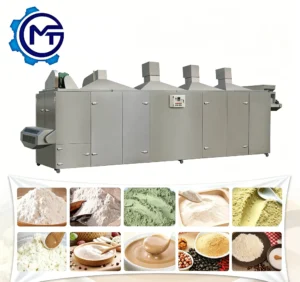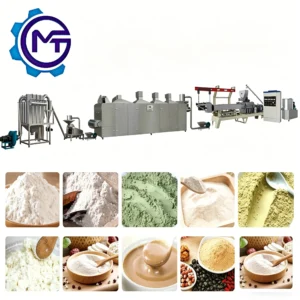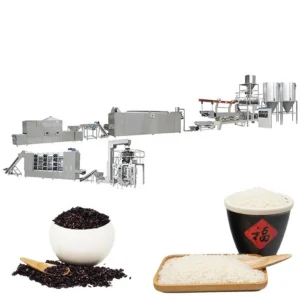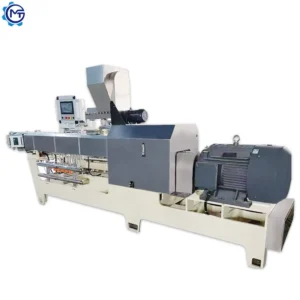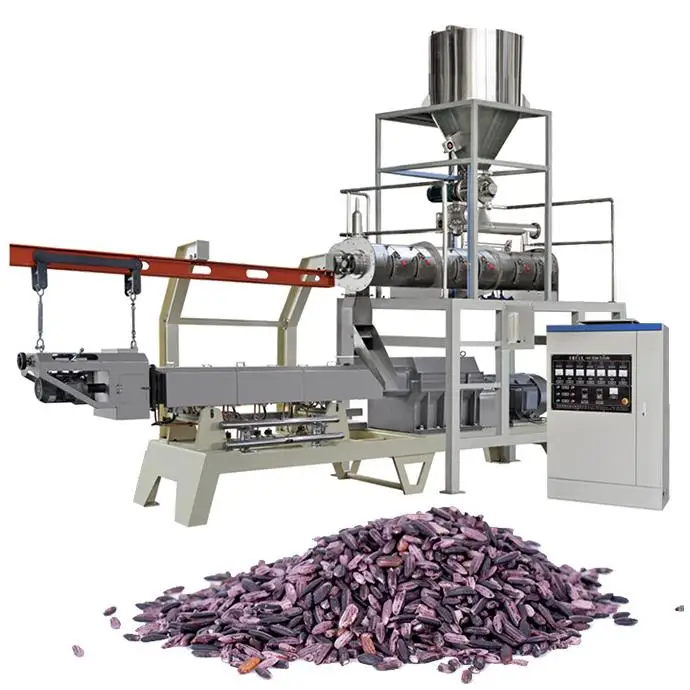


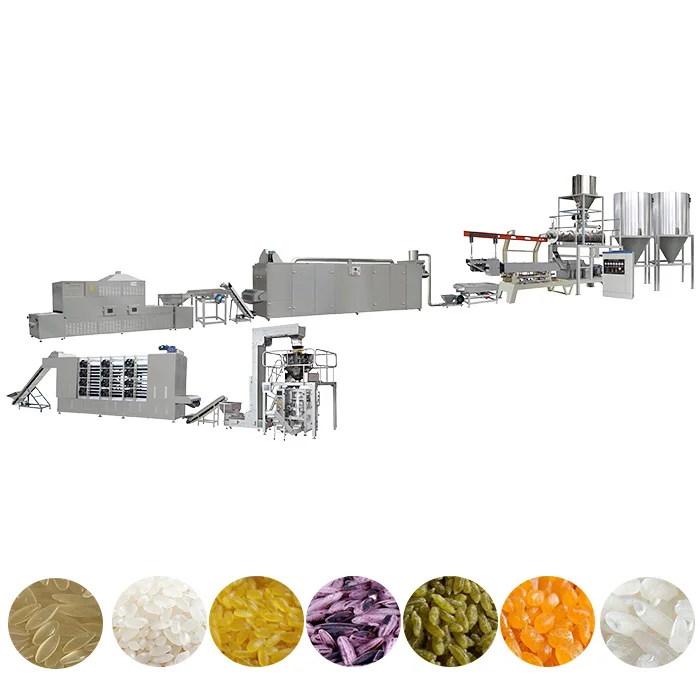
MT65 / MT70 / MT85 / MT75 / MT95 Nutritional Fortified Rice Production Line, Twin-Screw Extruder, PLC Control — complete turnkey line from batching through extrusion, low-temperature drying, roasting and packing.
- Screw and die configuration matched to your raw material — broken rice, corn, millet, starch blends with vitamin and mineral enrichment
- Frequency-controlled dryer and throughput-matched stations prevent bottlenecks across the full process
Every station is sized and balanced against the extruder output, so rated capacity holds on your actual formulation. Trial runs on your raw material are completed in our testing workshop before shipment, with full layout, screw configuration record and CE/ISO documentation provided.
Description
Integrated Project Delivery — Every station from batching to packing is throughput-matched under one supplier, so a nutritional fortified rice production line turnkey delivers its rated output on your actual formulation rather than a collection of mismatched machines.
Technical Specifications
| Parameter | Value |
|---|---|
| Product Type | Nutritional Fortified Rice Production Line |
| Extruder Models Available | MT65, MT70, MT75, MT85, MT95 |
| Extruder Type | Twin-screw extruder (single-screw feeding system available per material) |
| Line Capacity | 80–100 kg/h (basis not stated in source — confirm raw material / moisture) up to 800–1000 kg/h depending on extruder model selected |
| Raw Materials | Broken rice, corn, millet, wheat, oats, buckwheat, beans, starch; vitamins and minerals as partial ingredient |
| Production Procedure | Mixing → Extruding → Vibrating → Low-temperature Drying → Cooling → High-temperature Roasting → Cooling → Packing |
| Final Products | Artificial rice, fortified rice kernels |
| Speed Control | Frequency inverter (variable frequency drive) |
| Screw Construction | Wear-resistant alloy |
| Lubrication | Automatic lubricating and cooling system |
| Drying Oven Heating Source | Electric or gas (configurable) |
| Drying Oven Control | Frequency motor for mesh belt speed |
| Control System | PLC (brand / HMI language to be confirmed) |
| Voltage & Frequency | Customized to local requirement (e.g. 380 V / 50 Hz or other — to be confirmed) |
| Certification | CE, ISO |
| Key Features | Automatic lubricating system, frequency-controlled drying, twin-screw extrusion, low-temperature and high-temperature drying stages |
Application Suitability
| Application | Material or Output |
|---|---|
| Fortified rice programmes for schools, relief agencies and institutional feeding | Broken rice, corn, millet with vitamin and mineral premix blended during extrusion |
| Commercial upcycling of broken rice and rice bran | Broken rice kernels, rice bran, starch — converted into premium nutritional kernels for retail |
| Multi-grain or legume-based artificial rice formats | Buckwheat, oats, beans, wheat combined with starch matrix to form uniform reconstituted kernels |
| Purple sweet potato and specialty ingredient rice lines | Purple sweet potato flour, starch, and grain blends requiring adjusted moisture and barrel temperature profiles |
Why "Rated Capacity" Is the Wrong Starting Point
Capacity must be verified on your raw material before any line configuration is finalized.
A nutritional fortified rice production line turnkey is only as reliable as the data behind its throughput claim. I once worked on a purple sweet potato artificial rice project where the buyer ordered strictly by brochure capacity. Their local sweet potato flour carried higher moisture and a different gelatinisation curve. During trial production, actual output dropped to roughly six-tenths of the quoted figure. The dryer could not keep pace, and the cooling conveyor backed up within hours. [NEED_CITE: gelatinisation behaviour of non-standard starch sources in twin-screw extrusion]
That experience changed how I approach every project. I now insist on obtaining the buyer’s actual raw material for bench trials before screw combination, die opening, and downstream station sizing are locked in.
Screw and Die Configuration Matched to Your Formulation
The twin-screw extruder is the core of this nutritional fortified rice production line turnkey. Its value lies in the ability to adjust screw element sequencing, barrel temperature zones, and die geometry to a specific flour blend. A formulation heavy in legume protein requires different shear and residence time than one based primarily on broken rice starch. Generic screw builds copied from a standard catalogue often produce kernels that are too dense, too fragile, or uneven in size.
Throughput Balance Across Every Station
A line is only as fast as its slowest station. In this nutritional fortified rice production line turnkey, the low-temperature dryer, cooling conveyor, high-temperature roaster, and final cooling stage are each sized to match extruder output on the buyer’s confirmed recipe. If the dryer belt runs too slow, extruded kernels pile up and deform before moisture is reduced. If the roaster is undersized, the final kernel colour and hardness specification cannot be met. [NEED_CITE: throughput matching methodology for continuous food extrusion lines]
Reading the Specs Beyond the Brochure Numbers
The twin-screw extruder with automatic lubricating and cooling system supports continuous operation without manual greasing interruptions — critical when a nutritional fortified rice production line turnkey runs multi-day campaigns. Frequency-inverter speed control on the extruder allows operators to fine-tune screw RPM as raw material moisture drifts between batches. The drying oven uses a frequency motor on the mesh belt, giving independent control of dwell time inside the chamber; this is how final kernel moisture is held within specification regardless of ambient humidity. The PLC control system consolidates barrel temperature, screw speed, and feeder rate into a single interface, supporting batch-to-batch repeatability. Wear-resistant alloy screws extend service intervals when processing abrasive materials like fortified mineral premixes. [NEED_CITE: wear rates of extruder screws processing mineral-fortified grain blends]
The Hidden Cost of Skipping a Trial Run
When a line ships without a trial run on the buyer’s actual raw material, every formulation variable becomes an unknown at commissioning. Screw combinations that worked on the supplier’s test flour may produce under-expanded or over-dense kernels on your local grain supply. Dryer temperature profiles calibrated for one moisture level may leave kernels too wet for safe packing or too dry to survive roasting. The cost of reconfiguring screw elements and adjusting die openings on-site — with production deadlines already pressing — is far greater than a few days of pre-shipment testing in the supplier’s workshop. [NEED_CITE: on-site commissioning delays caused by untested raw material formulations]
What Sets This Project Approach Apart
Every station in the line is specified under one supplier, so mixing capacity, extruder throughput, dryer belt speed, and packing rate are calculated together rather than sourced from separate vendors and forced to fit.
Screw configuration and die design are recorded against the buyer’s raw material and target kernel density, not pulled from a generic template.
An in-house testing workshop runs the buyer’s formulation before shipment, producing a trial run report with measured output and product quality data.
Pre-sales engineering includes line layout and capacity calculation, followed by on-site installation, commissioning, and operator training on the PLC interface.
Wear parts such as screws, dies, and dryer belt sections are listed and stocked so that first replacement does not become an emergency sourcing exercise.
Documentation & Verification
- Line layout and capacity calculation showing throughput balance across mixing, extruding, drying, roasting, and packing
- Screw and die configuration record matched to your raw material formulation and target kernel density
- Trial run report on your actual raw material conducted in the testing workshop before shipment
- Electrical schematic with voltage, frequency, and PLC language confirmed before production begins
- CE declaration of conformity and ISO certificate for export compliance
- Operation and maintenance manual with wear parts list and lubrication schedule
Installation, Commissioning & Support
- Foundation and floor-space planning based on the selected extruder footprint and full line length
- Power supply sizing for installed capacity ranging across model options, with dedicated circuits for the drying oven heating elements
- Modular shipment and on-site assembly sequence for the twin-screw extruder, dryer, roaster, and cooling conveyors
- First-run parameter setting on your raw material, including screw speed, barrel temperature zones, and dryer belt frequency
- Operator training covering PLC operation, screw element inspection, and automatic lubrication system monitoring
- Wear parts stocking plan for screws, dies, and mesh belt sections aligned to your planned production campaign schedule
Preparing Your Enquiry
To configure the correct line, share your raw material formulation including moisture content and any vitamin or mineral premix ratios. Confirm your target daily output and available workshop floor dimensions. Specify your local voltage, frequency, and preferred PLC interface language so that electrical design and control documentation can begin in parallel with mechanical layout.
Frequently Asked Questions
Q: How is line capacity verified on my raw material before shipment?
A: Your raw material is shipped to the in-house testing workshop, where a bench-scale trial run is conducted using the proposed screw combination and die configuration. Output rate, kernel density, moisture content, and appearance are recorded. A trial run report is shared before the full line enters production, so capacity is confirmed on your actual formulation.
Q: How are dryer, cooler, and packing stations sized to avoid bottlenecking the extruder?
A: Each downstream station is calculated against the extruder’s verified throughput on your specific recipe. Dryer belt length and heating zone count, cooling conveyor residence time, and packing head speed are all specified to exceed the confirmed extruder output slightly, ensuring continuous flow without kernel accumulation or deformation.
Q: What documentation is provided with the line?
A: Documentation includes line layout and capacity calculation, screw and die configuration record, trial run report on your raw material, electrical schematic with confirmed voltage and frequency, CE declaration of conformity, ISO certificate, factory test record, operation manual, and wear parts list.
Q: Can the line be phased for installation in an existing factory with limited floor space?
A: The layout can be planned in stages to accommodate existing equipment or structural constraints. Station placement, conveyor routing, and utility connections are designed to allow phased installation while maintaining the throughput balance verified during the pre-shipment trial run.
Q: What operator training and commissioning schedule is included on site?
A: On-site commissioning covers extruder start-up, parameter tuning on your raw material, dryer and roaster calibration, and packing station synchronization. Operator training includes PLC interface navigation, screw element inspection, automatic lubrication system checks, and routine maintenance intervals for all major stations.
Related products
-
Línea de procesamiento de producción automática de 500 kg/h de polvo de nutrición de arroz para bebés orgánico y sin gluten
¥8,238.27 Add to cart -

Línea de procesamiento de extrusión de arroz en polvo nutricional para bebés de alta precisión 500kg/h
¥9,500.00 Add to cart -

Máquina Extrusora de Doble Tornillo Automática Controlada por PLC de Alta Calidad de 500kg/h para Polvo de Nutrición de Arroz para Bebés
¥8,238.27 Add to cart -
Máquina de hacer harina de arroz para bebés con extrusora de doble tornillo de 150-500kg/h
¥9,500.00 Select options This product has multiple variants. The options may be chosen on the product page