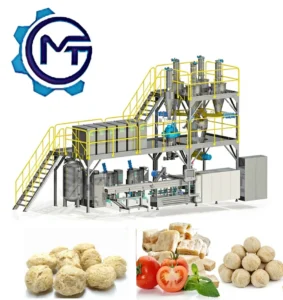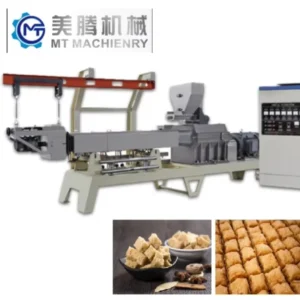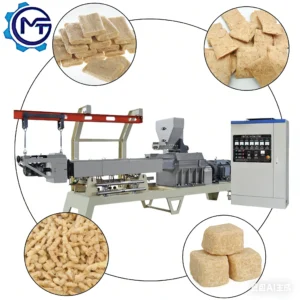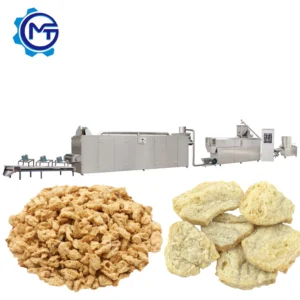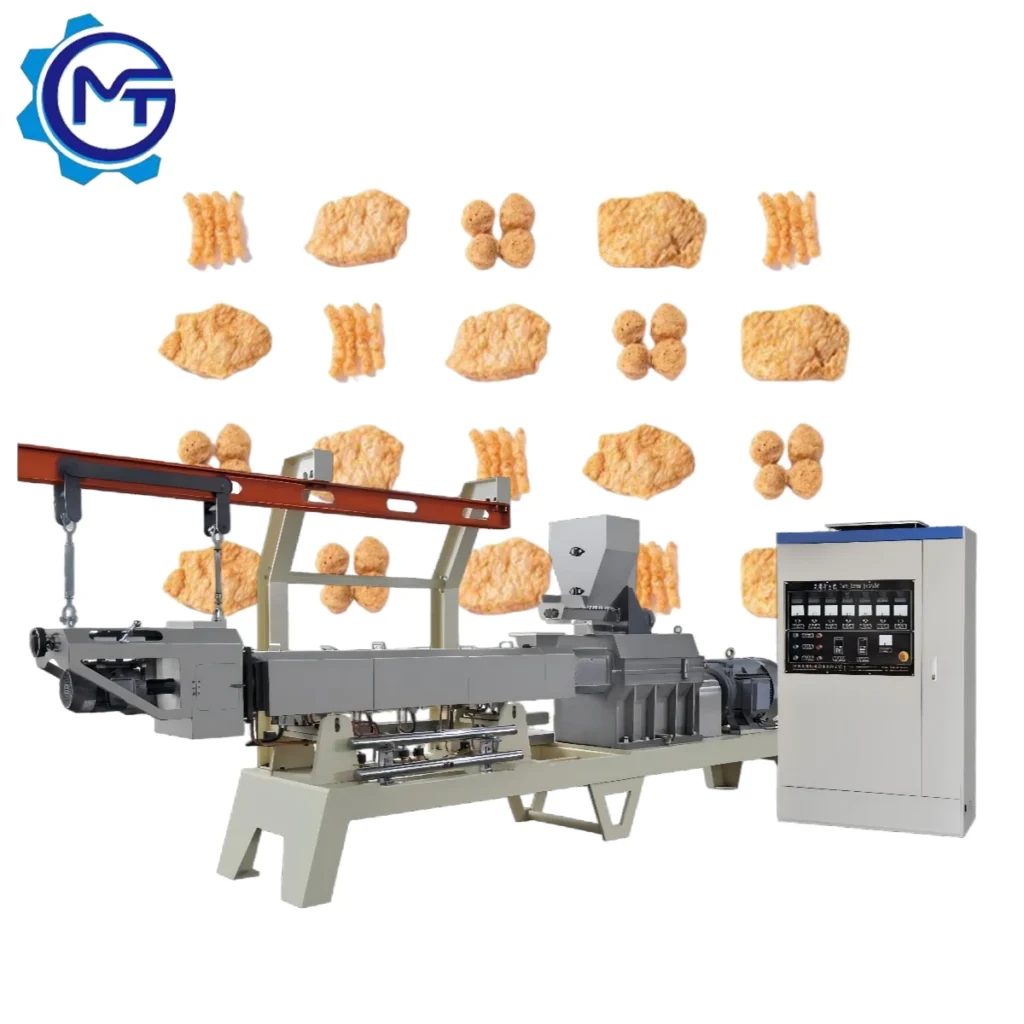

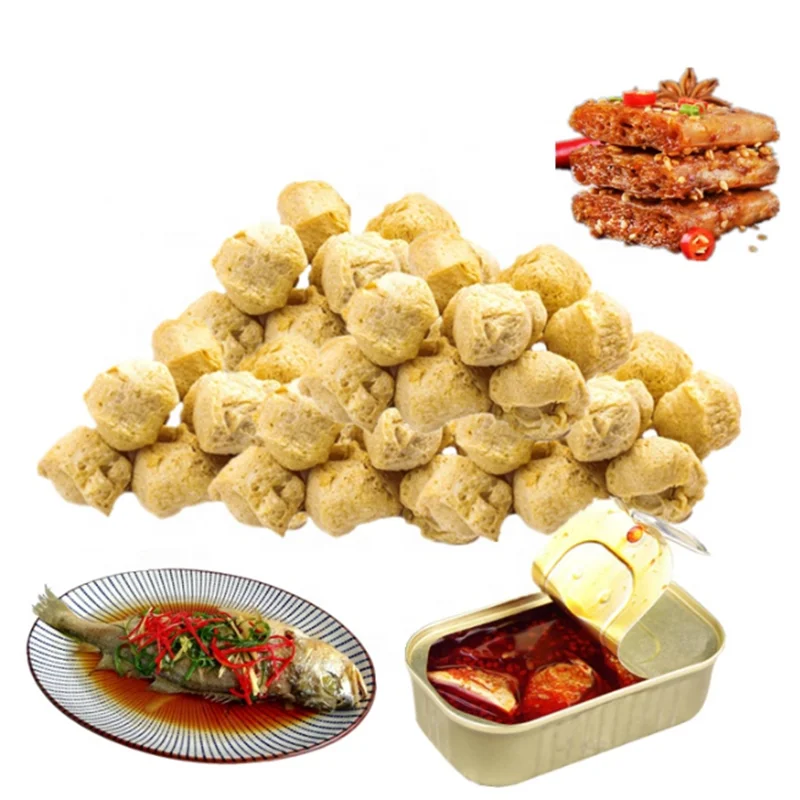
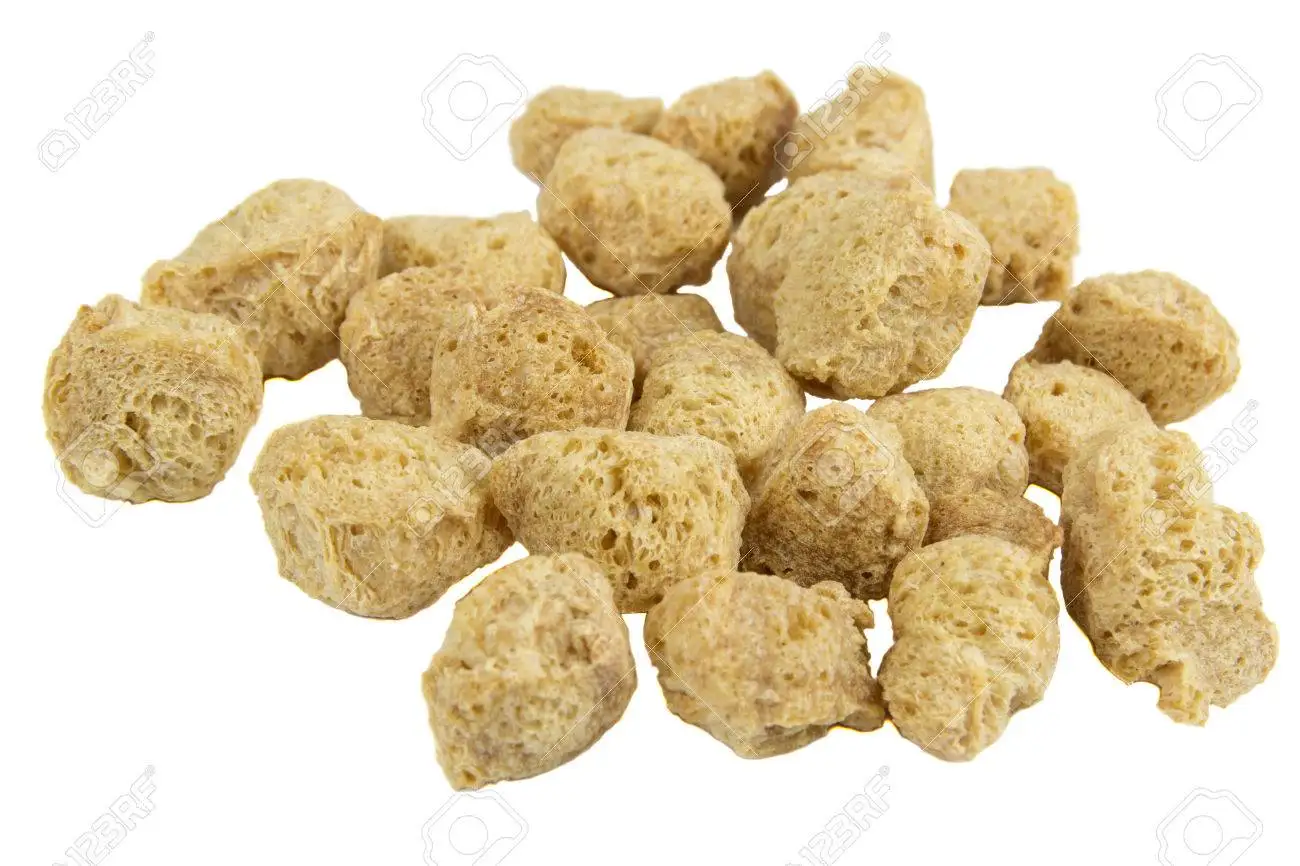
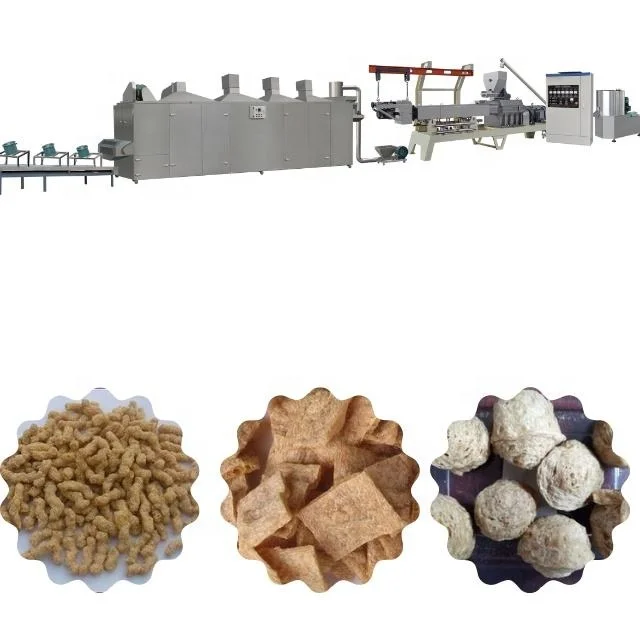

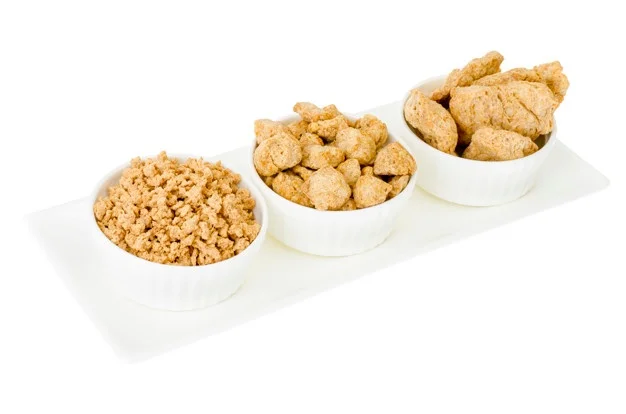
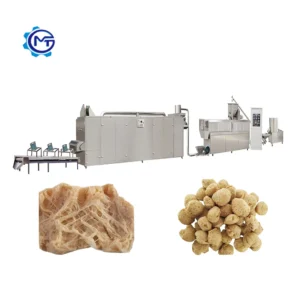
Textured Soy Protein Production Line, Twin-Screw, PLC Control — complete turnkey plant from batching through extrusion, drying and packing. Screw configuration and die design are specified to your soy protein concentrate or isolate, controlling moisture, shear and barrel temperature profile to hit target nugget density and texture. Every station is throughput-matched so no single unit bottlenecks the line. Trial runs on your raw material in our testing workshop confirm capacity and product format before shipment.
- Twin-screw extrusion with application-specific screw and die setup
- PLC intelligent control with MCC integration across all stations
- Supports nugget, chunk and granule plant-based protein formats
- Layout, commissioning and operator training delivered as one project
Description
Turnkey Line Matching — every station from batching to packing is throughput-balanced against the extruder so no single unit becomes the bottleneck when your soy protein formulation changes mid-shift.
Technical Specifications
| Parameter | Value |
|---|---|
| Product Type | Textured Soy Protein Production Line |
| Extruder Type | Twin-screw |
| Control System | PLC intelligent control with MCC integration |
| Product Compatibility | Multiple plant-based protein formats including nugget, chunk, and granule (confirm target format with supplier) |
| Raw Material Profile | Soy protein concentrate, soy protein isolate, pea protein, and blends (formulation-specific trial required) |
| Line Stations | Batching, extrusion, drying, cooling, packing (basis to be confirmed for specific layout) |
| Output Capacity | Dependent on raw material blend, moisture content, and target product density (basis to be confirmed) |
| Screw Configuration | Matched to buyer’s protein source and target texture (basis to be confirmed) |
| Die Configuration | Configured for nugget, chunk, or granule shape per buyer specification (basis to be confirmed) |
| Voltage & Frequency | Configurable to buyer’s site utility standard (basis to be confirmed) |
| Certification | CE and ISO certified facility |
Application Suitability
| Application | Material or Output |
|---|---|
| Vegetarian meat nugget manufacturing | Soy protein concentrate and isolate blends producing fibrous, bite-resistant nuggets |
| Textured soy protein as food ingredient | Defatted soy flour and concentrate for chunk and granule formats supplied to food processors |
| Plant-based meat alternative processing | Pea protein, wheat gluten, and soy blends for mince, patty, and strip formats |
| Institutional and food service supply | High-volume textured protein in standardized chunk sizes for meal preparation facilities |
Why Nominal Capacity Figures Mislead Protein Buyers
A line rated at a round number on paper means nothing until it runs your actual soy formulation at your target moisture.
I have walked into facilities where a textured soy protein production line turnkey was quoted at a comfortable output figure, but that figure was based on a generic soy flour test the supplier ran in-house. The buyer’s real formulation included pea protein and a higher fiber content. Once the actual blend hit the barrel, the material behaved differently — residence time shifted, shear dropped, and the tissue structure came out weak and crumbly. The extruder could not hold the quoted rate on that specific mix. [NEED_CITE: variability of protein extrusion behavior across different raw material blends]
This is not a supplier dishonesty issue in most cases. It is a gap between catalog testing and field reality. The only way to close it is to run the buyer’s exact raw material through the extruder before the line ships.
How Screw Configuration Determines Protein Fiber Structure
The texture of the final nugget or chunk depends almost entirely on what happens inside the barrel. A Textured Soy Protein Production Line turnkey must have its screw elements arranged to match the protein content and fiber target of the buyer’s product. High-protein isolates need more shear and a longer effective barrel length to align the protein molecules into visible fibers, while concentrate blends with residual starch require gentler handling to avoid over-gelatinization. The die plate at the end of the barrel controls expansion and shape — a smaller die opening increases back pressure and produces a denser, more meat-like chew.
Moisture Management Across the Barrel Zones
Water injection points along the barrel let operators tune the moisture profile zone by zone. On a textured soy protein production line turnkey project, the PLC control system manages these injection rates in real time, maintaining consistency when ambient humidity shifts between seasons or when a new batch of soy concentrate arrives with a slightly different baseline moisture. The MCC panel distributes power to each barrel heating zone independently, so the temperature gradient from feed inlet to die face stays stable across long production runs. [NEED_CITE: barrel zone temperature profiling in twin-screw protein extrusion]
Reading the Specs That Actually Matter for Protein Lines
The twin-screw design is fundamental here — single-screw extruders cannot generate the mixing intensity and shear profile needed to create fibrous, layered protein structures. The screw configuration record tells you how many kneading blocks, reverse elements, and conveying sections are in the barrel, and this arrangement is what produces the difference between a crumbly granule and a pullable, chicken-like chunk. The PLC intelligent control system matters because protein extrusion is sensitive to small temperature and moisture drifts; manual adjustment between shifts introduces inconsistency that shows up as texture variation in the finished product. Die configuration determines whether you are making mince, nuggets, or chunks, and switching formats typically means swapping die plates rather than reconfiguring the entire barrel. The overall line throughput depends on how well the upstream batching system and downstream dryer are sized relative to the extruder — an undersized dryer will force the extruder to slow down regardless of its mechanical capacity.
The Hidden Cost of Skipping the Trial Run
When a textured vegetable protein line ships without a prior trial on the buyer’s actual formulation, the first weeks on site become an expensive experiment. Screw combinations get swapped, barrel temperatures are adjusted by trial and error, and product that does not meet texture specifications goes to waste or gets sold at a steep discount as animal feed grade. I have seen a soy and pea protein blend that ran perfectly on a supplier’s test bench produce flat, dense sheets on site because the local water mineral content affected starch gelatinization in a way nobody anticipated. [NEED_CITE: impact of water chemistry on extrusion product quality]
Why This Line Is Configured as a Complete Project
Every station on this line is specified together, which means the batching system feeds at a rate the extruder can absorb, the dryer has enough bed area and residence time for the extruder’s actual output, and the cooling conveyor matches the dryer discharge. The screw and die configuration is not copied from a generic template — it is selected based on a trial run using the buyer’s specific soy protein source and target nugget density. The in-house testing workshop allows formulation adjustments before the equipment is crated, so commissioning on site starts from a proven baseline rather than from scratch. Electrical schematics and PLC interface language are confirmed to the buyer’s site standard before production begins, eliminating the delays that happen when a control panel arrives with the wrong voltage or an unfamiliar language on the HMI screen.
Documentation & Verification
- Line layout drawing showing throughput matching from batching through extrusion to packing
- Trial run report on buyer-supplied soy protein raw material conducted before shipment
- Screw and die configuration record matched to target nugget or chunk density
- Electrical schematic with voltage and frequency confirmed to site utility standard
- CE declaration of conformity and ISO certificate for the manufacturing facility
- Operation and maintenance manual with wear parts list and replacement intervals
Installation, Commissioning & Support
- Foundation and floor space plan accounting for the full line footprint from mixer to packer
- Dedicated electrical circuit sizing based on confirmed total connected load of the PLC-controlled system
- Modular assembly sequence allowing the twin-screw extruder and dryer to be positioned independently
- First-run parameter setting on site using the trial run report as the starting baseline
- Operator training covering PLC screen navigation, screw swap procedures, and daily barrel cleaning
- Wear parts inventory including spare screw elements and die plates specific to the configured format
- Scheduled maintenance checklist aligned with bearing, seal, and heater band replacement intervals
What to Prepare Before Requesting a Quote
To size a textured soy protein production line turnkey correctly, share your primary protein source and any blend ratios you plan to run, along with the target product format — nugget, chunk, mince, or granule. Include your daily or shift-based production target and the available floor space and ceiling height in your facility. Specify your local voltage, frequency, and preferred PLC interface language. If you already have upstream milling or downstream packing equipment, let the supplier know so the line can be configured to interface with what is already on site.
Frequently Asked Questions
Q: How is output capacity verified against my specific soy protein formulation and moisture level?
A: The supplier conducts a trial run in their testing workshop using your actual raw material blend at your target moisture content. The results — including achievable throughput, product density, and fiber structure quality — are documented in a report that forms the basis of the final line configuration and quotation.
Q: Can the line be phased for installation, and what is the commissioning schedule?
A: The line layout is designed in modular stations, allowing the extrusion section to be installed and commissioned first if the dryer or packing area is not yet ready. A phased commissioning schedule is provided during the proposal stage, with engineer availability aligned to your construction timeline.
Q: How are upstream batching and downstream drying capacities matched to the extruder throughput?
A: Each station is sized based on the extruder’s verified output on your specific formulation, not on a nominal catalog figure. The batching system delivers at a rate the barrel can absorb, and the dryer bed area provides sufficient residence time for the moisture level exiting the die.
Q: What operator training is included, and in what language is the PLC interface delivered?
A: On-site training covers extruder operation, screw configuration changes, die swaps, and daily maintenance routines. The PLC interface and HMI screens are configured in the buyer’s preferred language before shipment, confirmed during the specification review stage.
Q: How is the screw and die configuration selected for nugget versus chunk versus granule formats?
A: The screw element arrangement is chosen based on the shear and residence time needed for your protein source, while the die plate geometry determines the final product shape and density. Format changes typically require a die swap and minor screw adjustment, documented in the configuration record.
Related products
-
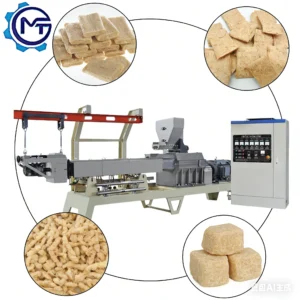
Extrusora de Doble Tornillo para Proteína Vegetal Texturizada (TVP)
¥9,500.00 Select options This product has multiple variants. The options may be chosen on the product page -
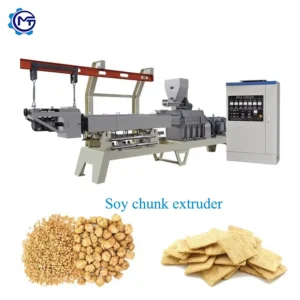
Planta de Extrusión de Proteína de Soja Texturizada Línea de Producción de Procesamiento de Proteínas Máquina para Fabricar TVP
¥30.00 Select options This product has multiple variants. The options may be chosen on the product page -
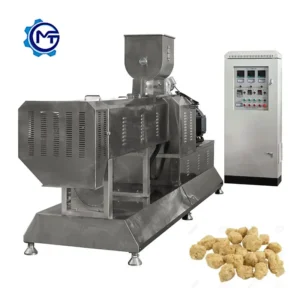
Máquina de Línea de Producción de Proteína de Carne de Soja Extrusora Multifuncional para Alimentos de Proteína de Soja
¥8,650.00 Select options This product has multiple variants. The options may be chosen on the product page -
Línea de Producción Automatizada de Nuevas Proteínas de Soja de Alta Productividad Línea de Procesamiento de Sustitutos de Carne
¥30.00 Select options This product has multiple variants. The options may be chosen on the product page