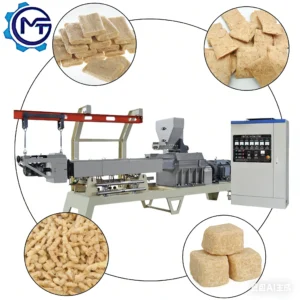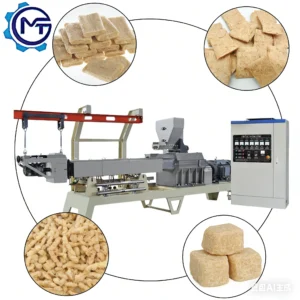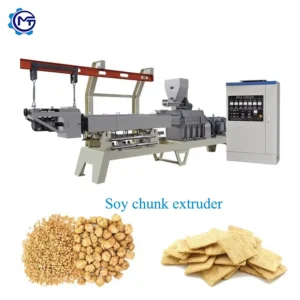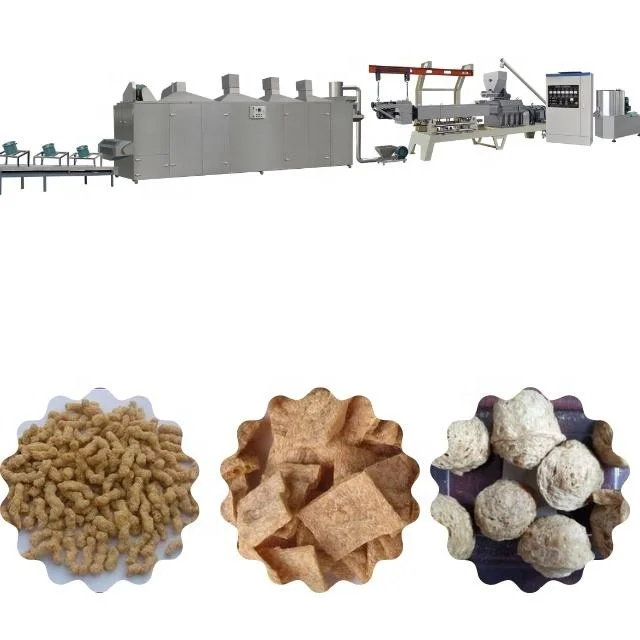


MT65 / MT70 / MT85 Textured Vegetable Protein Production Line, Twin-Screw Extrusion, Stainless Steel — configured as a turnkey project from batching to packing, with throughput calculated across mixer, extruder, dryer and cooler to prevent station bottlenecks. Screw and die design matched to your soybean or peanut meal formulation and target fiber texture, supported by full line layout and utility planning.
- Layout dimensions and capacity figures published per model for factory floor planning
- In-house testing workshop trial runs on your raw material before shipment, with documented report and CE conformity
Description
End-to-end throughput matching — every station on this TVP line from powder mixer through twin-screw extruder to cooler is calculated against your target output so no single machine bottlenecks the next, backed by in-house trial runs on your actual soybean or peanut meal formulation before the line ships.
Technical Specifications
| Parameter | Value |
|---|---|
| Product Type | Textured Vegetable Protein (TVP) Extrusion Production Line |
| Available Models | MT65 / MT70 / MT85 |
| Line Process Flow | Raw material preparation → mixing → conveying → extrusion → conveying → drying → cooling → packing |
| Extruder Type | Twin-screw |
| MT65 Installed Power / Real Power | 85 kW / 65 kW |
| MT65 Output Capacity | 150–200 kg/h (basis not stated in source — confirm raw material formulation and moisture content) |
| MT65 Overall Dimensions | 18,000 × 1,300 × 2,300 mm |
| MT70 Installed Power / Real Power | 120 kW / 90 kW |
| MT70 Output Capacity | 200–300 kg/h (basis not stated in source — confirm raw material formulation and moisture content) |
| MT70 Overall Dimensions | 20,000 × 1,500 × 2,400 mm |
| MT85 Installed Power / Real Power | 195 kW / 165 kW |
| MT85 Output Capacity | 600–800 kg/h (basis not stated in source — confirm raw material formulation and moisture content) |
| MT85 Overall Dimensions | 24,000 × 3,500 × 4,300 mm |
| Powder Mixer Tank Volume | 150 kg per batch |
| Powder Mixer Mixing Time | 10 min per batch |
| Powder Mixer Output | 300–600 kg/h |
| Powder Mixer Power | 4 kW |
| Powder Mixer Dimensions | 1,000 × 630 × 1,100 mm |
| High-Temperature Roaster Effective Belt Length | 3.5 m |
| High-Temperature Roaster Heater Power | 3.9 kW × 24 (far infrared) |
| High-Temperature Roaster Gas Consumption | 6.8 m³/h |
| High-Temperature Roaster Dimensions | 4,500 × 1,500 × 1,600 mm |
| Cooling Machine Capacity | 200–300 kg/h |
| Construction Material | Stainless steel (food-grade contact parts) |
| Certification | CE |
| Warranty | 1 year complete warranty |
Application Suitability
| Application | Material or Output |
|---|---|
| Textured vegetable protein for meat analogues | Soybean meal, defatted soy flour |
| Plant-based ham and sausage ingredients | Peanut meal, soy protein concentrate |
| Vegetarian canned and quick-frozen food components | Blended soy and peanut meal formulations |
| Small to medium-scale vegetarian meat manufacturing | High-protein legume-based raw materials |
| Fortified protein snacks and food supplements | Custom plant-protein blends per buyer recipe |
What "Rated Capacity" Leaves Out on a TVP Extrusion Line
A published kg/h figure means nothing until you know which raw material formulation and moisture content it was measured on.
I have watched lines arrive on site and immediately fall short of the capacity promised on paper — not because the extruder was undersized, but because the dryer downstream could not keep pace with the actual moisture load from the buyer’s specific soy-to-peanut meal ratio. When you are evaluating a textured vegetable protein production line turnkey package, the question is never just what the extruder can push through its barrel. The mixer must prepare batches fast enough to feed the extruder continuously, the roaster must evaporate moisture at a rate that matches extruder output, and the cooler must bring product temperature down before packing without creating a backlog. [NEED_CITE: throughput balancing principles in multi-station food extrusion lines] Every station on the MT65, MT70 and MT85 lines is specified with published output figures so you can verify the balance yourself before committing to a layout.
Layout Planning That Starts from the Building, Not the Brochure
A turnkey TVP project lives or dies on floor-level decisions: where the powder mixer sits relative to the extruder hopper, how the belt conveyor routes between the roaster and cooler, and whether the packing station has enough clearance for pallet staging. Each model in this range publishes full line dimensions — the MT65 line stretches 18 meters in length, the MT70 reaches 20 meters, and the MT85 extends to 24 meters with a 3.5-meter width that demands a wider bay. These are not extruder footprints in isolation; they are complete line envelopes that your contractor needs before pouring foundations or routing utility trenches.
Utility Routing Across the Full Line
Power distribution on a TVP line is not a single mains drop. The MT85 extruder alone draws up to 195 kW installed, the roaster adds 24 far-infrared heater elements at 3.9 kW each, and the mixer and cooling conveyor each require dedicated circuits. Voltage and frequency must be confirmed for the destination market before production starts — a 400 V 50 Hz build shipped to a 480 V 60 Hz facility will not commission on schedule. [NEED_CITE: industrial voltage and frequency standards across export markets] The textured vegetable protein production line turnkey scope includes electrical schematic confirmation and control language selection matched to the operator team on the ground.
How Screw Configuration and Die Design Shape TVP Fiber Structure
The twin-screw extruder is where protein fiber structuring actually happens, and the outcome depends on variables that are invisible in a spec sheet. Screw element arrangement determines shear intensity and residence time inside the barrel — too aggressive and the protein matrix tears rather than aligns, producing crumbly output with poor water-holding capacity. Die aperture and land length control the pressure drop at exit, which governs how the protein expands and sets into the layered, meat-like fiber structure that downstream processors expect for ham and sausage applications. The barrel temperature profile must be matched to the specific soybean or peanut meal blend; a formulation higher in peanut meal gelatinizes at a different temperature window than pure defatted soy flour. Moisture content at the feed point directly affects expansion ratio — a few percentage points of deviation can shift the product from a dense, chewy chunk to a brittle, over-expanded pellet. The food-grade stainless steel contact surfaces throughout the line prevent corrosion from the mildly acidic environment that high-protein formulations create during extrusion and drying, supporting consistent hygiene standards across production runs.
The Hidden Cost of Mismatched Stations Downstream
When the dryer capacity is specified against a generic moisture assumption rather than the buyer’s actual formulation, the extruder runs at full rate but the roaster cannot remove moisture fast enough. Product exits the belt with residual internal moisture, leading to mold growth during storage or texture collapse after packing. I have seen this pattern repeat across protein extrusion projects where the line was assembled from individual machine quotes rather than engineered as one system. The cooler then receives product that is still above target temperature, condensation forms inside the packing bags, and the buyer blames the extruder when the root cause sits two stations downstream. [NEED_CITE: common failure modes in multi-station food processing lines with mismatched throughput]
Why Source the Full Line from One Supplier
The mixer, extruder, roaster and cooler are configured as a matched set, so throughput at each station is verified against the others rather than quoted in isolation. Screw configuration and die design are specified to the buyer’s actual soybean or peanut meal formulation and the target fiber texture, not copied from a generic TVP build. An in-house testing workshop runs the buyer’s raw material before shipment, locking process parameters so the line produces acceptable product from the first day on site. Complete line documentation — from layout drawings to electrical schematics — arrives as one package, reducing coordination gaps between multiple vendors. On-site installation, commissioning and operator training are included in the project scope, covering every station from batching through packing.
Documentation & Verification
- Line layout with overall dimensions for MT65, MT70 or MT85 matched to your factory floor plan
- Capacity calculation showing throughput balance across mixer, extruder, roaster and cooler for your formulation
- Screw and die configuration record specific to your soybean or peanut meal recipe
- Electrical schematic with voltage, frequency and control language confirmed for your market
- Trial run report on your actual raw material produced in the in-house testing workshop before dispatch
- CE declaration of conformity and factory test record included with shipment
Installation, Commissioning & Support
- Foundation and floor leveling planned to the published line dimensions, up to 24 m × 3.5 m for the MT85 configuration
- Dedicated power circuits sized to the total installed load, with voltage and frequency locked before production
- Extruder barrel and screw assembly verified on site against the pre-shipment configuration record
- Roaster far-infrared heater zones calibrated to the moisture profile of your specific TVP formulation
- Operator training covering twin-screw process parameters, mixer batch timing and roaster belt speed adjustment
- Wear parts list for screws, dies and roaster belt provided with first replacement intervals noted
Before You Request a Quote
To configure a line that actually holds its rated output on your material, share your raw material formulation including the soybean-to-peanut meal ratio and any additional protein concentrates, your target daily or hourly production volume, the available workshop length and ceiling height, and the local voltage and frequency standard. If you have existing upstream milling or downstream packing equipment, note the interface points so the line layout accounts for them.
Frequently Asked Questions
Q: How is line throughput verified against my raw material before shipment?
A: Your specific soybean or peanut meal formulation is run in the in-house testing workshop using the configured screw and die setup. Process parameters — barrel temperature, moisture addition rate, screw speed — are adjusted until the target fiber structure and density are achieved. A trial run report documenting these locked parameters ships with the line.
Q: How are voltage, frequency and control language confirmed before production?
A: The destination market electrical standard is confirmed during the specification stage, and the electrical schematic is reviewed with the buyer before the control cabinet is wired. Control panel language is set to match the operator team. This prevents rewiring delays during on-site commissioning.
Q: What does the trial run report cover?
A: The report records raw material batch details, screw configuration, barrel temperature zones, moisture content at feed, extruder screw speed, die type, product density and fiber structure observations, plus dryer settings. It serves as the baseline reference for the first production run after installation.
Q: How is throughput balanced between extruder, roaster and cooler?
A: Each station’s published capacity is cross-checked against the others using the buyer’s target output and formulation moisture load. The mixer batch cycle time is matched to extruder feed rate, roaster belt length and heater power are sized for the evaporation demand, and cooler capacity is verified to bring product to packing temperature without backlog.
Q: What is included in the on-site commissioning scope?
A: Installation covers station positioning, utility connection, screw and die verification, and full line run-in with the buyer’s raw material. Operator training addresses process parameter adjustment, routine maintenance on twin-screw elements, roaster belt tensioning and daily cleaning procedures across all stations.
Related products
-
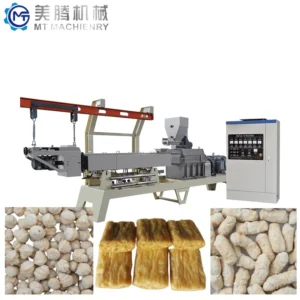
Small Multifunctional Textured Soy Protein Machine – Soy Protein Production Line – Vegetarian Meat Processing Equipment
¥65.00 Select options This product has multiple variants. The options may be chosen on the product page -
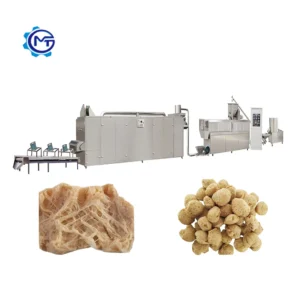
Línea de Producción Automatizada de Nuevas Proteínas de Soja de Alta Productividad Línea de Procesamiento de Sustitutos de Carne
¥30.00 Select options This product has multiple variants. The options may be chosen on the product page -
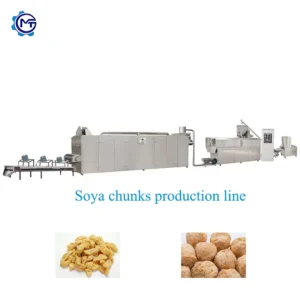
Máquina de Hacer Proteína de Soja Línea de Producción Automática de Trozos de Soja
¥30.00 Select options This product has multiple variants. The options may be chosen on the product page -
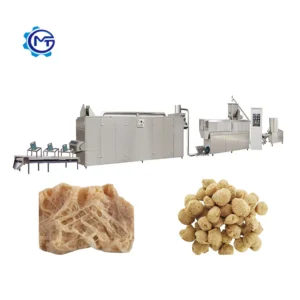
Nueva línea de producción de proteínas de alta eficiencia, equipo de proteínas vegetales para el procesamiento de carne vegetariana artificial, grado alimenticio.
¥65.00 Select options This product has multiple variants. The options may be chosen on the product page