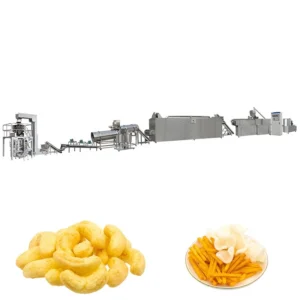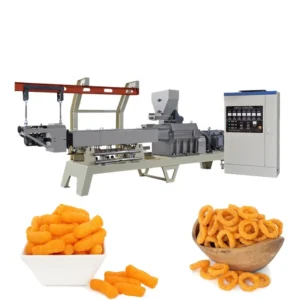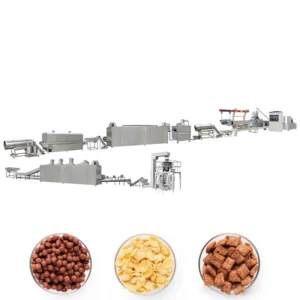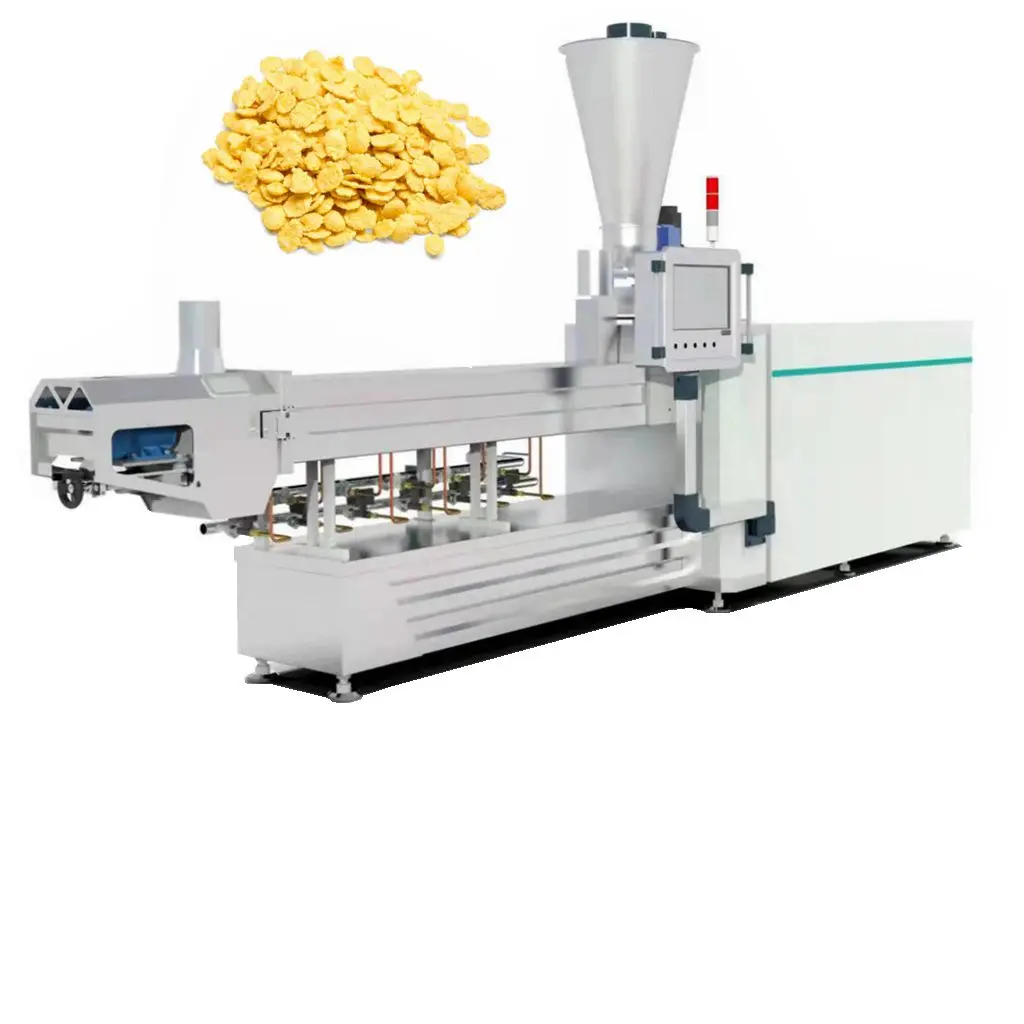
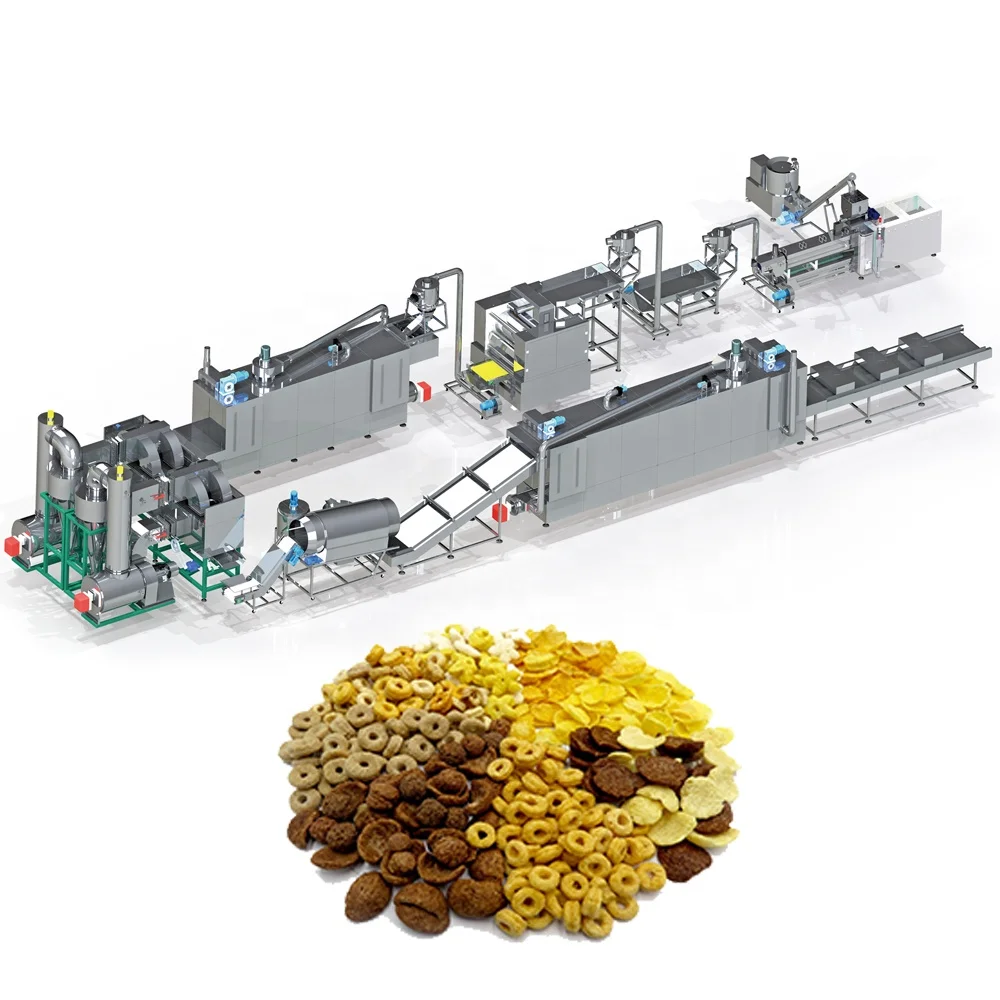
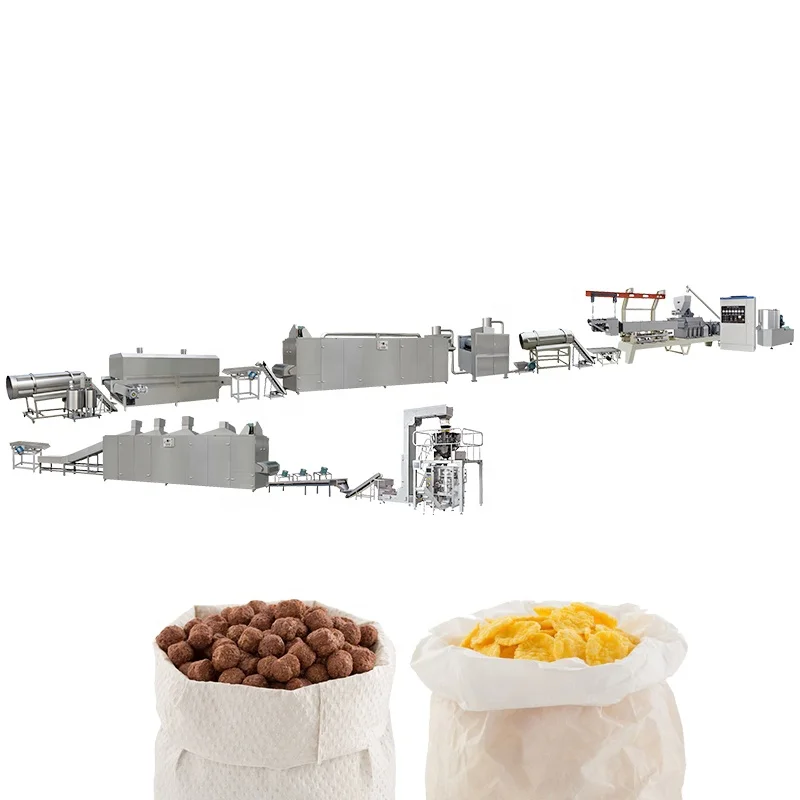

MT70 / MT85 / MT75 Corn Flakes Production Line, Twin-Screw, PLC Control — configured for natural and sugar-coated flakes from corn, rice, wheat, oat, and barley.
- Screw configuration and die design matched to raw material formulation for target flake density and shape
- Hydraulic flaker with infrared temperature control paired with dual-fan roasting oven for consistent blistering and crispness
- Throughput balanced across mixing, extruding, flaking, drying, roasting, coating, and packing stations
Complete line layout, trial runs on your raw material in our testing workshop, and full electrical documentation confirmed before shipment.
Description
Integrated Line Throughput — Every station from mixing to packing is sized together so the extruder never waits on the dryer and the roaster never starves the coating drum.
Technical Specifications
| Parameter | Value |
|---|---|
| Product Type | Corn Flakes Breakfast Cereals Production Line |
| Model Options | MT70 / MT85 / MT75 |
| Screw Type | Twin Screw |
| Installed Power (MT70) | 160 kW |
| Installed Power (MT85) | 190 kW |
| Installed Power (MT75) | 210 kW |
| Power Consumption (MT70) | 120 kW |
| Power Consumption (MT85) | 140 kW |
| Power Consumption (MT75) | 150 kW |
| Output Capacity (MT70) | 150–200 kg/h (basis to be confirmed — dependent on raw material formulation, moisture content, and final product shape) |
| Output Capacity (MT85) | 300–400 kg/h (basis to be confirmed — dependent on raw material formulation, moisture content, and final product shape) |
| Output Capacity (MT75) | 300–500 kg/h (basis to be confirmed — dependent on raw material formulation, moisture content, and final product shape) |
| Overall Dimensions (MT70) | 41 × 1.5 × 2.2 m |
| Overall Dimensions (MT85) | 43 × 1.5 × 3.2 m |
| Overall Dimensions (MT75) | 45 × 1.5 × 3.5 m |
| Control System | PLC |
| Extruder Features | Automatic lubricating and cooling function |
| Flaking Machinery | Hydraulic double-roller system with dual separate-drive motors and infrared sensor temperature control |
| Dryer Heating Source | Gas or Electric (configurable) |
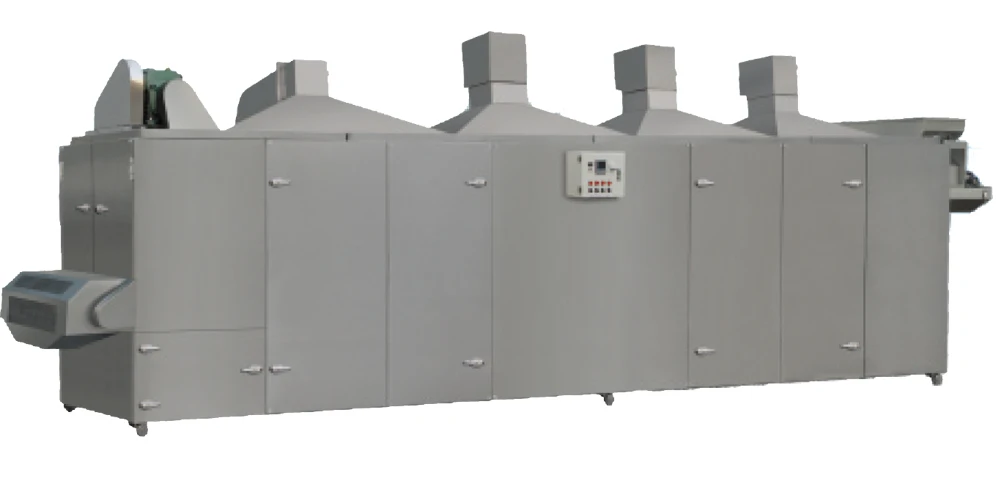
| Roasting Oven | Hot air roasting with vibrating pan, high temperature spraying tubes, conciliation burner, dual circulating fans, cyclone dust removal device |
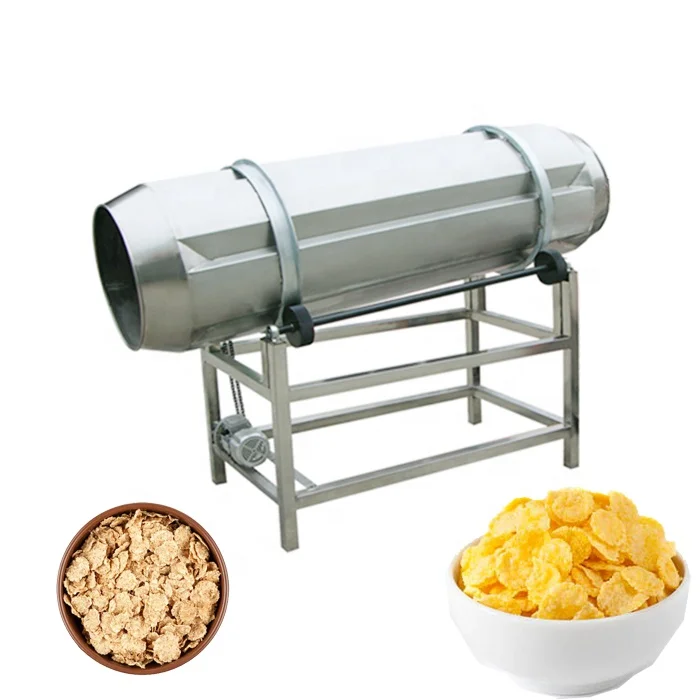
| Coating System | Double tumble sugar melting unit, elevator, coating drum, and spraying nozzle |
| Line Stations (Natural) | Mixing → Extruding → Flaking → Drying → Hot Air Roasting → Cooling → Packing |
| Line Stations (Sugar Coated) | Mixing → Extruding → Flaking → Drying → Hot Air Roasting → Sugar Spraying → Sugar Coating → Drying → Cooling → Packing |
| Basic Material Compatibility | Corn, rice, wheat, oat, barley powder |
| Final Product Shapes | Ball, tube, stick, ring, fruit loop, star, wheel, flower, heart (via extruder die changes) |
| Standards | CE, ISO |
Application Suitability
| Application | Material or Output |
|---|---|
| Natural corn flakes for breakfast cereal packaging | Corn grits or corn flour at controlled moisture, extruded and flaked to uniform thickness |
| Sugar-coated flakes for retail cereal boxes | Corn or multi-grain base with sugar syrup coating in the tumble drum |
| Multi-grain fortified cereal flakes | Blends of rice, wheat, oat, or barley powder processed through the twin-screw extruder |
| Shaped breakfast cereals for children’s market | Ball, ring, star, fruit loop, and heart shapes by switching extruder die plates |
| Pilot-scale cereal development runs | Raw material trial production in the in-house testing workshop before line commitment |
Why Nominal Line Capacity Often Disappoints at Startup
A corn flakes production line turnkey rated at a certain throughput on standard corn flour may deliver far less on the buyer’s actual degerminated corn grits.
The problem almost never starts with the extruder itself. It starts with the assumption that raw material behaviour is universal. Degerminated corn grits gelatinise at a different temperature profile than fine corn flour, and the moisture window for proper flake formation is narrower than most line specifications suggest. When the flaking rollers meet a pellet that has not reached the right internal plasticity, the result is broken flakes and a high percentage of material that has to be recycled through the mixer [NEED_CITE: starch gelatinisation temperature ranges for corn and multi-grain formulations]. I have spent two weeks on a single commissioning adjusting screw combination and conditioning temperature because the trial in our workshop ran on standard flour while the customer’s local supply was a coarser grit entirely. That kind of mismatch does not show up on a quotation — it only shows up when the line is running and the output does not match what the buyer planned for.
Matching Extrusion Conditions to Your Raw Material
The twin-screw extruder in this corn flakes production line turnkey system is designed around configurability rather than a fixed process. Barrel segments can be arranged to create distinct heating and shear zones, and the screw elements are selected to match the gelatinisation requirements of the specific grain or grain blend the buyer intends to run. Automatic lubrication and cooling keep the extruder running continuously through long production shifts without the thermal drift that causes inconsistency from the first batch to the last.
How the Flaking and Roasting Stages Determine Final Texture
Flake thickness is controlled by the hydraulic pressure on the double rollers, with each roller driven by a separate motor so that surface speed stays matched even under load variation. The infrared sensor monitors roller temperature in real time, because even a few degrees of drift changes how the extruded pellet deforms under pressure. Downstream, the hot air roasting oven uses dual circulating fans and a vibrating pan to ensure every flake receives uniform heat exposure, producing the surface blistering and crispness that the market expects from a breakfast cereal [NEED_CITE: industrial roasting parameters for cereal flake blistering and moisture reduction].
Reading the Specs Beyond the Headline Numbers
The installed power figures — 160 kW, 190 kW, and 210 kW across the three model options — reflect the total connected load of the complete line, not just the extruder motor. Actual power consumption runs lower, between 120 kW and 150 kW, which matters when sizing the electrical supply and planning utility costs. The overall line length stretches from 41 to 45 metres depending on the model, which determines not just floor space but also the number of operators needed to monitor the line during production. The PLC control system centralises the entire process, but the voltage and frequency must be confirmed before electrical panels are built, because rewiring a control cabinet on site is both slow and expensive [NEED_CITE: voltage and frequency standards by export market].
What Happens When Stations Are Sized Independently
A buyer who sources the extruder from one vendor and the dryer from another often discovers that the dryer cannot handle the moisture load coming off the flaker at full extruder output. The bottleneck then moves to drying, and the entire corn flakes production line turnkey project runs below the capacity the buyer paid for. The coating drum may also be undersized relative to the roaster output, which means flakes sit in a holding bin losing temperature before sugar application — and sugar coating applied to cool flakes does not adhere properly. These are not defects in individual machines; they are mismatches that arise when no single supplier is responsible for the throughput balance across every station.
What Makes This Line Configuration Stand Up to Real Production
Every station in this line is specified together, which means the mixer output feeds the extruder at a rate the flaker can accept, and the dryer capacity is calculated from the actual moisture content leaving the flaking rollers. The screw and die configuration is not copied from a generic template but selected based on the buyer’s raw material and target flake density. Trial production runs take place in our in-house testing workshop using the customer’s own raw material before the line ships, so formulation problems surface before installation rather than during commissioning. The roasting oven’s cyclone dust removal and conciliation burner are included as standard line components, not offered as optional extras. Documentation covers the full chain from line layout through to wear parts lists, and the electrical schematic is confirmed against the buyer’s local supply before the control panels go into production [NEED_CITE: CE machinery directive requirements for food processing equipment].
Documentation & Verification
- Line layout drawing scaled to your factory footprint with station-by-station throughput calculation
- Screw and die configuration record matched to your specific grain formulation and target flake density
- Trial run report produced on your raw material in the testing workshop before the line ships
- Electrical schematic with confirmed voltage, frequency, and control language for your facility
- CE declaration of conformity and ISO certificate included with shipping documentation
- Operation and maintenance manual with wear parts list specific to your line configuration
Installation, Commissioning & Support
- Floor plan and utility connections planned around the 41–45 m line length and 1.5 m width footprint
- Dedicated electrical circuits sized to the 160–210 kW installed power requirement with confirmed local voltage
- Line arrives in modular sections for assembly and alignment on your prepared foundation
- Commissioning includes first-run parameter setting on the PLC for your raw material and target output
- Operator training covers screw configuration changes, roller pressure adjustment, and roasting temperature profiles
- Wear parts list supplied at delivery with recommended spare screws, dies, and roller surfaces for your first replacement cycle
What We Need to Move Forward
To prepare a line layout and quotation that reflects your actual production conditions, we need to know the grain or grain blend you plan to run and its source, the target hourly output you have planned, and the available floor space and ceiling height in your facility. Please also confirm your local voltage and frequency, the preferred control language for the PLC interface, and whether you would like to send a raw material sample for a trial run in our testing workshop before finalising the configuration.
Frequently Asked Questions
Q: How is the line capacity verified on my specific raw material formulation?
A: We run a trial production in our in-house testing workshop using the exact grain or grain blend you supply. The extruder screw configuration, barrel temperature profile, and conditioning moisture are adjusted during the trial until the flake output meets your density and texture targets. A written trial report is provided before the line is cleared for shipment.
Q: How is the screw and die configuration matched to my target flake density and shape?
A: The screw elements are selected based on the gelatinisation behaviour of your raw material, and the die plate is chosen for the pellet shape that produces the correct flake geometry after pressing. This configuration is recorded and included in your documentation so that replacements can be ordered with the same specification.
Q: How is throughput balanced across mixing, extruding, flaking, drying, and coating stations?
A: Each station is sized during the layout phase based on the extruder output and the moisture and temperature profile at each stage. The dryer capacity is calculated from the actual moisture load leaving the flaker, and the coating drum volume is matched to the roaster discharge rate so that no station becomes a bottleneck.
Q: What voltage, frequency, and control language options are confirmed before production?
A: We confirm your facility’s supply voltage and frequency before the electrical panels are built, and the PLC interface language is set to your preference. This avoids on-site rewiring and ensures the control system is readable by your operators from the first day of commissioning.
Q: Can I do a trial run on my raw material before the line ships?
A: Yes. Our testing workshop is equipped with a production-scale extruder and flaker, so you can send your raw material and we run it under the same conditions the full line will use. Any adjustments to screw configuration, moisture levels, or temperature profiles are made during this trial before your line is assembled for final factory testing.
Related products
-

Máquina Extrusora de Cereal para Desayuno de 200kg/h Venta Caliente Línea de Producción de Copos de Maíz
¥30,000.00 Select options This product has multiple variants. The options may be chosen on the product page -
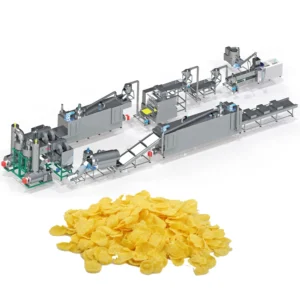
Nueva Máquina Automática de Fabricación de Copos de Maíz Línea de Procesamiento de Extrusión de Snacks de Avena y Chips
¥30.00 Select options This product has multiple variants. The options may be chosen on the product page -
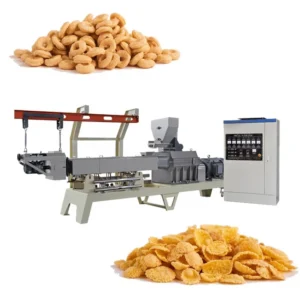
Máquina de Corn Flakes Línea de Producción de Cereal de Desayuno Corn Flakes Máquina para Hacer Cornflakes
¥85,800.00 Select options This product has multiple variants. The options may be chosen on the product page -
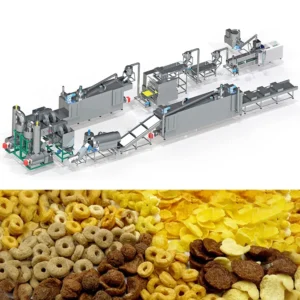
Máquina automática para la fabricación de cereales de desayuno instantáneos y alimentos para bocadillos
¥10,000.00 Select options This product has multiple variants. The options may be chosen on the product page