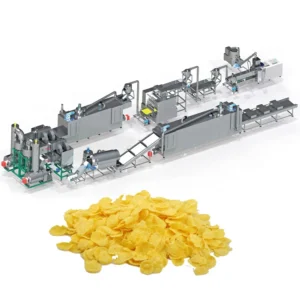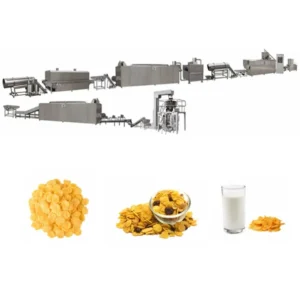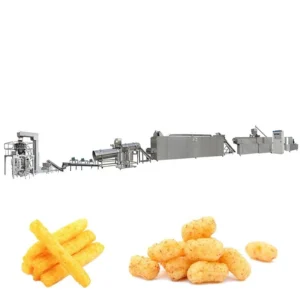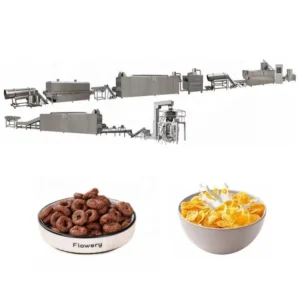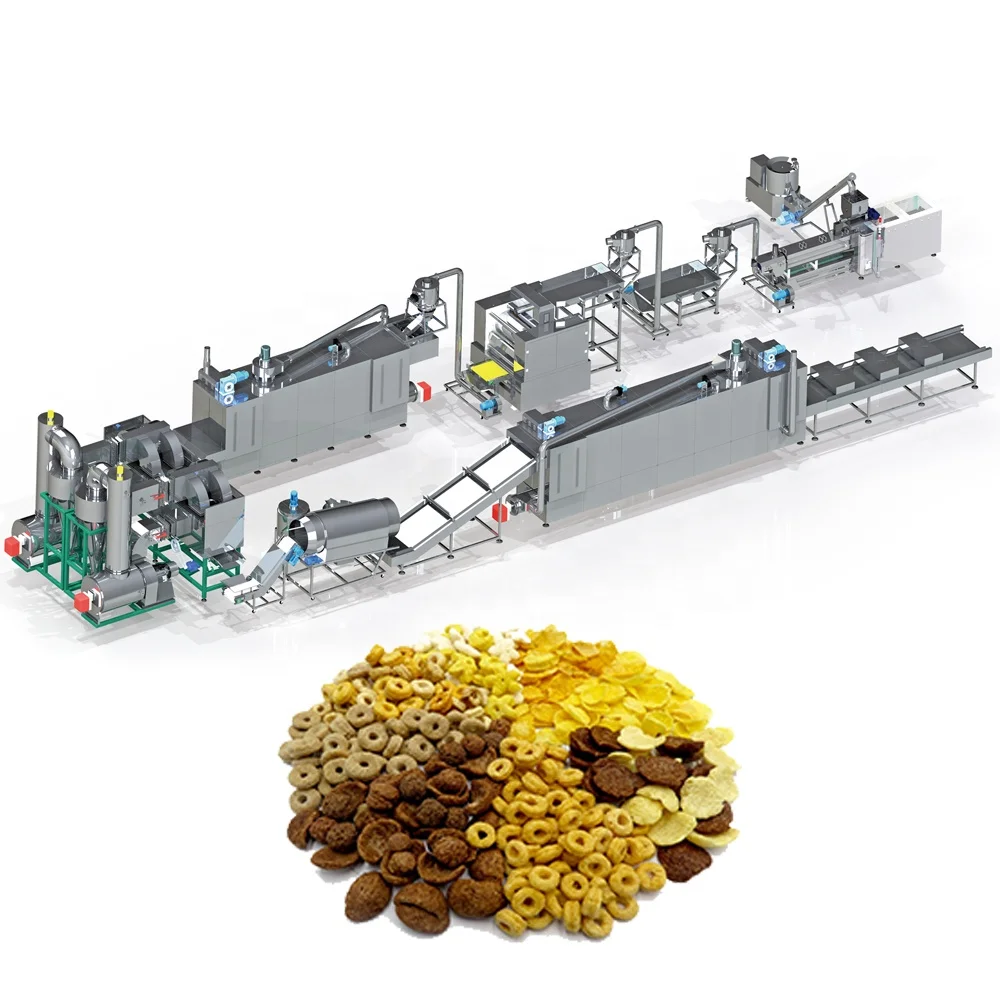


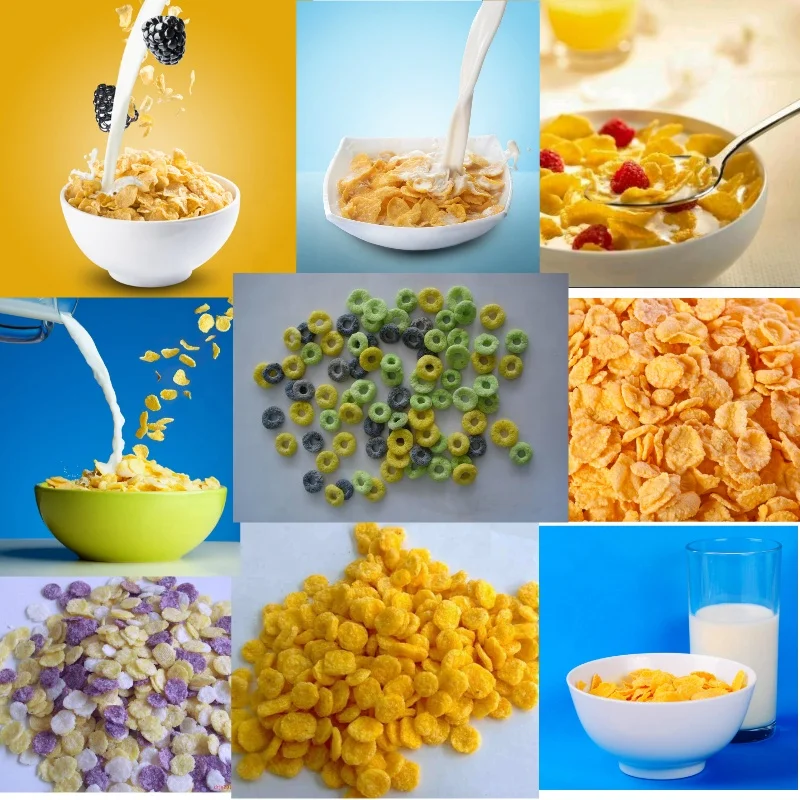
MT-65 Twin Screw Extruder Breakfast Cereal Production Line, 16.12 kW Press, Gas Oven — engineered as one integrated project from flour mixer through cooling conveyor.
- Co-rotating sectional twin screw ensures continuous gelatinisation and forming; adjustable roller distance and integrated cooling deliver consistent flake thickness.
- Gas-fired both-side baking oven and throughput-matched drying, coating and cooling stations prevent bottlenecks across the full sequence.
- Supports corn, rice, oat and fortified grain recipes for breakfast cereal producers scaling new or existing lines.
Line layout, capacity calculation and trial runs on your raw material are completed in our testing workshop before shipment, with voltage and control language confirmed for your market.
Description
Integrated Turnkey Engineering — Every station from the flour mixer through the cooling conveyor is calculated against the same target throughput, eliminating the bottlenecks that occur when extruders and dryers are sourced separately.
Technical Specifications
| Parameter | Value |
|---|---|
| Product Type | Twin Screw Extruder Breakfast Cereal Production Line |
| Extruder Model | MT-65 |
| Screw Configuration | Co-rotating twin screw, sectional modules |
| Corn Flakes Press Machine Power | 16.12 kW |
| Corn Flakes Press Machine Dimensions | 1550 × 1300 × 2000 mm |
| Corn Flakes Press Machine Roller Size | 510 × 310 × 1050 mm |
| Corn Flakes Press Machine Material | Stainless Steel |
| Mixer Output | 10–30 kg/load |
| Mixer Power | 4 kW |
| Mixer Tank Size | φ600 × 500 mm |
| Mixer Dimensions | 1000 × 800 × 1200 mm |
| Screw Conveyor Driving Power | 0.75 kW |
| Screw Conveyor Dimensions | 2700 × 500 × 2400 mm |
| High-temperature Oven Dimensions | 4.5 × 1.4 × 1.8 m |
| High-temperature Oven Power | 3.75 kW |
| High-temperature Oven Heating Method | Gas-fired, both-side baking system |
| Sugar Spraying System Total Power | 28.75 kW |
| Sugar Spraying System Dimensions | 4000 × 1900 × 1880 mm |
| Sugar Spraying System Roller Size | Ø600 × 2700 mm |
| Control System | Separate controller box for press machine |
| Line Station Sequence | Flour Mixer → Screw Elevator → Double-screw Extruder → Elevator → Dryer → Elevator → Coating Line → Vibrating Spreader → Elevator → Dryer → Cooling Conveyor |
| Raw Materials | Corn, rice, oat, other grain powders, nutritional ingredients |
| Certification | CE |
Application Suitability
| Application | Material or Output |
|---|---|
| Corn flakes breakfast cereal | Corn grits, corn flour, rice flour |
| Shaped cereal (rings, balls, stars, sticks) | Corn, oat, multi-grain blends |
| Sugar or honey coated snack cereal | Extruded cereal pieces with sugar syrup or honey glaze |
| Fortified and nutritional breakfast cereal | Grain powders blended with vitamins and minerals |
| Instant cereal foods for milk consumption | Puffed grain pellets processed into ready-to-eat flakes |
Why Extruder Output Means Nothing Without Downstream Matching
A corn flakes production line turnkey only performs when every station is engineered against the same throughput target.
In my years laying out breakfast cereal lines, I have seen extruders that push high volumes on standard corn flour completely stall once the material changes. The downstream dryer cannot evaporate moisture fast enough, the flaking press cannot compress the throughput, and the entire line backs up. Buyers often focus on extruder motor power and barrel diameter, but those figures become irrelevant when the oven belt speed or coating drum volume cannot keep pace. On one project in Southeast Asia, the client mixed 30% multi-grain premix into their corn base, and the viscosity spike pushed the screw torque past its alarm threshold — it took five days of on-site adjustment just to stabilize flake output. That experience reinforced a basic rule: the corn flakes production line turnkey layout must be validated against the buyer’s actual recipe, not a generic laboratory standard. [NEED_CITE: industrial twin screw extruder torque load variation with multi-grain feedstock]
Sequencing the Full Line as a Single Throughput Calculation
The complete station sequence — flour mixer, screw elevator, twin screw extruder, dryer, coating line, vibrating spreader, second dryer, and cooling conveyor — is designed as one continuous material flow rather than individual machines placed side by side. Each elevator is sized to carry the exact discharge rate of the preceding station, and the dryer belt length is matched to the moisture reduction required at that specific throughput. When a breakfast cereal producer specifies a target daily volume, we calculate the residence time at each station backward from that number, which is how a corn flakes production line turnkey avoids the common trap of an extruder that outpaces its own oven.
Managing Raw Material Variability Across the Extrusion and Flaking Stages
Twin screw co-rotating sectional modules allow the screw profile to be reconfigured when raw material changes — swapping kneading block angles and reverse-flight elements to handle a shift from pure corn grits to a rice-oat blend. The flaking press downstream relies on a consistent pellet geometry coming out of the extruder die. If moisture content or starch gelatinisation varies, the pellets compress unevenly between the rollers and flake thickness drifts outside specification. We have learned through site installations that locking in the screw combination after a trial run on the buyer’s own formulation prevents days of commissioning delays, because the corn flakes production line turnkey configuration is verified before the machines leave the factory. [NEED_CITE: twin screw sectional module reconfiguration for grain viscosity variation]
What the Press, Oven, and Coating Specifications Mean for Flake Quality
The corn flakes press machine uses stainless steel rollers at 510 × 310 × 1050 mm with an adjustable roller gap, which directly controls flake thickness and therefore the final crispness after baking. The integrated cooling system on the press stabilizes roller surface temperature so that successive batches do not experience thermal drift — a common source of flake inconsistency in warm production environments. Downstream, the gas-fired high-temperature oven with both-side baking at 4.5 meters in length provides enough belt residence time for uniform moisture evaporation across the flake bed. The sugar spraying system, with its Ø600 × 2700 mm roller and 28.75 kW total power, applies syrup or honey coating with sufficient tumble time for even coverage before the final drying stage.
The Hidden Cost of Skipping Station-to-Station Verification
When the flaking press is sourced from a different vendor than the extruder, the pellet shape and moisture arriving at the rollers often fall outside what the press was designed to handle. Flakes come out cracked or uneven, the sugar coating clings poorly, and the final product does not meet the crunch specification the market expects. We have seen lines where the oven was undersized relative to extruder output — meaning the operator has to slow the extruder down to let the oven catch up, and the effective output drops well below the quoted capacity. Commissioning delays compound when voltage, frequency, and control language are not confirmed before the machines ship, because rewiring and reprogramming on-site adds days of dead time before a single flake is produced. [NEED_CITE: consequences of mismatched extrusion and drying capacity in cereal processing]
Why Buyers Source the Full Line Here
The line layout is calculated as one integrated project, so throughput at the mixer, extruder, press, oven, and coating drum is matched from the start rather than reconciled after delivery. Screw configuration and die design are specified to the buyer’s own raw material and target flake density, not copied from a generic build. An in-house testing workshop allows trial runs on customer formulation before shipment, so the screw combination and process parameters are locked in before the machines are crated. Electrical schematics include voltage and frequency confirmation for the target market, preventing the commissioning standstill that occurs when a 50 Hz line arrives at a 60 Hz facility. Pre-sales engineering consultation, on-site installation, commissioning, and operator training are handled under one supplier, so accountability for line performance rests in a single place.
Documentation & Verification
- Line layout and capacity calculation matched to your grain formulation and target flake thickness
- Screw and die configuration record specifying module arrangement for your raw material viscosity
- Trial run report on customer-supplied raw material from in-house testing workshop before dispatch
- Electrical schematic with voltage, frequency, and control language confirmed for destination market
- CE declaration of conformity and factory test record included in the shipment documentation package
Installation, Commissioning & Support
- Foundation layout accounts for the 4.5-meter oven length and full station footprint before equipment arrives
- Dedicated electrical circuits specified for the 28.75 kW sugar spraying system and 16.12 kW press machine
- Separate controller box for the press machine allows independent parameter tuning during first-run commissioning
- On-site screw configuration verification against actual raw material viscosity during commissioning phase
- Wear parts list covering screw modules, die plates, and press roller surfaces supplied with the documentation package
- Gas supply connection and ventilation planning for the both-side baking oven before installation begins
What We Need to Configure Your Line
To build an accurate layout, send us your raw material recipe including any multi-grain or fortified premix ratios, your target daily output in kilograms, and the flake thickness or shape specification your market requires. Include your workshop dimensions and ceiling height so we can plan elevator inclines and oven placement. Confirm local voltage, frequency, and preferred control panel language so the electrical schematics are finalized before production begins.
Frequently Asked Questions
Q: How is line throughput matched between the extruder, dryer, and coating stations?
A: We calculate the discharge rate of each station backward from your target daily output. The dryer belt length, oven residence time, and coating drum volume are all sized so that no station forces the extruder to slow down. This throughput matching is documented in the line layout we provide before production starts.
Q: What is the footprint and utility planning requirement for the full line?
A: The complete sequence from flour mixer to cooling conveyor requires a linear layout accommodating the 4.5-meter oven and the 4-meter sugar spraying system. Gas supply, dedicated electrical circuits for the 28.75 kW coating system, and ventilation for the both-side baking oven must be planned before equipment arrives on site.
Q: How do you confirm voltage, frequency, and control language before production?
A: We request your local electrical standards during the inquiry stage and issue an electrical schematic for your confirmation before manufacturing begins. The control panel language and the separate press machine controller box are set to your specification so that no reprogramming is needed during commissioning.
Q: What does the on-site installation, commissioning schedule, and operator training include?
A: Our team oversees station placement, utility connection verification, and first-run testing with your actual raw material. The screw configuration is adjusted on-site if viscosity differs from the factory trial. Operator training covers extruder parameter control, press roller gap adjustment, and daily maintenance routines.
Q: How is the screw configuration and die design specified to our raw material and target flake density?
A: We run a trial on your supplied formulation in our testing workshop, measuring torque, moisture, and pellet geometry at the die exit. The co-rotating sectional screw modules are rearranged — kneading blocks, reverse flights — until the output matches your target flake density and thickness before the configuration is locked in for shipment.
Related products
-

Línea de producción de cereales de desayuno de copos de maíz automática de venta caliente
¥20,000.00 Select options This product has multiple variants. The options may be chosen on the product page -
Máquina automática de fabricación de copos de maíz de 500 kg/h Nueva condición Alta productividad Línea de procesamiento de cereales dulces para el desayuno Desde la fábrica
¥8,500.00 Select options This product has multiple variants. The options may be chosen on the product page -

Línea de Producción de Copos de Maíz Máquina de Producción de Cereales para el Desayuno Línea de Maquinaria para la Fabricación de Copos de Maíz
¥59,800.00 Select options This product has multiple variants. The options may be chosen on the product page -
Máquina Automática para Hacer Copos de Maíz Línea de Producción de Procesamiento de Cereales para el Desayuno Copos de Maíz
¥500.00 Select options This product has multiple variants. The options may be chosen on the product page