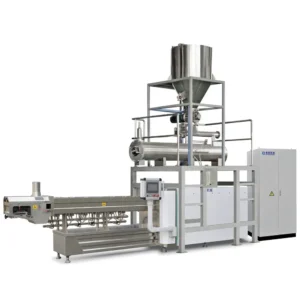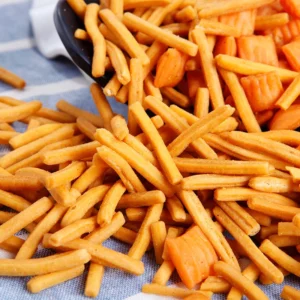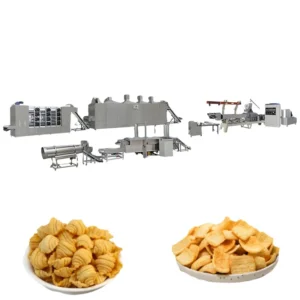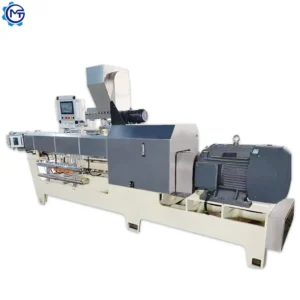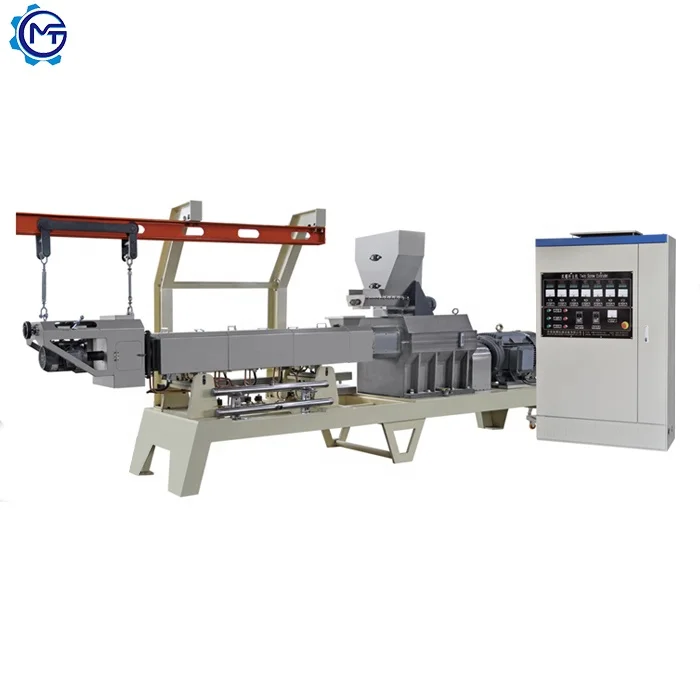


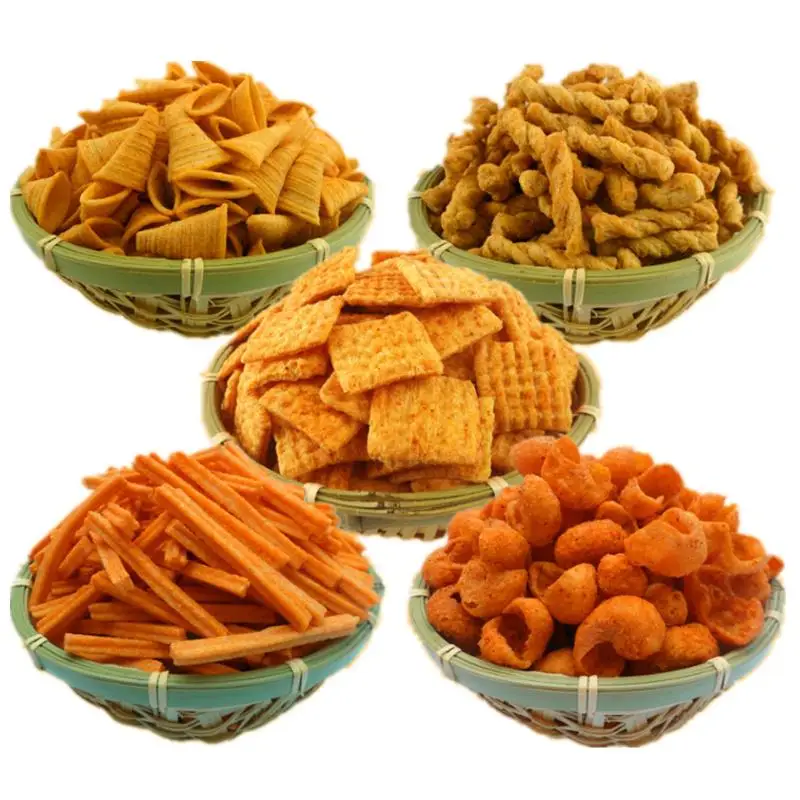
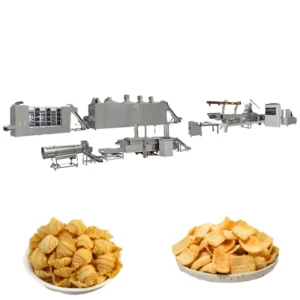
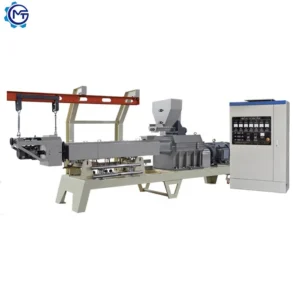
MT100/MT120 Deep Fried Snack Production Line, Single Screw Extruder, 50-70 kW — engineered as one integrated turnkey project from batching through extrusion, frying, flavoring, and packing.
- Single screw with high/low pressure configuration handles potato starch, corn starch, and wheat flour for varied puffing textures
- Interchangeable dies produce screw shell, round tube, square tube, ring, and cartoon shapes
- Line throughput balanced across every station to eliminate bottleneck risk, with food-grade 201/304 stainless steel contact surfaces
- Energy options include electricity, gas, diesel, or steam matched to factory utility infrastructure
Trial runs on your raw material are completed in our testing workshop before shipment, ensuring the line holds target output on your actual formulation.
Description
Integrated Throughput Matching — Every station from mixing to packing is calculated against the same target output on your actual raw material, preventing the bottleneck failures common in assembled snack lines.
Technical Specifications
| Parameter | Value |
|---|---|
| Model | MT100/MT120 |
| Product Type | Deep Fried Snack Production Line |
| Extruder Type | Single screw extruder (high and low pressure screw equipped) |
| Rated Power | 50-70 kW (electricity); 50-60 kW (gas or diesel) (basis to be confirmed) |
| Voltage & Frequency | Three phases 380V/50Hz, Single phase 220V/50Hz (customizable to local voltage) |
| Output Capacity | 120 kg/h (basis to be confirmed with specific raw material and product shape) |
| Die Configuration | Interchangeable dies for screw shell, round tube, square tube, ring, cartoon shapes |
| Line Stations | Mixer → Screw conveyor → Single screw extruder → Pulling and cutting machine → Automatic fryer → Automatic flavoring line → Cooling → Packing |
| Construction Material | Food grade stainless steel 201/304 |
| Energy Options | Electricity / gas / diesel / steam |
| Motor & Electrical | Siemens (made in China) or China top brand motors; Delixi or Delta inverters |
| Overall Dimensions (L×W×H) | 12000-26000 × 1200 × 2200 mm |
| Certification | CE, ISO 9001 |
| Warranty | One year warranty and lifetime technical guidance |
Application Suitability
| Application | Material or Output |
|---|---|
| Secondary puffing snack production | Potato starch, corn starch, wheat flour blends |
| Golgappa and pani puri production | Wheat flour and semolina-based dough sheets |
| Shaped fried snack formats | Screw shell, round tube, square tube, ring, cartoon shapes from starch-based formulations |
| Miscellaneous grains processing | Multi-grain flour blends for snack factory specialty lines |
Why "120 kg/h" Means Nothing Without Your Raw Material Formula
Line capacity is only real when measured against your specific flour blend, moisture content, and target snack geometry.
I spent years watching snack lines underperform after installation, and the pattern is always the same: the extruder was rated on one material while the buyer runs a completely different recipe. A deep fried snack production line turnkey project quoted at a nominal figure will fall short if your miscellaneous grains formula carries higher oil content or different gelatinisation behaviour than the test material. The extruder, fryer, and flavoring drum each have their own throughput ceiling, and if those ceilings are not matched to your actual recipe before production begins, one station will always hold the others back. This is not a defect in any single machine — it is a failure of line-level engineering. [NEED_CITE: snack extrusion line throughput matching principles]
How Line-Level Engineering Prevents Station Mismatch
A deep fried snack production line turnkey project designed as one integrated system starts with your raw material data and works backward through every station. The single screw extruder output must feed the pulling and cutting machine at a rate the automatic fryer can absorb without oil temperature drop. If the fryer cannot recover heat fast enough between batches, the snack pieces absorb excess oil and emerge unevenly coloured. Each station is sized so that its maximum sustainable throughput aligns with the others under your specific production conditions.
Raw Material Behaviour That Changes Every Calculation
Miscellaneous grains flour blends behave differently from pure corn or potato starch in the extrusion barrel. The protein and fibre content alters how the material gelatinises under heat and shear, which in turn affects expansion ratio and piece density after frying. A recipe that works at a given moisture level on white corn flour may produce brittle, high-breakage pieces when switched to a multi-grain blend without adjusting screw speed, barrel temperature, or die pressure. We run your actual material in the testing workshop before the line ships, documenting screw configuration, moisture adjustment, and die selection against your target shape. [NEED_CITE: starch gelatinisation behaviour in single screw extrusion]
Reading the Specs That Actually Matter for Snack Extrusion
The single screw design with interchangeable high and low pressure screws is significant because it determines how much shear energy transfers into your raw material during extrusion. High pressure screws compress the dough more aggressively, producing denser pellets suited for thick-walled tube shapes, while low pressure screws allow gentler expansion for thin, delicate forms like rings and cartoon shapes. The 50-70 kW electrical power range indicates the thermal headroom available at the barrel — higher wattage supports continuous running at elevated temperatures without thermal cycling that causes batch inconsistency. Stainless steel 201/304 construction across food contact zones ensures the fryer and flavoring drum meet food safety standards without corrosion from repeated oil exposure and seasoning residue. Die interchangeability across five shape families means one extruder platform covers your full product range without requiring a separate machine for each format. [NEED_CITE: food grade stainless steel standards for snack processing equipment]
The Hidden Cost of Skipping Line Integration
When a snack line is assembled from standalone machines purchased separately, the extruder vendor quotes one capacity, the fryer vendor quotes another, and nobody owns the gap between them. The result on the factory floor is an extruder running at partial output because the downstream fryer cannot keep pace, or a flavoring drum that receives product faster than it can tumble evenly. Operators compensate by slowing the entire line, which means the nominal capacity you paid for never materialises. In some cases, the moisture content leaving the extruder does not match what the fryer expects, producing pieces that are either under-cooked in the centre or over-browned on the surface. [NEED_CITE: production bottleneck analysis in snack food manufacturing]
Why Sourcing the Complete Line From One Supplier Changes the Outcome
The line layout and capacity calculation we produce covers every station from mixer to packing, with throughput figures tied to your specific raw material and target product shape. The screw and die configuration is documented and recorded before the extruder enters production, so replacements match the original setup exactly. Our testing workshop runs your actual flour blend through the single screw extruder before shipment, generating a trial run report that confirms expansion, density, and piece integrity against your specification. Electrical schematics include confirmed voltage and frequency for your local grid, and the control language is set before the panel is wired. Installation follows a phased schedule that sequences foundation work, utility connections, and station-by-station commissioning in the order your facility requires.
Documentation & Verification
- Line layout showing throughput matched at every station from mixer to packing
- Trial run report on your miscellaneous grains flour before the extruder ships
- Screw and die configuration record for each target snack shape
- Electrical schematic with voltage and frequency confirmed for your market
- Factory test record documenting continuous run performance before dispatch
Installation, Commissioning & Support
- Foundation plan matched to the 12000-26000 mm line footprint and load distribution
- Dedicated circuit planning for the 50-70 kW extruder and fryer energy draw
- Station-by-station commissioning sequence with throughput verification at each handoff point
- Die changeover and screw swap training on all five included shape configurations
- Wear parts list covering screws, dies, and fryer mesh belts with replacement intervals
What We Need to Build Your Line Configuration
Send your raw material formula including flour types, moisture targets, and any oil or additive percentages. Confirm your target daily output, workshop dimensions, and ceiling height so we can draft a layout that fits your floor plan. Specify your local voltage, frequency, and preferred control language so the electrical package is built correctly before shipment.
Frequently Asked Questions
Q: How is line capacity verified on my specific raw material and target snack shape?
A: We run your actual flour blend through the single screw extruder in our testing workshop before shipment. The trial documents screw configuration, barrel temperature profile, moisture adjustment, and die selection against your target shape. The resulting report confirms expansion ratio, piece density, and fryer behaviour so the line arrives with validated settings rather than requiring development after installation.
Q: What is the phased installation and commissioning schedule for a complete fried snack line?
A: Installation follows a sequenced plan starting with foundation and utility preparation, then station placement from mixer through packing. Each station is commissioned individually before linking to the next, confirming throughput handoff at every junction. Operator training runs alongside final commissioning so your team learns die changes, screw swaps, and fryer temperature management on live production runs.
Q: How is throughput balanced between the extruder, fryer, and flavoring stations to avoid bottlenecks?
A: Every station is sized against the same target output calculated from your raw material data. The extruder feed rate, fryer belt speed and oil recovery capacity, and flavoring drum tumble cycle are matched so no single station limits the others. This matching is documented in the line layout before production begins, not adjusted after installation.
Q: What voltage, frequency, and control language options are confirmed before production?
A: Your local three-phase or single-phase voltage and frequency are confirmed during the specification stage, and the electrical panel is wired accordingly using Delixi or Delta inverters. Control language is set before the panel leaves the factory so operators can read all parameters in their working language from the first day of commissioning.
Related products
-
Línea de producción de máquina de proceso de fritura de palitos de ensalada, chips crujientes, extrusora de fabricación de chips Doritos, bugles de maíz fritos, snacks en pellet.
¥100.00 Select options This product has multiple variants. The options may be chosen on the product page -
Puffed Octopus Snack Processing Line – Full-Automatic Fried Octopus Production Machinery
¥65.00 Select options This product has multiple variants. The options may be chosen on the product page -
Línea de procesamiento de alimentos para bocadillos inflados de venta caliente Línea de procesamiento de bocadillos fritos Máquina para bocadillos de maíz inflados
¥100.00 Select options This product has multiple variants. The options may be chosen on the product page -
Industrial Fully Automatic Stainless Steel Deep Fried Line – Snack Factory Miscellaneous Grains Special Processing Equipment
¥65.00 Select options This product has multiple variants. The options may be chosen on the product page