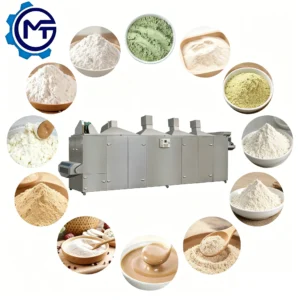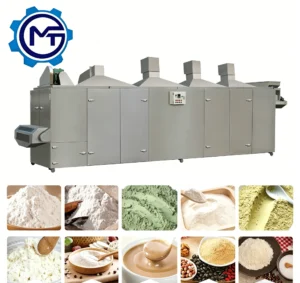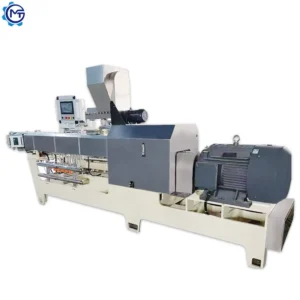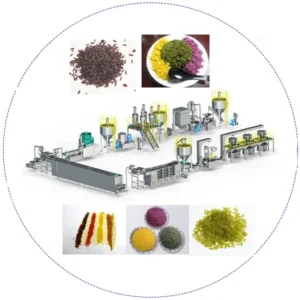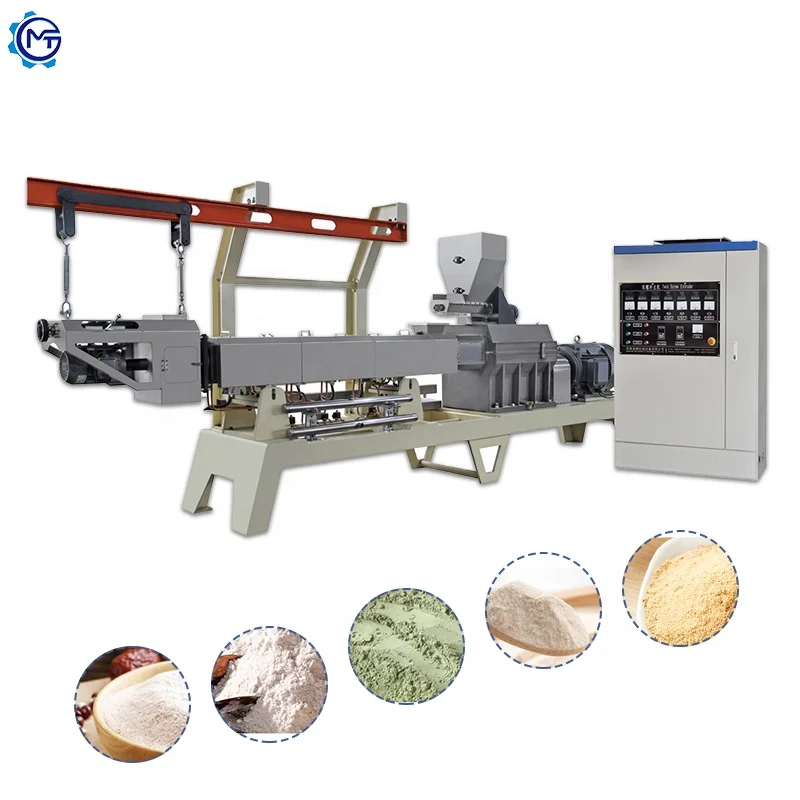

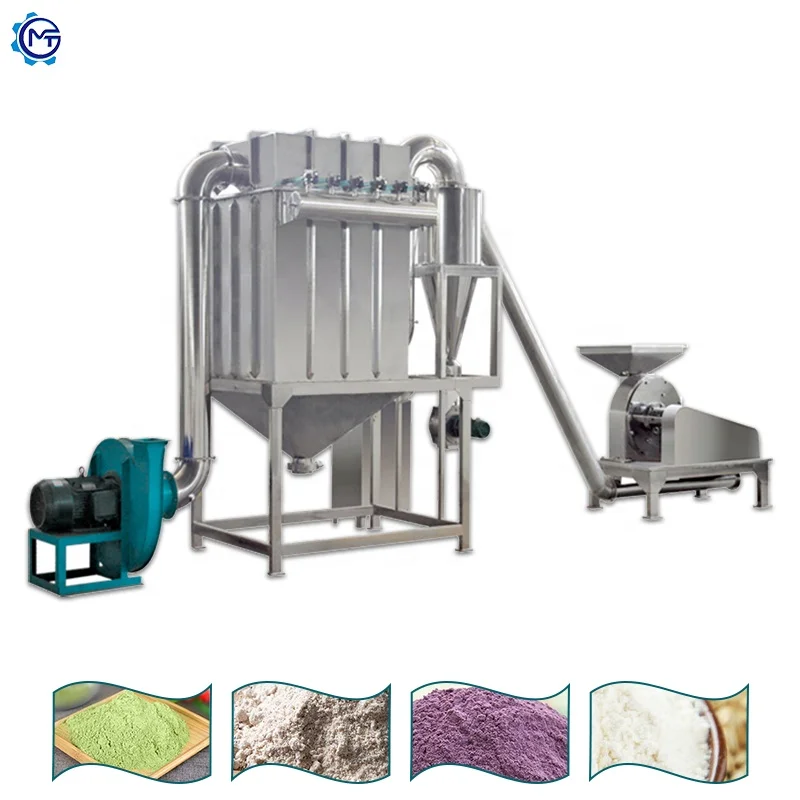
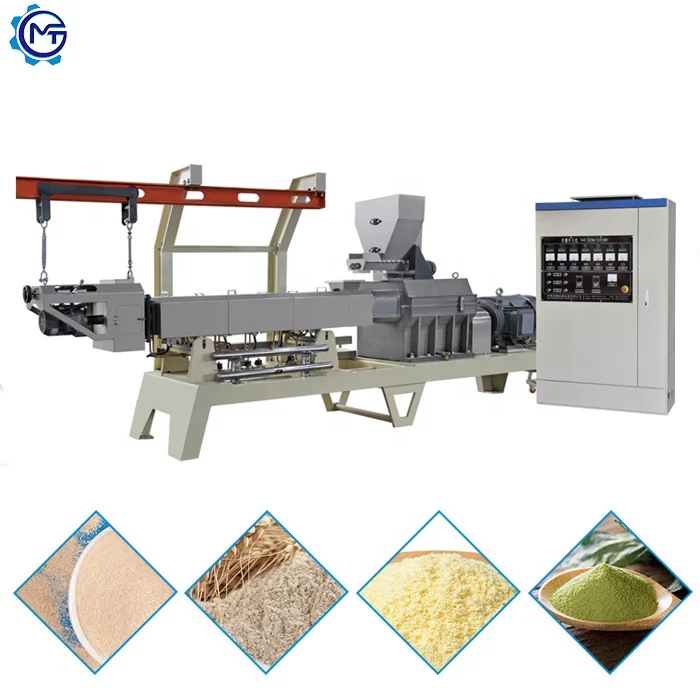

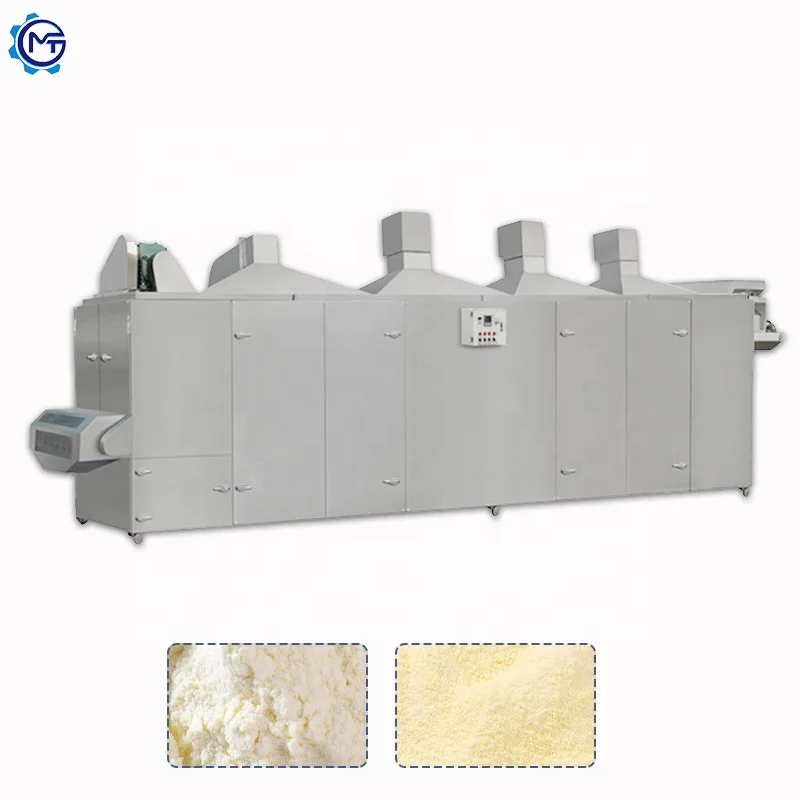
Nutritional Powder Processing Line, Twin-Screw Extrusion, PLC/MCC Control, CE Certified — engineered as a complete turnkey project from raw material batching through extrusion, drying, secondary crushing to final packaging, with throughput balanced at every station. Screw configuration and die design are specified to your grain blend and target powder granularity, ensuring consistent starch gelatinisation and expansion across infant cereal and health nutrition formulations. Trial runs on your raw material are completed in our testing workshop before shipment, and capacity calculations are verified at proposal stage.
Description
Throughput Balanced Across Every Station — each segment of this nutritional powder processing line is engineered to the buyer’s grain blend so mixing, extrusion, drying, and packaging run without cascading bottlenecks.
Technical Specifications
| Parameter | Value |
|---|---|
| Product Type | Nutritional Powder Processing Line |
| Screw Type | Twin-screw |
| Control System | PLC / MCC |
| Installed Power | MT-65: 81.5 kW; MT-70: 115 kW; MT-85: 181 kW |
| Actual Consumed Power | MT-65: 53 kW; MT-70: 76 kW; MT-85: 117 kW |
| Output Capacity | MT-65: 100–150 kg/h (basis not stated in source — confirm raw material / moisture); MT-70: 200–240 kg/h (basis not stated in source — confirm raw material / moisture); MT-85: 400–500 kg/h (basis not stated in source — confirm raw material / moisture) |
| Overall Dimensions (L×W×H) | MT-65: 21000×1200×2200 mm; MT-70: 23000×1500×2200 mm; MT-85: 28000×3500×4300 mm |
| Line Stations | Raw material mixing → crushing → extrusion expansion → drying → cooling → secondary crushing → secondary mixing → packaging → finished product warehousing |
| Certification | CE, ISO |
| Assembly State | Complete turnkey line from batching to packing |
Application Suitability
| Application | Material or Output |
|---|---|
| Instant baby food porridge (cerelac-type) | Corn, rice, millet, milk powder, maltodextrin, vitamin premix |
| Health-care and fortified nutrition powder | Oats, Coix seed, yam, konjac, wheat germ, black sesame |
| Grain expanded powder as auxiliary thickener | Highland barley, red beans, black beans, supplemented with sugar powder |
| Edible fungus solid beverage | Hericium erinaceus uniform powder blended with grain bases |
Why Nominal Capacity Fails on Real Grain Formulations
A rated output figure means nothing until it is validated against your actual raw material blend at your target moisture.
I once watched a Colombian infant nutrition line stall for ten days because the extruder had been specified on a standard corn flour benchmark. The customer’s local formula included quinoa and whey protein, which shifted the gelatinisation temperature entirely. The discharge clumped, the dryer could not keep pace, and the secondary crusher choked on uneven granules [NEED_CITE: starch gelatinisation behaviour across non-standard grain matrices]. A nutritional powder processing line turnkey project only delivers its promised throughput when every station — from the mixer through the packaging head — is configured around the buyer’s specific formulation, not a generic datasheet figure.
Layout Engineering for Infant Cereal Production
The station sequence on a nutritional powder processing line turnkey installation moves raw grains through mixing, primary crushing, twin-screw extrusion, drying, cooling, secondary crushing, secondary blending with heat-sensitive ingredients such as milk powder and vitamins, and finally packaging. Each transition point is a potential bottleneck if upstream output exceeds downstream handling. The layout document supplied at proposal stage maps these throughput relationships so that the dryer residence time, the cooling conveyor length, and the secondary crusher feed rate all align with the extruder discharge rate on the buyer’s grain blend.
How Raw Material Trials Prevent Commissioning Delays
Before a line leaves the factory, the buyer’s actual raw material — shipped in advance — runs through the testing workshop on the configured screw and die combination. The trial run report records barrel temperature profiles, moisture adjustment, expansion ratio, and powder granularity after secondary crushing [NEED_CITE: twin-screw extrusion trial methodology for grain-based nutrition powders]. This step catches formulation mismatches that would otherwise surface weeks after installation, when the cost of re-configuring screw elements and die geometry is far higher than adjusting them before the machines are crated.
Reading the Specs: What Power, Dimensions, and Screw Type Mean on the Floor
The installed versus consumed power gap — 81.5 kW installed against 53 kW consumed on the smaller model — reflects motor sizing headroom for start-up torque and viscous grain dough, not continuous energy waste. Overall length spanning 21 to 28 metres across the three capacity tiers accounts for the drying and cooling conveyors required to stabilise moisture before secondary crushing. Twin-screw extrusion provides the shear and residence time control needed to fully gelatinise mixed grains — corn, rice, oats, and legume blends behave very differently inside the barrel, and screw element arrangement determines whether starch conversion is uniform or produces hard unexpanded cores that contaminate the final powder.
The Hidden Cost of Mismatched Dryer and Crusher Capacity
When an extruder is quoted without verifying that the downstream dryer and secondary crusher can absorb its output, the line stalls in cycles: the extruder pauses while the dryer catches up, barrel temperature drops, and the next batch enters with inconsistent gelatinisation [NEED_CITE: throughput imbalance consequences in extrusion-based powder lines]. The result is variable particle density in the final powder, rejected batches during quality checks, and an operator constantly overriding the PLC to throttle feed rates — defeating the purpose of automated control.
Why Procurement Through a Single Line Contractor Matters
Every station from the batching hopper to the packaging conveyor is specified under one supplier, so throughput calculations are cross-referenced rather than assumed. Screw configuration and die design are recorded against the buyer’s grain formulation and target powder granularity, not copied from a standard build. The in-house testing workshop validates the recipe before shipment, producing a trial report the buyer reviews before the machines are packed. Electrical schematics, voltage ratings, and control language are confirmed before production begins, so the MCC and PLC panels arrive matching the facility’s supply and the operator’s language. Pre-sales engineering through on-site installation, commissioning, and ongoing maintenance are handled by the same technical team that configured the line.
Documentation & Verification
- Line layout and capacity calculation matched to your grain blend and target output
- Screw and die configuration record tied to your specific raw material formula
- Trial run report on customer-supplied raw material before dispatch
- Electrical schematic with voltage and frequency confirmed for your facility
- CE declaration of conformity and ISO certificate for customs and compliance
- Operation and maintenance manual with wear parts list for the extruder and dryer
Installation, Commissioning & Support
- Foundation plan and floor space layout based on the 21–28 metre line footprint
- Dedicated power circuit sized for the 53–117 kW continuous consumption range
- Assembled and factory-tested before crating; reassembled on-site with alignment checks
- First-run parameter setting using your grain formulation to dial in barrel temperature and screw speed
- Operator training on PLC interface, die changes, and screw element replacement
- Wear parts list covering screws, dies, and crusher blades with recommended stock levels
What to Include in Your Inquiry
Provide your raw material list with proportions, the target powder particle size and bulk density, and the daily or hourly production target so the line can be configured around your actual formula. Include your facility voltage, frequency, and preferred control language, along with available floor space and ceiling height, so the layout fits your building without compromise.
Frequently Asked Questions
Q: How is output capacity verified against my specific grain formulation and moisture level?
A: Your raw material is shipped to the testing workshop before production. A trial run on the configured screw and die combination records throughput, expansion, and granularity at your target moisture. The resulting report confirms realistic output before the quotation is finalised.
Q: What voltage, frequency, and control language options are confirmed before production begins?
A: Electrical schematics and the PLC interface language are agreed during the specification confirmation stage. The MCC and control panels are then built to match your facility’s supply standard, so no rewiring or reprogramming is needed on arrival.
Q: How do you match dryer and secondary crushing capacity to extruder output so the line doesn’t bottleneck?
A: Each station’s throughput is calculated from the extruder discharge rate on your grain blend. Dryer belt length, cooling conveyor speed, and crusher feed rate are all specified to absorb continuous extruder output without pause cycles.
Q: What is the phased installation and commissioning schedule for a complete nutritional powder line?
A: Installation follows a sequenced plan — base positioning, utility connections, station alignment, and individual station testing before full-line runs. Commissioning then uses your grain formula to set barrel temperatures, screw speeds, and dryer parameters to target powder specifications.
Q: Which screw configuration and die design do you recommend for my target powder granularity and density?
A: Screw element arrangement and die aperture are selected based on your grain blend’s starch content and protein ratio. The trial run validates whether the configuration achieves your target expansion and particle size, with adjustments made before the final build is locked in.
Related products
-
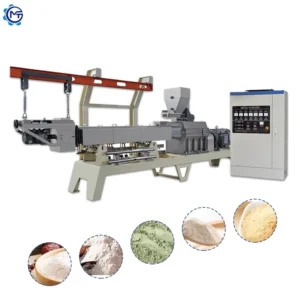
CE cerelac Máquina de producción de línea de elaboración de papilla instantánea para bebés
¥35,000.00 Select options This product has multiple variants. The options may be chosen on the product page -

Línea de procesamiento de extrusión de arroz en polvo nutricional para bebés de alta precisión 500kg/h
¥9,500.00 Add to cart -
Línea de procesamiento de extrusión de arroz en polvo nutricional para bebés de alta precisión 500kg/h
¥8,238.27 Add to cart -
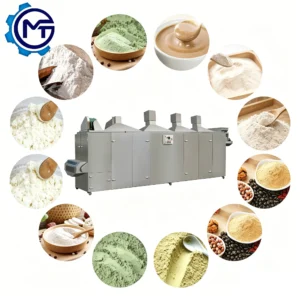
Máquina extrusora automática de alimentos para bebés controlada por PLC de 500 kg/h para el procesamiento de cereales de arroz
¥9,500.00 Add to cart