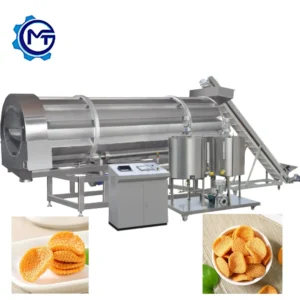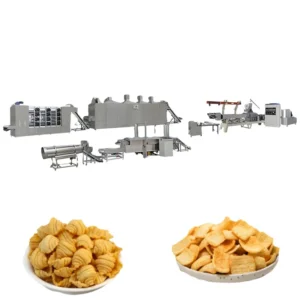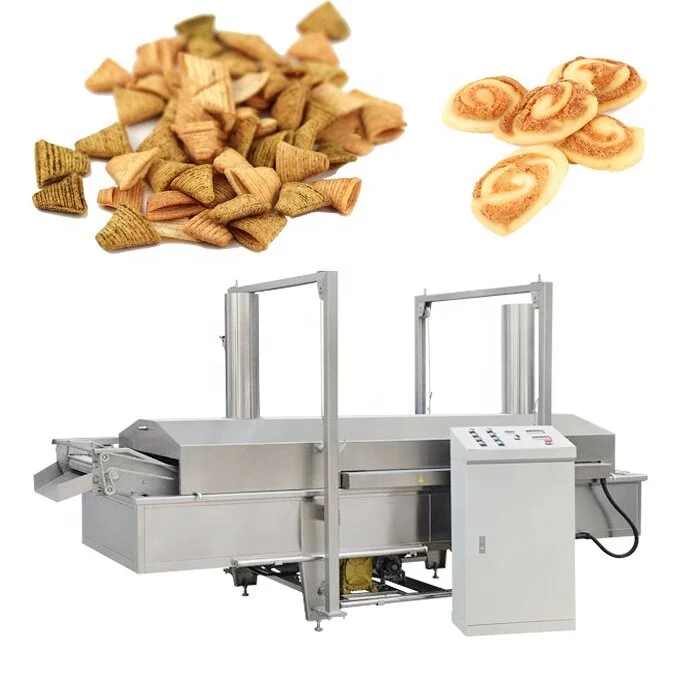


MT65 / MT70 / MT70c / MT75 Twin Screw Extruder for Fried Snack Chips, Siemens main motor, 38CrMoAl nitrided screws — engineered as a complete turnkey line from corn flour batching through shaping, frying and double-drum flavoring.
- Screw configuration and die design matched to your raw material and target chip density, with throughput balanced across extruder, fryer and coating stations to eliminate bottlenecks.
- Trial runs on your actual corn flour formulation conducted in our testing workshop before shipment, ensuring texture and expansion meet specification from day one.
Description
Throughput-matched turnkey layout — every station from corn flour batching through extrusion, frying and flavoring is engineered as one integrated fried chip line rather than assembled from standalone units.
Technical Specifications
| Parameter | Value |
|---|---|
| Product Type | Twin Screw Extruder for Fried Snack Chips (Nacho / Tortilla / Doritos) Production Line |
| Model | MT65 / MT70 / MT70c / MT75 |
| Screw Type | Twin screw |
| Screw Material | Alloy 38CrMoAl, nitriding process |
| Screw Feature | Self-cleaning ability |
| Main Power (MT65) | 22 kW |
| Main Power (MT70) | 30 kW |
| Main Power (MT70c) | 45 kW (source value — verify against manufacturer catalog) |
| Main Power (MT75) | 55 kW |
| Output Capacity (MT65) | 100–150 kg/h (basis not stated in source — confirm raw material, moisture content and product format) |
| Output Capacity (MT70) | 150–200 kg/h (basis not stated in source — confirm raw material, moisture content and product format) |
| Output Capacity (MT70c) | 200–250 kg/h (basis not stated in source — confirm raw material, moisture content and product format) |
| Output Capacity (MT75) | 200–300 kg/h (basis not stated in source — confirm raw material, moisture content and product format) |
| Feeding System | Food-grade stainless steel twin screw feeder with speed-adjusted converter |
| Main Motor | Siemens brand |
| Gearbox | Automatic lubrication function |
| Cooling | Increased radiator on driving part for forced cooling |
| Cutting System | Rotary cutting knife fixed in die head seat, V-belt drive |
| Line Stations | Extruder, shaper, fryer (electric / diesel / gas), double-drum flavoring system with powder hopper, conveyor, sprayer |
| Raw Material | Corn flour / corn powder |
| Assembly State | Complete production line from batching to flavoring |
| Control System | Speed-adjusted converter on feeding, extrusion and cutting systems |
| Standards | CE certified (company-level certification since 2014) |
Application Suitability
| Application | Material or Output |
|---|---|
| Nacho chip production | Corn flour dough extruded, shaped, fried and seasoned |
| Tortilla chip line | Corn-based masa processed through twin-screw extrusion and rotary cutting |
| Doritos-style flavored corn chips | Extruded corn dough formed into triangles, fried and coated in double-drum flavoring system |
| Puffed and fried corn snacks | Corn powder formulations requiring controlled expansion before frying |
| Turnkey snack line projects | Full production from raw corn flour batching through to flavored finished chip packing |
Why "Nominal Capacity" Can Stall a Fried Snack Line Before It Starts
A twin screw extruder fried snack chips production line turnkey is only as productive as its weakest station match.
I learned this the hard way running a line in Mexico last year. The buyer ordered based on the brochure capacity number. When we fired it up with their locally sourced corn flour — different particle size and starch profile from what we tested with — the extruder surged, the fryer ran half-empty and the flavoring drums got overwhelmed in pulses. The line never held its rated output during that first week [NEED_CITE: starch gelatinisation behaviour varies with corn flour particle size and moisture]. The fix was not a bigger motor. It was a new screw combination, a die swap and a recalibrated feed rate. That week of lost production cost more than a proper pre-shipment trial ever would have.
Matching Every Station to the Corn Dough Profile
A fried chip line lives or dies on how the extruder hands dough to the shaper and fryer. Corn flour behaves differently from wheat or rice — its starch gelatinises at a specific temperature window, and moisture content at the barrel exit controls how the chip expands in hot oil. If the twin screw extruder fried snack chips production line turnkey pushes product faster than the fryer can recover oil temperature, the chips absorb excess oil and emerge greasy rather than crisp. Each station on this line is sized against the extruder output so that dough residence time, fryer dwell and flavoring drum speed stay in balance.
Trial Runs That Catch Problems Before They Reach Your Floor
The testing workshop is where assumptions about your corn flour get proven or broken. Before any MT65, MT70, MT70c or MT75 ships, your actual raw material runs through the extruder at target moisture and feed rate. The screw configuration is adjusted until the dough exits the die at the density and texture your market expects. If the chips come out too dense or too airy, the die geometry and barrel temperature profile are revised — not after installation on your factory floor, but before the crate leaves Jinan [NEED_CITE: food extrusion trial methodology for starch-based snack products].
What the Screw and Die Configuration Actually Controls
The 38CrMoAl nitrided twin screws do more than convey corn dough — they define shear history. Shear determines how completely the starch gelatinises inside the barrel, which in turn controls how much the chip puffs when it hits the fryer oil. A screw combination with too many reverse elements overworks the dough, producing chips that are tough rather than crisp. Too few kneading blocks and the starch remains partially raw, giving a floury taste after frying. The die opening diameter and land length set the initial chip thickness before the rotary cutter takes over. Siemens main motors with speed-adjusted converters give operators fine control over screw RPM, which is the single most responsive variable when corn flour batches vary in moisture or particle size across a production run. The automatic lubrication gearbox and forced-cooling radiator on the drive end keep the extruder running through long shifts without thermal drift in output.
The Hidden Cost of an Undersized Fryer
An extruder running at full output into a fryer that cannot hold oil temperature is the most common bottleneck I have seen on fried snack lines. The result is not just slower production — it is inconsistent chip color, uneven oil absorption and a seasoning layer that fails to adhere. Buyers often focus on extruder motor power and overlook whether the fryer heat recovery rate matches the mass flow of dough entering the oil. When the twin screw extruder fried snack chips production line turnkey is quoted as separate machines from different vendors, this mismatch is almost guaranteed [NEED_CITE: heat recovery requirements for continuous industrial fryers in snack food plants].
Why Buyers Source This Line as a Single Project
The MT65 through MT75 models are offered as complete lines rather than standalone extruders because throughput matching across stations eliminates the finger-pointing that happens when a bottleneck falls between two suppliers’ contracts. Screw and die configurations are specified against your corn flour sample, not copied from a generic build. The in-house testing workshop validates output on your raw material before shipment, so commissioning on your floor starts with a proven recipe rather than a guess. Electrical schematics and control language are confirmed for your destination country before production begins. Spare screws, dies and cutting knives are listed and stocked so the first replacement does not become an emergency air-freight order.
Documentation & Verification
- Line layout drawing showing station spacing and utility connection points for your fried chip format
- Capacity calculation matching extruder output to fryer heat recovery and flavoring drum throughput
- Screw and die configuration record tied to your corn flour sample trial run results
- Electrical schematic with voltage, frequency and control panel language confirmed for your market
- Trial run report documenting actual output, chip density and oil absorption on your raw material
- CE declaration of conformity covering the complete line from batching through flavoring
Installation, Commissioning & Support
- Foundation plan accounting for fryer weight and oil load, sized to the MT model footprint selected
- Dedicated electrical circuit sizing for the Siemens main motor and fryer heating elements
- Phased assembly sequence from extruder through fryer and double-drum flavoring system
- First-run parameter logging for screw RPM, barrel temperatures and fryer oil setpoint
- Operator training on screw configuration changes when corn flour batches vary in moisture
- Wear parts list covering screws, dies and rotary cutting knives with first-replacement stocking guidance
What to Include with Your Inquiry
To configure a line that holds output on your actual corn flour, share the raw material specification including particle size range and typical moisture content, the chip geometry and thickness your market expects, and the daily production target in kilograms of finished product. Confirm your facility voltage and frequency, and whether the fryer will run on electric, diesel or gas heating. If you have existing upstream batching or downstream packing equipment, note the interface points so the twin screw extruder fried snack chips production line turnkey connects cleanly.
Frequently Asked Questions
Q: How is line capacity verified against my specific corn flour formulation and moisture content?
A: Your raw material sample runs through the extruder in our testing workshop before shipment. We log actual throughput, chip density and fryer oil absorption at your target moisture level. If output or texture falls outside specification, the screw combination and die geometry are adjusted and re-tested until the line holds a stable production rate on your flour.
Q: How do you match extruder output with fryer and flavoring station capacity to avoid bottlenecks?
A: Each station is sized from the extruder’s verified output on your corn flour, not from a generic brochure number. The fryer heat recovery rate is calculated against the dough mass flow, and the double-drum flavoring system is set to handle peak seasoning application without product backlog at any point in the line.
Q: What utility planning is required for the full fried chip line?
A: You need confirmed electrical supply matching the Siemens motor rating and fryer heating load, plus water supply for barrel cooling and cleaning. If you select a gas or diesel fryer, fuel line sizing and ventilation must be planned. We provide a utility requirement sheet tied to the specific MT model and fryer type in your quotation.
Q: What is included in the installation and commissioning process?
A: An engineer oversees phased assembly from extruder through fryer and flavoring stations, then runs a first production batch on your floor. Screw RPM, barrel temperatures, fryer oil temperature and cutting speed are logged. Operators are trained on parameter adjustments for corn flour batch variation and on screw and die changeover procedures.
Q: How are spare wear parts supplied for first replacement?
A: A wear parts list covering screws, dies and rotary cutting knives ships with the line. We recommend stocking the first replacement set before startup so that normal wear does not cause unplanned downtime. Replacement parts are manufactured to the same 38CrMoAl specification as the originals.
Related products
-
Orion TURTLE CHIPS Maquinaria de Snack Puffing Línea de Producción Crujiente de Cuatro Capas de Celebridad de Internet
¥65.00 Select options This product has multiple variants. The options may be chosen on the product page -
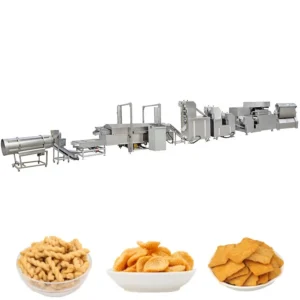
Línea de producción de máquina de alimentos para fritura de bocadillos de chips fritos de pellets de Bugles de maíz 3D crujientes, extrusora para hacer Bugles
¥100.00 Select options This product has multiple variants. The options may be chosen on the product page -
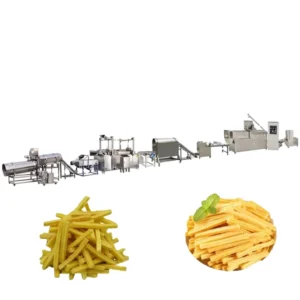
High-Yield Automated Fried Snack Production Line – Double Screw Salad Strips & Millet Crust Making Equipment
¥65.00 Select options This product has multiple variants. The options may be chosen on the product page -
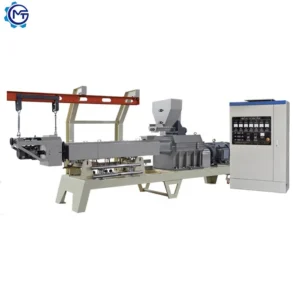
Industrial Fully Automatic Stainless Steel Deep Fried Line – Snack Factory Miscellaneous Grains Special Processing Equipment
¥65.00 Select options This product has multiple variants. The options may be chosen on the product page