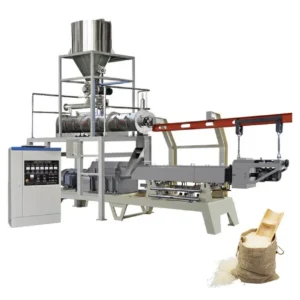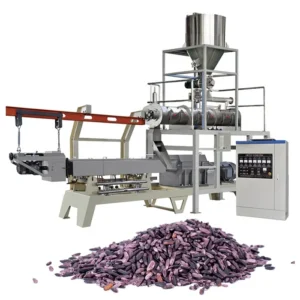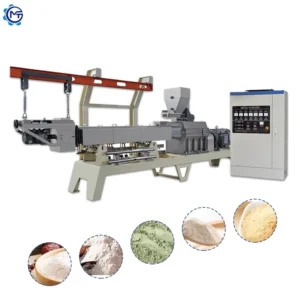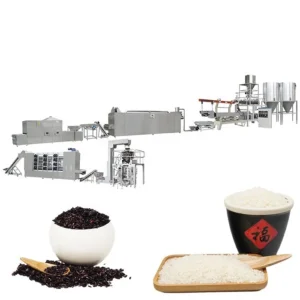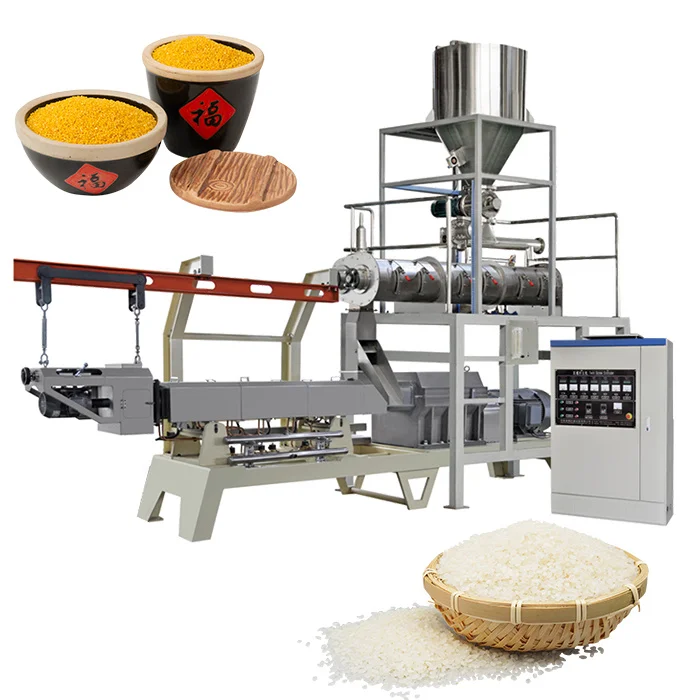
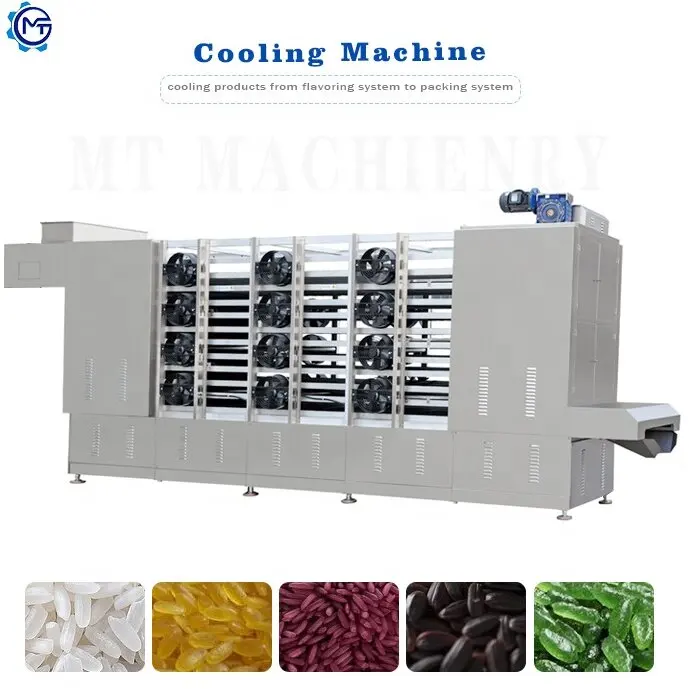
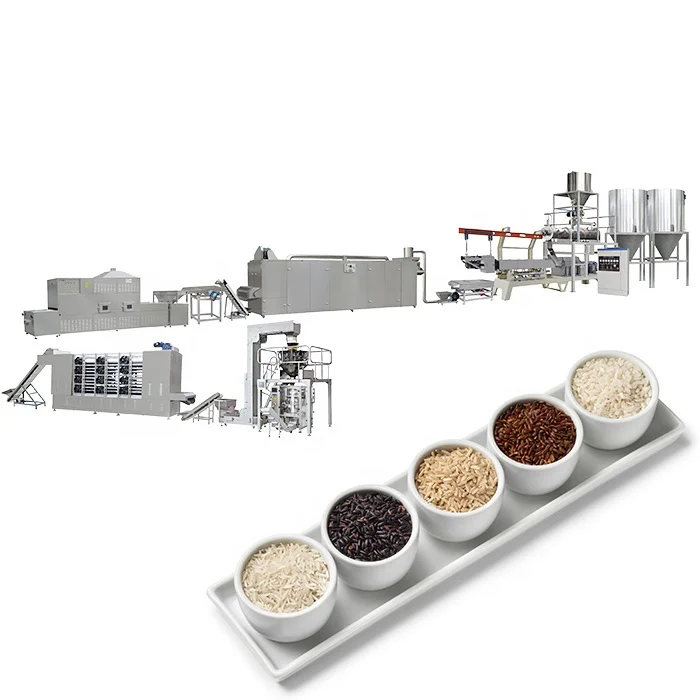
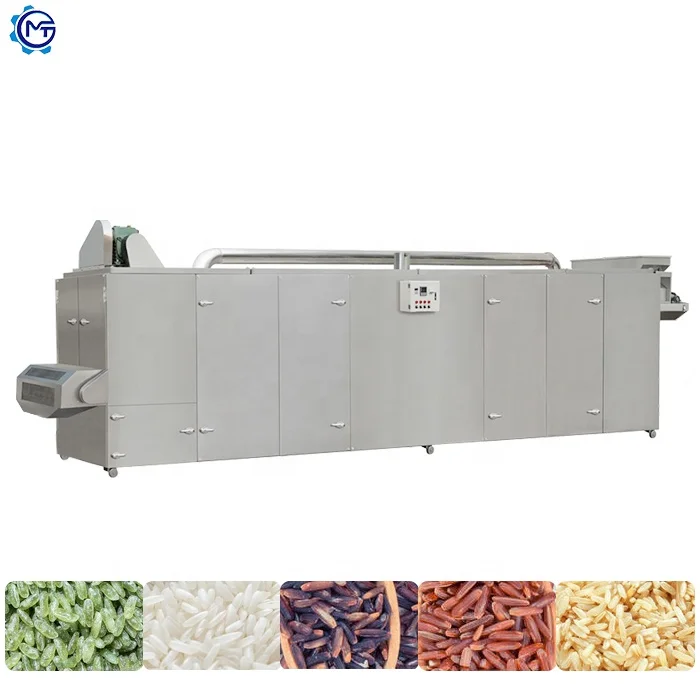
Artificial Rice Extrusion Production Line, 70-300 kg/h, 380V/50Hz, Food-Grade Stainless Steel — engineered as one integrated turnkey project where throughput is balanced from mixing through extrusion to packing.
- Twin-screw configuration and die geometry specified to your rice flour formulation, controlling grain shape, density, and cooking behaviour
- Automatic control system for stable, repeatable output across continuous shifts
- Complete line scope covers batching, extrusion, drying, and downstream stations
Trial runs on your exact raw material in our testing workshop confirm capacity and product specification before the line ships to your factory.
Description
Integrated Line Engineering — every station from mixing through extrusion to packing is specified together so throughput stays balanced across your artificial rice production process, eliminating single-machine bottlenecks before they form.
Technical Specifications
| Parameter | Value |
|---|---|
| Product Type | Artificial Rice Extrusion Production Line |
| Output Capacity | 70–300 kg/h (basis not stated in source — confirm raw material, moisture content, and pellet size) |
| Voltage & Frequency | 380V / 50Hz |
| Control System | Automatic control (PLC or MCC available) |
| Construction Material | Food-grade stainless steel (product-contact surfaces) |
| Line Stations | Mixer, extrusion system, fryer, downstream stations configurable |
| Screw Type | Configurable (single or twin screw — confirm based on formulation) |
| Raw Material Compatibility | Rice flour and grain-based formulations |
| Assembly State | Complete integrated production line |
| Customization | Minor, drawing-based, and full customization supported |
| Standards Compliance | CE, ISO |
Application Suitability
| Application | Material or Output |
|---|---|
| Artificial rice production | Rice flour, grain-based raw materials |
| Fortified nutritional rice | Vitamin and mineral-enriched rice flour blends |
| Extruded rice product manufacturing | Multi-grain formulations for food processing plants |
What "Nominal Capacity" Actually Means on Your Factory Floor
A capacity number without a raw material basis is a guess, not a guarantee.
I have stood in factories where the extruder nameplate promised a certain output, but the buyer’s actual formulation — brown rice mixed with millet, lentil starch, or other non-standard grains — behaved completely differently under heat and shear. The gelatinization curve shifted, screw speed needed retuning, barrel temperatures had to be adjusted zone by zone. Two weeks of on-site re-commissioning before product density and shape came within spec. When you evaluate an artificial rice production line turnkey proposal, the first question should not be the price — it should be whether the supplier has tested your exact blend before quoting output [NEED_CITE: extrusion behavior variance across different grain starch profiles].
How Raw Material Behavior Dictates Line Configuration
Every grain formulation has a unique starch gelatinization window. Rice flour alone extrudes differently than a blend incorporating sorghum, millet, or pulse-based starches. The artificial rice production line turnkey configuration must account for these differences at the screw and die level — barrel temperature profile, moisture injection rate, and screw element arrangement all shift depending on what you are actually feeding into the hopper.
Why Throughput Matching Matters Across Every Station
An extruder running at full output means nothing if the downstream dryer cannot keep pace, or if the cooling conveyor creates a backlog that forces the extruder to idle. Each station in this line is specified against the others so material flow remains continuous. The mixer batch cycle, extrusion rate, fryer residence time, and packing speed are calculated together — not sourced independently and bolted together after the fact [NEED_CITE: throughput balancing methodology in continuous food extrusion lines].
Reading the Specifications Beyond the Nameplate
The 70–300 kg/h capacity range spans a wide operational envelope. Where your line falls within that range depends on raw material density, moisture content at the extruder inlet, and the target grain shape and size. A smaller die opening producing slender fortified rice grains will yield different mass throughput than a larger die forming standard-size artificial rice. The 380V / 50Hz electrical supply drives the main extrusion motor and all auxiliary systems — confirm whether your local supply matches, or specify the required voltage and frequency before production begins. Food-grade stainless steel across all product-contact surfaces meets hygiene requirements for nutritional rice intended for institutional feeding programmes or retail distribution. The automatic control system maintains consistent screw speed and barrel temperature across production shifts, reducing batch-to-batch variation that would otherwise require manual adjustment.
The Hidden Cost of Skipping a Factory Trial Run
Shipping an extrusion line without first running the buyer’s actual raw material in the testing workshop creates a costly sequence of events. The machine arrives, installation proceeds, and then commissioning reveals that the screw configuration produces the wrong grain density or that the die geometry does not hold the target shape. On-site re-tuning then stretches across days or weeks, with raw material consumed and production schedules delayed. The trial run report should be a non-negotiable document in any artificial rice production line turnkey package [NEED_CITE: industry practice for pre-shipment extrusion trial runs].
Why Source the Complete Line From One Supplier
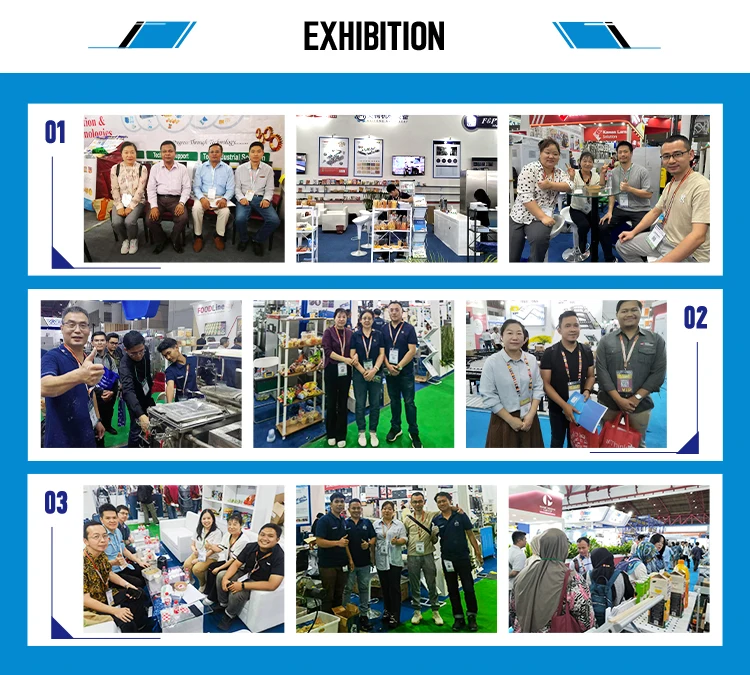
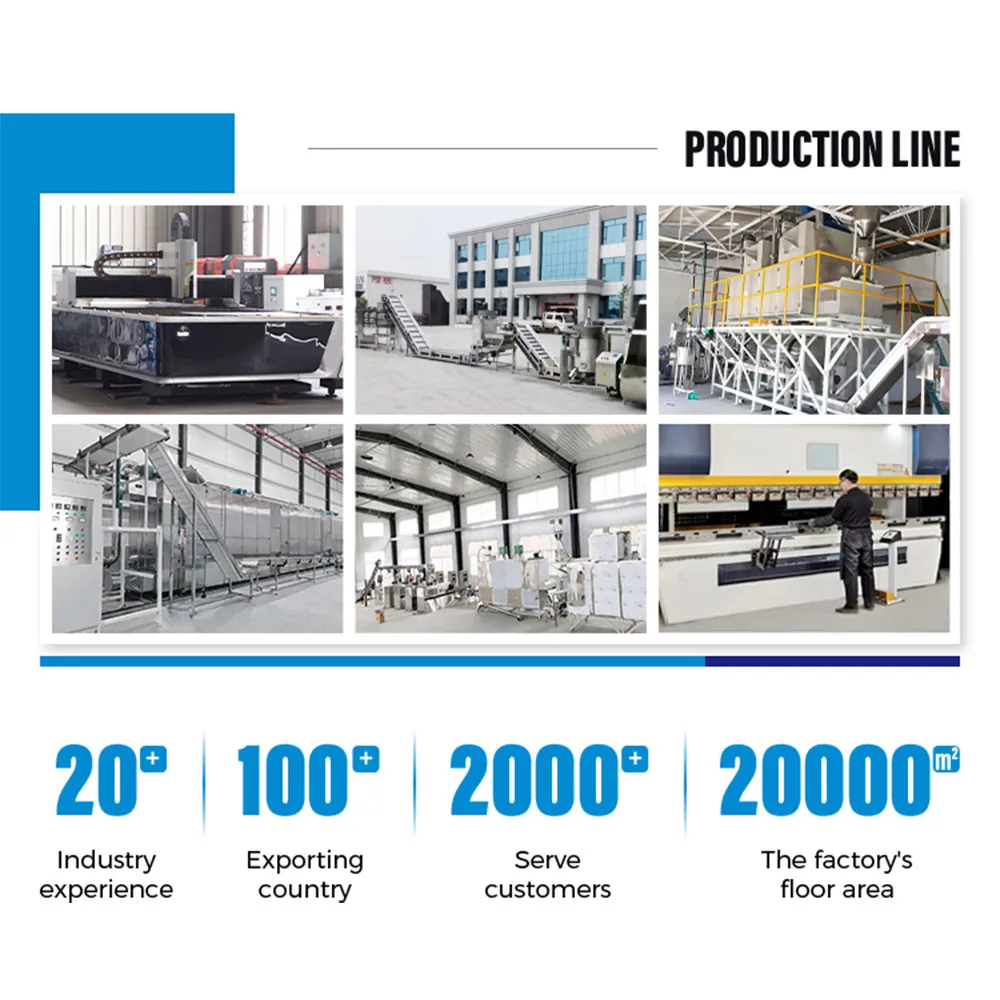
The extruder, mixer, fryer, dryer, cooler, and packing station are designed around a single throughput target rather than assembled from mismatched standalone machines. Screw configuration and die geometry are documented specifically for your formulation, so ordering replacement wear parts later does not require reverse-engineering. The testing workshop runs your exact raw material before the line ships, producing a trial run report that confirms shape, density, and output. Pre-sales consultation covers line layout and utility planning, and the installation team remains on site through commissioning and operator training. CE and ISO compliance are documented with certificates and declarations included in the shipping package.
Documentation & Verification
- Line layout and capacity calculation confirming throughput at every station
- Trial run report on your specific rice flour formulation before dispatch
- Screw and die configuration record for repeatability and wear part reordering
- Electrical schematic with voltage, frequency, and control language confirmation
- Operation and maintenance manual with wear parts list
- CE declaration of conformity and ISO certificate
Installation, Commissioning & Support
- Floor plan and utility connections planned around the 380V / 50Hz supply requirement
- Assembly state confirmed before shipping — partial or full breakdown for container loading
- On-site commissioning includes barrel temperature and screw speed tuning to your formulation
- Operator training covers control system operation, die changes, and daily cleaning procedures
- Wear parts list provided with recommended reorder intervals for screws and dies
- Maintenance schedule aligned to food-grade stainless steel cleaning and sanitation cycles
Before You Request a Quotation
Provide your raw material formulation, including the percentage breakdown of rice flour, alternative grains, and any vitamin or mineral premix. Specify your target daily output and the grain shape and size your market expects. Confirm your local voltage, frequency, and preferred control language so the electrical specification matches your facility before production starts.
Frequently Asked Questions
Q: How is line capacity verified on my specific rice flour formulation before shipment?
A: Your exact raw material blend is run through the extruder in the testing workshop. Screw speed, barrel temperature profile, and moisture feed are adjusted until grain shape, density, and cooking behavior meet specification. A trial run report documenting output rate and product parameters is provided before the line ships.
Q: What stations are included — does the line cover mixing through packing?
A: The line integrates mixer, extrusion system, fryer, and downstream stations including drying, cooling, and packing. Every station is specified against the same throughput target so no single machine creates a bottleneck. The exact station list is confirmed during the line configuration stage.
Q: How do you match screw and die design to different artificial rice shapes?
A: Screw element arrangement and die geometry are selected based on your target grain shape, size, and density. A die producing round fortified rice grains requires a different configuration than one forming elongated basmati-style grains. The chosen setup is recorded for future wear part orders.
Q: What utility requirements should I plan before installation?
A: You need a 380V / 50Hz power supply or a confirmed alternative matching your local grid. Water supply for the mixer and steam system, floor drainage for washdown, and ventilation for the fryer and dryer exhaust are also required. Utility planning is part of the layout proposal.
Q: How is commissioning phased, and what training is included?
A: Installation proceeds from station positioning through electrical connection to mechanical alignment. Commissioning starts with dry runs, then moves to production trials using your raw material. Operator training covers control system use, die changes, cleaning procedures, and routine maintenance for all line stations.
Related products
-
Línea de producción de polvo de nutrición de cereales para bebés automática y compacta con capacidad de 500 kg/h y control PLC
¥9,500.00 Add to cart -
Máquina de hacer harina de arroz para bebés con extrusora de doble tornillo de 150-500kg/h
¥9,500.00 Select options This product has multiple variants. The options may be chosen on the product page -
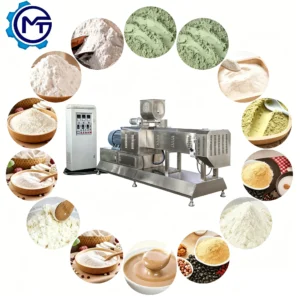
Línea de producción de alimentos para bebés en polvo de nutrición fortificada totalmente automática
¥8,238.27 Select options This product has multiple variants. The options may be chosen on the product page -
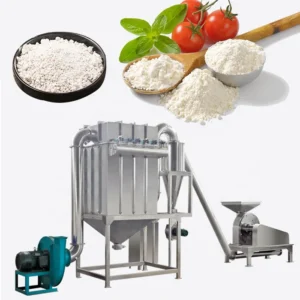
Nueva máquina automática para la producción de polvo nutricional para la línea de producción de alimentos para bebés.
¥20.00 Select options This product has multiple variants. The options may be chosen on the product page