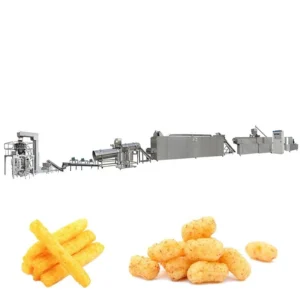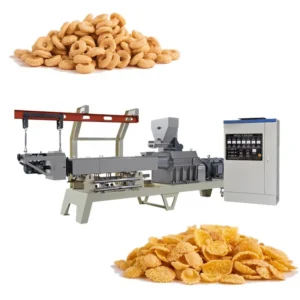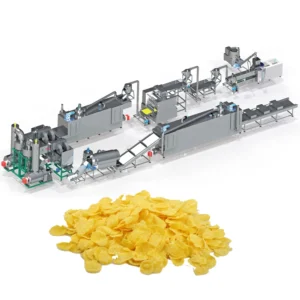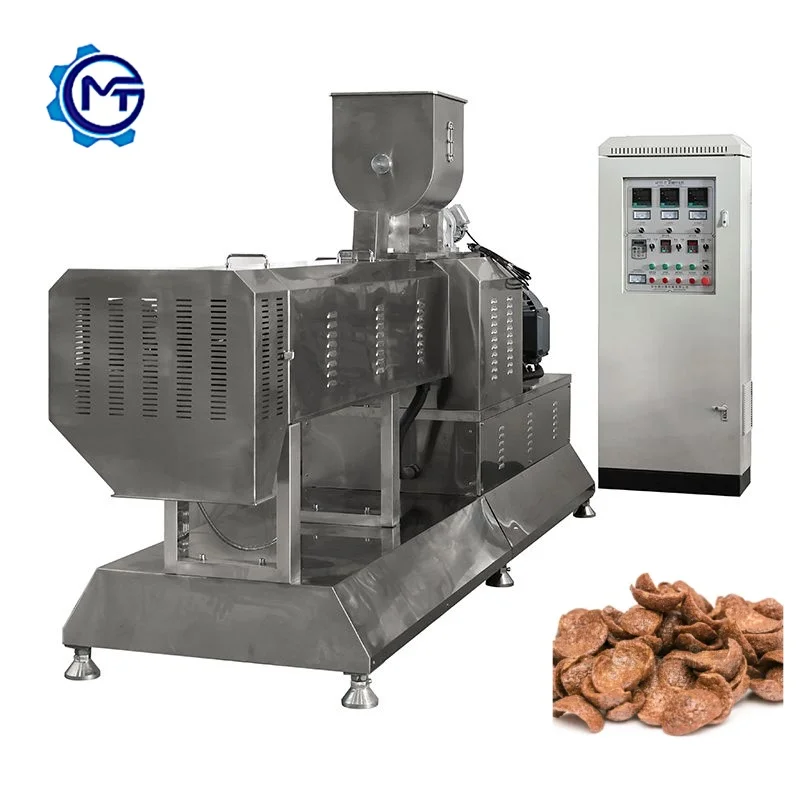
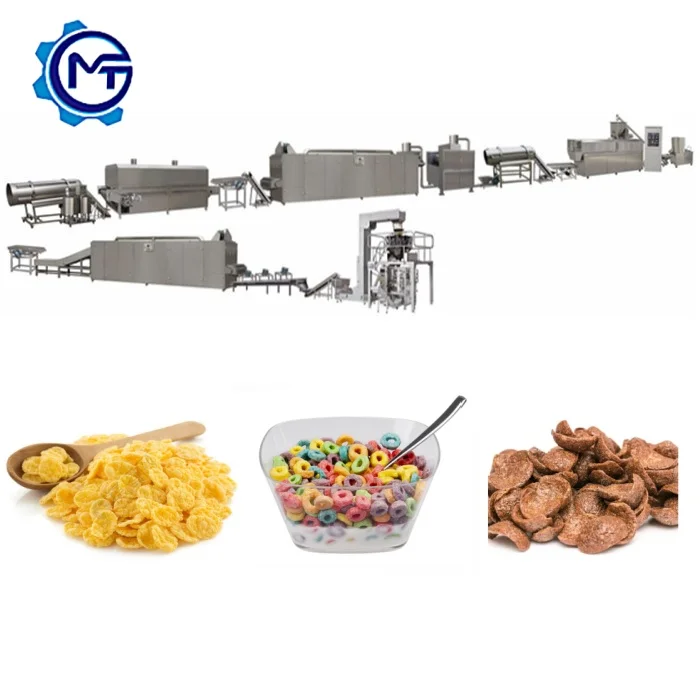
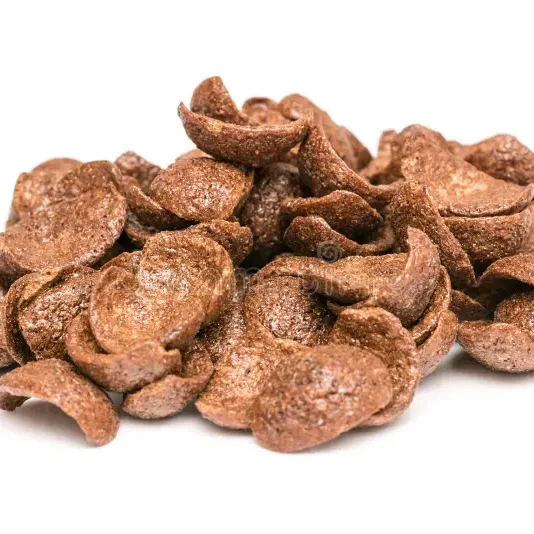
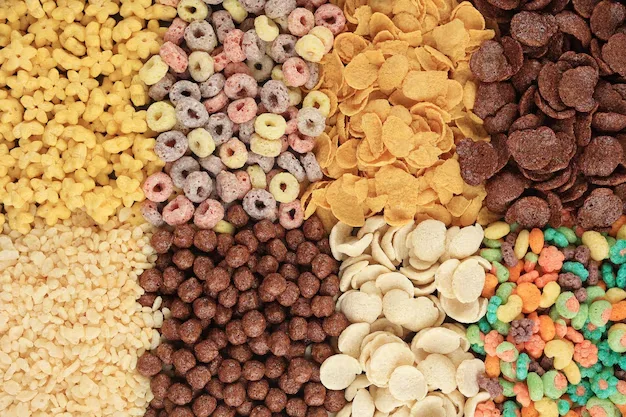
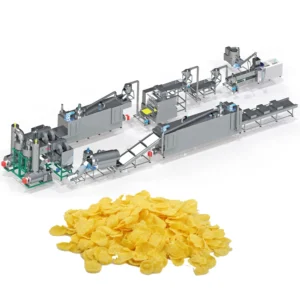
MT75 Twin Screw Breakfast Cereal Production Line, 210 kW Installed Power, PLC Control — complete turnkey system from mixing through extruding, flaking, roasting, coating, and packing for corn flakes and puffed cereals. Every station is throughput-matched and configured to your raw material and target product specification, with screw and die design aligned to grain base behavior. Line layout, capacity calculation, and trial run on your raw material provided before shipment.
Description
Thermal and mechanical integration across every station — every flaking roll, drying chamber, and roasting oven is specified against your exact grain formulation so the line holds its rated throughput without manual throttling between stages.
Technical Specifications
| Parameter | Value |
|---|---|
| Model | MT75 |
| Product Type | Twin Screw Breakfast Cereal Production Line |
| Screw Configuration | Twin screw, wear-resistant alloy |
| Installed Power | 210 kW |
| Power Consumption | 150 kW |
| Output Capacity | 300–500 kg/h (basis not stated in source — confirm raw material / moisture) |
| Overall Dimensions | 45 × 1.5 × 3.5 m |
| Control System | PLC control (flaking machinery); MCC and PLC control (extruder line) |
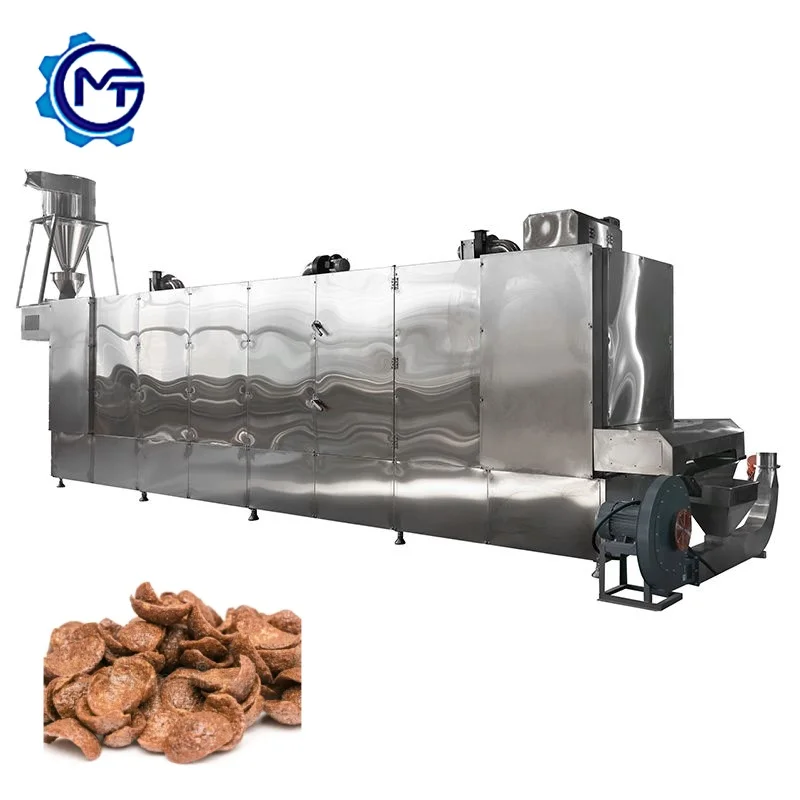
| Heating Source (Dryer) | Steam / Gas / Electric, configurable |
| Flaking Machinery | Hydraulic double-roller system; double motors for separate roller driving; infrared sensor temperature control |
| Roasting Oven | Vibrating pan, conciliation burner combustion chamber, dual circulating fans, cyclone dust removal |
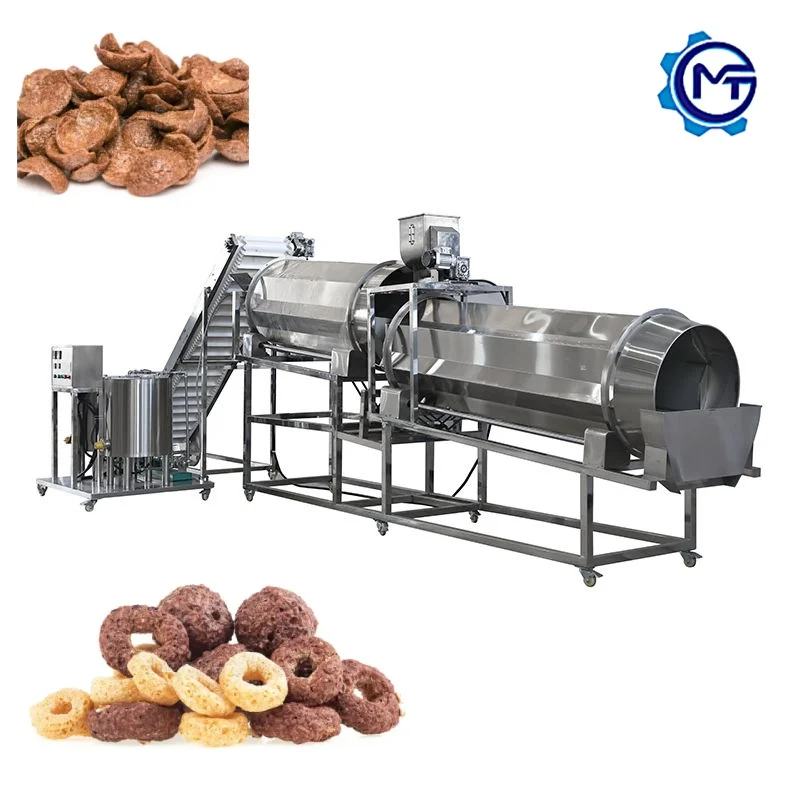
| Coating System | Double tumble sugar melting, elevator, coating drum, spraying nozzle |
| Automatic Lubrication | Yes, with cooling function |
Application Suitability
| Application | Material or Output |
|---|---|
| Natural corn flakes production | Corn grits, corn flour, whole corn meal |
| Sugar-coated corn flakes | Corn base with sugar syrup coating |
| Puffed breakfast cereals | Rice, wheat, oat, and barley powder blends |
| Fortified grain cereals | Multi-grain formulations with added nutritional premix |
| Shaped cereal pieces | Ball, tube, ring, star, wheel, and fruit loop shapes via die exchange |
What the "300–500 kg/h" Figure Does Not Tell You About Your Cereal Line
A rated capacity number means nothing until it is proven on the grain blend you actually run.
When I first set up a breakfast cereal line for a Southeast Asian plant, the buyer handed us a corn flour recipe and we configured the screw set for wheat starch behavior. The extrusion expansion never hit the target, and the flakes came off the press hard and flat. We spent three nights swapping screw elements and die orifice sizes before the breakfast cereal production line turnkey ran at the rhythm the buyer expected. That project reinforced a rule I now apply to every cereal installation: verify the throughput on the customer’s actual raw material before the line leaves the factory floor [NEED_CITE: importance of raw material trial runs in extrusion-based cereal production].
Station Sizing That Prevents Mid-Line Bottlenecks
A breakfast cereal production line turnkey is only as productive as its slowest station. When the extruder pushes more mass than the flaking rollers can compress, wet dough backs up into the conveyor. When the roasting oven cannot match the dryer discharge rate, the cereal pieces over-dry and crack. Every unit in the MT75 line — from the mixing hopper to the coating drum — is capacity-matched during the layout phase so material flow stays continuous from batching to packing.
Process Flow Configured for Your Target Flake or Puff
Natural corn flakes follow a direct path through mixing, extruding, flaking, drying, hot air roasting, and cooling. Sugar-coated variants add sugar spraying, tumble coating, and a second drying pass before the final cooling stage. The MT75 supports both flows within the same footprint. Process engineers can reconfigure the coating circuit without rewiring the PLC, because the MCC and PLC architecture separates logic zones by station rather than bundling the entire line into one program block [NEED_CITE: PLC zone separation in multi-stage food processing lines].
Why Screw Shear and Die Orifice Dictate Flake Texture
Twin screw extrusion subjects the grain mass to controlled shear and thermal input across multiple barrel zones. The screw element arrangement — conveying, kneading, and reverse-shear sections — determines how completely the starch gelatinizes before the dough reaches the die. A die with too-large an orifice produces thick, under-expanded dough that flakes into dense chips. A die with properly sized openings yields a half-cooked pellet that the hydraulic rollers flatten into the thin, blister-prone sheet that roasts into a crisp flake. The MT75’s automatic lubrication system with cooling keeps the gearbox at a stable temperature during long production runs, preventing thermal drift that would otherwise alter screw speed consistency.
What Happens When Voltage and Fuel Type Are an Afterthought
I have seen cereal line installations stall for weeks because the roasting oven was wired for 380 V / 50 Hz while the buyer’s facility runs 440 V / 60 Hz, and the burner was set up for natural gas where only LPG was available. The conciliation burner on the MT75 roasting oven is configurable, but the confirmation must happen before fabrication, not after the container arrives [NEED_CITE: voltage and frequency standards by export market]. The same applies to the dryer: steam, gas, and electric heating sources are all available, and choosing the wrong one locks you into a utility cost structure that does not match your local tariff.
Why Buyers Choose This Project Partner
The entire line from mixing through packing is supplied by one manufacturer, so throughput matching is engineered rather than negotiated across separate vendors. The in-house testing workshop runs your corn, rice, or oat formulation on the actual twin screw extruder before shipment, producing a documented trial report. Screw configuration and die design are recorded against your target product specification, not copied from a generic build. Electrical schematics and control language are confirmed against your site requirements before production begins, reducing commissioning delays.
Documentation & Verification
- Line layout drawing showing station placement and throughput at each node against your grain formulation
- Trial run report from in-house workshop on your specific corn, wheat, or multi-grain raw material
- Screw and die configuration record matching the exact flake thickness and puff geometry you require
- Electrical schematic with voltage, frequency, and control language confirmed for your facility
- CE declaration of conformity and ISO certificate included with shipment documentation
- Wear parts list covering screw elements, die plates, and roller sleeves with reorder codes
Installation, Commissioning & Support
- Foundation plan accounts for the 45-meter line length and 3.5-meter maximum height clearance
- Power supply requirement covers 210 kW installed load with dedicated MCC panel and PLC circuit
- Hydraulic flaking station arrives pre-assembled with double-roller system calibrated for your target flake gauge
- Commissioning includes first-run parameter setting on your raw material with PLC recipe storage
- Operator training covers screw changeover, die exchange, and infrared sensor recalibration on the flaking rollers
- Spare screw elements and die plates shipped with initial order to cover the first replacement cycle
What We Need to Move Your Project Forward
Share the exact grain formulation you plan to run — corn, rice, wheat, oat, or a blend — along with target moisture content and finished flake or puff dimensions. Confirm your facility’s voltage, frequency, and available fuel type for the dryer and roasting oven. Provide workshop dimensions so the layout can be drafted to your floor plan before the quotation is finalized.
Frequently Asked Questions
Q: How is line capacity verified on my actual raw material and recipe formulation?
A: Before shipment, your grain blend runs through the twin screw extruder in our in-house testing workshop. We document expansion rate, dough consistency, and throughput at each station, then adjust screw elements and die sizing until the output matches your product specification. The trial run report ships with the line.
Q: What factory layout and utility planning is included in the turnkey project scope?
A: We provide a scaled line layout based on your workshop dimensions, covering all stations from mixer to packing conveyor. Utility planning includes electrical load distribution across the 210 kW installed power, fuel source routing for the dryer and roasting oven, and compressed air points for the PLC actuators.
Q: How are extruder, dryer, and coating stations throughput-matched to avoid bottlenecks?
A: Each station is sized during the engineering phase against the same throughput target. The flaking roller speed, dryer belt residence time, and coating drum rotation are calculated together so wet dough never accumulates between stages and finished cereal never waits for the next process.
Q: What is the phased installation and commissioning schedule, and does it include operator training?
A: Installation follows a station-by-station sequence aligned with your facility readiness. Commissioning includes running your raw material through the full breakfast cereal production line turnkey, adjusting PLC recipes, and training operators on screw changeover, flaking roller calibration, and roasting oven temperature control.
Q: How is voltage, control language, and fuel source confirmed for my target market before production?
A: During the specification confirmation stage, we verify your site voltage and frequency, select the dryer heating source from steam, gas, or electric options, and set the PLC interface language. These parameters are locked in the electrical schematic before fabrication begins.
Related products
-
Cereales Copos de Maíz con Azúcar Máquina de Extrusión de Copos de Maíz Línea de Producción de Cereal para Desayuno
¥23,000.00 Select options This product has multiple variants. The options may be chosen on the product page -
Máquina extrusora de anillos de cereal de trigo crujiente con choco integral / Producción de cereales para el desayuno Corn Flakes y Fruit Loops
¥48,000.00 Select options This product has multiple variants. The options may be chosen on the product page -
Máquina automática de fabricación de copos de maíz de 500 kg/h Nueva condición Alta productividad Línea de procesamiento de cereales dulces para el desayuno Desde la fábrica
¥8,500.00 Select options This product has multiple variants. The options may be chosen on the product page -
Nueva Máquina Automática de Fabricación de Copos de Maíz Línea de Procesamiento de Extrusión de Snacks de Avena y Chips
¥30.00 Select options This product has multiple variants. The options may be chosen on the product page