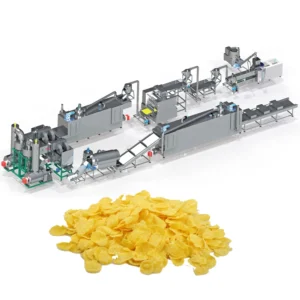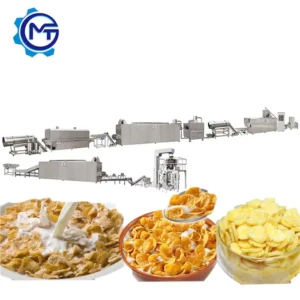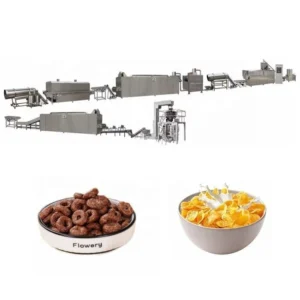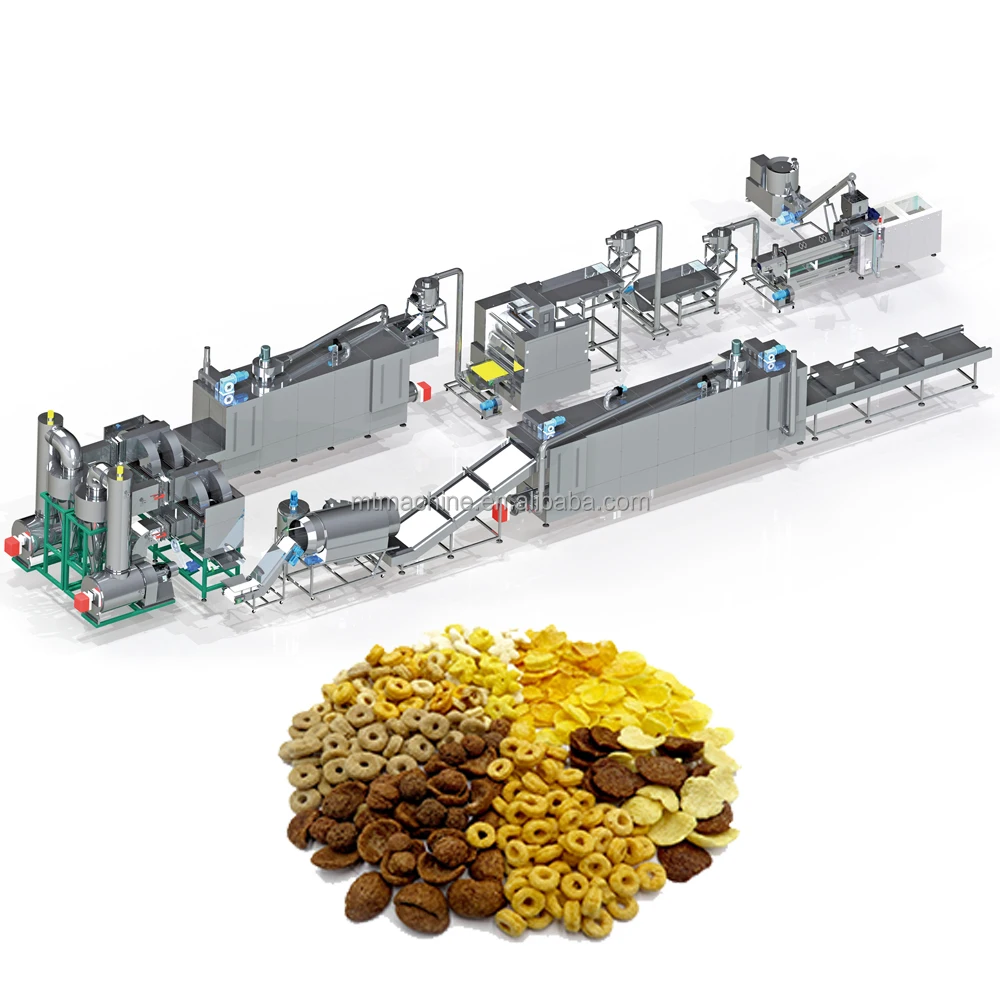


- In-house testing workshop validates your corn formulation before shipment, delivering verified throughput rather than nominal promises.
Description
Integrated Throughput Matching — Every station on this corn flakes line is calculated against the same raw material basis, so extruder output, flaking rolls, and roasting oven capacity are balanced before steel is cut.
Technical Specifications
| Parameter | Value |
|---|---|
| Product Type | Corn Flakes Breakfast Cereal Production Line |
| Model Options | MT70 / MT85 / MT75 |
| Extruder Type | Twin Screw Extruder |
| Installed Power (MT70) | 160 kW |
| Installed Power (MT85) | 190 kW |
| Installed Power (MT75) | 210 kW |
| Power Consumption (MT70) | 120 kW |
| Power Consumption (MT85) | 140 kW |
| Power Consumption (MT75) | 150 kW |
| Output Capacity (MT70) | 150–200 kg/h (basis not stated in source — confirm raw material type, moisture content, flake thickness) |
| Output Capacity (MT85) | 300–400 kg/h (basis not stated in source — confirm raw material type, moisture content, flake thickness) |
| Output Capacity (MT75) | 300–500 kg/h (basis not stated in source — confirm raw material type, moisture content, flake thickness) |
| Overall Dimensions (MT70) | 41 × 1.5 × 2.2 m |
| Overall Dimensions (MT85) | 43 × 1.5 × 3.2 m |
| Overall Dimensions (MT75) | 45 × 1.5 × 3.5 m |
| Control System | PLC and MCC available |
| Flaking Machinery Drive | Double motors, separate roller driving |
| Flaking Roller System | Hydraulic system for double rollers |
| Flaking Temperature Control | Infrared sensor, even temperature pipe control |
| Dryer Heating Source | Gas or Electric |
| Roasting Oven | Hot air roasting, vibrating pan, conciliation burner, two circulating fans, cyclone dust removal |
| Coating System | Double tumble sugar melting, elevator, coating drum, spraying nozzle |
| Screw Material | Wear-resistant, special technology treatment |
| Extruder Lubrication | Automatic lubricating and cooling |
| Basic Raw Materials | Corn, rice, wheat, oat, barley powder |
| Certifications | CE (since 2014); ISO certified |
Application Suitability
| Application | Material or Output |
|---|---|
| Natural corn flakes | Corn powder, controlled flake thickness and density |
| Sugar-coated corn flakes | Corn base with sugar glaze through tumble coating drum |
| Fortified breakfast cereal | Blended corn, rice, wheat, oat, barley with nutrient premix |
| Extruded cereal shapes | Ball, tube, stick, ring, fruit loop, star, wheel, flower, heart via die exchange |
| Aquatic or pet food crossover | Same extruder platform with screw and die reconfiguration |
Why the Roasting Oven Capacity Can Make or Break Your Corn Flakes Line
A roasting oven that cannot keep pace with the flaking station upstream will turn a rated corn flakes production line turnkey project into a bottleneck you only discover during commissioning.
I once configured a corn flake line where the extruder and flaking rolls were correctly matched, but the hot air roasting oven had a smaller vibrating pan area than the flaking output required. The flakes piled up on the conveyor, lost surface moisture unevenly, and entered the coating drum at inconsistent temperatures. The client had to replace the oven six weeks into production [NEED_CITE: thermal balance between flaking throughput and roasting pan area in cereal lines]. When you evaluate a corn flakes production line turnkey proposal, the oven circulation capacity and pan area must be calculated against the actual flake throughput, not the extruder’s nominal figure.
Layout Sequencing for Phased Installation
A corn flakes production line turnkey project spans mixing, extrusion, flaking, drying, roasting, optional sugar coating, secondary drying, cooling, and packing. Each station occupies a defined footprint with specific utility drops — gas or electric supply for dryers, compressed air for pneumatic gates, chilled water for the flaking roller hydraulic system. When a factory is being built or renovated, phased installation means the line layout must account for which section goes in first, where temporary walls can be placed, and which utility headers need to be roughed in before the floor is poured [NEED_CITE: phased installation scheduling for food processing lines].
Throughput Verification Before the Line Leaves the Factory
The difference between a line that runs at nameplate and one that constantly stalls comes down to whether anyone tested the actual formulation before welding the frames together. Our in-house testing workshop allows us to run your specific corn, oat, or blended cereal formulation through the twin-screw extruder and downstream flaking equipment. We document the screw configuration, barrel temperature profile, and die selection that produced the target flake density and blister pattern. This means the corn flakes production line turnkey system arrives at your dock with a known process recipe, not a generic starting point that your operators have to develop from scratch during commissioning.
Reading the Specification Sheet Against Your Production Target
The installed power figures — 160 kW for MT70, 190 kW for MT85, 210 kW for MT75 — tell you the motor and heating capacity available, but actual power consumption runs lower at 120 kW, 140 kW, and 150 kW respectively. This gap reflects the difference between peak startup load and steady-state running. The twin-screw extruder’s automatic lubricating and cooling system keeps barrel temperature stable during long production runs, which directly affects starch gelatinisation consistency. The flaking machinery uses double motors for independent roller driving, meaning each roller speed can be adjusted to control flake thickness without relying on a single shared gearbox that limits fine adjustment. Hydraulic roller pressure maintains contact force even as the rollers wear over time, and the infrared sensor monitors temperature across the roller surface to prevent hot spots that produce uneven flake texture.
The Hidden Cost of Mismatched Station Capacity
When the coating drum volume does not match the roasting oven output, sugar-coated flakes sit in a queue losing crispness before they enter the tumble. When the dryer after the coating stage is undersized, residual moisture stays trapped inside the glaze, and the finished product goes soft within days on the shelf [NEED_CITE: moisture migration in coated breakfast cereals during storage]. These are not defects in any single machine — they are failures in line-level calculation that surface only after weeks of production.
Why Project Buyers Source This Line Here
Every station from batching to packing is specified under one project scope, so throughput is matched across mixing, extrusion, flaking, drying, roasting, coating, cooling, and packing rather than assembled from separate vendors. The screw configuration and die design are selected based on your specific cereal formulation and target flake characteristics, not copied from a generic template. The in-house testing workshop runs your raw material before shipment, generating a documented trial run report. PLC and MCC control systems are configured to your site voltage and operator language before dispatch. Pre-sales engineering covers line layout, utility planning, and phased installation scheduling so your factory contractor knows exactly what to prepare [NEED_CITE: turnkey project documentation standards for food extrusion lines].
Documentation & Verification
- Line layout drawing with capacity calculation for each station matched to your target throughput
- Screw and die configuration record specific to your corn or cereal formulation
- Trial run report on your raw material generated in the testing workshop before shipment
- Electrical schematic with voltage and frequency confirmed for your local grid
- CE declaration of conformity and ISO certificate included with shipping documents
Installation, Commissioning & Support
- Foundation plan provided based on MT75 overall dimensions of 45 × 1.5 × 3.5 m for structural load calculation
- Electrical panel configured to confirmed site voltage before dispatch to avoid rewiring on arrival
- Phased assembly sequence documented so extruder, flaking rolls, and roasting oven install in logical order
- Hot air roasting oven commissioning includes burner calibration and circulating fan balance verification
- Operator training covers PLC interface navigation, screw speed adjustment, and hydraulic roller pressure settings
- Wear parts list specifies screw elements, die plates, and flaking roller surfaces for first reorder planning
Before You Request a Quotation
To size this corn flakes production line turnkey system correctly, share your primary cereal raw material and whether you plan natural flakes, sugar-coated variants, or both. Let us know your daily production target in kilograms of finished product and the flake thickness specification your market expects. If your factory is under construction, provide the available floor area and ceiling height so we can propose a layout that fits your phased build schedule.
Frequently Asked Questions
Q: How is line throughput verified against my actual corn or cereal formulation before shipment?
A: Your raw material is run through the extruder and flaking station in our in-house testing workshop. We document screw configuration, barrel temperatures, die selection, and resulting flake density. The trial run report travels with the shipment so your team starts production with a proven recipe rather than developing one from scratch.
Q: What layout and utility planning is included for phased installation in my factory?
A: The project package includes a scaled line layout showing every station footprint, utility drop locations for gas, electric, compressed air, and water, and a phased installation sequence. This lets your contractor prepare foundations, cable trays, and ductwork in stages that match the construction timeline.
Q: How is voltage, frequency, and control language confirmed to match my local site conditions?
A: During the specification confirmation stage, we collect your site electrical standard and operator language preference. The MCC panel, PLC interface, and motor ratings are configured accordingly before production, so the line powers up correctly on arrival without electrical modification or software translation delays.
Q: How are extruder screw configuration and flaking roller settings matched to my target flake thickness and density?
A: Screw element arrangement and die geometry are selected based on your raw material composition and target flake characteristics. The flaking machinery uses hydraulic roller pressure and independent motor speed control to set thickness. Both parameters are validated during the pre-shipment trial run on your actual formulation.
Q: What operator training and commissioning schedule is provided after line installation?
A: On-site commissioning covers station-by-station startup, parameter calibration, and full-line continuous run testing. Operator training includes PLC navigation, screw and die changeover, roller pressure adjustment, and daily maintenance routines. A commissioning schedule is agreed before installation so your production team is available for hands-on sessions.
Related products
-
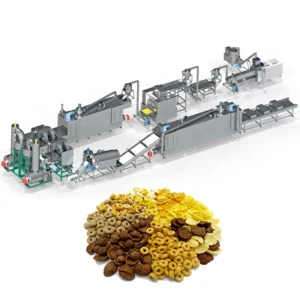
Máquina de fabricación de cereales para el desayuno a pequeña escala para la línea de proceso de copos de maíz
¥45,000.00 Select options This product has multiple variants. The options may be chosen on the product page -
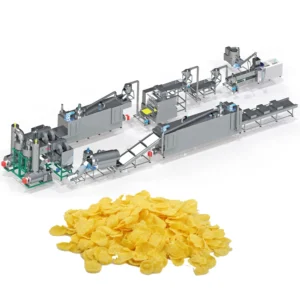
Nueva Máquina Automática de Fabricación de Copos de Maíz Línea de Procesamiento de Extrusión de Snacks de Avena y Chips
¥30.00 Select options This product has multiple variants. The options may be chosen on the product page -
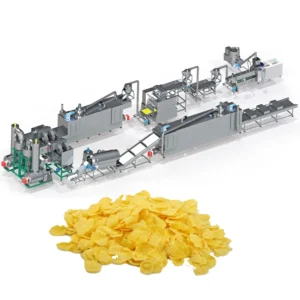
New High Efficiency Electric Corn Flakes Production & Manufacturing Machine
¥7,500.00 Select options This product has multiple variants. The options may be chosen on the product page -
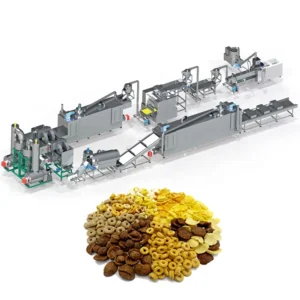
Línea de Producción de Copos de Maíz Máquina de Producción de Cereales para el Desayuno Línea de Maquinaria para la Fabricación de Copos de Maíz
¥59,800.00 Select options This product has multiple variants. The options may be chosen on the product page