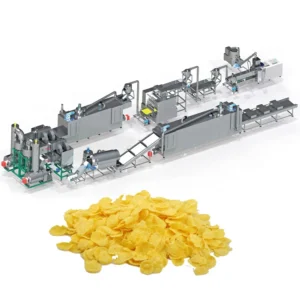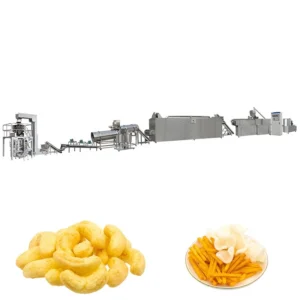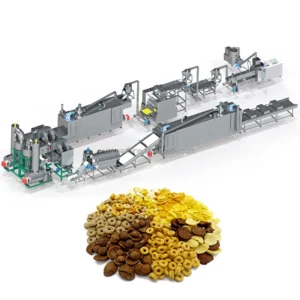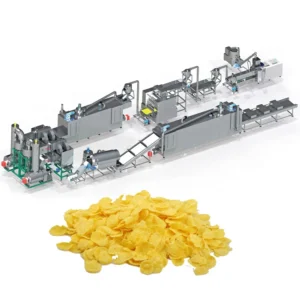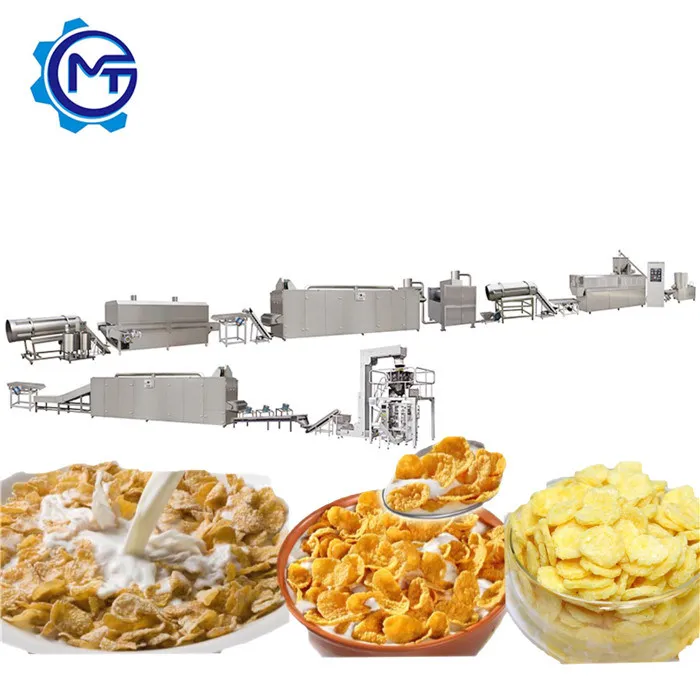


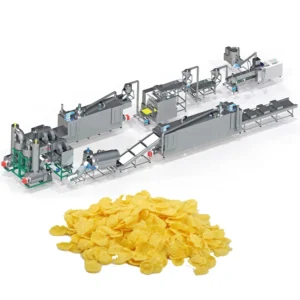
MT70 Corn Flakes Making Machine, Twin-Screw, 160 kW Installed Power — engineered as a complete turnkey project from batching through extrusion, flaking, roasting and packing.
- Designed for breakfast cereal producers requiring layout planning, throughput matching between stations, and phased installation under single-supplier accountability
- PLC-controlled flaking with hydraulic double-roller system and infrared temperature sensing ensures consistent flake thickness across production runs
Backed by in-house trial runs on customer raw materials before shipment, complete electrical documentation, and ongoing operator training support.
Description
Screw configuration matched to your raw material blend — MT70 twin-screw extruder die profiles and screw elements are specified after reviewing your corn, rice, wheat, or oat formulation, ensuring the cooked dough reaches the flaking unit at the correct gelatinisation and moisture state.
Technical Specifications
| Parameter | Value |
|---|---|
| Model | MT70 |
| Product Type | Corn Flakes Making Machine |
| Installed Power | 160 kW |
| Power Consumption | 120 kW |
| Capacity | 150-200 kg/h (basis not stated in source — confirm raw material formulation / moisture content / flake thickness) |
| Overall Dimensions | 41 × 1.5 × 2.2 m |
| Screw Type | Twin-screw |
| Control System | PLC control system (flaking unit); MCC and PLC control (line level) |
| Heating Source (Dryer) | Gas / Electric |
| Flaking Roller Drive | Double motors, separate roller driving |
| Hydraulic System | Hydraulic system for double rollers (flaking unit) |
| Temperature Control | Infrared sensor for even temperature pipe control (flaking unit) |
| Lubrication | Automatic lubricating and cooling function (extruder) |
| Roasting Oven Burner | Conciliation burner with two separate circulating fans and cyclone dust removal device |
| Coating System | Double tumble for sugar melting, elevator, coating drum, spraying nozzle |
| Basic Raw Material | Powder of corn, rice, wheat, oat, barley |
| Production Procedure | Mixing → Extruding → Flaking → Drying → Hot Air Roasting → Sugar Coating (optional) → Drying → Cooling → Packing |
| Final Products | Natural corn flakes, sugar-coated corn flakes, various breakfast cereal shapes |
| Line Assembly State | Complete turnkey line from mixing to packing |
| Customization | Factory layout designed to customer’s factory size and local voltage |
| Standards | CE (since 2014), ISO certified |
Application Suitability
| Application | Material or Output |
|---|---|
| Natural corn flakes production | Corn powder blends with varying moisture content |
| Sugar-coated breakfast cereal lines | Extruded corn or multi-grain flakes passing through double tumble coating |
| Multi-grain flaked cereal | Blended powder of corn, rice, wheat, oat, barley |
| Shape-formatted snack cereals | Ball, tube, stick, ring, fruit loop, star, wheel, flower, heart formats |
| Granola and cereal mix expansion | Flaked output integrated into blended cereal packing lines |
What "300 kg/h on Paper" Actually Means When the Corn Hits the Barrel
A rated capacity is only as honest as the raw material and flake thickness behind it.
I have watched buyers sign off on a line quoted at a flat throughput number, only to find their specific corn formulation — higher fiber, different starch ratio, local moisture variance — pushes the extruder to half that output. The corn flakes production line turnkey is not a single machine with a fixed dial; it is a chain of stations that either balance or bottleneck each other. When the flaking unit cannot press the extrudate thin enough at speed, the dryer backs up and the roasting oven cycles irregularly [NEED_CITE: throughput balancing across sequential food processing stations].
Balancing Extruder Output Against Flaking and Drying Stations
Every station on a corn flakes production line turnkey must pass the same mass forward at the same rate, and the flaking unit is where most imbalance shows up first. The MT70 line uses a hydraulic double-roller system with separate motor drives, giving independent control over each roller’s gap and speed so flake thickness stays consistent even as the extruder output varies slightly with raw material batches.
Roasting Uniformity and Surface Quality Control
The hot air roasting oven uses a conciliation burner with two separate circulating fans and a cyclone dust removal device, which keeps temperature distribution even across the bed depth and pulls fine particulate out before it scorches onto the flake surface. Uniform bubbling and color development on the flake surface depend on this airflow balance [NEED_CITE: hot air circulation and temperature uniformity in cereal roasting ovens].
Reading the Specs That Actually Matter for Corn Flake Density
The twin-screw extruder with automatic lubricating and cooling maintains barrel temperature profile stability across long production runs, which directly controls starch gelatinisation degree and therefore the density of the cooked dough entering the flaking unit. The PLC-controlled flaking unit with infrared sensor temperature monitoring catches thermal drift before it translates into uneven flake thickness. Installed power at 160 kW and power consumption at 120 kW on the MT70 indicate the motor is not running at its thermal ceiling during normal operation, which extends screw and bearing service intervals. The 41-meter line footprint means utility planning — gas lines for the dryer and roaster, electrical distribution for the PLC panels, dust extraction ducting — must be mapped before the foundation is poured.
The Hidden Cost of Skipping the Voltage Conversation
I have seen a complete cereal line sit on a factory floor for three weeks because the local supply was 400V/50Hz and the motors were wound for a different standard. The MCC panels and PLC control language must be confirmed before production begins, not after the containers arrive [NEED_CITE: voltage and frequency standards by export market]. A mismatched flaking unit motor cannot be fixed on-site with a transformer swap; it requires rewinding or replacement, and the commissioning schedule collapses.
Why Source the Entire Line From One Supplier
Throughput matching across every station is calculated at the design stage, not discovered during commissioning. The screw configuration and die design are specified to the buyer’s actual corn blend and target flake density, not copied from a generic build. The in-house testing workshop runs trial batches on the customer’s raw material before shipment, so product development starts before installation rather than after. Factory layout is designed to the customer’s building dimensions and utility entry points. Pre-sales consultation continues through on-site installation, commissioning, and ongoing maintenance with a single accountability point.
Documentation & Verification
- Line layout and capacity calculation showing throughput matching from mixer to packer
- Screw and die configuration record matched to buyer’s corn formulation
- Trial run report on customer raw material from the in-house testing workshop
- Electrical schematic with voltage, frequency, and PLC language confirmation
- CE declaration of conformity and ISO certificate
- Wear parts list with recommended replacement intervals
Installation, Commissioning & Support
- 41-meter line footprint requires utility mapping for gas, electrical, and dust extraction before foundation work
- MCC and PLC panels wired to confirmed local voltage and frequency before dispatch
- Twin-screw extruder barrel alignment and screw element sequence verified during on-site assembly
- PLC control language set and operator training conducted during commissioning phase
- Hydraulic flaking roller system calibrated to target flake thickness with customer’s actual dough
- Automatic lubricating system tested and maintenance schedule handed over at sign-off
What We Need to Build Your Line Correctly
Share your corn or multi-grain formulation including moisture content and particle size, your target daily output, and your factory floor dimensions with ceiling height. Confirm your local voltage, phase, and frequency along with preferred PLC control language. Let us know if you need a trial run on your specific raw material before the line ships.
Frequently Asked Questions
Q: How is line capacity verified, and what raw material assumptions underpin the quoted output?
A: Quoted capacity on the MT70 is 150-200 kg/h, but that figure depends on your specific corn formulation, moisture content, and target flake thickness. We verify actual throughput by running your raw material in our in-house testing workshop and documenting the results in a trial run report before the line ships.
Q: How is throughput matched between the extruder, flaking unit, dryer, roaster, and coater?
A: Each station is sized so its maximum pass-through rate equals or exceeds the extruder output at your confirmed formulation. The hydraulic double-roller flaking unit, dryer bed length, roasting oven capacity, and coating drum volume are all calculated from the same mass-flow target to prevent bottlenecks.
Q: What is included in the phased installation and commissioning schedule?
A: Installation covers mechanical assembly of the 41-meter line, utility connections to confirmed voltage and gas specifications, PLC and MCC panel wiring, and hydraulic system charging. Commissioning includes running your raw material through the full sequence, operator training on the PLC interface, and handover of maintenance documentation.
Q: How are voltage, frequency, and PLC control language confirmed before the line ships?
A: We request your site’s electrical specification — voltage, phase, and frequency — during the quotation stage and record it on the electrical schematic. The PLC control language is confirmed at the same point and verified on the MCC panel before factory testing, so the line powers up correctly on arrival.
Related products
-
Máquina para hacer copos de maíz Máquina para hacer puffs de maíz Línea de producción de alimentos para bocadillos
Price range: ¥500.00 through ¥1,200.00 Select options This product has multiple variants. The options may be chosen on the product page -
Máquina Extrusora de Cereal para Desayuno de 200kg/h Venta Caliente Línea de Producción de Copos de Maíz
¥30,000.00 Select options This product has multiple variants. The options may be chosen on the product page -
Línea de procesamiento de mezclador freidora intercambiador de calor de acero inoxidable de grado alimenticio automático completo de cereales para el desayuno de copos de maíz dulce
¥8,000.00 Add to cart -
Línea de producción de copos de maíz completa Máquina de procesamiento de cereales para el desayuno Componente central del motor Equipo de procesamiento de copos de maíz
¥19,000.00 Select options This product has multiple variants. The options may be chosen on the product page