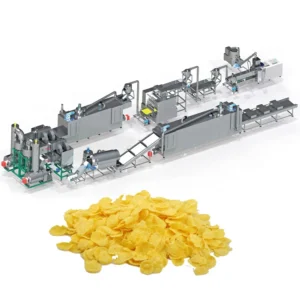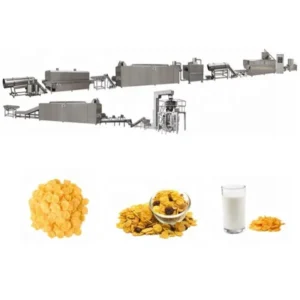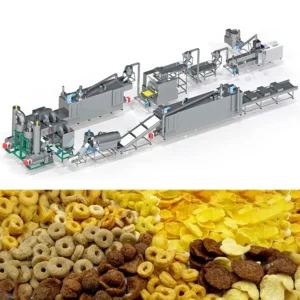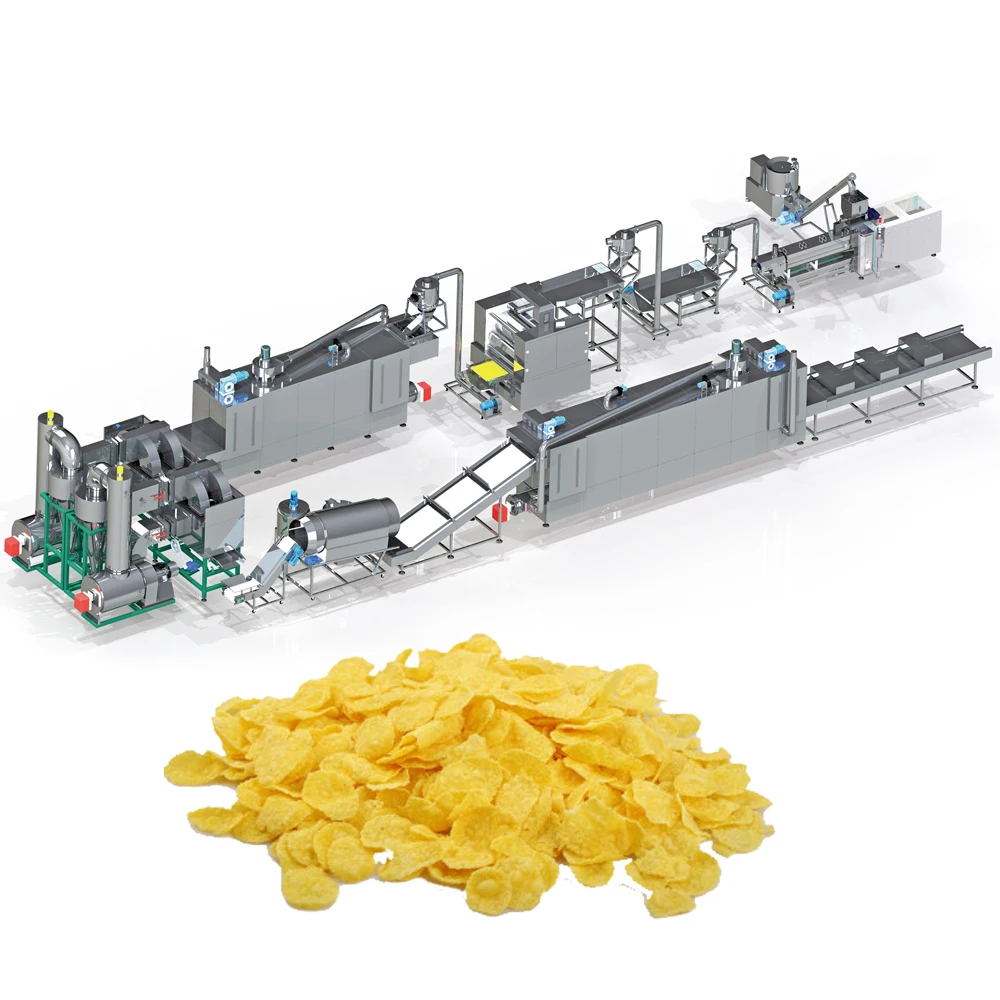
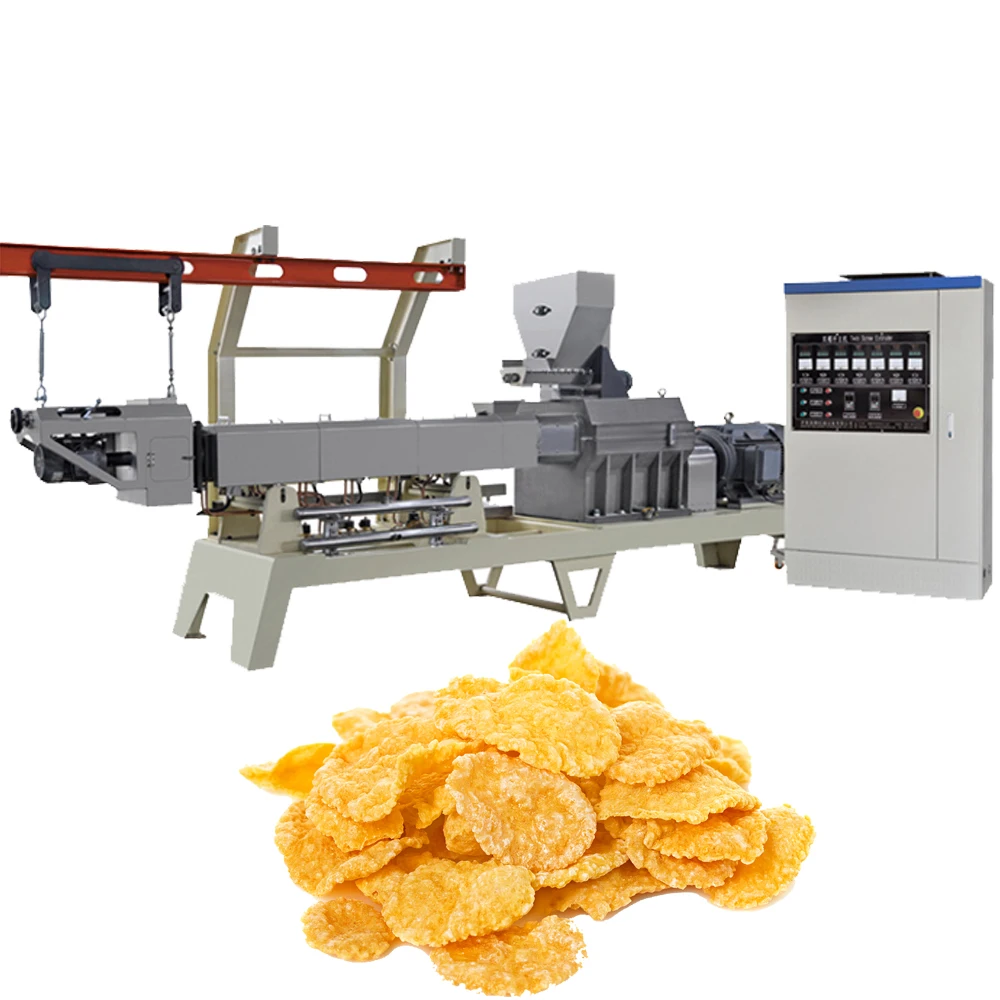
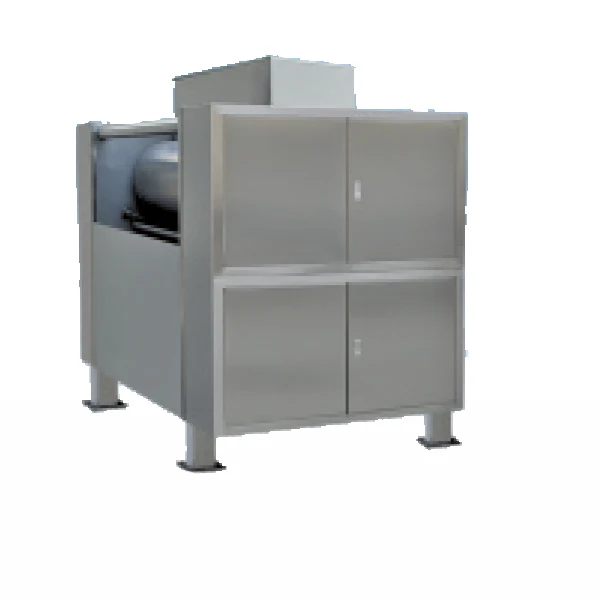


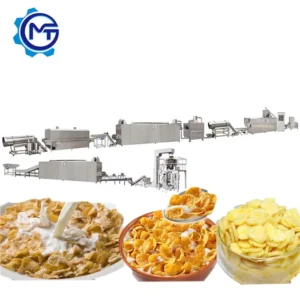
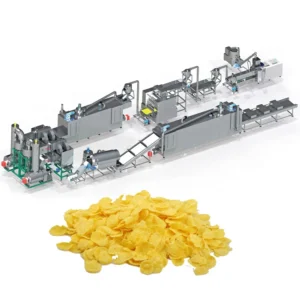
MT70 / MT85 / MT75 Corn Flakes Production Line, Twin Screw Extruder, PLC Flaking Control — engineered as one integrated turnkey project from batching through extrusion, flaking, drying, roasting, coating and packing, with every station throughput-matched to your raw material behaviour and target flake density.
- Hydraulic double-roller flaker with infrared temperature control for uniform thickness
- Hot-air roasting oven with dual circulating fans and cyclone dust removal for consistent blister and crispness
- Die configuration specified to your cereal recipe, enabling shape changeover across corn flakes, fruit loops, stars and rings
- Natural and sugar-coated variants supported on the same line platform
Trial runs on your actual raw material are completed in our in-house testing workshop before shipment, verifying expansion, flake density and roasting behaviour against your product specification rather than nominal capacity alone.
Description
Integrated Project Engineering — every station from batching to packing is throughput-matched against your actual corn recipe, not quoted on isolated extruder capacity.
Technical Specifications
| Parameter | Value |
|---|---|
| Product Type | Corn Flakes Production Line with Twin Screw Extruder |
| Model Options | MT70, MT85, MT75 |
| Screw Configuration | Twin Screw |
| Installed Power (MT70) | 160 kW |
| Installed Power (MT85) | 190 kW |
| Installed Power (MT75) | 210 kW |
| Power Consumption (MT70) | 120 kW |
| Power Consumption (MT85) | 140 kW |
| Power Consumption (MT75) | 150 kW |
| Output Capacity (MT70) | 150–200 kg/h (basis to be confirmed) |
| Output Capacity (MT85) | 300–400 kg/h (basis to be confirmed) |
| Output Capacity (MT75) | 300–500 kg/h (basis to be confirmed) |
| Overall Dimensions (MT70) | 41 × 1.5 × 2.2 m |
| Overall Dimensions (MT85) | 43 × 1.5 × 3.2 m |
| Overall Dimensions (MT75) | 45 × 1.5 × 3.5 m |
| Control System | PLC for flaking machinery; MCC available for full line |
| Flaking System | Hydraulic double-roller, double-motor separate drive, infrared sensor temperature control |
| Dryer Heating Source | Gas / Electric |
| Roasting Oven | Hot-air circulating with conciliation burner, two circulating fans, cyclone dust removal, vibrating pan |
| Coating System | Double tumble sugar melting, elevator, coating drum, spraying nozzle |
| Natural Corn Flakes Line Stations | Mixing → Extruding → Flaking → Drying → Hot Air Roasting → Cooling → Packing |
| Sugar-Coated Corn Flakes Line Stations | Mixing → Extruding → Flaking → Drying → Hot Air Roasting → Sugar Spraying → Sugar Coating → Drying → Cooling → Packing |
| Raw Material Compatibility | Corn, rice, wheat, oat, barley and other cereal powders |
| Final Product Shapes | Ball, tube, stick, ring, fruit loop, star, wheel, flower, heart (by adjusting extruder die) |
| Voltage & Frequency | Customised to buyer’s local standard (confirm before order) |
| Certification | CE (declared since 2014), ISO certified |
Application Suitability
| Application | Material or Output |
|---|---|
| Natural corn flakes for breakfast cereal market | Corn grits and corn flour at controlled moisture |
| Sugar-coated and glazed corn flakes | Corn base with sugar syrup coating and secondary drying |
| Multi-grain breakfast cereal production | Rice, wheat, oat, barley and blended cereal powders |
| Extruded cereal snacks in varied shapes | Corn, rice and oat blends formed through interchangeable dies |
Why "300 kg/h on Paper" Can Mean 150 kg/h on Your Floor
The only capacity figure that matters is the one measured on your actual corn blend at your target moisture and flake thickness.
I spent two weeks in a Middle Eastern facility watching a corn flakes line struggle at half its quoted output. The buyer had calculated capacity on a laboratory-grade corn flour, but the local supplier delivered a coarser grind. The twin-screw extruder could not feed consistently, and every downstream station starved. That mismatch between the corn flakes production line turnkey promise and reality is something we now prevent by running your material in our testing workshop before the screw configuration is locked. [NEED_CITE: raw material particle size and its effect on extruder feed rate]
How Station Throughput Is Balanced Across the Full Line
When a corn flakes production line turnkey project is assembled from separate vendors, the extruder might deliver more wet flake than the dryer can handle, or the roasting oven may cycle faster than the coating drum can receive product. We calculate every station against the extruder’s real output on your recipe. The hydraulic flaking rollers, hot-air dryer, roasting oven with dual circulating fans, and sugar coating drum are each sized so material flows without accumulation or starvation at any transfer point.
What the Flaking and Roasting Stage Actually Controls
Flake thickness is set at the hydraulic double-roller station, where infrared sensors monitor surface temperature to keep the sheet consistent before it enters the dryer. The roasting oven then uses a conciliation burner and two circulating fans to produce the surface blister and crispness that define a quality corn flake. Cyclone dust removal pulls fines from the hot-air stream so they do not deposit on the flake surface or accumulate in the ductwork. [NEED_CITE: hot-air roasting temperature profiles for breakfast cereal flake blister formation]
Reading the Power and Capacity Numbers Correctly
The MT70, MT85, and MT75 differ in installed power, consumption, and line footprint, but the output figures listed are nominal and must be validated against your specific cereal blend, moisture content, and target flake dimension. Installed power covers every motor from the mixer through the packing conveyor, while power consumption reflects typical running load. For a multi-grain recipe using oat or barley alongside corn, the extruder motor load and screw wear pattern will differ from a pure corn grits run, which is why we record screw configuration and die selection against each material tested. The overall line length of 41 to 45 metres means your facility needs clear floor space plus utility runs for gas or electric heating, compressed air, and three-phase power at your local voltage and frequency.
What Happens When the Dryer Is Undersized
If the dryer capacity is calculated against the extruder’s catalogue rating rather than its actual output on your recipe, wet flakes pile up before the roasting oven. The result is inconsistent moisture entering the roast stage, which produces some flakes that are brittle and others that remain chewy. We have seen lines where this bottleneck forced operators to slow the extruder manually, turning a continuous process into a batch-and-wait routine that no amount of PLC adjustment could fix. [NEED_CITE: moisture variation entering cereal roasting ovens and its effect on final texture]
Why Buyers Source This Line as a Single Project
We engineer the full sequence from mixing through packing under one scope, which means the dryer, roasting oven, and coating drum are not afterthoughts bolted on later. The screw and die configuration is specified to your raw material and target product rather than copied from a generic build. Every line leaves our workshop with a trial run report on your actual cereal blend, so product development does not begin only after installation. Voltage, frequency, and control language are confirmed before production starts, not discovered during commissioning. Wear parts including replacement screws and dies are listed and available from the first day of operation.
Documentation & Verification
- Line layout drawing scaled to your factory dimensions with utility connection points
- Screw and die configuration record matched to your tested cereal recipe
- Trial run report on your raw material covering flake density, expansion, and roast behaviour
- Electrical schematic with confirmed voltage, frequency, and control language
- CE declaration of conformity and ISO certificate for customs and regulatory filing
- Operation and maintenance manual with illustrated wear parts list
Installation, Commissioning & Support
- Foundation and floor space plan based on the 41–45 m line footprint and station weights
- Three-phase power connection at your confirmed voltage with dedicated circuit for the extruder motor
- Gas supply sizing for the roasting oven burner when electric heating is not selected
- First-run parameter setting covering barrel temperature profile, flake gap, and roast cycle time
- Operator training on PLC interface, die changeover, and screw extraction for cleaning
- Scheduled wear parts supply covering screws, dies, and flaking roller surfaces
What We Need from You to Start the Layout
Share your target cereal type, the specific grain blend or corn grits specification you plan to run, and the flake thickness your market expects. We also need your workshop dimensions, ceiling height, and local voltage and frequency so the electrical design and line layout can be drafted before any metal is cut. If you have existing upstream milling or downstream packing equipment, tell us the interface points so the corn flakes production line turnkey scope connects cleanly.
Frequently Asked Questions
Q: How is the output capacity of each station verified against my actual raw material and recipe?
A: We run your cereal blend in our testing workshop and record throughput at each station — extruder, flaker, dryer, roasting oven, and coating drum. The trial run report documents the measured output, flake density, and roast behaviour, which then becomes the basis for sizing every downstream component rather than relying on nominal extruder figures alone.
Q: What does the phased installation and commissioning schedule look like for a full line?
A: Installation follows a sequenced plan starting with the extruder and flaking station, then dryer and roasting oven, and finally coating and packing. Commissioning runs each station individually before linking them, and operator training covers PLC operation, die changeover, screw extraction, and daily maintenance routines specific to your line configuration.
Q: How are utility requirements planned across all line stations before the factory build?
A: We calculate total electrical load from every motor and heater, size the gas supply for the roasting oven burner, and specify compressed air and water points. The electrical schematic confirms voltage, frequency, and control language for your market before production begins so there are no surprises when the line arrives on site.
Q: What documentation ships with the line?
A: The package includes a scaled line layout, screw and die configuration record, trial run report on your material, CE declaration, ISO certificate, electrical schematic, operation manual, wear parts list, and packing photographs. Customs documentation support is provided to match your import requirements.
Q: How is throughput balanced between the extruder and every downstream station?
A: Each station is sized against the extruder’s measured output on your specific recipe, not its catalogue rating. The flaker roller width, dryer belt area, roasting oven volume, and coating drum capacity are all calculated so material flows continuously without accumulation or starvation at any transfer point.
Related products
-
Línea de Producción de Copos de Maíz Máquina de Producción de Cereales para el Desayuno Línea de Maquinaria para la Fabricación de Copos de Maíz
¥59,800.00 Select options This product has multiple variants. The options may be chosen on the product page -
Máquina para hacer copos de maíz Máquina para hacer puffs de maíz Línea de producción de alimentos para bocadillos
Price range: ¥500.00 through ¥1,200.00 Select options This product has multiple variants. The options may be chosen on the product page -
Línea de procesamiento de mezclador freidora intercambiador de calor de acero inoxidable de grado alimenticio automático completo de cereales para el desayuno de copos de maíz dulce
¥8,000.00 Add to cart -
Mejor Precio Máquina de Hacer Copos de Maíz Línea de Procesamiento de Cereales para Desayuno con Motor como Componente Principal
¥19,000.00 Select options This product has multiple variants. The options may be chosen on the product page