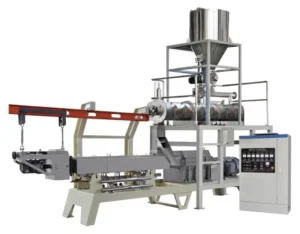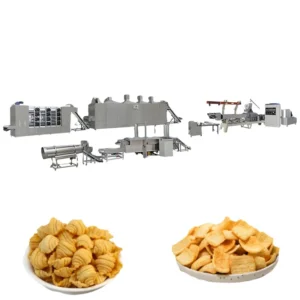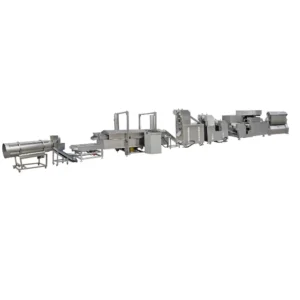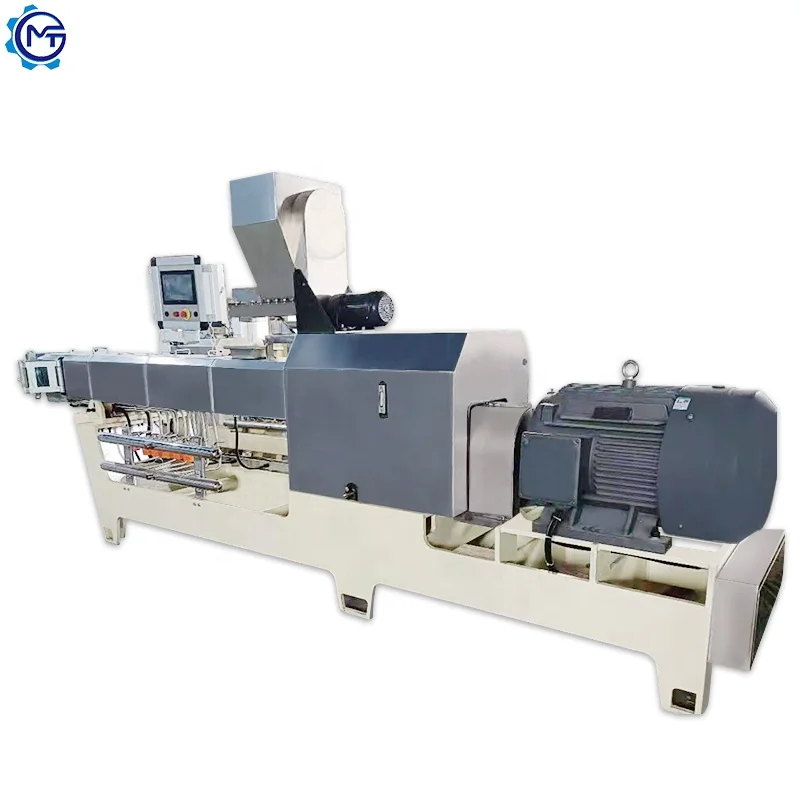


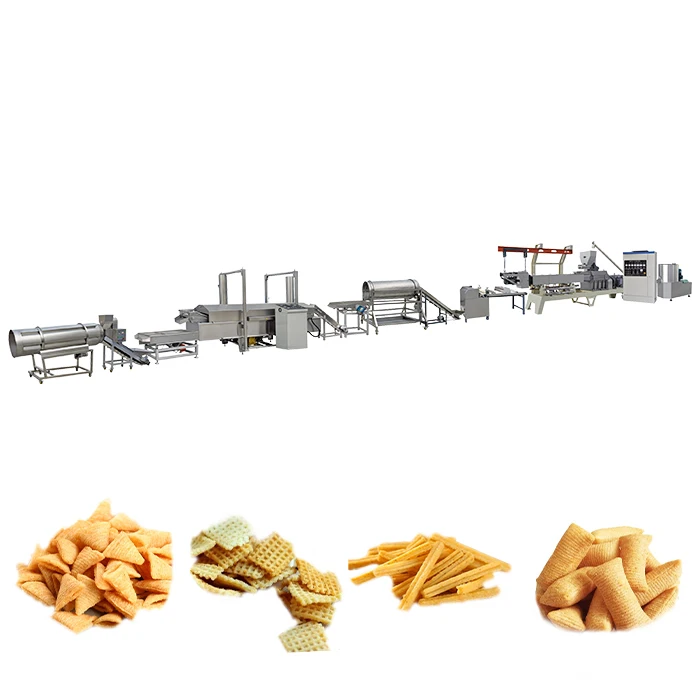

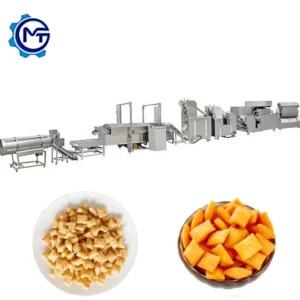
MT65 / MT70 / MT70c / MT75, Frying Chips Making Machine, Twin Screw, Siemens Motor — integrates extrusion, frying, and double-drum flavoring into one production line with matched throughput across all stations.
- 38CrMoAl alloy screws with nitriding process and self-cleaning design for faster recipe changeover
- Speed-adjusted converters on feeding, extrusion, and cutting systems to fine-tune output rhythm
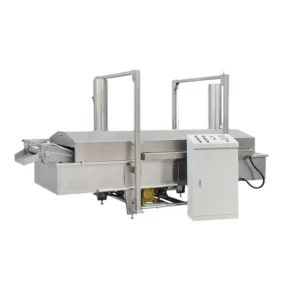
- Fryer available in electric, diesel, or gas heating to match site utility conditions
Complete line layout and capacity calculation provided, with in-house trial runs on your raw material before shipment to confirm product density and texture.
Description
Screw Configuration Matched to Recipe — Twin-screw geometry and die profile are specified to your corn flour formulation and target puff density, then proven on your actual raw material in the testing workshop before the line ships.
Technical Specifications
| Parameter | Value |
|---|---|
| Model | MT65 / MT70 / MT70c / MT75 |
| Product Type | Twin Screw Extruder Corn Flour Puff Snack Making Machine |
| Screw Type | Twin screw, self-cleaning profile |
| Screw Material | Alloy 38CrMoAl, nitriding process |
| Main Motor | Siemens |
| Gearbox | Automatic lubrication function |
| Control System | Speed-adjusted converter on feeding, extrusion and cutting systems |
| Cutting Method | Rotary cutting by V-belt drive, knife fixed in die head seat |
| Feeding System | Food-grade stainless steel twin screw feeder |
| Cooling | Increased radiator on driving part for forced cooling |
| Line Stations | Extruder, fryer (electric / diesel / gas), double-drum flavoring system with conveyor and sprayer |
| Output Capacity (MT65) | 100–150 kg/h (basis not stated in source — confirm raw material and moisture) |
| Output Capacity (MT70) | 150–200 kg/h (basis not stated in source — confirm raw material and moisture) |
| Output Capacity (MT70c) | 200–250 kg/h (basis not stated in source — confirm raw material and moisture) |
| Output Capacity (MT75) | 200–300 kg/h (basis not stated in source — confirm raw material and moisture) |
| Rated Power (MT65) | 22 kW |
| Rated Power (MT70) | 30 kW |
| Rated Power (MT70c) | 45–55 kW |
| Rated Power (MT75) | 55 kW |
| Overall Dimensions (MT65) | 22000 × 1200 × 2200 mm |
| Overall Dimensions (MT70) | 25000 × 1500 × 2200 mm |
| Overall Dimensions (MT70c) | 30000 × 3500 × 4300 mm |
| Overall Dimensions (MT75) | 33000 × 3500 × 4300 mm |
| Assembly State | Complete production line from batching to packing |
| Warranty | One year from equipment arrival at customer site |
| Standards | CE, ISO |
Application Suitability
| Application | Material or Output |
|---|---|
| Corn flour puff snacks | Corn-based dough, fried and flavored to target density |
| Nacho and tortilla chips | Corn flour sheeted or extruded into triangles, fried until crisp |
| Doritos-style savory triangles | Corn grits and flour blend, seasoned after frying |
| Bugles and cone-shaped puffs | Corn flour extruded through conical die, fried for hollow structure |
| Fried extruded snack lines | Corn-centered formulations expanded by twin-screw shear and heat |
What a Nominal Line Capacity Number Leaves Out About Your Snack Output
A fried snack line only produces what the slowest station allows, and that station is rarely the extruder.
When a turnkey fried extruded snack production line is quoted on extruder capacity alone, the downstream fryer and flavoring drums may not keep pace. I have walked into plants where half-formed corn chips sat cooling on conveyor belts because the fryer oil temperature dropped every time a fresh batch entered. The line was rated for a certain hourly output, but the real throughput was noticeably lower [NEED_CITE: line throughput bottleneck analysis in extruded snack production]. A turnkey fried extruded snack production line must be balanced across every station — extrusion, frying, draining, and double-drum seasoning — so that product flow remains continuous without intermediate accumulation or thermal loss.
Matching Throughput Between Extrusion and Frying Stages
The twin screw extruder pushes corn flour dough through the die at a continuous rate determined by screw speed and feeder output. The fryer must absorb that volume without oil temperature collapse. When the fryer recovery rate falls behind, product enters oil that is too cool, absorbs excess fat, and exits with a texture the market will reject. Every turnkey fried extruded snack production line from this range pairs the extruder model with a fryer rated for the same mass flow, and the double-drum flavoring system is sized to handle the full fried output without backlog.
Die Geometry and the Shape That Survives the Fryer
Corn flour expands differently through a conical Bugles die compared to a flat triangular nacho die. The screw configuration must generate enough shear to gelatinize the starch fully before the die, or the product will deform when it hits hot oil. Screw segments and die inserts on these models are selected for the specific corn formulation and target shape. The 38CrMoAl alloy screws withstand the abrasive nature of corn grits over extended production runs, and the nitriding surface treatment extends service intervals between screw replacements [NEED_CITE: screw wear rates in corn-based twin screw extrusion].
Reading the Specs That Actually Matter on a Fried Snack Line
The Siemens main motor paired with an automatic gearbox lubrication system reduces the risk of unplanned downtime during long production shifts. Speed-adjusted converters on the feeding, extrusion, and cutting systems allow operators to fine-tune the line rhythm — slowing the feeder while maintaining screw speed, for example, to adjust product density without stopping the line. The forced cooling radiator on the driving section prevents gearbox overheating during sustained operation in warm production environments. These are the parameters that determine whether a line holds its output across a full shift or degrades after the first few hours.
The Hidden Cost of an Unmatched Flavoring Station
When the double-drum flavoring system is undersized relative to the fryer output, seasoned product piles up on the conveyor between the fryer exit and the drum entrance. Seasoning coverage becomes uneven — some chips receive a heavy coat while others pass through with almost none. This inconsistency reaches the packaging station and ultimately the consumer [NEED_CITE: flavoring distribution uniformity in extruded snack finishing]. The integrated line approach sizes both seasoning drums to the full fryer discharge rate, maintaining a continuous flow that keeps coverage consistent across the entire production batch.
Why Source the Complete Line From One Supplier Responsibility
Each station on this turnkey fried extruded snack production line is engineered as part of a single project rather than assembled from independent vendors. Throughput calculations are documented across every station from extruder to packing. Screw and die configurations are specified to the buyer’s raw material and target product shape, not copied from a generic build. The in-house testing workshop runs trial production on the buyer’s actual corn flour before the line ships, generating a trial report that confirms product density, expansion, and fryer behavior. Electrical schematics and voltage are confirmed against the buyer’s plant supply before production begins.
Documentation & Verification
- Line layout drawing showing matched throughput between MT extruder, fryer, and flavoring stations
- Trial run report generated on your corn flour formulation in the testing workshop
- Screw and die configuration record specific to your target snack shape
- Electrical schematic with voltage and frequency confirmed to your plant supply
- CE declaration of conformity for the complete integrated line
- Factory test record documenting all station outputs before dispatch
Installation, Commissioning & Support
- Foundation requirements mapped to the specific MT model footprint and total line weight
- Electrical supply verification for the Siemens motor and fryer heating elements before energizing
- On-site assembly of the full line from batching through the double-drum flavoring station
- Parameter setting for screw speed, barrel temperatures, and fryer oil profile during first production run
- Operator training covering recipe changeover between corn puff formats on the same extruder
- Wear parts inventory plan covering 38CrMoAl screw segments and die inserts for first replacement cycle
What We Need to Configure Your Line
To move from inquiry to line proposal, share your target corn flour formulation, the specific snack shapes you intend to produce, and your target hourly output in finished product weight. Confirm your plant voltage, frequency, and available floor area with ceiling height. If you have existing upstream mixing or downstream packing equipment, provide the model and capacity so the new line can be integrated without replacing functional stations.
Frequently Asked Questions
Q: How is line capacity verified on my actual corn flour before shipment?
A: Your raw material is shipped to the testing workshop, where the configured twin screw extruder runs trial production through the matching fryer and flavoring drums. The resulting trial report documents output rate, product density, expansion ratio, and seasoning coverage on your specific formulation, confirming what the line will produce when installed.
Q: How are extruder, fryer, and flavoring throughputs matched to prevent bottlenecks?
A: The line layout calculation starts from your target finished output and works backward through each station. The fryer recovery capacity is sized to absorb the full extruder discharge without oil temperature drop, and the double-drum flavoring system is rated to handle the complete fried product flow without conveyor accumulation between stations.
Q: What screw and die configuration is used for different corn snack shapes?
A: Screw segment arrangement and die geometry are selected based on your target product — conical dies for Bugles-style shapes, flat dies for nacho triangles — and the specific corn flour blend. The 38CrMoAl nitrided screws are configured to generate the correct shear and residence time for full starch gelatinization before the die.
Q: What electrical and utility details must be confirmed before production starts?
A: Plant voltage, frequency, and available amperage for the Siemens main motor and fryer heating system must be confirmed. Control system language, fryer fuel type selection between electric, diesel, or gas, and compressed air requirements for pneumatic actuators are finalized during the specification stage to avoid delays during commissioning.
Q: What does on-site installation and ongoing support include?
A: Engineers assemble the complete line on your foundation, connect utilities, and run first production with your operators present. Training covers recipe parameters, screw speed adjustments, and changeover procedures. A wear parts list with 38CrMoAl screw segments and die inserts is provided, and spare parts supply continues through the warranty period and beyond.
Related products
-
Industrial Wheat Flour Snacks Processing Equipment – Stainless Steel Fried Food Production Line
¥65.00 Select options This product has multiple variants. The options may be chosen on the product page -

Nueva línea de producción automática de bocadillos Puff Bugles Precio máquina para hacer chips de maíz máquina de maíz frito alta productividad grande
¥8,570.00 Select options This product has multiple variants. The options may be chosen on the product page -
Industrial Fully Automatic Stainless Steel Deep Fried Line – Snack Factory Miscellaneous Grains Special Processing Equipment
¥65.00 Select options This product has multiple variants. The options may be chosen on the product page -
Máquina de fritura automática completa para la producción de bocadillos de bugles de masa de trigo fritos, línea de producción de bocadillos inflados fritos.
¥7,349.41 Select options This product has multiple variants. The options may be chosen on the product page